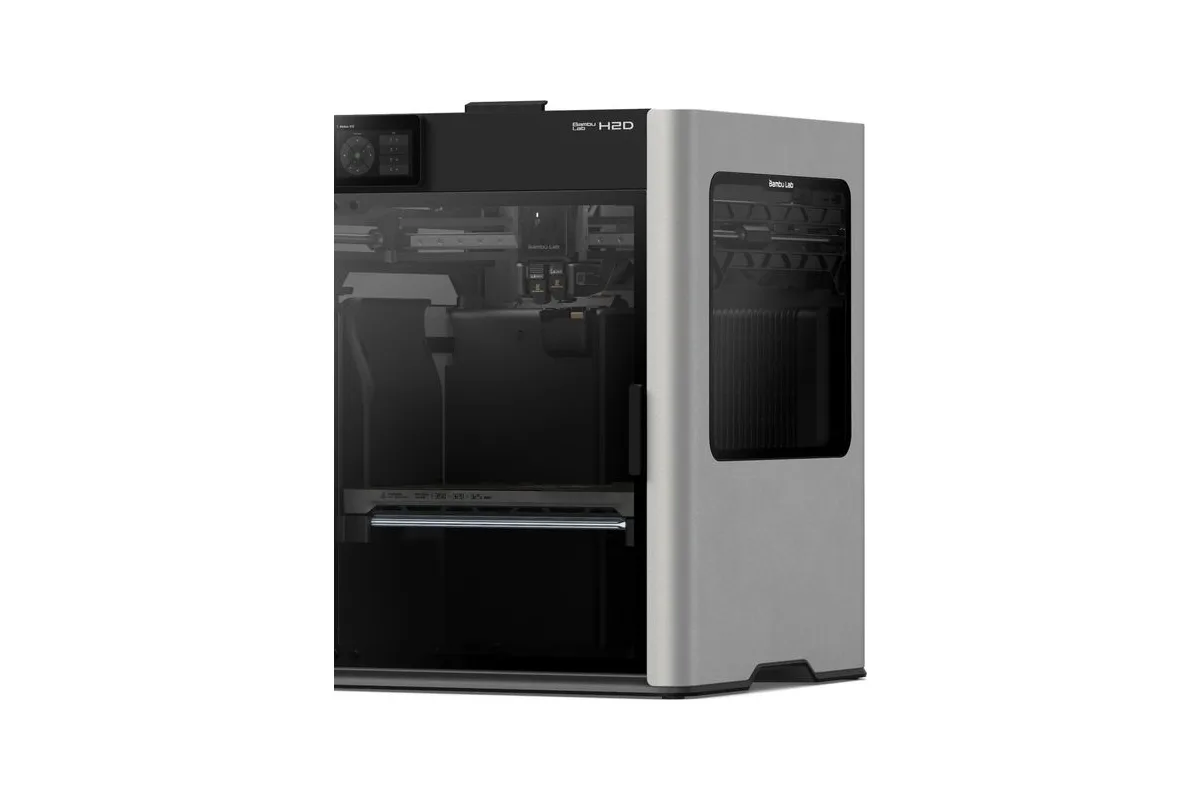
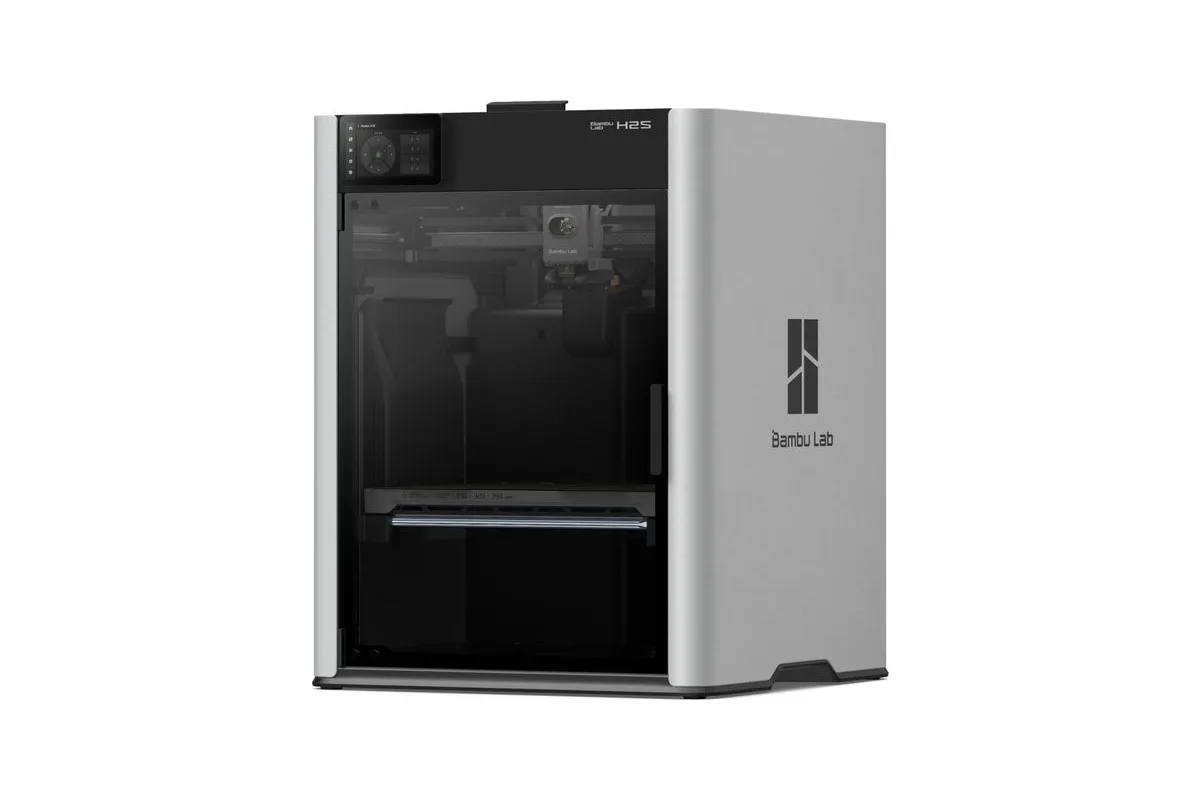
Side by side
| Feature | Bambu LabH2D | Bambu LabH2S |
|---|---|---|
| Build volume | 325 × 320 × 325 mm (single nozzle) | 340 × 320 × 340 mm |
| Max nozzle / bed | 350 °C / 120 °C | 350 °C / 120 °C |
| Chamber | Active, 65 °C | Active, 65 °C |
| Nozzles | 2 |
Bambu Lab H2D
- Build volume
- 325 × 320 × 325 mm (single nozzle)
- Max nozzle / bed
- 350 °C / 120 °C
- Chamber
- Active, 65 °C
- Nozzles
- 2
Bambu Lab H2S
- Build volume
- 340 × 320 × 340 mm
- Max nozzle / bed
- 350 °C / 120 °C
- Chamber
- Active, 65 °C
- Nozzles
Bambu Lab H2D or H2S: what’s the difference?
The H2D has two nozzles; the H2S has one. Almost everything else is shared: a 350 °C hotend, a 120 °C bed, an active chamber that heats to 65 °C, 1,000 mm/s motion, G3 + H12 HEPA + carbon filtration and the same 492 × 514 × 626 mm body. In November 2026 at Bambu’s US store:
- H2D: $1,399 printer-only, $1,599 with an AMS 2 Pro (typical $1,549 and $1,749).
- H2S: $1,049 printer-only, $1,249 with an AMS 2 Pro (typical $1,199 and $1,399).
The gap is $350 on every matching configuration, sale or typical. For that, the H2D gives you a second nozzle, so two-material prints need no purge between them, and it accepts the 40W laser. The H2S keeps the money and gives you Bambu’s largest build volume, 340 × 320 × 340 mm.
Buy the H2S if you mostly print one material at a time. Buy the H2D if you print models with dedicated support material or two colors, or want the stronger laser. Read our H2S review and H2D review.
H2D vs H2S specs
| Bambu Lab H2D | Bambu Lab H2S | |
|---|---|---|
| Price, printer only (Bambu US, Nov 28, 2026) | $1,399 ($1,549 typical) | $1,049 ($1,199) |
| Price with AMS 2 Pro | $1,599 ($1,749) | $1,249 ($1,399) |
| Laser Full Combo | 10W $1,949; 40W $2,399 | 10W only, $1,599 |
| Released | Mar 25, 2025 | Aug 26, 2025 |
| Nozzles | 2 | 1 |
| Build volume | 325 × 320 × 325 mm single nozzle (33.8 L, our estimate); 300 × 320 × 320 mm with both; 350 × 320 × 320 mm total | 340 × 320 × 340 mm (37.0 L) |
| Max nozzle / bed / chamber | 350 °C / 120 °C / active 65 °C | 350 °C / 120 °C / active 65 °C |
| Speed (Bambu) | 1,000 mm/s, 20,000 mm/s²; 40 or 65 mm³/s | 1,000 mm/s, 20,000 mm/s²; 40 or 65 mm³/s |
| Max colors with AMS | 25 | 24 |
| Cameras | Live View, nozzle and toolhead, all 1920 × 1080; BirdsEye on laser editions | Live View 1920 × 1080, toolhead 1600 × 1200; BirdsEye on the Laser Edition |
| Noise (Bambu) | No figure published | 50 dB average, 55.6 dB peak (high-speed Benchy, 1 m) |
| Power, PLA (Bambu) | About 197 W | About 200 W |
| Max power at 110 V | 1,320 W | 1,170 W |
| Weight | 31 kg | 30 kg (30.5 kg Laser Edition) |
| Network | Wi-Fi; no Ethernet | Wi-Fi with 5 GHz; no Ethernet |
| Updates (bug and feature / security) | Mar 25, 2030 / Mar 25, 2032 | Aug 26, 2030 / Aug 26, 2032 |
| Warranty (Bambu US store) | 24 months; dual extruder unit 3 months | 24 months |
| Price per liter, printer only (our estimate) | $41 | $28 |
Source: Bambu’s US store, specifications, wiki and compare page, read November 28, 2026.
What does the second nozzle do?
It lets one print use two filaments without flushing. Bambu’s wiki explains that switching between the H2D’s two nozzles needs no purge, so the only purging comes from AMS filament changes within the same nozzle. Bambu Studio’s filament-saving mode splits colors across the two nozzles to reduce flushing.
That’s most useful for two jobs:
- Support material. A model in PETG or nylon with supports in a dedicated support filament, or soluble PVA, prints with no purge between the two.
- Two-color prints. A logo or label in a second color costs no purge at all.
With three or more colors, flushing comes back on at least one nozzle. On the single-nozzle H2S, every change flushes.
How much filament does the H2D save over the H2S?
Less than you might expect on a many-color print. Bambu’s H2C page gives Bambu Studio calculations for a Geminaraptor model (six colors per part, two parts):
| Bambu example | H2D | H2S | H2C (for reference) |
|---|---|---|---|
| Purge and prime-tower waste | 3,032 g | 3,917 g | 532 g |
| Print time (H2S = 100%) | 88% | 100% | 58% |
On that print, the H2D wastes 885 g less than the H2S, about 23% less (our estimate). At $14.99 per kg for Bambu PLA Basic refills (Bambu’s November 2026 refill price), that’s about $13 of filament per print (our estimate). It would take roughly 26 prints like it to recover the H2D’s $350 premium in filament alone. Bambu doesn’t publish a two-color comparison, which is where the H2D’s saving is biggest.
For heavy multicolor work, the H2C is the one to look at: Bambu’s figures put it at 532 g on the same print. See H2C vs H2D.
Which has the bigger build volume?
The H2S. Bambu calls 340 × 320 × 340 mm “the largest print space among all Bambu Lab printers”, about 9% more than the H2D’s single-nozzle 325 × 320 × 325 mm (our estimate: 37.0 L vs 33.8 L). The H2D’s total reach across both nozzles is wider, 350 × 320 × 320 mm, but a print that uses both nozzles is limited to 300 × 320 × 320 mm.
For tall prints, the H2S has 15 mm more height. For more big options, see the best large 3D printers.
Which has the better laser?
The H2D. Both have laser bundles with blade cutting, but the H2S takes the 10W laser only; Bambu says it “does not support 40W laser”. The H2D takes 10W or 40W. The 40W module engraves at up to 1,000 mm/s and cuts basswood plywood up to 15 mm thick, against 400 mm/s and 5 mm for the 10W. The 40W H2D bundle cost $2,399 in November 2026. See the best laser engravers.
Can you upgrade an H2S to an H2D?
No. Bambu’s H2S FAQ answers that directly: “Can the H2S be upgraded to an H2D? No.” A laser upgrade kit for the H2S does exist. Bambu’s H2C FAQ also says both the H2D and H2S can take the Vortek Upgrade Kit, though it recommends buying an H2C instead. We didn’t find the kit’s US price.
What about noise, power and reliability?
They’re close. Bambu measured the H2S at a 50 dB average and 55.6 dB peak on its high-speed Benchy at 1 m in a 40 dB room. It publishes no figure for the H2D. Both draw about 200 W printing PLA, about 14.5¢ for a 4-hour print at 18.17¢ per kWh (our estimate), and idle at about 25–27 W.
Both get Bambu’s 24-month warranty from its US store; Micro Center and Best Buy sell the AMS Combos ($1,599.99 and $1,249.99), but Bambu’s 2-year US term covers only its own US and Canada stores. On the H2D, the dual extruder unit is covered for just 3 months. Combos with an AMS 2 Pro from a May–July 2026 production batch fall under Bambu’s feeder service program, which sends free replacement feeders to eligible serial numbers.
Two H2D-specific notes:
- USB drive. None comes in the box. Without one, Bambu says time-lapses are off and “printing cannot be initiated through the LAN”.
- Mixed nozzle sizes. Bambu’s wiki added the H2D to its mixed-nozzle-size printing guide in late November 2026. We couldn’t confirm the feature’s release status.
The H2S is the newer model, so Bambu’s published update support runs five months longer: to August 26, 2030, for bug and feature fixes.
Should you buy the H2D or H2S?
- Buy the H2S if you print big parts in one material, want the most volume for the money (about $28 per liter printer-only, our estimate), and don’t need the 40W laser.
- Buy the H2D if you print models with dedicated support material, two-color parts, or want the 40W laser.
- Buy the H2C if you print many colors often.
- Look at the X2D if your parts fit a 256 mm cube: it’s dual-nozzle with a 65 °C chamber for $589.
Neither the H2D nor H2S is sold on Amazon. For rivals at this size, see Creality K2 Plus vs Bambu Lab H2S.
Questions people ask
Is the H2D better than the H2S?
For two-material prints and the 40W laser, yes. For big single-material parts, the H2S is bigger and $350 cheaper.
Is the H2S just an H2D with one nozzle?
Mostly. They share the body, 350 °C hotend, 120 °C bed, 65 °C chamber, filtration and speed. The H2S trades the second nozzle for a wider and taller single-nozzle build volume, and it takes only the 10W laser.
How much more does the H2D cost than the H2S?
$350 for every matching configuration in November 2026: $1,399 vs $1,049 printer-only, $1,599 vs $1,249 with an AMS 2 Pro.
Does the H2S waste more filament than the H2D?
On multicolor prints, yes. Bambu’s Geminaraptor calculation puts the H2S at 3,917 g of purge and prime-tower waste against 3,032 g on the H2D. On single-color prints there’s no difference.
Which is quieter, the H2D or H2S?
Bambu publishes a figure only for the H2S: 50 dB average and 55.6 dB peak at 1 m.
Do they have Ethernet?
No. Only the H2D Pro, sold through resellers, adds Ethernet.
Sources
- Bambu Lab H2D product page (US store), us.store.bambulab.com
- Bambu Lab H2D specifications, bambulab.com
- Bambu Lab H2D FAQ (wiki), wiki.bambulab.com
- Bambu Lab H2S product page (US store), us.store.bambulab.com
- Bambu Lab H2S specifications, bambulab.com
- Bambu Lab H2S overview, bambulab.com
- Bambu Lab H2S FAQ (wiki), wiki.bambulab.com
- Bambu Lab H2C FAQ (H2 series differences), wiki.bambulab.com
- Bambu Lab H2C overview (purge figures), bambulab.com
- Bambu Lab compare page, bambulab.com
- Bambu Lab power consumption by model (wiki), wiki.bambulab.com
- Bambu Lab multi-AMS compatibility guide (wiki), wiki.bambulab.com
- Bambu Lab warranty policy, bambulab.com
- Bambu Lab H2D firmware release history, wiki.bambulab.com
- Micro Center Bambu Lab listings, microcenter.com
- Best Buy Bambu Lab listings, bestbuy.com
Keep exploring

How to
Hardened steel vs brass nozzles, and what nozzle size to use
Brass, or the stainless steel Bambu ships on the A1, is fine for PLA, PETG, ABS, ASA and TPU. Carbon fiber, glass fiber, glow-in-the-dark and sparkle filaments need hardened steel. Use a 0.4 mm nozzle for most prints, 0.6 mm for carbon fiber and big parts, and 0.2 mm for miniatures.
Read story
How to
Can you 3D scan with an iPhone? Yes, but not to tight tolerances
Yes. Any current iPhone can 3D scan objects from photos (photogrammetry), and KIRI Engine's free tier exports STL for printing. Only the iPhone 18 Pro and 18 Pro Max have LiDAR in Apple's current lineup. For parts that must fit, a $359 scanner is about ten times tighter.
Read story