
Printers in this guide
Hardened steel vs brass nozzle: which do I need?
You need hardened steel only if you print abrasive filament: carbon fiber, glass fiber, glow-in-the-dark, or PLA with marble or sparkle particles. For PLA, PETG, ABS, ASA, PC and TPU, a brass nozzle, or the stainless steel nozzle Bambu Lab fits to the A1, A1 mini and P1S, is all you need. Bambu’s filament guide is blunt about the abrasive ones: “Do not use a stainless steel or brass nozzle,” and “Always use a hardened steel nozzle.”
The cost of getting it wrong is fast. Bambu says that with the most abrasive filaments a softer nozzle “can be damaged after a single print”, and shows a stainless nozzle worn out by 10 hours of PETG-CF. Polymaker’s data sheet for its PA6-CF20 nylon puts the life of a brass nozzle at about 9 hours.
The good news is that hardened steel is cheap now. On the Bambu A1, a complete 0.4 mm hardened steel hotend costs $11.99, just $2 more than the $9.99 stainless one, and Bambu’s P2S, X1C, H2D and H2S already ship with hardened steel.
Brass, stainless, hardened steel and the rest compared
| Nozzle | What it’s for | Example prices (Nov 28, 2026) |
|---|---|---|
| Brass | Non-abrasive filament; Prusa says it “offers excellent thermal conductivity” | Prusa Nozzle brass $21.99; Micro Swiss brass-plated RepRap $14.99; Prusa V6 nozzles $5.99 |
| Coated brass (CHT) | Faster printing of non-abrasive filament | Bondtech CHT coated brass $13.93 on sale ($19.90 list); Prusa brass CHT $26.99 |
| Stainless steel | General-purpose filament; Bambu says it’s “softer compared to hardened steel” | Bambu A1 0.4 mm hotend $9.99 |
| Hardened steel | Carbon fiber, glass fiber, glow, marble and sparkle | Bambu A1 hotend $11.99; X1C hotend $14.99; H2/P2S Standard Flow $17.99 (0.4 and 0.6 mm out of stock); E3D V6 hardened $28.99 (Prusa); Micro Swiss M2 $21.99 |
| Coated hardened (ObXidian) | Abrasives, with a corrosion-resistant coating | Prusa ObXidian $57.99; ObXiDian 500 $75.99 |
| Copper with steel inserts | Abrasives with better heat transfer | Bondtech CHT BiMetal $27.93 on sale ($39.90 list) |
| Tungsten carbide | Abrasives; Bambu rates it HRA 90 and 350 °C | Bambu kit for H2, P2S and X2D $47.99 |
| Diamond insert (PCD) | Metal- and ceramic-filled engineering filaments | Micro Swiss DiamondBack $124.99; Prusa DiamondBack $149.99 |
Prices are from Bambu’s, Prusa’s, Bondtech’s and Micro Swiss’s own stores on November 28, 2026, during Black Friday sales. Micro Swiss prices are before its 30% off code. Bambu prices are for a complete quick-swap hotend, not a bare nozzle, which is why they look cheap.
Which filaments are abrasive?
Bambu marks a hardened steel nozzle as required for:
- Carbon fiber and glass fiber blends: PLA-CF and PLA-GF, PETG-CF, ABS-GF, PA-CF and PA-GF, PAHT-CF, PET-CF, PPA-CF and PPS-CF
- PLA Glow (glow-in-the-dark)
- Particle-filled PLA: Bambu’s list of particle filaments names PLA Marble and PLA Sparkle
- Bambu’s support material for PA and PET
Bambu marks it not required for PLA, PETG, ABS, ASA, PC and TPU. Metal-filled and marble PLA are gray areas: Bambu’s material table says PLA Metal and PLA Marble don’t need hardened steel, while its particle list names marble and its P1S upgrade page lists “metal-filled” filament among the abrasive ones. If a maker doesn’t say, treat a filled filament as abrasive; Prusa’s advice is the same: “Most of the abrasive materials are composites and plastics with additives,” so ask the vendor if you’re unsure.
Abrasive filament wears more than the nozzle. Bambu says carbon fiber and glow filaments “can eventually grind down the internal PTFE feed channels” of its AMS units, and that the extruder gears need more frequent maintenance. For what carbon fiber actually adds to a part, see carbon fiber and nylon filament.
Does a hardened steel nozzle print worse than brass?
Not in a way any maker puts a number on. Brass conducts heat better, which Prusa and Bondtech both point to: Bondtech says that for non-abrasive filament its coated brass nozzle “will deliver better performance” than its steel-insert one, and it builds its abrasive nozzle with a copper body to make up for the steel. But no maker we found publishes a thermal conductivity figure for brass or hardened steel, or a rule like “raise the temperature 10 °C.” Treat the higher-temperature advice you see online as a starting point to tune, not a spec.
What makers do say:
- Bambu ships hardened steel as the standard nozzle on the P2S, X1C, H2D and H2S, and those printers print PLA and PETG with it like any other nozzle.
- Prusa’s nickel-plated hardened nozzle is “ideal for frequent switches between abrasive and non-abrasive materials.”
- Micro Swiss rates its M2 hardened steel nozzle at 68 HRC, says it keeps that hardness up to 450 °C and covers it with a “limited lifetime warranty against wear.”
So if your printer came with hardened steel, keep it for everything. If you have brass or stainless and print an abrasive spool now and then, buy a hardened nozzle for those jobs.
Which Bambu Lab printers come with a hardened steel nozzle?
| Printer | Stock nozzle | Hardened steel upgrade |
|---|---|---|
| A1 | 0.4 mm stainless steel | A1 hotend in 0.4, 0.6 or 0.8 mm: $11.99 |
| A1 mini | 0.4 mm stainless steel | Same A1 hotend: $11.99 |
| P1S and P1P | Stainless steel hotend and extruder | Hotend plus hardened extruder gears (Bambu’s upgrade guide) |
| X1C | 0.4 mm hardened steel | Included |
| P2S | Hardened steel nozzle and extruder gears | Included |
| H2D and H2S | Hardened steel, 350 °C | Included |
Bambu says CF, GF, glow, PETG-CF and PAHT-CF need a hardened nozzle on the A1. Even with one, the A1 is an open-frame printer, so stick to the PLA and PETG versions of those blends; Bambu doesn’t recommend nylon or other high-temperature materials on it except for small, low-infill models. Elsewhere, Elegoo’s Centauri Carbon 2 also ships with a 350 °C hardened steel nozzle.
What nozzle size should I use?
Use 0.4 mm for almost everything. It’s the size Bambu fits to the A1, A1 mini and X1C, and Bambu calls it “ideal for everyday use with the perfect balance of speed and quality.” Switch to 0.6 mm for carbon fiber and other abrasive filaments, or for big functional parts you want faster; 0.8 mm for very large, chunky parts; and 0.2 mm only for small, detailed models like miniatures, text and logos.
| Nozzle | Best for (Bambu) | Max layer height (our estimate, Prusa’s 80% rule) | Abrasive filament | Bambu A1 hotend price |
|---|---|---|---|---|
| 0.2 mm | Miniatures, logos, text, molds: “precision that’s worth the wait” | About 0.16 mm | Never (Bambu: clogging risk “extremely high”) | $11.99 (stainless only) |
| 0.4 mm | Everyday prints: “the perfect balance of speed and quality” | About 0.32 mm | Yes, hardened steel (“second choice”) | $9.99 stainless, $11.99 hardened |
| 0.6 mm | Large functional parts, abrasive and high-performance filament | About 0.48 mm | Best choice (Bambu’s “first choice”) | $11.99 hardened |
| 0.8 mm | Large structural parts, fastest prints | About 0.64 mm | Yes, hardened steel | $11.99 hardened |
Max layer heights are our arithmetic: Prusa says layer height “should be below 80% of the nozzle diameter,” so we multiplied each size by 0.8. Prices are Bambu’s US store on November 28, 2026, for the A1 and A1 mini hotend.
The trade-off runs in one direction. Bambu puts it this way: as the diameter goes up from 0.4 to 0.6 to 0.8 mm, “print detail decreases, but the clogging risk also decreases,” and a larger nozzle “extrudes more filaments per second, resulting in faster print speed.”
How much more plastic? A 0.8 mm nozzle printing 0.4 mm layers lays down a line about 0.8 × 0.4 = 0.32 mm² in cross section, against 0.4 × 0.2 = 0.08 mm² for a 0.4 mm nozzle at 0.2 mm layers: up to four times as much per millimeter of travel (our estimate, assuming the line is as wide as the nozzle). In practice the hotend’s melting rate caps the gain, which is why Bambu sells High Flow hotends and Bondtech says its CHT nozzles need “at least 0.6mm” to make a meaningful difference.
When to use a 0.2 mm nozzle
For tabletop figures, small text and fine logos, when you’ll wait for the result. Bambu says not to use it with carbon or glass fiber, glow, wood or marble filaments, and Prusa marks wood- and metal-filled filament unsuitable at its 0.25 mm size. For very fine figures, resin printing still resolves more detail; see resin vs filament 3D printers.
When to use a 0.6 or 0.8 mm nozzle
For brackets, storage boxes, planters, cosplay armor and anything big where layer lines don’t matter, and for every abrasive spool. Bambu’s carbon fiber advice is a 0.6 mm hardened steel nozzle first and 0.4 mm second, with layer heights of 0.15–0.3 mm on the 0.4 mm and speeds of about 100 mm/s.
Does nozzle size limit which filaments you can use?
Sometimes. Besides keeping abrasives off 0.2 mm, Bambu says its soft TPU 85A isn’t compatible with a 0.4 mm nozzle. The common TPU 95A prints on 0.4 mm; see the best TPU filament.
How do you change nozzle size?
On Bambu printers the nozzle comes as part of a complete hotend, so you swap the hotend rather than unscrewing a nozzle. Bambu sells a Multi-Size Hotends Kit for the A1 series with four sizes for $35.97 or three for $30.57. On Prusa and most other printers you change the nozzle itself.
Then tell your slicer. Pick the matching nozzle in the printer profile so it recalculates line width and layer height: PrusaSlicer shows an error if layer height exceeds the nozzle diameter, and Cura warns above 80% of it. For layer height and infill choices on each size, see infill and layer height.
Questions people ask
Is a hardened steel nozzle worth it for PLA?
You don’t need one, but there’s little reason to avoid it. On a Bambu A1 the hardened hotend is $2 more than stainless, and it lets you print glow, marble, sparkle and carbon fiber PLA without another swap.
How long does a brass nozzle last?
Hundreds of print hours on plain filament: Prusa says a replacement nozzle, about $20, lasts that long. On abrasive filament it can be hours: Polymaker gives about 9 hours on its PA6-CF20, and Bambu shows a stainless nozzle worn after 10 hours of PETG-CF.
Can I use a brass nozzle for food-contact prints?
Avoid it. Prusa says its standard brass nozzle “is not considered food-safe” and that you’d need a stainless steel or titanium one, and Oklahoma State University’s extension service warns that “some brass print nozzles may contain lead.” The nozzle is only one part of it; see food-safe 3D printing.
Is a tungsten carbide or diamond nozzle better than hardened steel?
They’re harder and cost more: Bambu’s tungsten carbide kit is $47.99 and a Micro Swiss DiamondBack $124.99, against $11.99 to $17.99 for a Bambu hardened steel hotend. They make sense if you print abrasive filament every day, such as glass-filled nylon on an H2D or P2S, not for an occasional spool of PLA-CF.
What size nozzle comes on most 3D printers?
0.4 mm. Bambu lists a 0.4 mm nozzle as standard on the A1, A1 mini and X1C, and 0.4 mm is the size its hotend lineup calls “ideal for everyday use.”
How often should I replace my nozzle?
When cleaning no longer fixes under-extrusion or the tip looks worn. For a full schedule and part prices, see 3D printer maintenance.
Sources
- Bambu Lab filament guide: material table, wiki.bambulab.com
- Bambu Lab: P1S extruder upgrade (hardened steel), wiki.bambulab.com
- Bambu Lab A1 technical specifications, bambulab.com
- Bambu Lab A1 mini FAQ, wiki.bambulab.com
- Bambu Lab A1 FAQ, wiki.bambulab.com
- Bambu Lab P2S product page, us.store.bambulab.com
- Bambu Lab H2D technical specifications, bambulab.com
- Bambu Lab hotend for A1 and A1 mini, us.store.bambulab.com
- Bambu Lab hotend for H2 series and P2S, us.store.bambulab.com
- Bambu Lab hotend for X1C, us.store.bambulab.com
- Bambu Lab Tungsten Carbide Printing Upgrade Kit, us.store.bambulab.com
- Bambu Lab Multi-Size Hotends Kit, us.store.bambulab.com
- Prusa: nozzle types for Nextruder printers, help.prusa3d.com
- Prusa store: nozzles, prusa3d.com
- Prusa: layers and perimeters, help.prusa3d.com
- Prusa: food-safe FDM printing, help.prusa3d.com
- Bondtech CHT coated brass nozzle, bondtech.se
- Bondtech CHT for abrasive materials, bondtech.se
- Micro Swiss nozzles, store.micro-swiss.com
- Micro Swiss M2 hardened high-speed steel nozzle, store.micro-swiss.com
- Micro Swiss FlowTech DiamondBack nozzles, store.micro-swiss.com
- Oklahoma State University FAPC-244: 3-D printed parts for food contact, extension.okstate.edu
Keep exploring

How to
Can you 3D scan with an iPhone? Yes, but not to tight tolerances
Yes. Any current iPhone can 3D scan objects from photos (photogrammetry), and KIRI Engine's free tier exports STL for printing. Only the iPhone 18 Pro and 18 Pro Max have LiDAR in Apple's current lineup. For parts that must fit, a $359 scanner is about ten times tighter.
Read story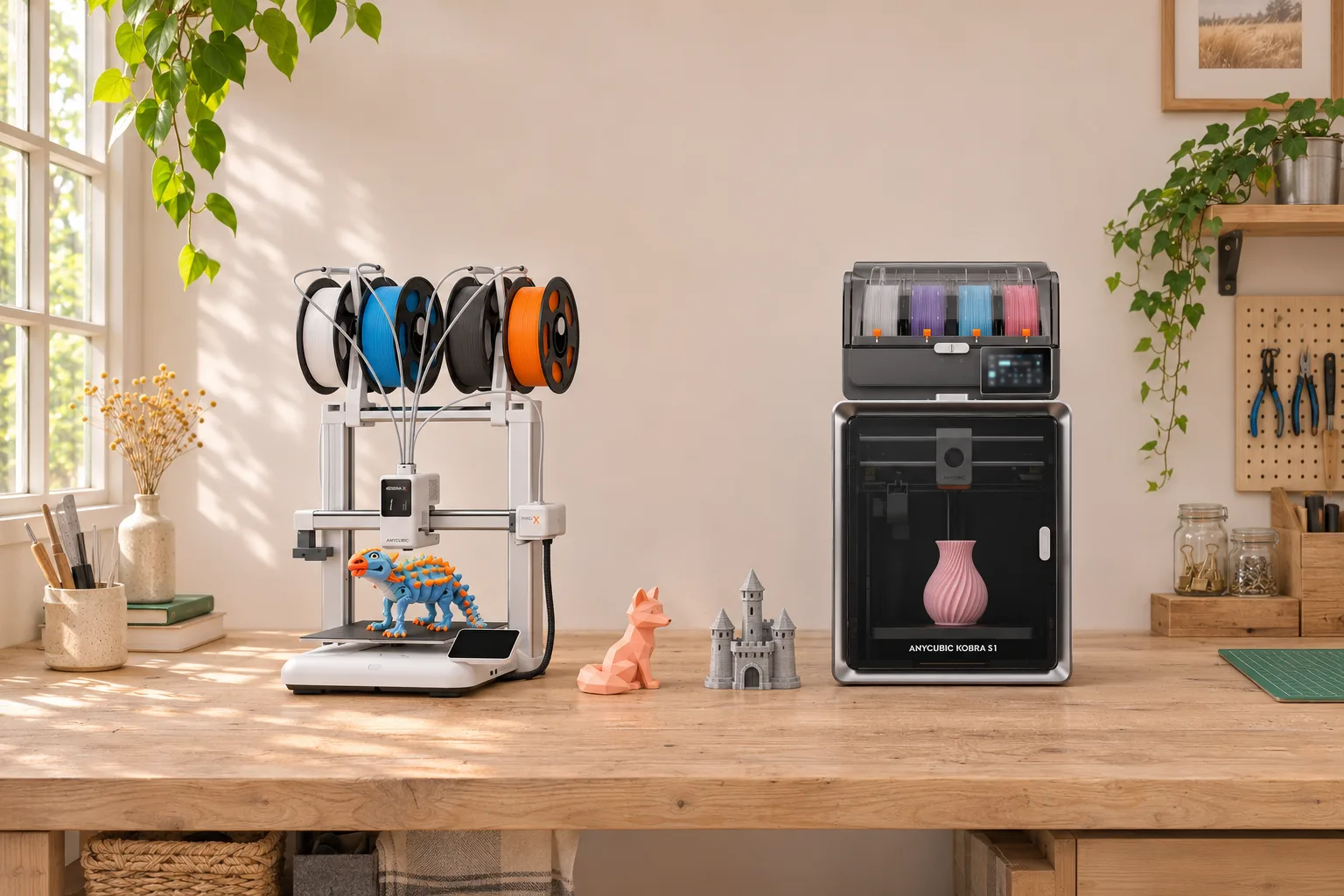
How to
Anycubic 3D printer lineup explained: which Anycubic should you buy?
Most people should buy the Anycubic Kobra X ($279 in November 2026): four colors built into the toolhead, no box needed. Get the Kobra S1 ACE 2 Pro Combo ($429) for an enclosed printer, the S1 Max Combo ($799) for a heated chamber, and the Photon Mono M7 Pro ($429) for resin.
Read story