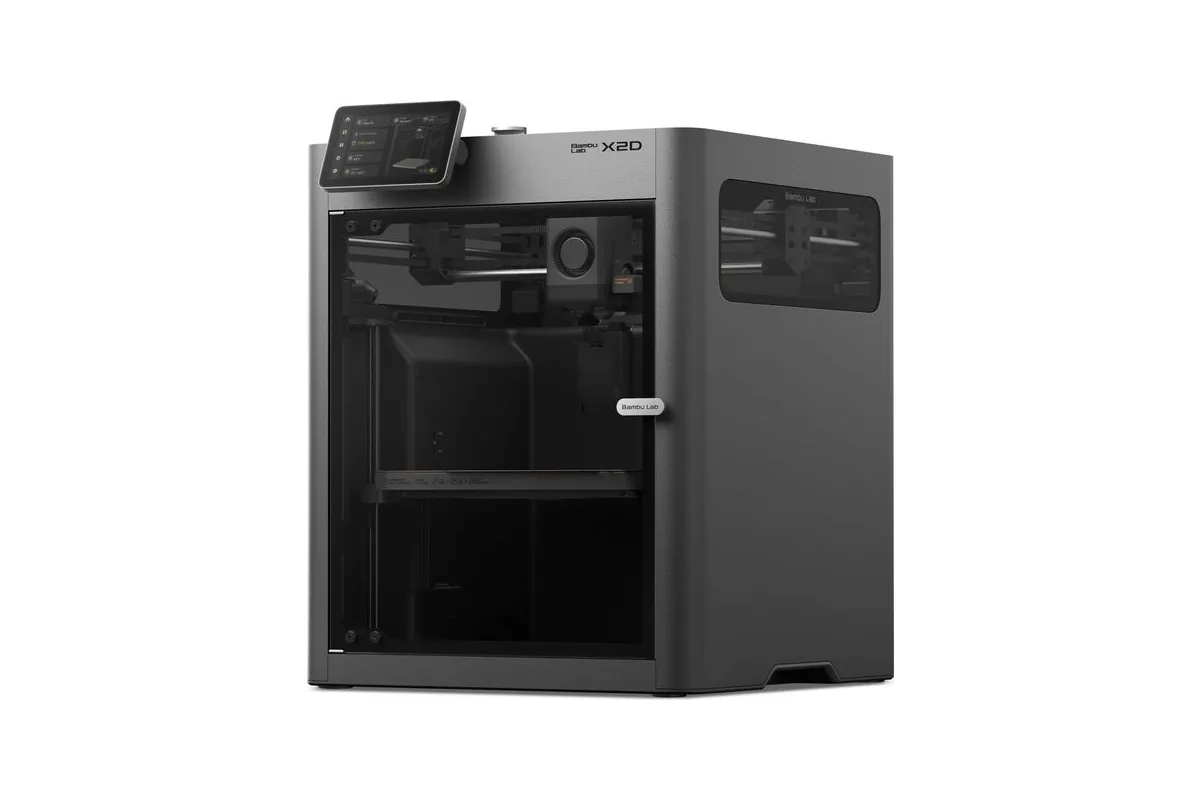
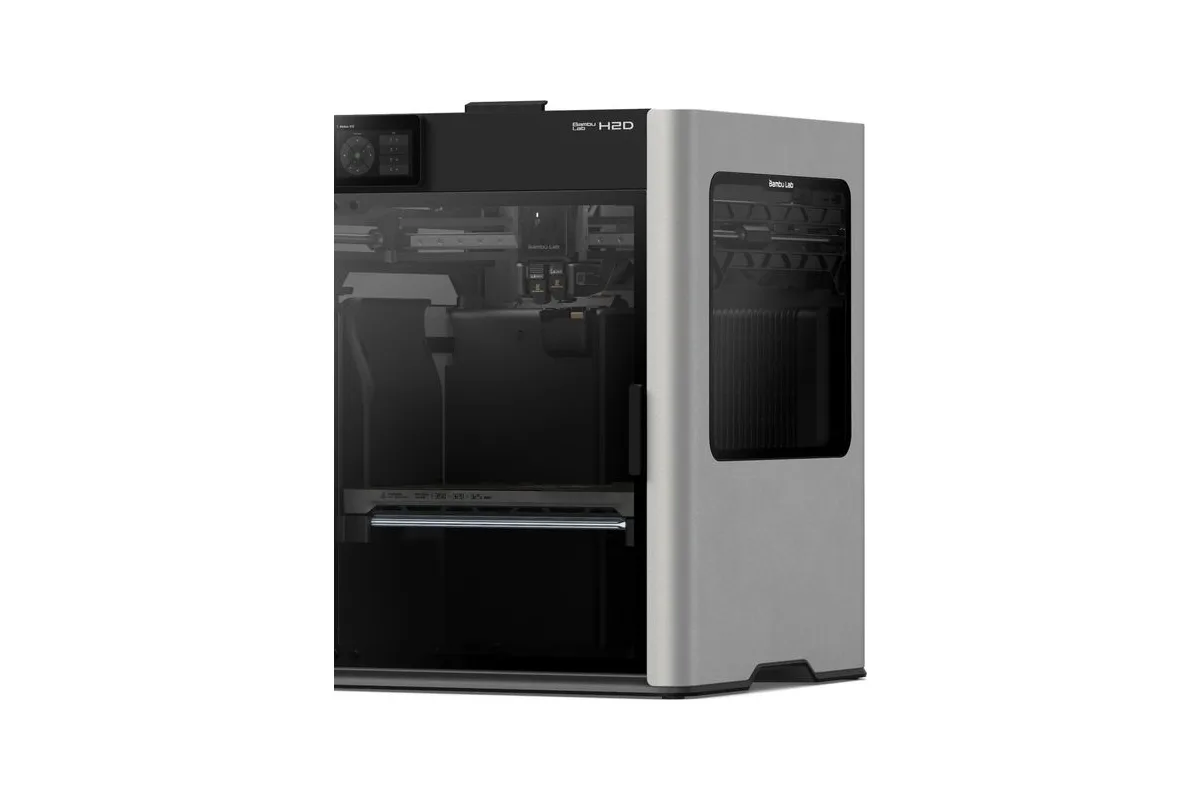
Side by side
| Feature | Bambu LabX2D | Bambu LabH2D |
|---|---|---|
| Build volume | 256 × 256 × 260 mm | 325 × 320 × 325 mm (single nozzle) |
| Max nozzle / bed | 300 °C / 120 °C | 350 °C / 120 °C |
| Chamber | Active, 65 °C | Active, 65 °C |
| Nozzles | 2 (main + auxiliary) | 2 |
Bambu Lab X2D
- Build volume
- 256 × 256 × 260 mm
- Max nozzle / bed
- 300 °C / 120 °C
- Chamber
- Active, 65 °C
- Nozzles
- 2 (main + auxiliary)
Bambu Lab H2D
- Build volume
- 325 × 320 × 325 mm (single nozzle)
- Max nozzle / bed
- 350 °C / 120 °C
- Chamber
- Active, 65 °C
- Nozzles
- 2
Bambu Lab X2D or H2D: which should you buy?
The X2D for most people; the H2D if you need size, 350 °C or a laser. Both are enclosed dual-nozzle Bambu printers with an active chamber that heats to 65 °C, a 120 °C bed, 1,000 mm/s motion and room for up to 25 colors with AMS units. In November 2026 they cost:
- X2D: $589 printer-only or $789 with an AMS 2 Pro (typical $649 and $899).
- H2D: $1,399 printer-only or $1,599 with an AMS 2 Pro (typical $1,549 and $1,749).
That’s an $810 gap in the sale either way. The H2D’s money buys about twice the build volume (33.8 L against 17.0 L, our estimate), 350 °C nozzles instead of 300 °C, a second nozzle without the X2D’s auxiliary-nozzle limits, and 10W or 40W laser bundles. If your prints fit in a 256 mm cube and you print PLA, PETG, ABS, ASA or nylon, the X2D does the job for half the price. Read our X2D review and H2D review.
What’s the difference between the X2D and H2D?
| Bambu Lab X2D | Bambu Lab H2D | |
|---|---|---|
| Price, printer only (Bambu US, Nov 28, 2026) | $589 ($649 typical) | $1,399 ($1,549) |
| Price with AMS 2 Pro | $789 ($899) | $1,599 ($1,749) |
| Other bundles | Print More with 2 AMS 2 Pro $1,049 | AMS + AMS HT $1,699; Laser 10W $1,949; Laser 40W $2,399 |
| Released | Apr 14, 2026 | Mar 25, 2025 |
| Build volume, main / single nozzle | 256 × 256 × 260 mm (17.0 L, our estimate) | 325 × 320 × 325 mm (33.8 L) |
| Build volume, both nozzles | 235.5 × 256 × 256 mm | 300 × 320 × 320 mm |
| Max nozzle temperature | 300 °C | 350 °C |
| Bed / chamber | 120 °C / active 65 °C | 120 °C / active 65 °C |
| Second nozzle | Auxiliary, fed through a PTFE tube; max 200 mm/s and 1,000 mm/s² | Second full nozzle |
| Speed (Bambu) | 1,000 mm/s, 20,000 mm/s² (main nozzle) | 1,000 mm/s, 20,000 mm/s² |
| PPS-CF / PPS-GF | Not supported | Supported |
| Max colors with AMS | 25 | 25 |
| Cameras | Live View 1920 × 1080, toolhead 1600 × 1200 | Live View, nozzle and toolhead, all 1920 × 1080; BirdsEye on laser editions |
| Filtration | G3 + H12 HEPA + carbon | G3 + H12 HEPA + carbon |
| Laser / cutting | None | 10W or 40W laser, blade cutting |
| Noise (Bambu) | Below 50 dB in silent mode at 1 m | No Bambu figure published |
| Power, PLA (Bambu) | About 250 W | About 197 W |
| Size / weight | 392 × 406 × 478 mm, 16.25 kg | 492 × 514 × 626 mm, 31 kg |
| Storage / network | 8 GB + USB; dual-band Wi-Fi; no Ethernet | 8 GB; no USB drive in the box; Wi-Fi; no Ethernet |
| Updates (bug and feature / security) | Apr 14, 2031 / Apr 14, 2033 | Mar 25, 2030 / Mar 25, 2032 |
| Warranty (Bambu US store) | 24 months; auxiliary extruder 3 months | 24 months; dual extruder unit 3 months |
| Price per liter, AMS Combo (our estimate) | $46 | $47 |
Source: Bambu’s US store, specifications, wiki, warranty and compare pages, read November 28, 2026.
Per liter of build volume, the two Combos cost about the same. The real question is whether you need the bigger chamber at all.
How do the two nozzles differ?
This is the biggest practical difference after size.
The X2D has a main nozzle driven by a PMSM servo extruder and an auxiliary nozzle fed by a stepper extruder on the rear panel, through a PTFE tube. A gear-and-trigger mechanism switches between them, and Bambu cites over a million switches in life-cycle testing. Bambu’s own footnotes set the limits on the auxiliary side:
- It “must not exceed 200 mm/s” and 1,000 mm/s².
- “Print quality from the auxiliary nozzle is slightly lower than that of the main nozzle.”
- Bambu recommends official filament on it, and flow calibration runs on the main nozzle only.
- Bambu lists PLA Silk, PETG-CF, ASA-CF, PA6-CF and TPU as filaments to print “with caution” on it.
That makes the X2D’s second nozzle best for support material, a second color in small areas, or a breakaway interface, not for printing half of a large part.
The H2D has two full nozzles at 350 °C and lists none of those auxiliary limits. Bambu’s eddy-current calibration sets the offset between them automatically. If you want to print two materials across a big part without those limits, the H2D is the one.
Which wastes less filament?
Both avoid purging when a print uses two filaments, one per nozzle. Bambu’s wiki notes that on the X2D “printing with more than 2 colors requires purging”, and the same applies to the H2D: each nozzle still flushes when its own AMS colors change.
Bambu gives no gram figure for the X2D beyond “significantly less filament waste”. For the H2D, its H2C page shows Bambu Studio calculations: 3,032 g of purge and prime-tower waste on a six-color-per-part Geminaraptor example (against 3,917 g on the single-nozzle H2S), and 2,051 g on a Racer model (against 2,953 g on the X1C). If you print with many colors often, neither is the low-waste choice. Look at the H2C or the P3C, and see the best dual nozzle 3D printers.
Which prints more materials?
The H2D, at the top end. Both handle ABS, ASA, PC and nylon with their heated chambers and 120 °C beds. The H2D’s 350 °C nozzles add PPS-CF and PPS-GF, which Bambu’s compare page lists as not supported on the X2D. For most home and small-shop work, 300 °C is enough.
Is the X2D the X1 Carbon replacement?
Yes. Bambu’s store FAQ says “X2D is X1C’s next chapter”, and the X1, X1 Carbon and X1E reached end of life on March 31, 2026. Bambu still promises X1-series bug fixes until May 31, 2027, and security patches until May 31, 2029. Over the X1C, Bambu lists the X2D’s dual hotend, 25 colors instead of 16, active chamber heating, servo-based tangle detection, a toolhead camera and Vision Encoder support. If you want something cheaper and single-nozzle, see P2S vs X2D.
What about size, noise and power at home?
The X2D fits a desk: 392 × 406 × 478 mm and 16.25 kg, the same footprint as the P2S. The H2D is 492 × 514 × 626 mm and 31 kg, so plan for a sturdy table and a lot of clearance.
Bambu rates the X2D below 50 dB in silent mode at 1 m and publishes no noise figure for the H2D. Power is similar in daily use: about 250 W for the X2D and 197 W for the H2D on PLA, or about 18.2¢ and 14.3¢ for a 4-hour PLA print at 18.17¢ per kWh (our estimate). The H2D’s maximum is higher, 1,320 W against 1,100 W at 110 V.
One quirk: the H2D ships without a USB drive, and without one, Bambu says time-lapses are off and “printing cannot be initiated through the LAN”. The X2D has built-in storage plus USB. Neither has Ethernet; only the reseller-only H2D Pro does.
Which has the better warranty and support?
Both get 24 months when bought from Bambu’s US store, and both have a weak point: the X2D’s auxiliary extruder and the H2D’s dual extruder unit are each covered for 3 months, and hotends aren’t covered on either. Retailer purchases, such as the X2D Combo at $789.99 at Micro Center, don’t get Bambu’s 2-year US term, which covers only its own US and Canada stores.
The X2D is the newer design, so its published update window runs a year longer: bug and feature fixes until April 14, 2031, against March 25, 2030, for the H2D. X2D firmware 01.03.00.00 (November 25, 2026) added Cool Plate SuperTack, E1 Purifier and E3D High-Flow hotend support, plus reduced oozing and stringing.
Should you buy the X2D or H2D?
- Buy the X2D if your parts fit in 256 mm, you want a heated chamber and a second nozzle for supports or two colors, and you’d rather keep $810.
- Buy the H2D if you print big parts, need 350 °C materials, want two full nozzles, or want a laser and cutter in one machine. See the best laser engravers if the laser is the main draw.
- Look at the H2D vs H2S if you want the H2 size but only one nozzle, for $350 less than the H2D.
Neither is sold on Amazon. For the full lineup, see the Bambu Lab lineup explained.
Questions people ask
Is the H2D better than the X2D?
It’s bigger and more capable: about twice the build volume, 350 °C nozzles, a second full nozzle and laser options. For prints that fit in 256 mm, the X2D does the same job for $810 less.
Do the X2D and H2D both have heated chambers?
Yes. Both actively heat the chamber to 65 °C, which the P2S and P3C don’t do.
How much cheaper is the X2D than the H2D?
$810 in the November 2026 sale, both printer-only ($589 vs $1,399) and with an AMS 2 Pro ($789 vs $1,599). At typical prices the gap is $900 printer-only and $850 for the Combos.
Can the X2D use a laser?
No. Bambu lists no laser or cutting module for it. The H2D takes 10W or 40W lasers and a blade cutter.
Which is quieter?
Bambu rates the X2D below 50 dB in silent mode. It publishes no noise figure for the H2D.
Can I use the first-generation AMS?
Yes, on both, but without drying. The X2D isn’t compatible with the AMS hub, and the H2D doesn’t support the AMS lite.
Sources
- Bambu Lab X2D product page (US store), us.store.bambulab.com
- Bambu Lab X2D specifications, bambulab.com
- Bambu Lab X2D FAQ (wiki), wiki.bambulab.com
- Bambu Lab: presenting the X2D, blog.bambulab.com
- Bambu Lab: the X1 series is EOL, blog.bambulab.com
- Bambu Lab H2D product page (US store), us.store.bambulab.com
- Bambu Lab H2D specifications, bambulab.com
- Bambu Lab H2C overview (purge figures for the H2D), bambulab.com
- Bambu Lab compare page, bambulab.com
- Bambu Lab power consumption by model (wiki), wiki.bambulab.com
- Bambu Lab multi-AMS compatibility guide (wiki), wiki.bambulab.com
- Bambu Lab warranty policy, bambulab.com
- Bambu Lab X2D firmware release history, wiki.bambulab.com
- Micro Center Bambu Lab listings, microcenter.com
Keep exploring

How to
Hardened steel vs brass nozzles, and what nozzle size to use
Brass, or the stainless steel Bambu ships on the A1, is fine for PLA, PETG, ABS, ASA and TPU. Carbon fiber, glass fiber, glow-in-the-dark and sparkle filaments need hardened steel. Use a 0.4 mm nozzle for most prints, 0.6 mm for carbon fiber and big parts, and 0.2 mm for miniatures.
Read story
How to
Can you 3D scan with an iPhone? Yes, but not to tight tolerances
Yes. Any current iPhone can 3D scan objects from photos (photogrammetry), and KIRI Engine's free tier exports STL for printing. Only the iPhone 18 Pro and 18 Pro Max have LiDAR in Apple's current lineup. For parts that must fit, a $359 scanner is about ten times tighter.
Read story