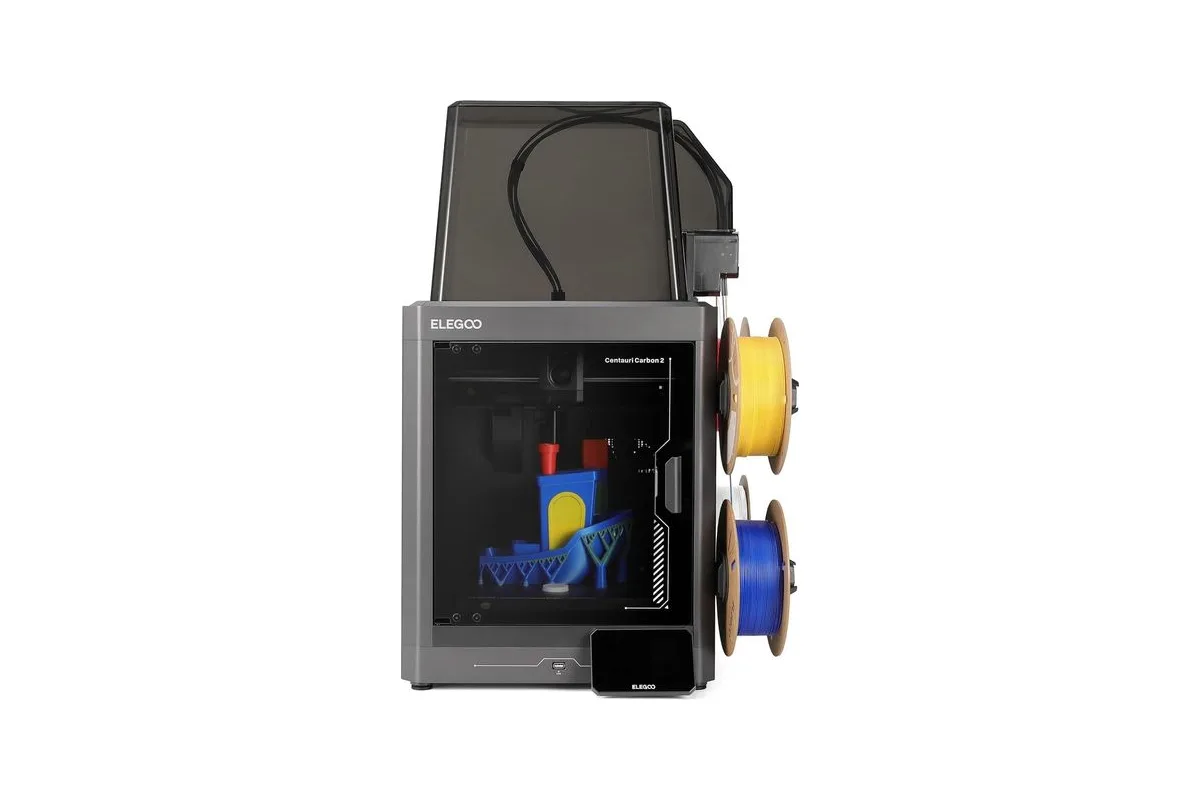
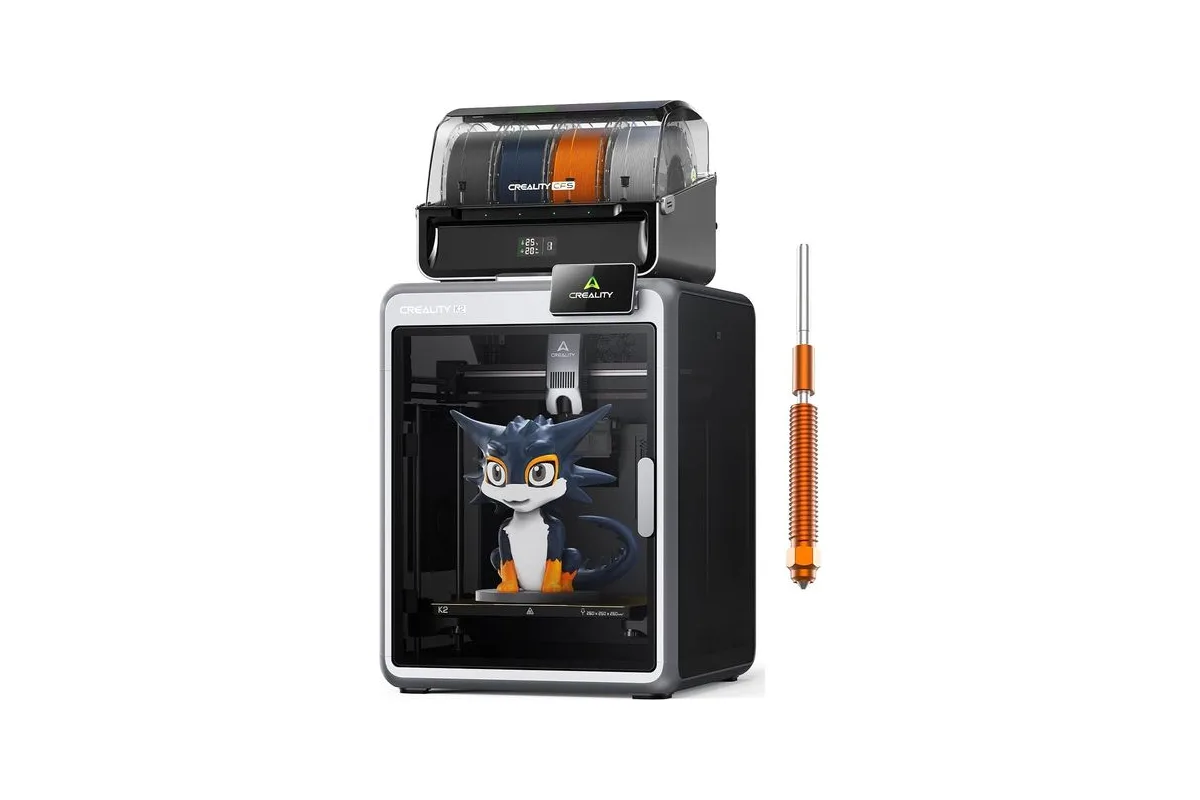
Side by side
| Feature | Elegoo Centauri Carbon 2 Combo | Creality K2 Combo |
|---|---|---|
| Frame | Enclosed CoreXY | Enclosed CoreXY |
| Build volume | 256 x 256 x 256 mm | 260 x 260 x 260 mm |
| Multicolor | 4 colors (CANVAS) | 4 colors (CFS), up to 16 |
| Materials | PLA, PETG, TPU, ABS, ASA, CF blends | PLA, PETG, ABS, PLA-CF |
| Where to buy | Check price at Amazon | Check price at Amazon |
Elegoo Centauri Carbon 2 Combo
- Frame
- Enclosed CoreXY
- Build volume
- 256 x 256 x 256 mm
- Multicolor
- 4 colors (CANVAS)
- Materials
- PLA, PETG, TPU, ABS, ASA, CF blends
Creality K2 Combo
- Frame
- Enclosed CoreXY
- Build volume
- 260 x 260 x 260 mm
- Multicolor
- 4 colors (CFS), up to 16
- Materials
- PLA, PETG, ABS, PLA-CF
Elegoo Centauri Carbon 2 or Creality K2: which should you buy?
The Elegoo Centauri Carbon 2 Combo, for most people. Both are enclosed CoreXY printers of almost the same size, with hardened nozzles and a four-color feeder in the box. The CC2 Combo was $369 at Elegoo in November 2026 (list $449), $80 less than the Creality K2 Combo at $449, and it has the hotter hardware: a 350 °C nozzle against 300 °C, a 110 °C bed against 100 °C, and a HEPA and carbon filter.
Buy the Creality K2 Combo if you want to grow past four colors. Its CFS system expands to 16 colors with more units, while Elegoo’s CANVAS stops at four. The K2 also has a 720p camera with AI failure detection and a slightly bigger 260 mm build volume.
You can find the Centauri Carbon 2 Combo on Amazon, where it was also $369 in late November; the K2 Combo was $449 there.
Elegoo Centauri Carbon 2 vs Creality K2: specs
| Elegoo Centauri Carbon 2 | Creality K2 | |
|---|---|---|
| Combo price (Nov 2026) | $369 with CANVAS (list $449) | $449 with one CFS (about $699 list, our estimate) |
| Printer-only price | $319 (list $359) | $349 (list $549) |
| Released | January 26, 2026 (Combo launch release) | August 2025 (launch release) |
| Frame | Enclosed CoreXY, glass door | Enclosed CoreXY |
| Chamber | Passive: thermal cover and automatic exhaust grille | None listed; no heater |
| Build volume | 256 x 256 x 256 mm (16.8 L, our estimate) | 260 x 260 x 260 mm (17.6 L, our estimate) |
| Max nozzle | 350 °C, brass-hardened steel | 300 °C, hardened steel |
| Max bed | 110 °C | 100 °C |
| Speed (maker) | 500 mm/s (250 recommended); 20,000 mm/s² | 600 mm/s (300 typical); 20,000 mm/s² |
| Colors in the box / max | 4 / 4 (CANVAS) | 4 / 16 (up to 4 CFS units) |
| Filtration | HEPA and coconut-shell activated carbon | One air filter (activated carbon) |
| Camera / AI | Live view and time-lapse; no AI detection claimed on Elegoo’s US page | 720p, 30 fps chamber camera with AI spaghetti and build-plate checks |
| Screen | 5-inch touchscreen | 4-inch touchscreen |
| Connectivity | Wi-Fi, USB | 2.4 GHz Wi-Fi only, USB; no Ethernet |
| Size and weight | Combo 500 x 480 x 743 mm, 19.35 kg (with CANVAS) | 404 x 436 x 545 mm, 18.3 kg (printer only) |
| Price per liter, Combo (our estimate) | $22.00 | $25.50 |
| Price per color, Combo (our estimate) | $92 | $112 |
| Warranty | 12 months; extruder 6 months; CANVAS boards and motors 12 months; none on nozzle, plate or hot end | 12 months, CFS included; wear parts 3 months; none on nozzle, cutter, PTFE tube or plate |
| US support | Ticket form | Phone line and email; online support Mon–Fri 7 a.m.–5 p.m. Pacific |
Sources: Elegoo’s and Creality’s US stores, product and support pages, and warranty policies, read November 28, 2026. Price per liter and per color are the Combo sale price divided by the build volume and by four colors. The K2’s list price is Creality’s sale price plus its “Save $250” figure.
What’s the difference between the Centauri Carbon 2 and the K2?
They’re the same kind of printer with different priorities:
- The CC2 runs hotter and filters better. A 350 °C nozzle and 110 °C bed give it more headroom for engineering filaments, and Elegoo says its HEPA and carbon filter removes ultrafine particles as well as fumes and odors.
- The K2 expands further and watches more closely. Up to four CFS units feed 16 colors, and its chamber camera runs AI spaghetti detection and checks the build plate.
- Size is a wash. The K2’s 260 mm cube is about 5% bigger by volume (our estimate), which you’ll rarely notice.
Neither has a heated chamber. That matters more on the K2 than you’d think: Creality lists ABS for the K2, but its own K2-series page says printing ABS, ASA and PPS “requires a chamber temperature of 60 °C”, which only the K2 Pro and K2 Plus reach. Neither printer heats its chamber, so treat large ABS and ASA parts as a risk on both, and more so on the K2 with its cooler bed.
Which prints better?
They’re close, with an edge to the CC2 on hot materials. Both are enclosed CoreXY machines with automatic leveling and hardened nozzles, so PLA, PETG and PLA-CF look similar from either. The CC2’s hotter bed helps ABS and ASA stick, and Elegoo lists both as ideal materials. The CC2’s default Z offset can sit a little low, which a single adjustment fixes.
Which is faster?
The K2, slightly, on paper. Creality rates it at 600 mm/s with a typical speed of 300 mm/s; Elegoo rates the CC2 at 500 mm/s and recommends 250. Both use 20,000 mm/s² acceleration. In multicolor prints, color changes take most of the extra time on both.
Which is better for multicolor?
The K2, if you’ll ever want more than four colors. Otherwise it’s a tie.
- K2 and CFS: the Combo includes one four-spool CFS, and you can add up to three more for 16 colors. The CFS can’t feed TPU and doesn’t dry filament.
- CC2 and CANVAS: four colors with RFID spool detection, automatic refill and tangle detection, and no way past four. The spools sit outside the enclosure without drying.
Both are single-nozzle systems that cut and purge filament at every color change, and neither Creality nor Elegoo publishes a purge-waste figure for them. On the K2 there’s no purge chute, so purged filament can end up loose in the cabinet. If you’ll print a lot of multicolor, a tool changer wastes far less; see is a multicolor 3D printer worth it?
Which is more reliable?
Neither is trouble-free. Owner reports for each:
- Centauri Carbon 2: connection drops between printer, app and slicer, occasional false spaghetti alarms and, on some units, a camera that stops working after repeated power cycles. An open-source community project documents the cause and a fix; Elegoo hasn’t acknowledged it.
- Creality K2: after a February 2026 firmware update, some owners reported repeated false “foreign object on plate” pauses, a blank screen during prints and RFID tags not being recognized, while others saw improvements. Owners also report Creality Cloud app binding failures.
Support favors Creality. It lists a toll-free phone line and email, with online support Monday to Friday, 7 a.m. to 5 p.m. Pacific; Elegoo works through a ticket form. Both give 12 months on the printer, and both treat the nozzle and build plate as consumables with no warranty.
Which needs the cloud?
Neither for basic printing. The CC2 prints over your local network from ElegooSlicer, and Elegoo’s Matrix app adds remote control. The K2 prints over LAN without an account, but remote camera viewing and control go through Creality Cloud, which needs one.
On openness, Elegoo publishes the CC2’s firmware source under GPL-3.0. Creality advertises root access on the K2, but its warranty is voided by third-party firmware.
Which should you buy?
- Buy the Elegoo Centauri Carbon 2 Combo ($369) for the best value in an enclosed four-color printer. Read our CC2 review.
- Buy the Creality K2 Combo ($449) if you want 16-color expansion, AI monitoring or phone support. Read our K2 Combo review.
- Want a heated chamber? Creality’s K2 Pro Combo ($749) and K2 Plus Combo ($1,044) reach 60 °C; see the Creality lineup explained.
- Want the easiest software? The Bambu P2S Combo costs $649.
For the wider picture, see Creality vs Elegoo and the best enclosed 3D printers. Creality’s sale ends around midnight Eastern on November 30 (our estimate from its countdown); Elegoo’s ends at 3 a.m. Eastern on December 1, 2026.
Questions people ask
Is the Centauri Carbon 2 better than the Creality K2?
For most people, yes: it’s $80 cheaper as a Combo and has a hotter nozzle and bed and a better filter. The K2 is better if you want more than four colors or AI print monitoring.
Can the Creality K2 print ABS?
Creality lists ABS for the K2, but it has no chamber heater, and Creality says ABS and ASA need a 60 °C chamber, which only the K2 Pro and Plus reach. The CC2 has no chamber heater either, but Elegoo lists ABS and ASA as ideal materials and its bed reaches 110 °C.
Does the Centauri Carbon 2 have a camera?
Yes, for live monitoring and time-lapses. Elegoo’s US page doesn’t claim AI failure detection. The K2’s camera has AI spaghetti detection.
Can the K2’s CFS print TPU?
No, Creality’s CFS can’t feed TPU. On the CC2, Elegoo lists TPU as a material the printer is “capable” of.
Which has the bigger build volume?
The K2, at 260 mm on each side against the CC2’s 256 mm, about 5% more volume (our estimate).
Which has better customer support?
Creality, on access: it lists a toll-free phone line and email, with online support during Pacific business hours. Elegoo uses a ticket form. Both warranties are 12 months on the printer.
Sources
- Elegoo Centauri Carbon 2 Combo product page, us.elegoo.com
- Elegoo Centauri Carbon 2 product page, us.elegoo.com
- Elegoo US refund and warranty policy, us.elegoo.com
- Elegoo Centauri Carbon 2 firmware source, github.com
- OpenCentauri: CC2 camera fix, github.com
- Creality K2 Combo store page, store.creality.com
- Creality K2 series comparison, creality.com
- Creality K2 series support page, creality.com
- Creality warranty policy, creality.com
- Creality store return policy, store.creality.com
- Creality forum: K2 series firmware feedback (Feb 2026), forum.creality.com
- Creality K2 Combo review, notebookcheck.net
Keep exploring

How to
Hardened steel vs brass nozzles, and what nozzle size to use
Brass, or the stainless steel Bambu ships on the A1, is fine for PLA, PETG, ABS, ASA and TPU. Carbon fiber, glass fiber, glow-in-the-dark and sparkle filaments need hardened steel. Use a 0.4 mm nozzle for most prints, 0.6 mm for carbon fiber and big parts, and 0.2 mm for miniatures.
Read story
How to
Can you 3D scan with an iPhone? Yes, but not to tight tolerances
Yes. Any current iPhone can 3D scan objects from photos (photogrammetry), and KIRI Engine's free tier exports STL for printing. Only the iPhone 18 Pro and 18 Pro Max have LiDAR in Apple's current lineup. For parts that must fit, a $359 scanner is about ten times tighter.
Read story