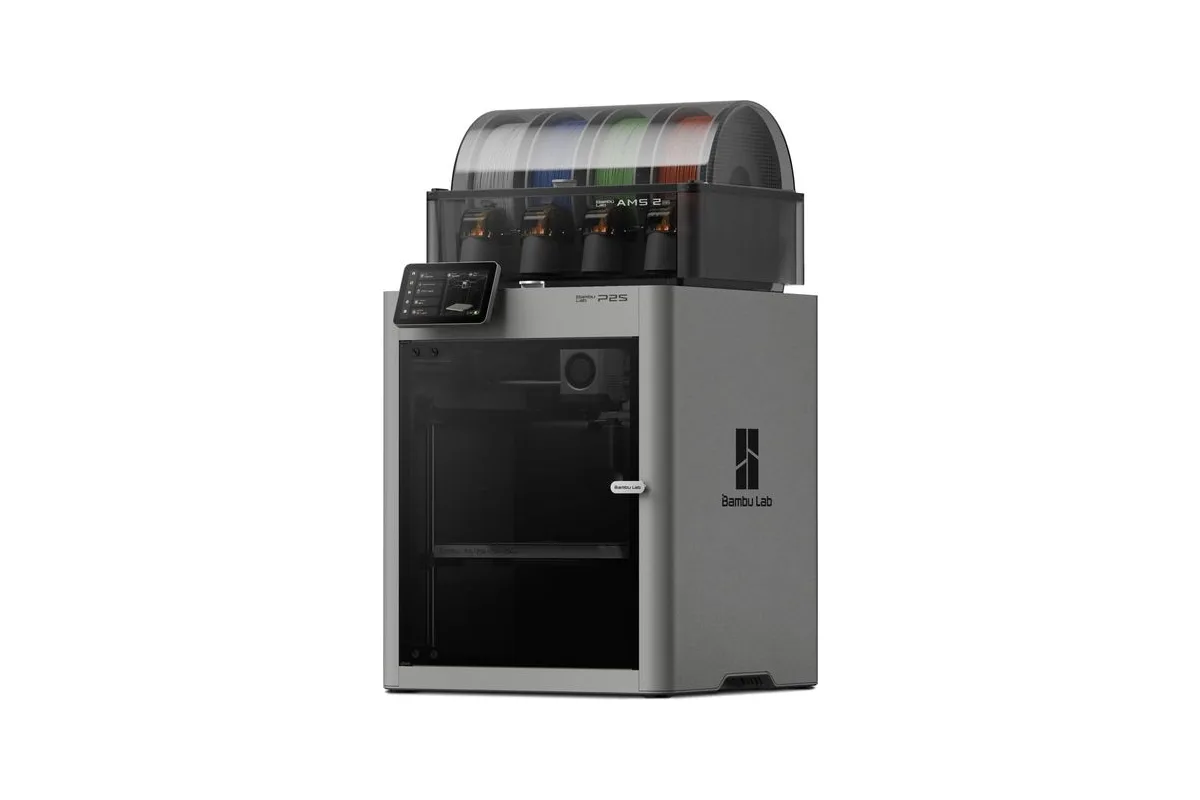
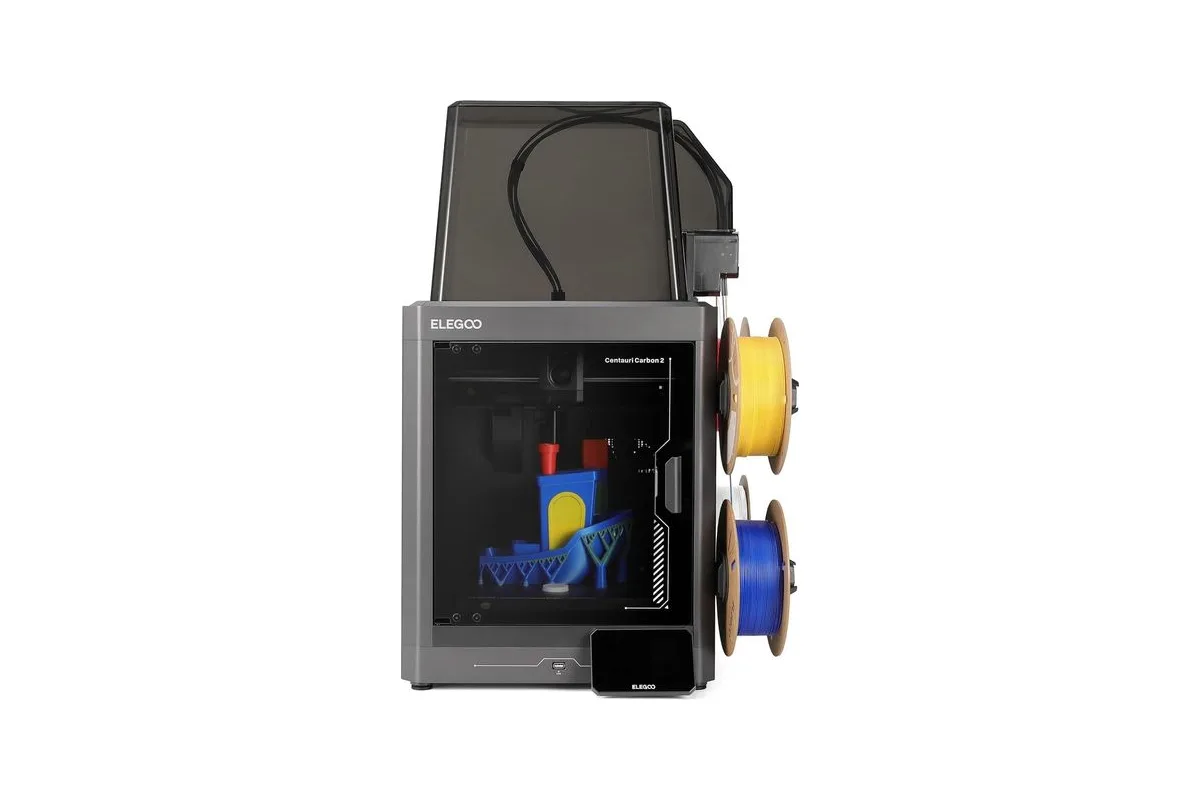
Side by side
| Feature | Bambu LabP2S Combo | Elegoo Centauri Carbon 2 Combo |
|---|---|---|
| Frame | Enclosed CoreXY | Enclosed CoreXY |
| Build volume | 256 x 256 x 256 mm | 256 x 256 x 256 mm |
| Multicolor | 4 colors (AMS 2 Pro), expandable | 4 colors (CANVAS) |
| Materials | PLA, PETG, TPU, ABS, ASA, CF blends | PLA, PETG, TPU, ABS, ASA, CF blends |
| Where to buy | Check price at Amazon | Check price at Amazon |
Bambu Lab P2S Combo
- Frame
- Enclosed CoreXY
- Build volume
- 256 x 256 x 256 mm
- Multicolor
- 4 colors (AMS 2 Pro), expandable
- Materials
- PLA, PETG, TPU, ABS, ASA, CF blends
Elegoo Centauri Carbon 2 Combo
- Frame
- Enclosed CoreXY
- Build volume
- 256 x 256 x 256 mm
- Multicolor
- 4 colors (CANVAS)
- Materials
- PLA, PETG, TPU, ABS, ASA, CF blends
Elegoo Centauri Carbon 2 or Bambu Lab P2S: which is better?
The Bambu Lab P2S is the better printer; the Elegoo Centauri Carbon 2 is the better value. Both are enclosed 256 mm CoreXY printers with a four-color feeder, a hardened nozzle and a 110 °C bed, so they print the same materials and similar-looking parts. The differences are software, extras and price:
- The P2S Combo ($649 at Bambu in November 2026, typical $749) has Bambu’s more polished slicer and app, a 1080p camera with AI failure detection, an AMS 2 Pro that dries filament, expansion to 20 colors and a 2-year warranty from Bambu’s own store.
- The Centauri Carbon 2 Combo ($369 at Elegoo, list $449) costs $280 less and has a hotter 350 °C nozzle and a HEPA and carbon filter. Its software is rougher, it stops at four colors, and the warranty is 12 months.
If you’ll print a lot and value your time, the P2S is worth the extra. If $280 matters more than polish, the CC2 is the best-value enclosed printer you can buy. Both are on Amazon: the P2S Combo was $649.99 and the Centauri Carbon 2 Combo $369 in late November.
Elegoo Centauri Carbon 2 vs Bambu P2S: specs
| Elegoo Centauri Carbon 2 | Bambu Lab P2S | |
|---|---|---|
| Combo price (Nov 2026) | $369 with CANVAS (list $449) | $649 with AMS 2 Pro (typical $749) |
| Printer-only price | $319 (list $359) | $449 (typical $549) |
| Released | January 26, 2026 (Combo launch release) | October 14, 2025 |
| Frame | Enclosed CoreXY, glass door | Enclosed CoreXY |
| Chamber | Passive: thermal cover and automatic exhaust grille | Passive: automatic flap between internal and external air circulation |
| Build volume | 256 x 256 x 256 mm (16.8 L, our estimate) | 256 x 256 x 256 mm (16.8 L) |
| Max nozzle | 350 °C, brass-hardened steel | 300 °C, hardened steel, tool-free quick swap |
| Max bed | 110 °C | 110 °C |
| Speed (maker) | 500 mm/s; 20,000 mm/s² max (10,000 default) | 600 mm/s; 20,000 mm/s². Travel up to 1,000 mm/s since firmware 01.03 |
| Max flow (maker) | 32 mm³/s | 40 mm³/s |
| Colors in the box / max | 4 / 4 (CANVAS) | 4 / 20 (AMS 2 Pro and AMS HT units) |
| Filament drying | None in CANVAS | AMS 2 Pro dries (one unit, while idle, without an extra adapter) |
| Filtration | HEPA and coconut-shell activated carbon | Activated carbon |
| Camera / AI | Live view and time-lapse; no AI detection claimed on Elegoo’s US page | 1080p, 30 fps; AI spaghetti, nozzle-blob and purge-chute jam detection |
| Screen | 5-inch touchscreen | 5-inch touchscreen |
| Connectivity | Wi-Fi, USB | Dual-band Wi-Fi, USB; no Ethernet |
| Noise (maker) | 45 dB or less, silent mode | Under 50 dB, silent mode, at 1 m |
| Power (maker) | 350 W rated at 110 V | 1,000 W max at 110 V; about 200 W printing PLA |
| Size and weight | Combo 500 x 480 x 743 mm, 19.35 kg (with CANVAS) | 392 x 406 x 478 mm, 14.9 kg (printer only) |
| Warranty | 12 months; extruder 6 months; none on nozzle, plate or hot end | 24 months from Bambu’s US store; none on hotend or extruder gears |
| Software updates promised | No end date published that we found | Bug and feature fixes to Oct 14, 2030; security to Oct 14, 2032 |
Sources: Elegoo’s and Bambu’s US product pages, specifications, FAQs and warranty pages, read November 28, 2026.
What do you get for the extra $280?
On the Combos, the P2S costs 76% more (our estimate). That money buys:
- Software. Bambu Studio and the Bambu Handy app are the most polished in home 3D printing. Elegoo’s slicer and app work, but owners report connection drops between printer, app and slicer on Windows, failed print sends and random initialization errors.
- A better camera with AI. The P2S’s 1080p camera runs AI detection on the printer for spaghetti, nozzle blobs and purge-chute jams, and checks print settings before it starts. Elegoo’s US page promises live monitoring and time-lapse but doesn’t claim AI detection.
- Drying and growth. The AMS 2 Pro dries filament, and the P2S takes up to four AMS 2 Pro and four AMS HT units, for 20 slots. CANVAS stops at four spools, which sit outside the enclosure without drying.
- Warranty and support dates. Bambu gives 2 years when you buy from its US store and publishes update dates: bug and feature fixes until October 14, 2030, and security patches until October 14, 2032.
What the CC2 has that the P2S doesn’t: a 350 °C nozzle (the P2S tops out at 300 °C), a HEPA stage in its filter, and published firmware source code under GPL-3.0.
Which prints better?
They’re close. Both are enclosed CoreXY printers with hardened nozzles and 110 °C beds, so both print PLA, PETG, ABS, ASA and carbon-fiber blends well. The P2S has more automation behind each print: an eddy-current sensor calibrates flow automatically, and its extruder pushes up to 8.5 kg of force. The CC2 can need a Z-offset tweak, because its default first layer can sit a little low.
The CC2’s hotter nozzle matters only for materials that need more than 300 °C. Elegoo lists PC, PA and PET as “capable”, not ideal.
Which is faster?
The P2S, on paper. Bambu rates it at 600 mm/s and 20,000 mm/s², with faster travel moves since firmware 01.03.00.00 (September 21, 2026), and a 40 mm³/s flow rate against the CC2’s 32. Elegoo rates the CC2 at 500 mm/s and recommends 250. In multicolor printing, both spend much of their time on color changes, so neither is quick there.
How much filament does each waste in multicolor?
A lot, on both. Each is a single-nozzle printer: every color change cuts the filament, loads the next one and purges the old color. Neither Bambu nor Elegoo publishes a grams-per-change figure for these printers. On the CC2, the purged filament piles up behind the printer; the P2S has a purge chute and watches it for jams.
If you print multicolor often, a tool changer like the Snapmaker U1 or Bambu’s new P3C wastes far less. See is a multicolor 3D printer worth it?
Which is more reliable?
The P2S, on the evidence. Both have owner-reported problems, but the CC2’s are harder to fix yourself:
- Centauri Carbon 2: connection drops, occasional false spaghetti alarms and, on some units, a camera that stops working after repeated power cycles. An open-source community project documents the cause and a fix; Elegoo hasn’t acknowledged it.
- P2S: after launch, owners reported problems tied to specific firmware updates, including under-extrusion and Wi-Fi instability, which later releases addressed.
Both print without the cloud. The CC2 prints over your local network from ElegooSlicer. The P2S has a LAN Only mode, which turns off remote printing, the Handy app and print history but keeps AI detection running on the printer; see can you use a Bambu Lab printer offline?
Can you make the CC2 match the P2S?
Partly. Elegoo sells a 2- or 3-year protection plan from a third party on the CC2 Combo page for $40.99 or $53.99, which brings the warranty term closer for about $410 total (our estimate). A separate filament dryer covers drying. Nothing adds more than four colors, AI detection or Bambu’s software.
Which should you buy?
- Buy the Bambu P2S Combo ($649) if this is your main printer and you want the fewest headaches. Read our P2S review.
- Buy the Elegoo Centauri Carbon 2 Combo ($369) if you want an enclosed, four-color printer for engineering filaments on a budget and don’t mind troubleshooting software now and then. Read our CC2 review.
- Skip the colors and save more: the CC2 alone is $319 and the P2S alone $449.
For the other enclosed options, see the best enclosed 3D printers, Creality K2 Combo vs P2S Combo and Centauri Carbon 2 vs Creality K2. Both sales end soon: Bambu’s at 2 a.m. Eastern and Elegoo’s at 3 a.m. Eastern on December 1, 2026.
Questions people ask
Is the Elegoo Centauri Carbon 2 as good as the Bambu P2S?
On hardware, nearly: same build volume, enclosure, bed temperature and four colors, with a hotter nozzle. On software, camera, drying, expansion and warranty, the P2S is better.
Is the Bambu P2S worth $280 more than the Centauri Carbon 2?
If you print often, yes: you’ll spend less time troubleshooting, and the AMS 2 Pro dries filament and expands to 20 colors. If you print occasionally and mostly in one color, the CC2 is the smarter buy.
Which has a heated chamber?
Neither. Both are enclosed and hold heat passively, which is enough for ABS and ASA. Bambu’s X2D and H2 series have active chamber heating.
Which is quieter?
Elegoo rates the CC2 at 45 dB or less and Bambu rates the P2S under 50 dB, both in silent mode. Makers measure differently, so treat them as similar.
Can the Centauri Carbon 2 use more than four colors?
No. CANVAS holds four spools, and Elegoo lists four colors as the maximum. The P2S takes up to 20.
Which has the better warranty?
The P2S: 24 months when bought from Bambu’s US store, against Elegoo’s 12 months. Neither covers the hotend or nozzle.
Sources
- Elegoo Centauri Carbon 2 Combo product page, us.elegoo.com
- Elegoo Centauri Carbon 2 product page, us.elegoo.com
- Elegoo Centauri Carbon 2 Combo overview, us.elegoo.com
- Elegoo US refund and warranty policy, us.elegoo.com
- Elegoo Centauri Carbon 2 firmware source, github.com
- OpenCentauri: CC2 camera fix, github.com
- Bambu Lab P2S store page and FAQ, us.store.bambulab.com
- Bambu Lab P2S specifications, bambulab.com
- Bambu Lab P2S FAQ, wiki.bambulab.com
- Bambu Lab P2S firmware release history, wiki.bambulab.com
- Bambu Lab P2S warranty, bambulab.com
- Bambu Lab printer comparison (software update support), bambulab.com
- Bambu Lab wiki: LAN Only mode, wiki.bambulab.com
- Elegoo Centauri Carbon 2 review, notebookcheck.net
Keep exploring

How to
Hardened steel vs brass nozzles, and what nozzle size to use
Brass, or the stainless steel Bambu ships on the A1, is fine for PLA, PETG, ABS, ASA and TPU. Carbon fiber, glass fiber, glow-in-the-dark and sparkle filaments need hardened steel. Use a 0.4 mm nozzle for most prints, 0.6 mm for carbon fiber and big parts, and 0.2 mm for miniatures.
Read story
How to
Can you 3D scan with an iPhone? Yes, but not to tight tolerances
Yes. Any current iPhone can 3D scan objects from photos (photogrammetry), and KIRI Engine's free tier exports STL for printing. Only the iPhone 18 Pro and 18 Pro Max have LiDAR in Apple's current lineup. For parts that must fit, a $359 scanner is about ten times tighter.
Read story