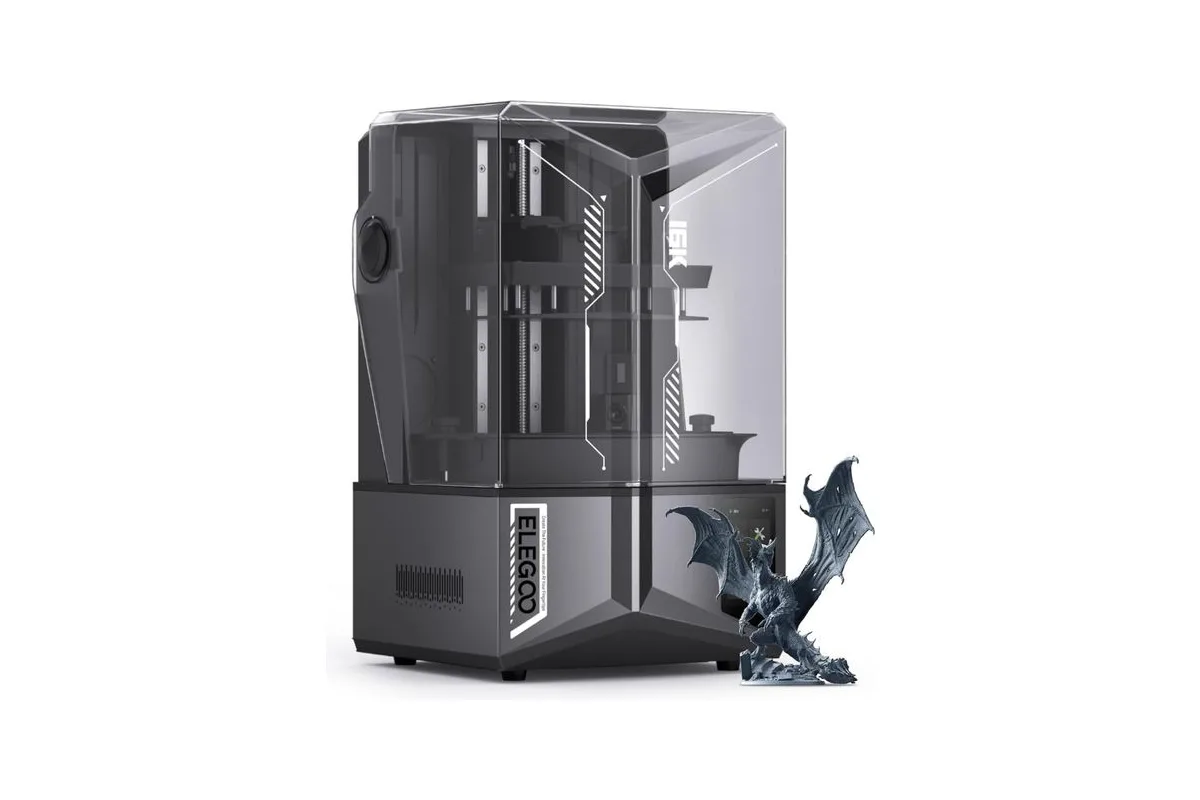
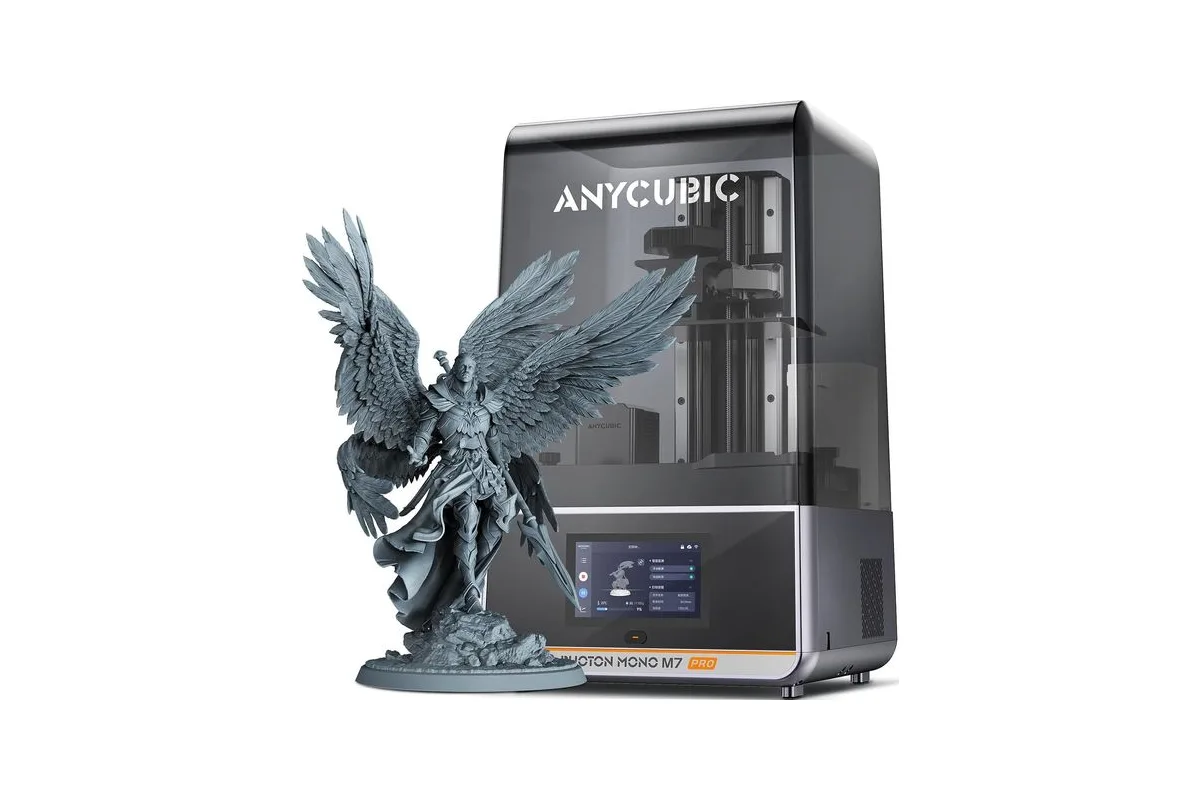
Side by side
| Feature | Elegoo Saturn 4 Ultra 16K | Anycubic Photon Mono M7 Pro |
|---|---|---|
| Type | Resin (MSLA) | Resin (MSLA) |
| Build volume | 211.68 x 118.37 x 220 mm | 223 x 126 x 230 mm |
| Resolution | 16K | 14K |
| Materials | Photopolymer resin | Photopolymer resin |
| Where to buy | Check price at Amazon | Check price at Amazon |
Elegoo Saturn 4 Ultra 16K
- Type
- Resin (MSLA)
- Build volume
- 211.68 x 118.37 x 220 mm
- Resolution
- 16K
- Materials
- Photopolymer resin
Anycubic Photon Mono M7 Pro
- Type
- Resin (MSLA)
- Build volume
- 223 x 126 x 230 mm
- Resolution
- 14K
- Materials
- Photopolymer resin
Elegoo Saturn 4 Ultra 16K or Anycubic Photon Mono M7 Pro: which is better?
The Elegoo Saturn 4 Ultra 16K, for miniatures and fine detail. The Anycubic Photon Mono M7 Pro, for less mess and a longer screen warranty. Both are 10-inch mono LCD resin printers with heated vats and build volumes of 5.5 to 6.5 liters. They differ in four ways that matter:
- Detail: the Saturn’s 16K screen has 14 x 19 µm pixels, against the M7 Pro’s 16.8 x 24.8 µm. Each Saturn pixel covers about 36% less area (our estimate), so faces, edges and small text can come out crisper.
- Release: the Saturn tilts its vat to peel each layer off gently. Anycubic doesn’t list tilt release for the M7 Pro.
- Resin handling: the M7 Pro pumps resin in from the bottle as it prints and pumps leftovers back. With the Saturn, you pour by hand.
- Screen warranty: Anycubic covers the M7 Pro’s LCD for 6 months; Elegoo covers the Saturn’s for 3.
On price, the Saturn was $399 in November 2026, but only with Elegoo’s Black Friday code BFDG16K; its page price was $649.99. The M7 Pro was $429 at Anycubic (list $669) with no code. On Amazon, the Saturn 4 Ultra 16K was $441.99 and the Photon Mono M7 Pro $449.99 in late November.
Saturn 4 Ultra 16K vs Photon Mono M7 Pro: specs
| Elegoo Saturn 4 Ultra 16K | Anycubic Photon Mono M7 Pro | |
|---|---|---|
| Price (Nov 2026) | $399 with code BFDG16K; page price $649.99 | $429 (list $669) |
| Screen | 10-inch 16K mono LCD | 10.1-inch 14K mono LCD |
| Resolution | 15,120 x 6,230 | 13,320 x 5,120 |
| XY pixel size | 14 x 19 µm | 16.8 x 24.8 µm |
| Build volume | 211.68 x 118.37 x 220 mm (5.5 L, our estimate) | 223 x 126 x 230 mm (6.5 L) |
| Release | Tilt release | Standard (ACF release film; no tilt listed) |
| Heated vat | Yes, 30 °C | Yes, “dynamic temperature control” (no temperature stated) |
| Automatic resin refill | No | Yes, refills and pumps back |
| Vat capacity | Not listed | Up to 1 L |
| Camera / AI | Live camera with light; AI failure detection | “Failed print detection” (camera not specified) |
| Sensors | Resin shortage, vat residue, leveling | Resin level, resin residue |
| Leveling | Automatic | Leveling-free plate |
| Max speed (maker) | 150 mm/h | 130 mm/h standard resin; 170 mm/h high-speed resin |
| Light source | Not listed on the US spec table | COB with Fresnel lens, 5,500 µW/cm² ±10% |
| Connectivity | USB, Wi-Fi, over-the-air updates | USB, Wi-Fi, LAN |
| Slicers | Elegoo SatelLite, Chitubox | Photon Workshop, Chitubox; Lychee “scheduled” |
| Power-loss resume | Not stated | Not supported |
| Size and weight | 327.4 x 329.2 x 548 mm, 16.1 kg | 312 x 315 x 520 mm, 12.8 kg |
| Price per liter of build volume (our estimate) | $72 with code; $118 at page price | $66 |
| Machine warranty | 12 months | 12 months |
| LCD screen warranty | 3 months | 6 months |
| Vat and build plate warranty | 6 months | Not listed separately on Anycubic’s US table |
| Release film warranty | None | None (FEP film excluded) |
Sources: Elegoo’s and Anycubic’s US product pages and warranty policies, read November 28, 2026. Price per liter is the November sale price divided by the build volume.
Which prints better miniatures?
The Saturn 4 Ultra 16K. For 28 mm and 32 mm tabletop figures, pixel size sets how fine faces, eyes, chainmail and engraved text can be. The Saturn’s 14 x 19 µm pixels are smaller in both directions than the M7 Pro’s 16.8 x 24.8 µm, and the gap is biggest along the long axis (19 µm against 24.8 µm).
Tilt release also helps small, delicate parts. Instead of pulling each layer straight up off the film, the Saturn tilts the vat to peel it, which puts less force on thin supports. Anycubic lists an improved ACF release film for the M7 Pro but no tilting vat.
The M7 Pro still prints very fine detail. If you print terrain, busts or larger display pieces rather than dense trays of minis, the difference matters less than the M7 Pro’s bigger build area. See the best resin for miniatures.
Which is easier to live with?
The M7 Pro, for resin handling. Its auto-fill unit draws resin from the bottle as the vat runs low and pumps leftover resin back when you’re done, so you pour and drain less by hand. That can mean fewer spills and less contact with uncured resin. The Saturn has no auto-fill; Elegoo’s successor, the Saturn 5 Ultra, adds it in “early Q1 2027”.
The Saturn, for monitoring and leveling. Its camera with a light lets you watch prints remotely, and its AI detection flags failures. It levels itself and has sensors for low resin, residue left in the vat and leveling problems.
Each has a design quirk. The Saturn’s vat ships bolted down and must be unbolted before first use, and its build plate shouldn’t be submerged. The M7 Pro’s cover lifts off rather than hinging, and its vat bolts down with no quick release.
What do the screen warranties cover?
This is where they differ most on paper. The LCD screen is the part of a resin printer most likely to wear out, and each maker covers it for less time than the rest of the printer:
| Elegoo Saturn 4 Ultra 16K | Anycubic Photon Mono M7 Pro | |
|---|---|---|
| Machine | 12 months | 12 months |
| LCD screen | 3 months | 6 months |
| Excluded from the LCD cover | Resin leakage, damage to the scratch-resistant film, collisions and other user damage | Unauthorized repairs and modifications may void the warranty |
| Resin vat and build plate | 6 months | Not listed separately on the US table |
| Release film | Not covered | Not covered |
| Spare parts bought later | — | 3 months, including a replacement LCD |
| Returns | 14 days | 14 days, no reason needed |
Sources: Elegoo’s and Anycubic’s US refund and warranty policies, read November 28, 2026.
Neither warranty lasts as long as a screen should. Anycubic’s screen-replacement guide is summarized as saying a mono LCD may need replacing after 500 to 2,000 hours, depending on use (we could see that figure only in search results, not on the page itself). At two hours of printing a day, a 3-month warranty covers about 180 printing hours and a 6-month warranty about 360 (our estimate: 90 or 180 days x 2 hours). Both run out before the low end of that range, so treat the screen as a part you may eventually buy. We couldn’t find a listed price for a replacement screen for either printer.
Two habits protect either screen: keep resin off it, since Elegoo excludes resin leakage, and don’t scratch its protective film. The Saturn’s screen ribbon cable has been described as fragile, and at least one unit has arrived with a dead display from a loose connector.
What does each cost to run?
Both take standard resins for LCD printers, so running costs depend mostly on the resin you buy, not the printer. Elegoo’s Standard Resin was $71.99 for 5 kg in November 2026, about $16 per liter (our estimate at 1.1 g/mL). Both also need a wash station and isopropyl alcohol or water-washable resin. See resin printing cost and the Elegoo Mercury Plus V3.0 vs Anycubic Wash & Cure 3 Plus.
Bundles in November 2026:
- Saturn 4 Ultra 16K + Mercury Plus V3.0: $579 at Elegoo (list $787).
- Photon Mono M7 Pro + Wash & Cure 3 Plus: $568 at Anycubic.
The release film wears on both. The Saturn prompts you to replace it after 60,000 uses; the M7 Pro has a film-life reminder.
What happens after the sale?
The answer can flip. The Saturn’s $399 depends on code BFDG16K during Elegoo’s sale, which ends December 1, 2026, at 3 a.m. Eastern; at its $649.99 page price, it costs about $221 more than the M7 Pro. Anycubic’s Black Friday phase ends the night of November 29 (our estimate from its countdown), followed by a Cyber Monday sale from November 30 to December 7.
If the Saturn is back near its page price, the M7 Pro is the better value. Check both at the cart.
Which should you buy?
- Buy the Elegoo Saturn 4 Ultra 16K ($399 with code) if you print miniatures and want the sharpest detail, tilt release and an AI camera. It’s our top pick in the best resin 3D printers.
- Buy the Anycubic Photon Mono M7 Pro ($429) if you want automatic resin refill, a slightly bigger build volume, a lighter printer and twice the screen warranty, or if the Saturn’s code has expired.
- On a tighter budget, the 7-inch Elegoo Mars 5 Ultra ($259) has 18 µm pixels and tilt release in a smaller printer; see Mars 5 Ultra vs Saturn 4 Ultra.
Whichever you choose, read resin safety: IPA and disposal first. Resin needs nitrile gloves, ventilation and cured disposal.
Questions people ask
Is 16K better than 14K for resin printing?
Yes, for small detail. The Saturn’s 16K screen has 14 x 19 µm pixels against the M7 Pro’s 16.8 x 24.8 µm, about 36% less area per pixel (our estimate). On large prints you’ll rarely see the difference.
Which has the bigger build volume?
The M7 Pro: 223 x 126 x 230 mm, or 6.5 liters, against the Saturn’s 211.68 x 118.37 x 220 mm, about 5.5 liters (our estimate).
Does the Photon Mono M7 Pro have tilt release?
Anycubic doesn’t list it. It uses an ACF release film. The Saturn 4 Ultra 16K has a tilting vat.
Does the Saturn 4 Ultra 16K refill resin automatically?
No. Elegoo’s Saturn 5 Ultra, due in early 2027, adds automatic resin monitoring and refill. The M7 Pro already has it.
How long is the screen warranty on each?
3 months on the Saturn 4 Ultra 16K and 6 months on the Photon Mono M7 Pro. Elegoo excludes resin leakage, scratched protective film and collision damage.
Do both have heated vats?
Yes. Elegoo heats the Saturn’s resin to 30 °C. Anycubic calls the M7 Pro’s vat “dynamic temperature control” but doesn’t state a temperature on its US page.
Is there a newer Anycubic to consider?
The Anycubic Photon P1, with two vats and two build plates for two materials, was $449 on Anycubic’s US Black Friday page (list $699). Anycubic hasn’t called it the M7 Pro’s replacement.
Sources
- Elegoo Saturn 4 Ultra 16K product page, us.elegoo.com
- Elegoo unveils Saturn 4 Ultra 16K, elegoo.com
- Elegoo US refund and warranty policy, us.elegoo.com
- Elegoo at Formnext 2026 (press release), prnewswire.com
- Anycubic Photon Mono M7 Pro product page, us.anycubic3d.com
- Anycubic US refund and warranty policy, us.anycubic3d.com
- Anycubic: how to replace a monochrome LCD screen, store.anycubic.com
- Elegoo Saturn 4 Ultra 16K review, gamingtrend.com
- Anycubic Photon Mono M7 Pro review, TechRadar
Keep exploring

How to
Hardened steel vs brass nozzles, and what nozzle size to use
Brass, or the stainless steel Bambu ships on the A1, is fine for PLA, PETG, ABS, ASA and TPU. Carbon fiber, glass fiber, glow-in-the-dark and sparkle filaments need hardened steel. Use a 0.4 mm nozzle for most prints, 0.6 mm for carbon fiber and big parts, and 0.2 mm for miniatures.
Read story
How to
Can you 3D scan with an iPhone? Yes, but not to tight tolerances
Yes. Any current iPhone can 3D scan objects from photos (photogrammetry), and KIRI Engine's free tier exports STL for printing. Only the iPhone 18 Pro and 18 Pro Max have LiDAR in Apple's current lineup. For parts that must fit, a $359 scanner is about ten times tighter.
Read story