Printers in this guide
How do you price 3D prints?
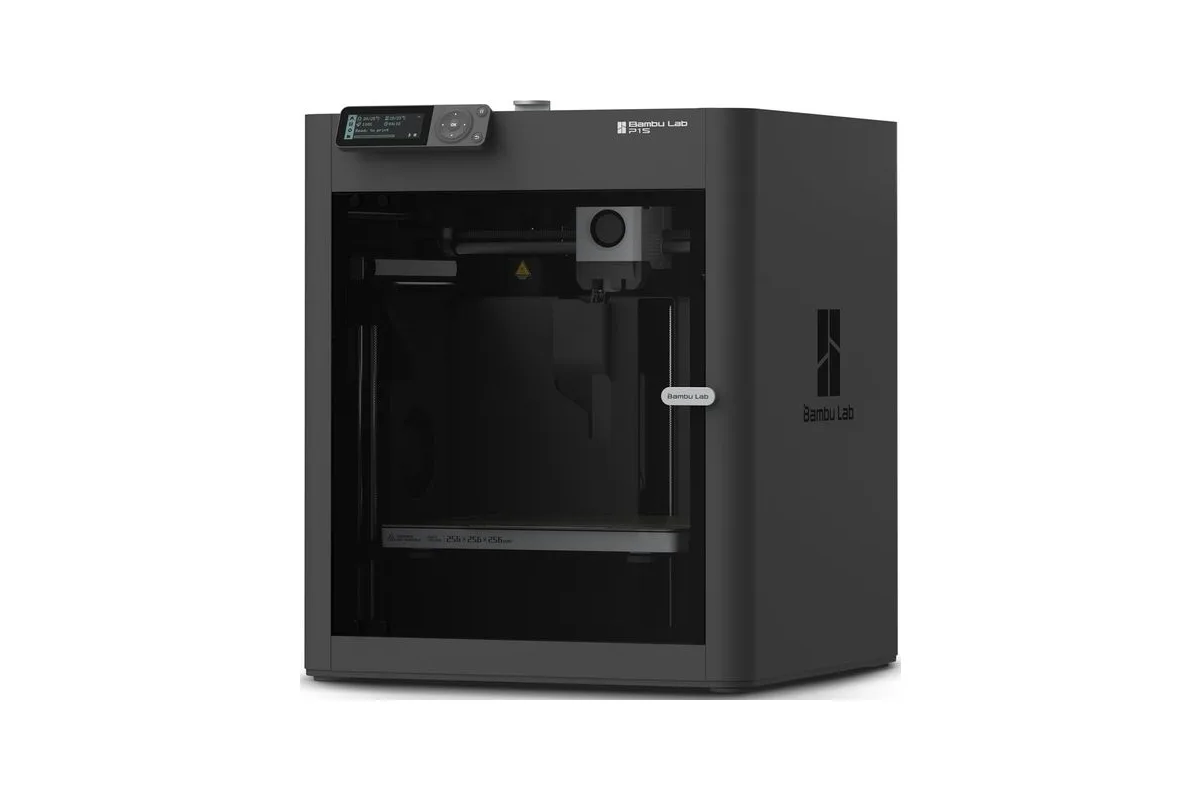
Work out what each print really costs, add your fees and shipping, then add the profit you want. For a 50 g PLA part that prints in 2.5 hours on a Bambu Lab P1S, filament, power, machine wear and a failure allowance come to about $1.33. Ten minutes of your time and a box bring it to $5.97. Sold on Etsy with free shipping, it breaks even at about $15.19 to $16.98, and makes $5 at about $20.72 to $22.51. All of these are our estimates; the inputs are below.
The cost per print, in order of size for a small part:
- Shipping, if you build it into the price: $7.33 to $8.95 for a small box.
- Labor: removing, checking, cleaning and packing.
- Marketplace fees: about 9.5% plus $0.45 a sale on Etsy.
- Packaging.
- Filament.
- Machine wear and failures.
- Electricity, about 1% of the cost.
Filament is the line everyone prices first, and it’s one of the smallest.
How much does filament cost per gram?
About 1 to 2.4 cents a gram for PLA in November 2026. Divide the price of a roll by its net weight; all of these are 1 kg rolls:
| Filament | Where | Price per kg | Per gram | 50 g part |
|---|---|---|---|---|
| Bambu Lab PLA Basic refill, 10+ rolls | Bambu | $9.74 | 0.97¢ | $0.49 |
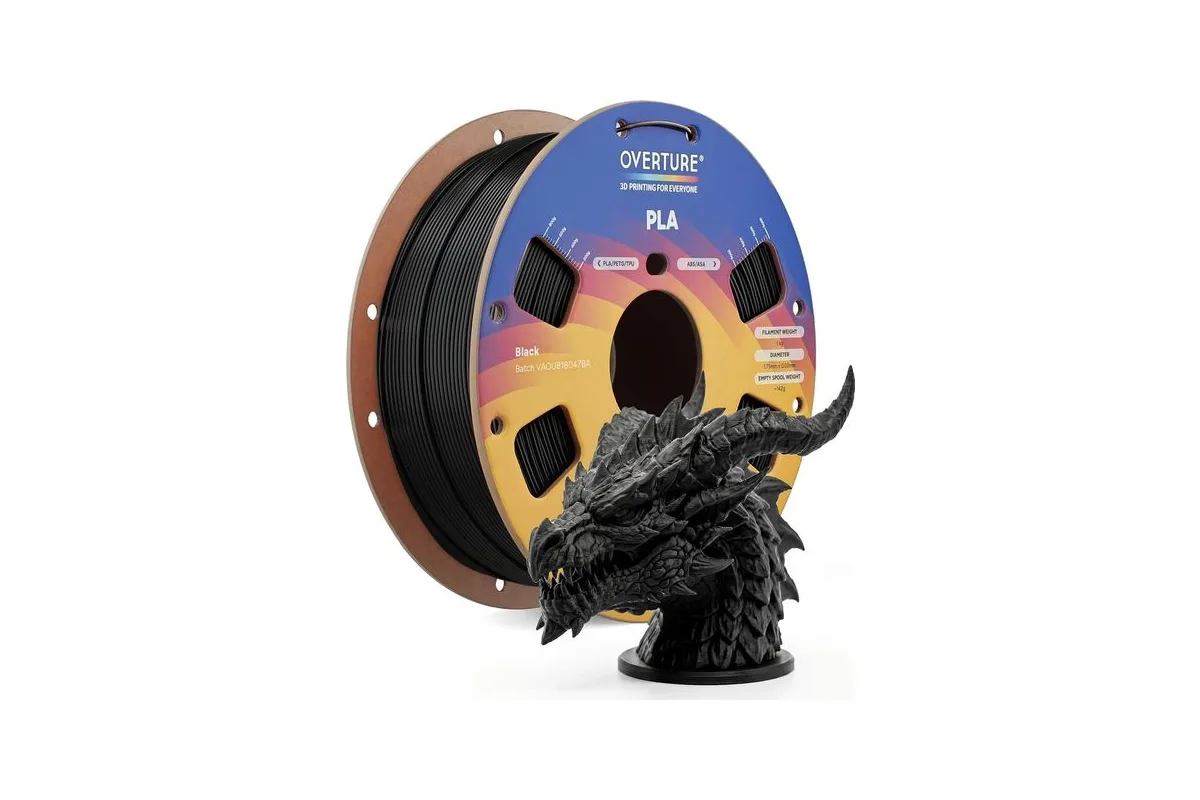
| Overture PLA refill, 10-pack | Overture | $10.00 | 1.00¢ | $0.50 |
| Overture PLA | Amazon | $11.88 | 1.19¢ | $0.59 |
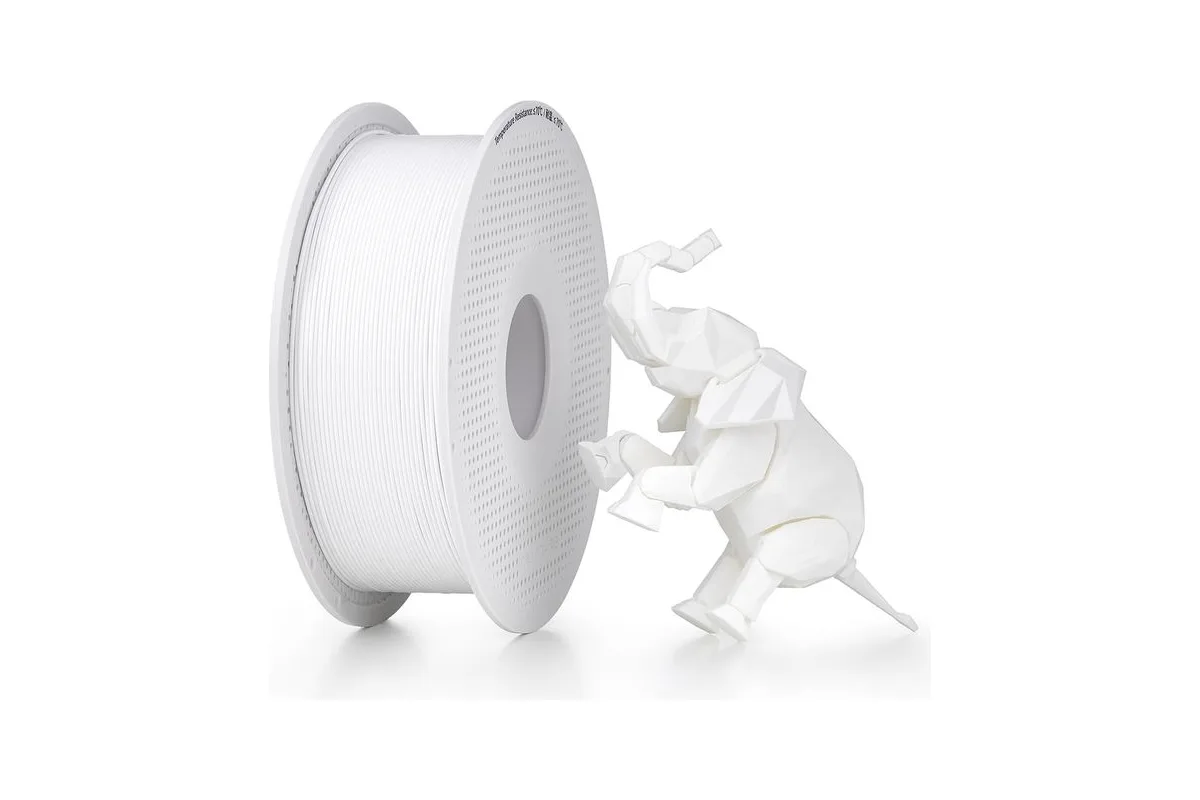
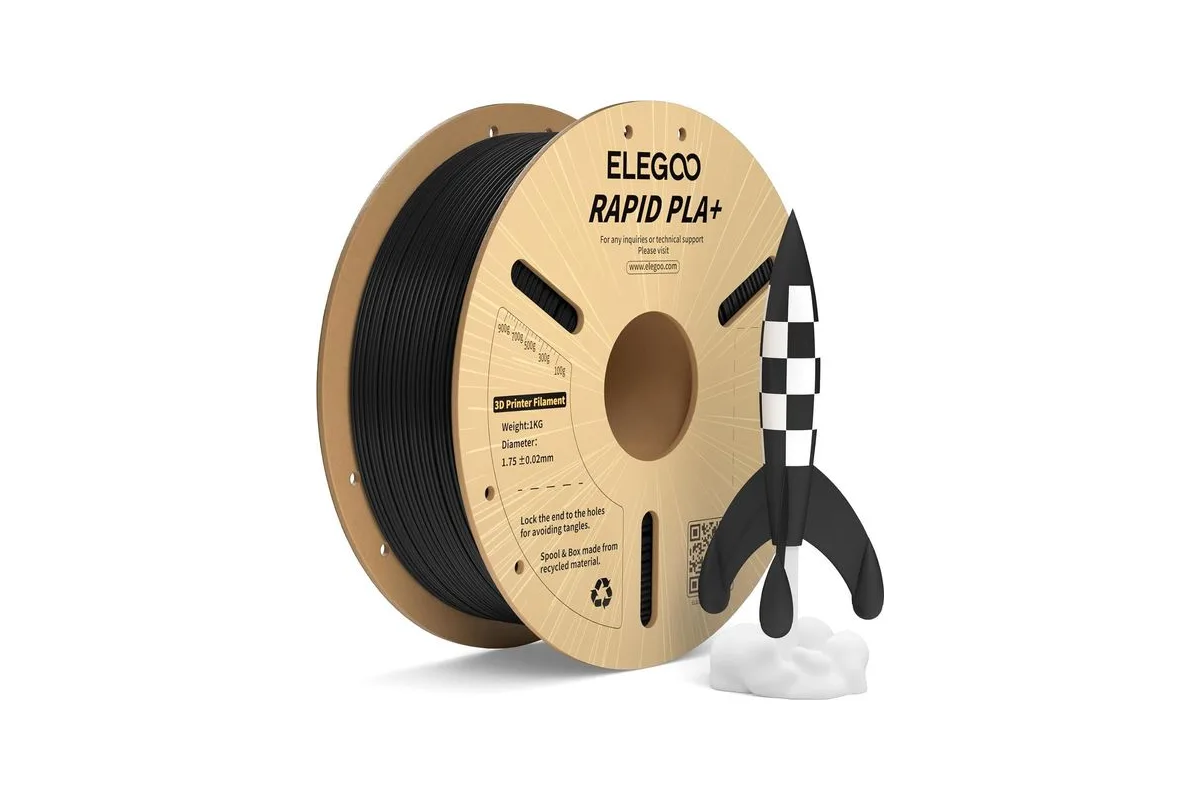
| Elegoo Rapid PLA+ | Amazon | $11.89 | 1.19¢ | $0.59 |
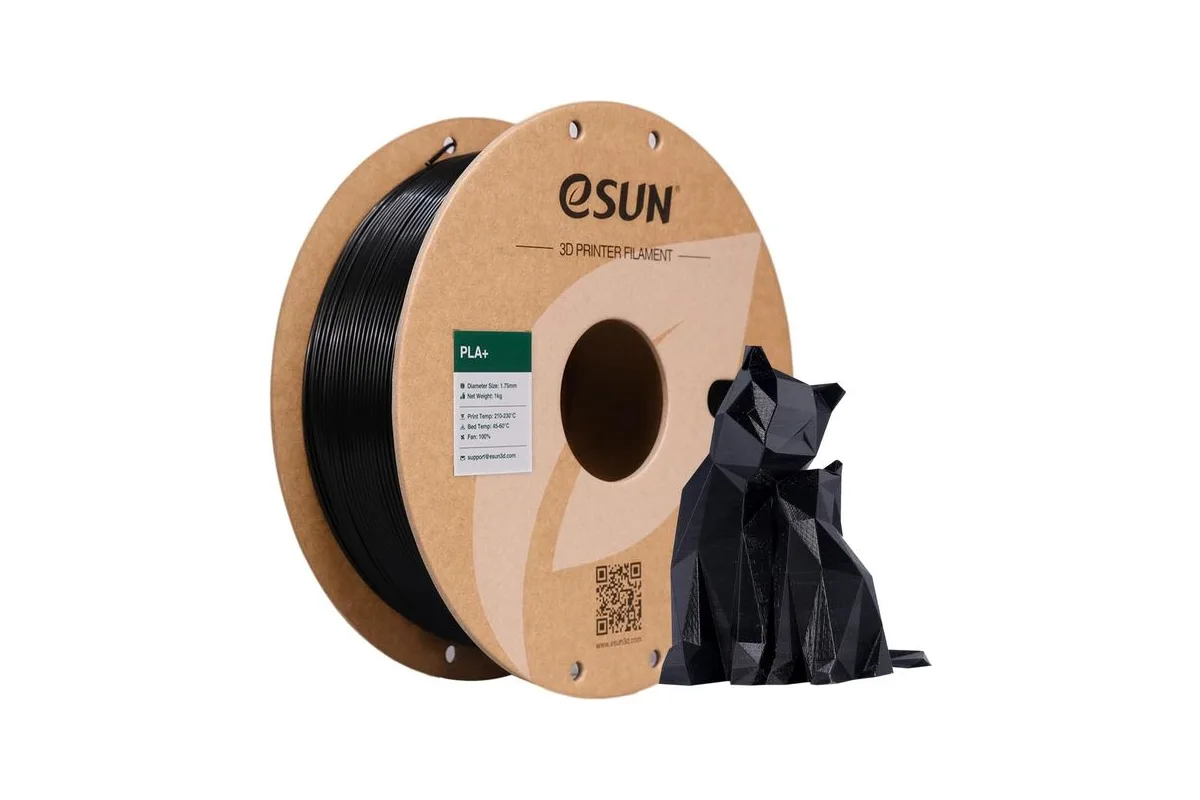
| eSun PLA+, 10+ rolls | eSun | $12.75 | 1.28¢ | $0.64 |
| Polymaker Panchroma Matte | Amazon | $13.56 | 1.36¢ | $0.68 |
| Bambu Lab PLA Basic refill, one roll | Bambu | $14.99 | 1.50¢ | $0.75 |
| eSun PLA+ | Amazon | $16.99 | 1.70¢ | $0.85 |
| Bambu Lab PLA Basic, with spool | Amazon | $20.99 | 2.10¢ | $1.05 |
| Hatchbox PLA | Amazon (third-party seller) | $22.99 | 2.30¢ | $1.15 |
| Prusament PLA | Prusa | $23.99 (list $29.99) | 2.40¢ | $1.20 |
Prices are Black Friday weekend prices, many of them on sale. Per-gram figures are our arithmetic. Bambu’s refills need a reusable spool, and Elegoo and eSun ship on cardboard spools.
Pricing rules of thumb that use 6 to 10 cents a gram for filament are four to eight times what most 1 kg rolls cost ($11.88 to $14.99), and up to ten times bulk prices. At 6 to 10 cents, a 50 g part is charged $3 to $5 for filament that costs $0.49 to $1.20. That isn’t wrong as a price, but it hides profit inside the material line, and it breaks the moment you quote a heavy print: a 300 g part would carry $18 to $30 of “filament” that costs $4.50. Price filament at what you pay, and put the profit where you can see it.
Other materials cost more per gram, on Amazon in November 2026:
| Filament | Price per kg | Per gram |
|---|---|---|
| Polymaker PETG | $12.47 | 1.25¢ |
| Polymaker TPU 95A | $19.49 | 1.95¢ |
| Polymaker ASA | $23.27 | 2.33¢ |
| Polymaker PA6-CF20 (carbon fiber nylon) | $52.99 | 5.30¢ |
Count waste too. Your slicer reports the grams of a print, but multicolor prints also purge filament at every color change, which can outweigh the model; see is a multicolor 3D printer worth it? and how much 3D printing costs. For material choices, see the best PLA filament.
What does an hour of printer time cost?
About 15 to 19 cents an hour for a $259 to $349 Bambu printer, by our estimate. Machine time has three parts:
- Depreciation: the printer’s price spread over its working hours. We use 3,000 productive hours, about a year at 8 hours a day: $349 ÷ 3,000 = $0.12 an hour on a P1S, $0.09 on a $259 A1. Prusa’s own published method recoups a printer over 6 months (4,392 hours), which would make it $0.08 an hour for a P1S.
- Wear parts: nozzles, build plates and belts. We allow $0.05 an hour. Prusa lists a replacement nozzle at about $20, lasting hundreds of print hours, and a print sheet at about $37; Bambu’s dual-texture PEI plate was $14.99 on sale ($24.99 typical).
- Electricity: Bambu rates the P1S at 105 W average for PLA and the A1 at 95 W. At the US average residential price of 18.17¢ per kWh (September 2026), that’s about 2 cents an hour.
That adds up to about $0.19 an hour on a P1S and $0.15 on an A1. Rules of thumb that charge $1 to $3 per machine hour are mostly profit, which is fine if you call it that. An operator of a 70-plus-printer farm profiled in Prusa’s farm guide targets $2 per print hour per machine and a 30% gross margin; that’s a useful profit target, not a cost.
Slicers help only partly. Bambu Studio has a filament price field, “for statistics only,” and no machine-time cost. OrcaSlicer adds a “Time cost” setting, “the printer cost per hour.” PrusaSlicer estimates cost from filament price per kg. None of them include labor, packaging, fees or shipping.
How do you account for failed prints?
Add a percentage to the cost of machine time and material. We use 10%, which matches the 90% to 95% success rate reported in Prusa’s farm guide. Prusa’s own cost method adds a flat 30% of material cost “for failed prints, filament loss, and maintenance,” and recommends tracking your real failure rate. Once you know yours, use it.
Worked example: a 50 g PLA part, 2.5 hours on a P1S
Our assumptions: filament at $14.99/kg (one Bambu refill), a $349 P1S over 3,000 hours, $0.05 an hour for wear parts, 10% for failures, 10 minutes of labor at $20 an hour, and $1.30 of packaging (a $1.05 Uline 6 x 4 x 4 box plus $0.25 for filler and a label).
| Line | Calculation | Cost |
|---|---|---|
| Filament | 50 g × $0.01499 | $0.75 |
| Electricity | 0.105 kW × 2.5 h × $0.1817 | $0.05 |
| Machine depreciation | $349 ÷ 3,000 h × 2.5 h | $0.29 |
| Wear parts | $0.05 × 2.5 h | $0.13 |
| Failure allowance | 10% of the lines above | $0.12 |
| Production cost | $1.33 | |
| Labor | 10 minutes at $20/h | $3.33 |
| Packaging | $1.30 | |
| All-in cost before fees and shipping | $5.97 |
Labor is more than half the cost, filament about an eighth, and electricity about 1%. The same part on an A1 ($259, 95 W) costs $5.88; with $9.74/kg bulk filament on the P1S, $5.68.
Labor is also the line you can shrink. If one 10-minute session covers a plate of four parts, labor drops to $0.83 a part and the all-in cost to about $3.47 (our estimate).
Selling it on Etsy with free shipping (USPS Ground Advantage commercial rates for a package under 1 lb: $7.33 to the nearest zones, $8.95 to the farthest; no Offsite Ad):
| Price | Result per order |
|---|---|
| $15.00 | Loses $0.18 to $1.80 |
| $15.19 to $16.98 | Breaks even |
| $20.72 to $22.51 | $5 profit, about $2 per print hour |
Worked example: a 300 g PLA part, 12 hours on a P1S
Our assumptions: 12 hours of print time (use your slicer’s estimate), 15 minutes of labor, $2.00 of packaging for a larger box, everything else as above.
| Line | Calculation | Cost |
|---|---|---|
| Filament | 300 g × $0.01499 | $4.50 |
| Electricity | 0.105 kW × 12 h × $0.1817 | $0.23 |
| Machine depreciation | $349 ÷ 3,000 h × 12 h | $1.40 |
| Wear parts | $0.05 × 12 h | $0.60 |
| Failure allowance | 10% | $0.67 |
| Production cost | $7.39 | |
| Labor | 15 minutes at $20/h | $5.00 |
| Packaging | $2.00 | |
| All-in cost | $14.39 |
With $9.74/kg bulk filament, $12.66. Sold at $40 with free shipping (1 lb USPS commercial, $8.01 to $11.22), Etsy’s fees are $4.25 and the profit is $10.14 to $13.35. If the order came through a 15% Etsy Offsite Ad, profit falls to $4.14 to $7.35. At 12 hours of printer time, even the best case is about $1.11 per print hour, under the $2 target, so a part like this needs a higher price or a faster print.
How do marketplace fees and shipping change the price?
They’re the reason small prints are hard to sell profitably. Etsy charges $0.20 per listing, 6.5% of the item price plus shipping, and 3% + $0.25 for payment processing. The break-even formula we used:
Break-even price = (all-in cost + shipping + $0.45) ÷ (1 − 0.095)
The $0.45 is the listing fee plus the fixed part of processing, and 0.095 is the 6.5% and 3% together. Two more things to know:
- Charging shipping separately doesn’t avoid fees. Both percentages apply to shipping too: a $15 item with $5 shipping pays $2.35 in fees on $20.
- Offsite Ads take 15% of an order that came from one (12% for shops over $10,000 a year, capped at $100 an order). Shops under $10,000 can opt out; above it, they can’t. Build at least part of that into your price if you’re in.
The full fee table and what you keep on $15 and $40 sales are in how to sell 3D prints on Etsy. USPS prices are the commercial rates in effect from October 4, 2026; Etsy sells its own labels, so your rate may differ.
Should you price by cost or by what buyers pay?
Cost sets your floor; the market sets the ceiling. Look at what similar items sell for before you design one. On Etsy’s first page for “3d printed” during the Cyber Week sale, personalized keychains started at about $2, photo-based figurines and car replicas ran $39.99 to $68.40, and lamps about $60. If the going price for an item is below your break-even, the answer isn’t to price lower; it’s to make it faster, batch more per plate, sell it in a set, or make something else.
A quick check for any product: profit per hour of printer time. Dividing the profit by print hours shows which items earn their place in the queue.
Questions people ask
What is a good price per gram for 3D prints?
There isn’t one, because filament is a small part of the cost. Filament itself costs about 1 to 2.4 cents a gram for PLA in November 2026. Price the whole print: labor, packaging, fees and shipping usually cost more than the plastic.
How much should I charge per hour for 3D printing?
The printer itself costs about 15 to 19 cents an hour to run and wear out, by our estimate. A farm operator in Prusa’s farm guide targets $2 of profit per print hour per machine, which is a reasonable goal for products you sell repeatedly.
How much should I charge for a custom 3D print?
Use the same method, and add your design time at your own hourly rate, since a one-off print carries all of its setup. The labor line in the examples, $20 an hour, is our assumption; use what your time is worth.
Can I use my slicer to price prints?
Partly. Enter your filament price in Bambu Studio, PrusaSlicer or OrcaSlicer, and OrcaSlicer also takes a cost per printer hour. None of them add labor, packaging, fees or shipping, so finish the price in a spreadsheet. See the best 3D printing slicer.
How much does electricity add to a 3D print?
About 2 cents an hour on a Bambu P1S or A1 at the US average of 18.17¢ per kWh, or about 5 cents for a 2.5-hour print. A P2S at 200 W uses about twice that.
Why do small 3D prints lose money?
Fixed costs. Every order carries labor, a box, $0.45 of Etsy’s fixed fees and $7 or more of shipping, whether the print weighs 10 g or 300 g. A $15 print with free shipping loses money in our example; bundling items or raising the price fixes it.
Sources
- Prusa blog: how to calculate printing costs, blog.prusa3d.com
- Prusa: how to build a 3D printing farm, pro.prusa3d.com
- Prusa CORE One (running costs), prusa3d.com
- OrcaSlicer source: filament_cost and time_cost settings, github.com
- Bambu Studio source: filament_cost setting, github.com
- Bambu Lab PLA Basic, us.store.bambulab.com
- Bambu Lab US store, us.store.bambulab.com
- Bambu Lab P1S, us.store.bambulab.com
- Bambu Lab A1, us.store.bambulab.com
- Bambu Lab wiki: power consumption, wiki.bambulab.com
- EIA Electric Power Monthly, Table 5.6.A, eia.gov
- Polymaker store, shop.polymaker.com
- Prusament PLA, prusa3d.com
- Uline 6 x 4 x 4 corrugated boxes, uline.com
- USPS Notice 123 (price list), pe.usps.com
- Etsy Fees & Payments Policy, etsy.com
- Etsy Payments Policy, etsy.com
- Etsy search: 3d printed, etsy.com
Keep exploring

How to
Hardened steel vs brass nozzles, and what nozzle size to use
Brass, or the stainless steel Bambu ships on the A1, is fine for PLA, PETG, ABS, ASA and TPU. Carbon fiber, glass fiber, glow-in-the-dark and sparkle filaments need hardened steel. Use a 0.4 mm nozzle for most prints, 0.6 mm for carbon fiber and big parts, and 0.2 mm for miniatures.
Read story
How to
Can you 3D scan with an iPhone? Yes, but not to tight tolerances
Yes. Any current iPhone can 3D scan objects from photos (photogrammetry), and KIRI Engine's free tier exports STL for printing. Only the iPhone 18 Pro and 18 Pro Max have LiDAR in Apple's current lineup. For parts that must fit, a $359 scanner is about ten times tighter.
Read story