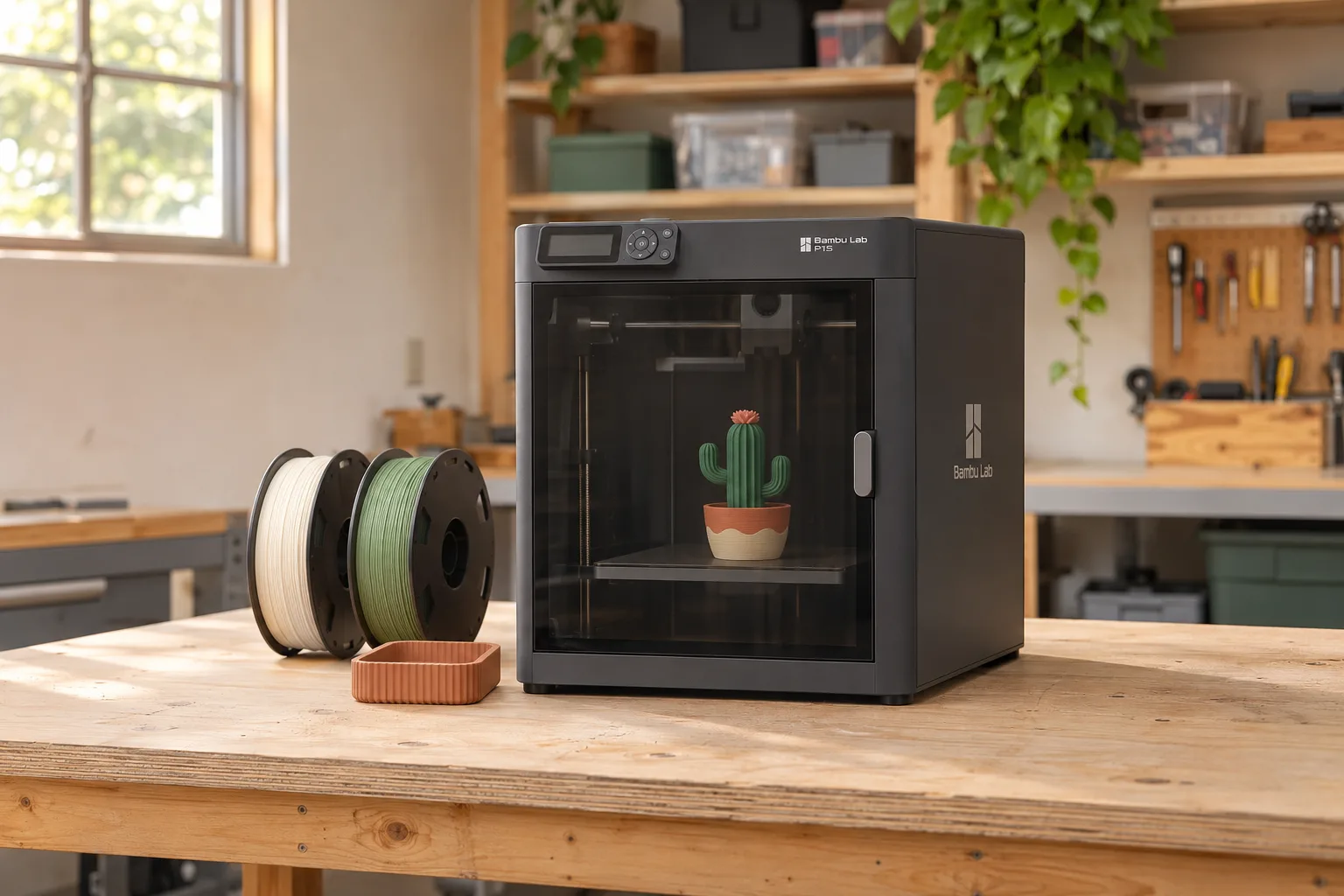
How it scores
- Print quality20%8.5
Enclosed CoreXY with Bambu's tuned profiles; Bambu rates PLA, PETG, TPU, ABS and ASA as ideal. The 0.4 mm stainless nozzle keeps it off carbon- and glass-fiber blends without an upgrade.
- Setup and ease of use20%8.0
Automatic bed leveling and Bambu's slicer and app make setup easy, but the 2.7-inch non-touch screen and 0.5 fps camera are basic, and nozzle changes mean swapping the whole hotend.
- Speed10%8.5
CoreXY at up to 500 mm/s and 20,000 mm/s² (Bambu), quick for most home prints, though the P2S and X2D are rated faster.
- Features and materials20%7.0
Enclosure, 256 mm build volume and up to 16 colors with four AMS units, but a passive chamber, 100 °C bed, carbon filter only, low-rate camera and no Ethernet.
- Reliability and ownership20%7.0
A mature design on sale since 2023, a 24-month warranty from Bambu's store and optional cloud, but feature updates end July 13, 2028, the soonest of any current Bambu.
- Value and running costs10%8.0
$349 in November 2026, about $20.80 per liter of build volume (our estimate), the lowest of any enclosed Bambu. Multicolor printing still purges filament at every swap.
Overall 7.8/10, the weighted average.How we score →
Is the Bambu Lab P1S still worth buying?
Yes, if you want the cheapest enclosed Bambu printer. The P1S cost $349 at Bambu’s US store in November 2026 (typical price $399). For that you get an enclosed CoreXY printer with a 256 mm build volume that prints ABS and ASA, plus Bambu’s easy slicer and the option to add AMS units for multicolor.
For most people, though, the P2S is the better buy at $449. It adds a 5-inch touchscreen, a 1080p camera, a hardened quick-swap nozzle and a 110 °C bed. It will also get bug and feature updates until October 14, 2030. The P1S’s feature updates end July 13, 2028, so you’d be buying a printer with about a year and a half of feature updates left (our estimate, from November 28, 2026). Security patches continue to July 13, 2030.
Buy the P1S if $100 matters, you print mainly PLA, PETG, ABS and ASA, and you can live with a basic screen and camera.
| Spec | Bambu Lab P1S |
|---|---|
| Price (Bambu US store, Nov 2026) | Printer $349 (typical $399); AMS Combo $479 ($549); AMS 2 Pro Combo $509 ($579) |
| Status | Still sold; Bambu has “no plans” to stop selling it |
| Type | Enclosed CoreXY (plastic and glass) |
| Build volume | 256 × 256 × 256 mm (16.8 liters, our estimate) |
| Max nozzle / bed | 300 °C / 100 °C |
| Chamber | Enclosed, no active heating; closed-loop chamber fan |
| Nozzle | 0.4 mm stainless steel, all-metal hotend |
| Speed | Up to 500 mm/s, 20,000 mm/s² |
| Colors | 1, or up to 16 with four AMS units |
| Camera / screen | 1280 × 720 at 0.5 fps / 2.7-inch 192 × 64, not touch |
| Filtration | Activated carbon |
| Power | 105 W average on PLA; 350 W max at 110 V |
| Size / weight | 389 × 389 × 458 mm / 12.95 kg |
| Updates | Bug and feature fixes to Jul 13, 2028; security to Jul 13, 2030 |
| Warranty | 24 months when bought from Bambu’s US or Canada store |
Source: Bambu’s US store, compare page, power-consumption page and AMS guide, read November 28, 2026. Black Friday prices end December 1, 2026, at 2:00 AM ET.
Is the P1S discontinued?
No. The P1S is still on Bambu’s US store in three configurations. Asked in its P2S FAQ whether the P1S will stop being sold, Bambu says “There are no plans for that at the moment.” Firmware is still coming: release 01.10.00.00 (March 30, 2026) added multicolor printing from external spools plus security patches.
Two of its siblings are gone:
- X1 Carbon (X1C): end of life on March 31, 2026, and no longer sold on Bambu’s US store. It gets bug fixes and features until May 31, 2027, security patches until May 31, 2029, and parts and support until March 31, 2031. Bambu calls the X2D “X1C’s next chapter.”
- P1P: the open-frame P1, discontinued February 10, 2026.
A refurbished X1C was $636.99 at Micro Center on November 28. That’s more than a new X2D ($589), which gets updates until 2031, so we wouldn’t buy the old flagship now.
Which P1S bundle should you buy?
| Bundle (Bambu, Nov 2026) | Price | Typical | What’s in it | Per liter (our estimate) |
|---|---|---|---|---|
| P1S | $349 | $399 | Printer | $20.80 |
| P1S AMS Combo | $479 | $549 | Printer + first-generation AMS (4 slots, no drying) | $28.55 |
| P1S AMS 2 Pro Combo | $509 | $579 | Printer + AMS 2 Pro (4 slots, with drying) | $30.34 |
Per-liter figures divide the price by the 16.8-liter build volume.
The AMS 2 Pro Combo is worth the extra $30 over the original AMS if you print moisture-sensitive filament like PETG, TPU or nylon, because it dries spools. On the P1S, drying needs a separate power adapter for each AMS 2 Pro, according to Bambu’s AMS guide.
On Amazon the P1S was also $349, and the P1S Combo with the original AMS was $479. Bambu’s 2-year US warranty covers only printers bought from Bambu’s own US and Canada stores, so a store purchase gets the longer cover. Micro Center had a refurbished P1S at $339.99, only $10 less than new.
How good are the prints?
Very good for the price. Bambu’s tuned profiles and automatic bed leveling give clean PLA and PETG prints without tinkering, and the closed chamber keeps ABS and ASA from warping and cracking the way they do on open-frame printers. Bambu lists PLA, PETG, TPU, PVA, PET, ABS and ASA as “ideal” and PA and PC as “capable”.
The limit is abrasive filament. Bambu doesn’t recommend carbon- or glass-fiber blends on the P1S “before an extruder and hotend upgrade is done”, because the stock nozzle is stainless steel. The P2S ships with a hardened-steel nozzle instead.
What are the P1S’s weak points?
- Dated controls. The 2.7-inch screen isn’t a touchscreen, and the camera records 1280 × 720 at 0.5 frames per second. That’s fine for time-lapses, poor for watching a print live.
- Nozzle changes. You swap the whole hotend rather than just the nozzle, which is slower than the P2S’s one-clip quick swap.
- No active chamber heat, no Ethernet. It holds heat passively, which is enough for ABS and ASA; Bambu rates nylon (PA) and PC only “capable”.
- Multicolor waste. Like every single-nozzle printer, it purges filament at every color change. Bambu publishes no grams-per-change figure. If you print multicolor often, see is a multicolor 3D printer worth it?
- Noise. Bambu publishes no noise figure for the P1S. It rates the P2S under 50 dB in silent mode; for a quiet room, see the best quiet 3D printers.
How long will Bambu support the P1S?
Bambu now publishes update dates for every model. Each current printer gets about five years of bug and feature updates and seven years of security patches from its launch date (our reading of Bambu’s compare page). The P1S launched July 13, 2023, so its window closes first.
| Model | Price (Nov 2026) | Bug and feature updates until | Security patches until |
|---|---|---|---|
| X1C (discontinued) | Not sold by Bambu US | May 31, 2027 | May 31, 2029 |
| P1S | $349 | Jul 13, 2028 | Jul 13, 2030 |
| P2S | $449 | Oct 14, 2030 | Oct 14, 2032 |
| X2D | $589 | Apr 14, 2031 | Apr 14, 2033 |
After the feature cutoff the printer keeps working; it just stops getting new features and bug fixes. If you plan to keep a printer five years or more, the P2S’s extra 27 months of updates (our estimate) are part of what the $100 buys.
P1S or P2S?
The P2S for most buyers. Here’s the short version; the full breakdown is in P1S vs P2S.
| Bambu P1S | Bambu P2S | |
|---|---|---|
| Printer only | $349 | $449 |
| With AMS 2 Pro | $509 | $649 |
| Screen | 2.7-inch, not touch | 5-inch touchscreen |
| Camera | 720p at 0.5 fps | 1080p at 30 fps |
| Nozzle | Stainless, whole-hotend swap | Hardened steel, quick swap |
| Bed | 100 °C | 110 °C |
| Max colors | 16 | 20 |
| PLA power draw | 105 W | 200 W |
| Updates until | Jul 2028 | Oct 2030 |
Bambu says a P1S can’t be upgraded into a P2S: the frame, mainboard, toolhead, screen and airflow were all redesigned.
What does it cost to run?
Not much. Bambu measures the P1S at 105 W on average printing PLA, about half the P2S’s 200 W. At the US average of 18.17¢ per kWh, a 4-hour PLA print costs about 7.6¢ in electricity (our estimate: 105 W × 4 h = 0.42 kWh). Filament is the real cost; see how much does 3D printing cost?
Warranty, cloud and offline use
- Warranty: 24 months when bought from Bambu’s US or Canada store. On the warranty tables Bambu publishes for the P2S, X2D and H2 series, the hotend is a wear part with no warranty. Returns are 30 days from Bambu’s store.
- Offline: the P1S prints from a microSD card or over your network in LAN Only mode without the cloud. In LAN Only mode you lose remote printing from outside your network, the Bambu Handy app and print history. See can you use a Bambu Lab printer offline?
Should you buy the Bambu Lab P1S?
Buy the P1S at $349 if you want an enclosed printer for ABS and ASA on the smallest budget, or a second printer for a small print farm. Buy the P2S ($449, or $649 as a Combo) if you want a printer you’ll keep for years. If you’ll print only PLA, the open-frame A1 at $259 is cheaper; see A1 vs P1S. For the whole range, see the Bambu Lab lineup explained and the best enclosed 3D printers.
Questions people ask
Is the Bambu Lab P1S being discontinued?
Not as of November 2026. Bambu says it has no plans to stop selling it, and it gets bug and feature updates until July 13, 2028.
Is the P1S still good in 2026?
Yes, as a budget enclosed printer at $349. It prints well, but its screen, camera and nozzle system are a generation behind the P2S.
Can the P1S print carbon fiber?
Not with the stock nozzle. Bambu doesn’t recommend carbon- or glass-fiber filament until the extruder and hotend are upgraded.
Is the P1S AMS Combo or AMS 2 Pro Combo better?
The AMS 2 Pro Combo ($509) for $30 more, because the AMS 2 Pro dries filament. On the P1S it needs a separate power adapter to dry.
How many colors can the P1S print?
Four with one AMS, and up to 16 with four AMS units.
Should I buy a used X1 Carbon instead of a P1S?
Probably not. The X1C was discontinued March 31, 2026, and its feature updates end May 31, 2027. A refurbished X1C cost more than a new X2D in November 2026.
Key specifications
| Feature | Bambu LabP1S | Bambu LabP2S Combo |
|---|---|---|
| Frame | Enclosed CoreXY | Enclosed CoreXY |
| Build volume | 256 x 256 x 256 mm | 256 x 256 x 256 mm |
| Multicolor | Optional (AMS or AMS 2 Pro) | 4 colors (AMS 2 Pro), expandable |
| Materials | PLA, PETG, TPU, ABS, ASA | PLA, PETG, TPU, ABS, ASA, CF blends |
| Where to buy | Check price at Amazon | Check price at Amazon |
Bambu Lab P1S
- Frame
- Enclosed CoreXY
- Build volume
- 256 x 256 x 256 mm
- Multicolor
- Optional (AMS or AMS 2 Pro)
- Materials
- PLA, PETG, TPU, ABS, ASA
Bambu Lab P2S Combo
- Frame
- Enclosed CoreXY
- Build volume
- 256 x 256 x 256 mm
- Multicolor
- 4 colors (AMS 2 Pro), expandable
- Materials
- PLA, PETG, TPU, ABS, ASA, CF blends
Sources
- Bambu Lab P1S product page and FAQ, us.store.bambulab.com
- Bambu Lab P1 series overview, bambulab.com
- Bambu Lab P2S product page and FAQ, us.store.bambulab.com
- Bambu Lab printer comparison (software update support), bambulab.com
- Bambu Lab: the X1 series is EOL, blog.bambulab.com
- Bambu Lab: meet the P2S, blog.bambulab.com
- Bambu Lab P1 firmware release history, wiki.bambulab.com
- Bambu Lab printer power consumption, wiki.bambulab.com
- Bambu Lab multi-AMS compatibility guide, wiki.bambulab.com
- Bambu Lab LAN Only mode guide, wiki.bambulab.com
- Bambu Lab warranty policy, bambulab.com
- Bambu Lab: P1P end of life, forum.bambulab.com
- Micro Center Bambu Lab listings, microcenter.com
- Amazon: Bambu Lab P1S, amazon.com
Keep exploring

How to
Hardened steel vs brass nozzles, and what nozzle size to use
Brass, or the stainless steel Bambu ships on the A1, is fine for PLA, PETG, ABS, ASA and TPU. Carbon fiber, glass fiber, glow-in-the-dark and sparkle filaments need hardened steel. Use a 0.4 mm nozzle for most prints, 0.6 mm for carbon fiber and big parts, and 0.2 mm for miniatures.
Read story
How to
Can you 3D scan with an iPhone? Yes, but not to tight tolerances
Yes. Any current iPhone can 3D scan objects from photos (photogrammetry), and KIRI Engine's free tier exports STL for printing. Only the iPhone 18 Pro and 18 Pro Max have LiDAR in Apple's current lineup. For parts that must fit, a $359 scanner is about ten times tighter.
Read story