Printers in this guide
PLA or PETG: which should you use?
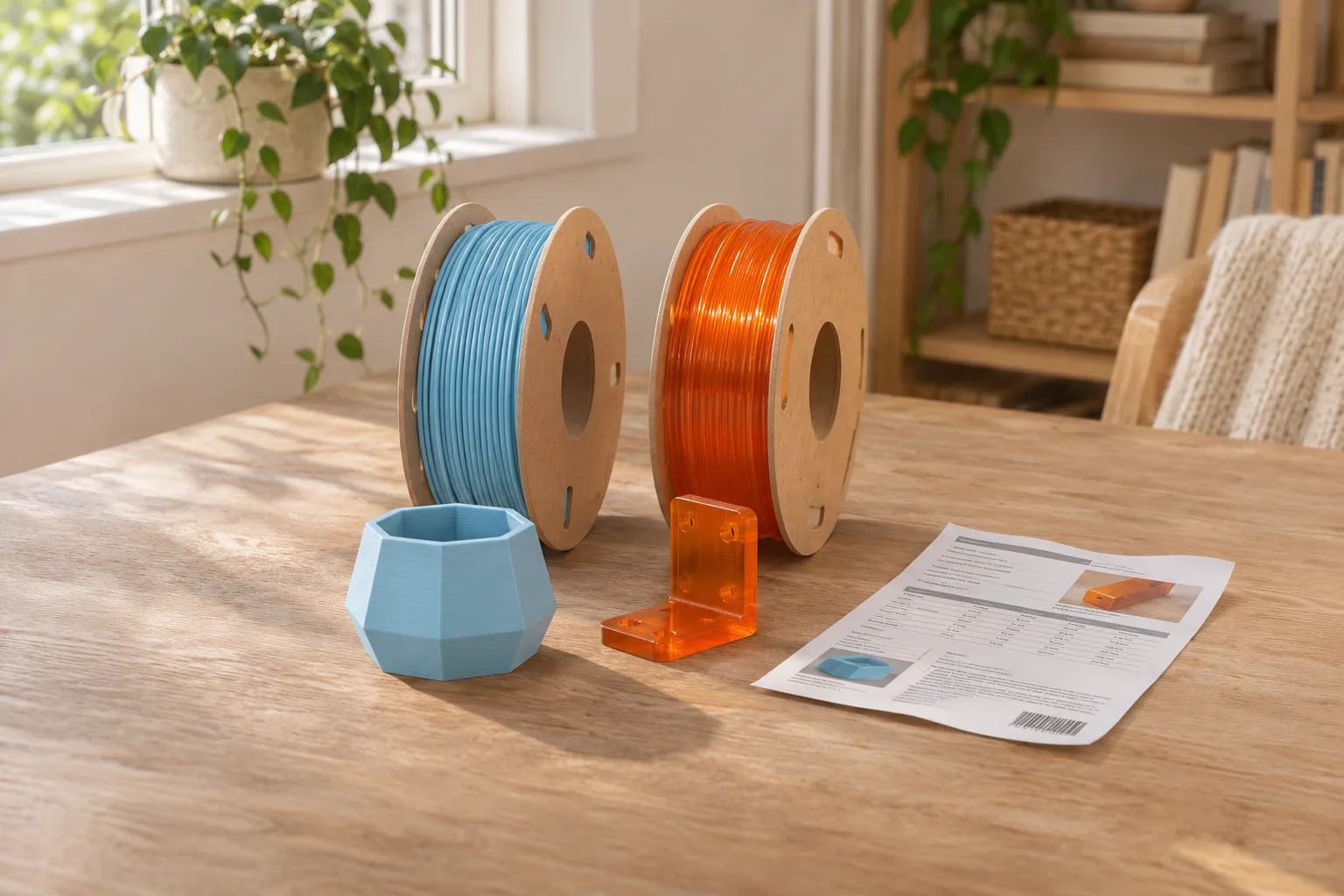
Use PLA for most prints, and PETG when the part has to be tough or survive heat. PLA is the easiest filament to print: it prints at lower temperatures, barely warps, needs no enclosure and gives off the fewest emissions of the common filaments. PETG is stronger and more flexible, resists heat and water better, and is better for functional parts, but it strings more, sticks harder to the bed and needs drying.
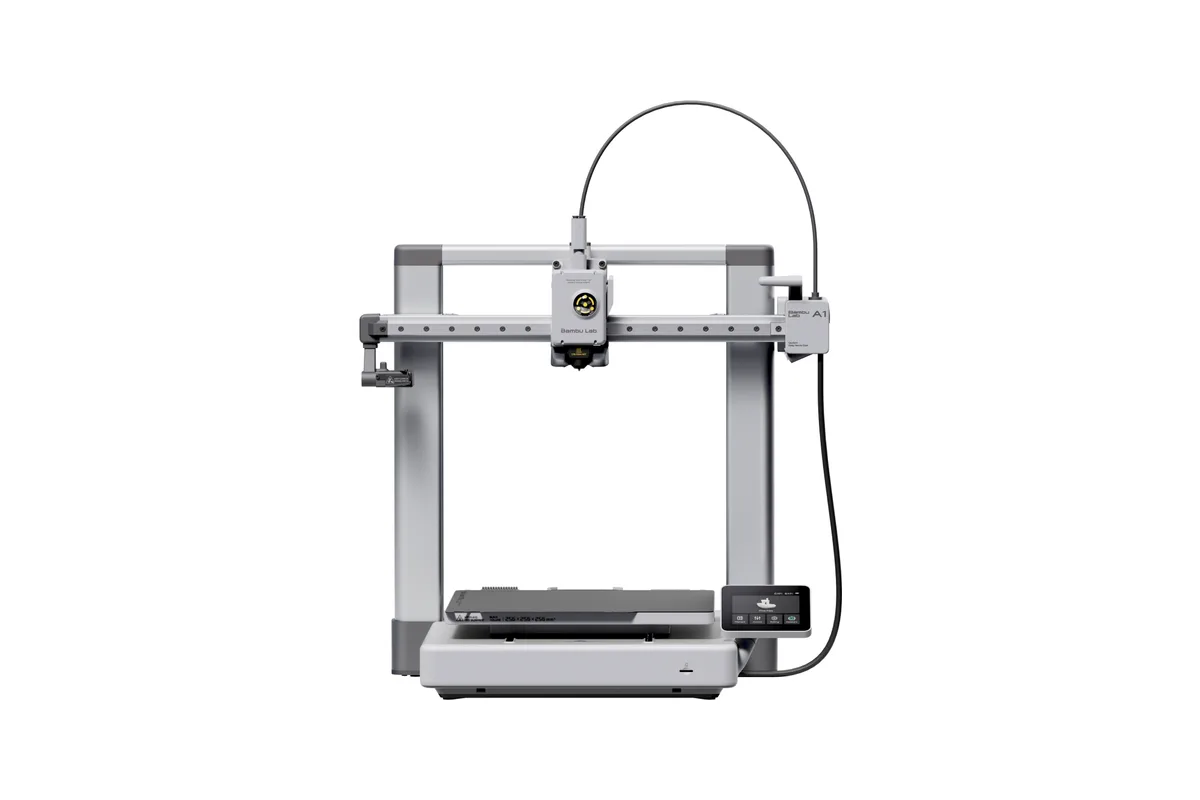
Both print on any current printer, including open-frame models like the Bambu Lab A1, and both cost about the same, roughly $10 to $24 a kilogram.
PLA vs PETG at a glance
| PLA | PETG | |
|---|---|---|
| Ease of printing | Easiest | Easy, with more stringing |
| Nozzle temperature (Bambu) | 190–240 °C | 230–260 °C |
| Enclosure needed | No | No |
| Heat resistance | Softens around 50 °C | Higher; better for warm places |
| Strength | Stiff but brittle | Tougher, slightly flexible |
| Moisture | Low sensitivity | Highly hygroscopic; dry before use |
| Emissions | Lowest of the common filaments | Low |
| Finish | Matte or glossy, crisp detail | Glossy, can be translucent |
| Best for | Models, toys, prototypes, decor | Functional parts, outdoor and car use, food-adjacent containers |
Temperatures from Bambu’s filament guide. Bambu says PLA isn’t recommended at about 50 °C or above, where it may soften and deform.
When should you use PLA?
For almost everything you’ll print as a beginner: figures, toys, organizers, cosplay pieces, planters, prototypes and gifts. PLA prints with crisp detail, comes in the most colors and finishes (matte, silk, wood-fill, glow), and is the most forgiving of temperature and cooling. It’s also the best choice indoors, because it gives off the fewest particles and fumes of the common filaments.
Its weakness is heat. A PLA part left in a car on a sunny day, near a radiator or in a dishwasher will soften and warp.
When should you use PETG?
For parts that have to work: brackets, hooks, clips, outdoor fixtures, phone mounts for the car, and anything that takes impacts or gets wet. PETG bends before it breaks, handles more heat and is more resistant to water and many chemicals.
It’s a little harder to print. It strings more between parts, can bond so strongly to smooth build plates that it tears the surface (use a textured plate or glue stick as a release agent), and absorbs moisture from the air, which causes bubbling and stringing.
Do you need to dry filament?
For PLA in normal humidity, usually not; for PETG and TPU, yes. Prusa says PLA barely changes properties when it absorbs humidity, while TPU and nylon need drying more often. Bambu calls PETG highly hygroscopic and recommends storing it airtight with desiccant. The makers’ drying settings:
| Material | Bambu | Prusa |
|---|---|---|
| PLA | 50 °C for 8 h (forced-air oven) | 45 °C for 6 h |
| PETG | 60–65 °C for 8 h | 55 °C for 6 h |
| TPU | Dry before use | 60 °C for 4–6 h |
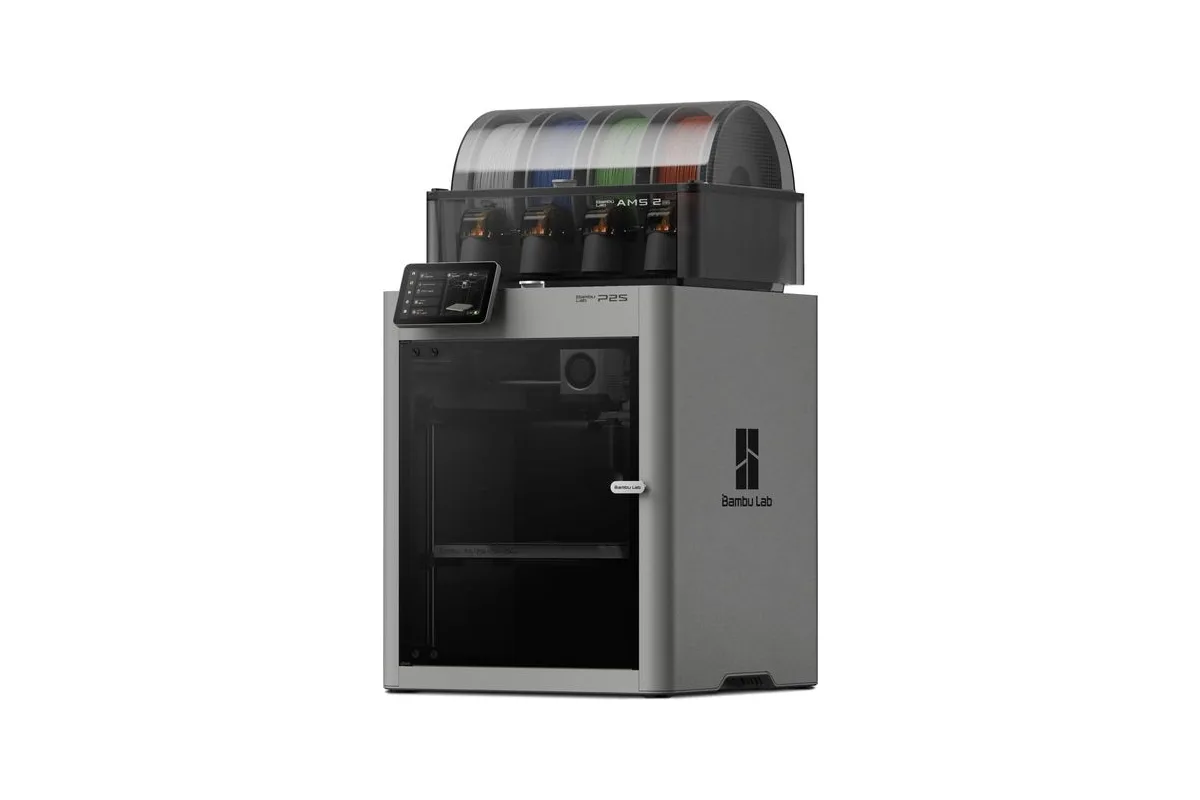
Bambu says not to dry filament in a microwave or kitchen oven. A dedicated filament dryer, or a filament box that dries, such as Bambu’s AMS 2 Pro, is the easy option.
What filament should a beginner use?
PLA. Start with a 1 kg spool of a well-known brand, such as Bambu PLA Basic, Elegoo PLA or Polymaker, in a light color, which shows detail best. Once your prints are reliable, try PETG for functional parts. Leave ABS and ASA, which need an enclosure and give off more fumes, until you have an enclosed printer; see the best enclosed 3D printers.
What about ABS, ASA and TPU?
- ABS and ASA: tougher and more heat-resistant than PETG, and ASA resists UV for outdoor parts. Both warp without an enclosure and emit more particles and fumes than PLA. Bambu marks ABS as not recommended on open-frame printers.
- TPU: flexible, rubbery filament for phone cases, gaskets and wheels. Print it slowly with a direct-drive extruder; Bambu says it isn’t compatible with the AMS.
Questions people ask
Is PETG stronger than PLA?
PETG is tougher: it bends and absorbs impacts where PLA snaps. PLA is stiffer, so it holds shape well under light loads.
Is PETG food safe?
PETG is used for food packaging, but a 3D print’s layer lines trap bacteria, and nozzles and colorants may not be food-safe. Don’t rely on any home 3D print for repeated food contact.
Can PLA go outside?
Not for long in the sun. PLA softens at about 50 °C, which a dark part in direct sun can reach. Use PETG or ASA for outdoor parts.
Do I need an enclosure for PETG?
No. PETG prints well on open printers. ABS and ASA need an enclosure.
Which is cheaper, PLA or PETG?
They cost about the same: roughly $10 to $24 a kilogram for both, depending on the brand. See how much does 3D printing cost?
Sources
- Bambu Lab filament guide: material table, wiki.bambulab.com
- Bambu Lab: PLA, wiki.bambulab.com
- Bambu Lab: PETG, wiki.bambulab.com
- Bambu Lab PLA Basic technical data sheet, wiki.bambulab.com
- Prusa: drying filament, help.prusa3d.com
- UL Chemical Insights: 3D printing safety tips, chemicalinsights.ul.org
Keep exploring

How to
Hardened steel vs brass nozzles, and what nozzle size to use
Brass, or the stainless steel Bambu ships on the A1, is fine for PLA, PETG, ABS, ASA and TPU. Carbon fiber, glass fiber, glow-in-the-dark and sparkle filaments need hardened steel. Use a 0.4 mm nozzle for most prints, 0.6 mm for carbon fiber and big parts, and 0.2 mm for miniatures.
Read story
How to
Can you 3D scan with an iPhone? Yes, but not to tight tolerances
Yes. Any current iPhone can 3D scan objects from photos (photogrammetry), and KIRI Engine's free tier exports STL for printing. Only the iPhone 18 Pro and 18 Pro Max have LiDAR in Apple's current lineup. For parts that must fit, a $359 scanner is about ten times tighter.
Read story