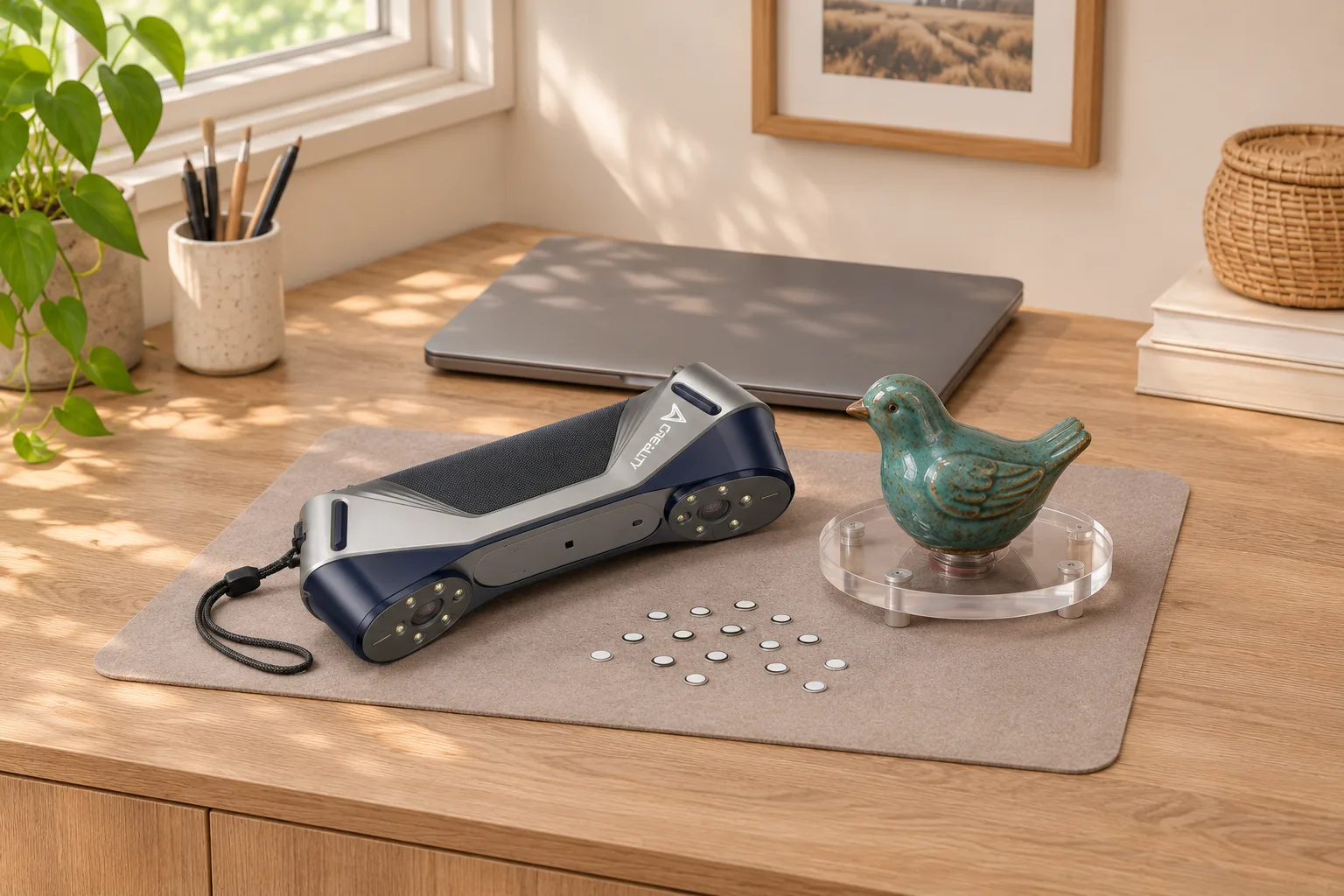
The quick answer
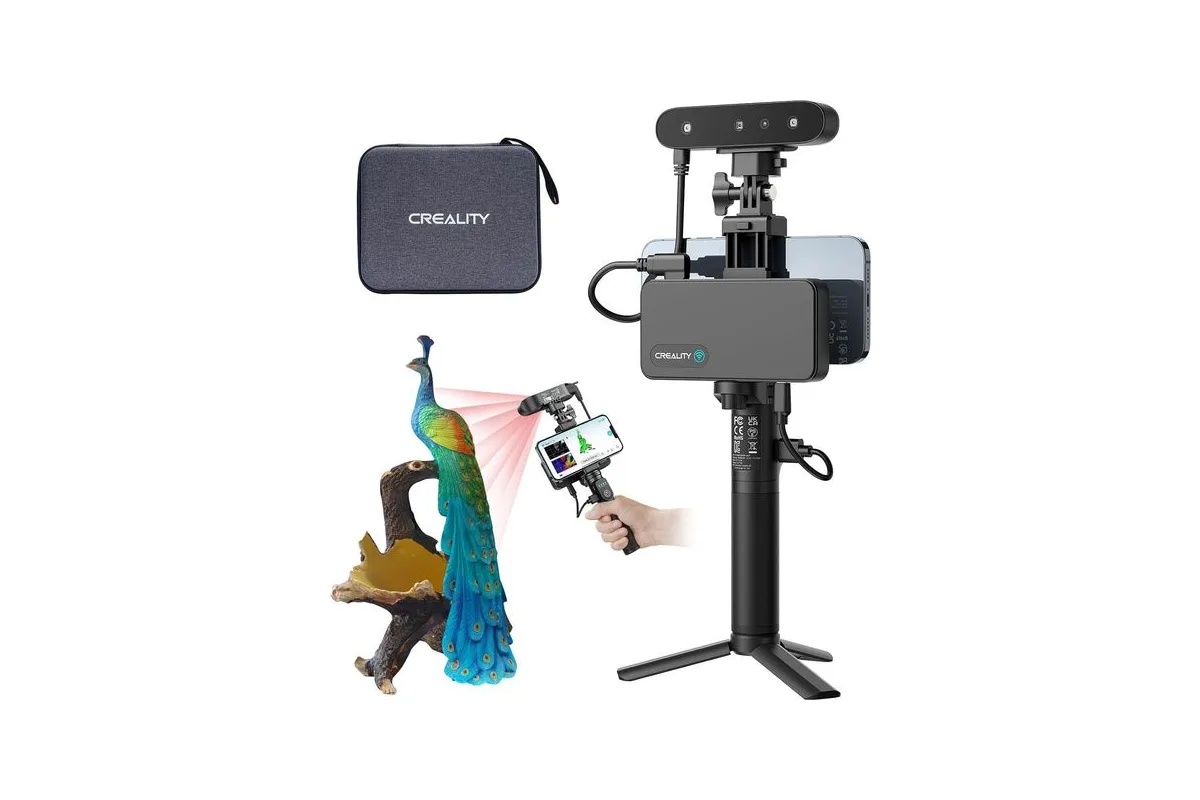
The Creality CR-Scan Raptor ($824 in November 2026) is the best 3D scanner for 3D printing: blue laser lines plus infrared, rated to 0.02 mm, for objects from 5 mm to 2 meters, and black or metal parts without spray. The Revopoint POP 3 Plus ($499.84) is the value pick for objects from 20 mm, but needs spray on dark and shiny surfaces. On a budget, the Creality Ferret Pro ($359) is rated 0.1 mm for objects from 50 mm. For tiny parts, get the Revopoint MINI 2 ($630.04). Every accuracy figure is the maker's own "up to" rating.
Our quick picks
Compare the picks
| Feature | Best 3D scanner for most peopleCreality CR-Scan Raptor | Best value for small and medium objectsRevopoint POP 3 Plus | Best Revopoint for fine detail and dark partsRevopoint POP 4 | Best budget 3D scannerCreality CR-Scan Ferret Pro | Best for tiny objectsRevopoint MINI 2 | Best for large partsShining 3D Einstar 2 | Infrared scanner for mixed sizesCreality CR-Scan Otter |
|---|---|---|---|---|---|---|---|
| Light | 7 blue laser lines + NIR | Infrared structured light | Blue laser + NIR | Class 1 blue light | 17 blue laser lines + IR | NIR four-lens stereo | |
| Accuracy | Up to 0.02 mm (maker) | 0.08 mm single frame (maker) | Up to 0.03 mm (maker) | 0.1 mm (maker) | 0.05 mm single frame (maker) | 0.02–0.05 mm (maker, conflicting) | |
| Objects | 5–2,000 mm | From 20 mm | From 10 mm | From 50 mm | From 10 mm | From 10 mm (laser) | 10–2,000 mm |
| Weight | 372 g | 286 g | 420 g | ||||
| Where to buy | Check price at Amazon | Check price at Amazon | Check price at Amazon | Check price at Amazon | Check price at Amazon | Check price at Amazon | Check price at Amazon |
Best 3D scanner for most people
Creality CR-Scan Raptor
- Light
- 7 blue laser lines + NIR
- Accuracy
- Up to 0.02 mm (maker)
- Objects
- 5–2,000 mm
- Weight
- 372 g
Best value for small and medium objects
Revopoint POP 3 Plus
- Light
- Infrared structured light
- Accuracy
- 0.08 mm single frame (maker)
- Objects
- From 20 mm
- Weight
Best Revopoint for fine detail and dark parts
Revopoint POP 4
- Light
- Blue laser + NIR
- Accuracy
- Up to 0.03 mm (maker)
- Objects
- From 10 mm
- Weight
- 286 g
Best budget 3D scanner
Creality CR-Scan Ferret Pro
- Light
- Accuracy
- 0.1 mm (maker)
- Objects
- From 50 mm
- Weight
Best for tiny objects
Revopoint MINI 2
- Light
- Class 1 blue light
- Accuracy
- 0.05 mm single frame (maker)
- Objects
- From 10 mm
- Weight
Best for large parts
Shining 3D Einstar 2
- Light
- 17 blue laser lines + IR
- Accuracy
- Objects
- From 10 mm (laser)
- Weight
- 420 g
Infrared scanner for mixed sizes
Creality CR-Scan Otter
- Light
- NIR four-lens stereo
- Accuracy
- 0.02–0.05 mm (maker, conflicting)
- Objects
- 10–2,000 mm
- Weight
01Best 3D scanner for most people
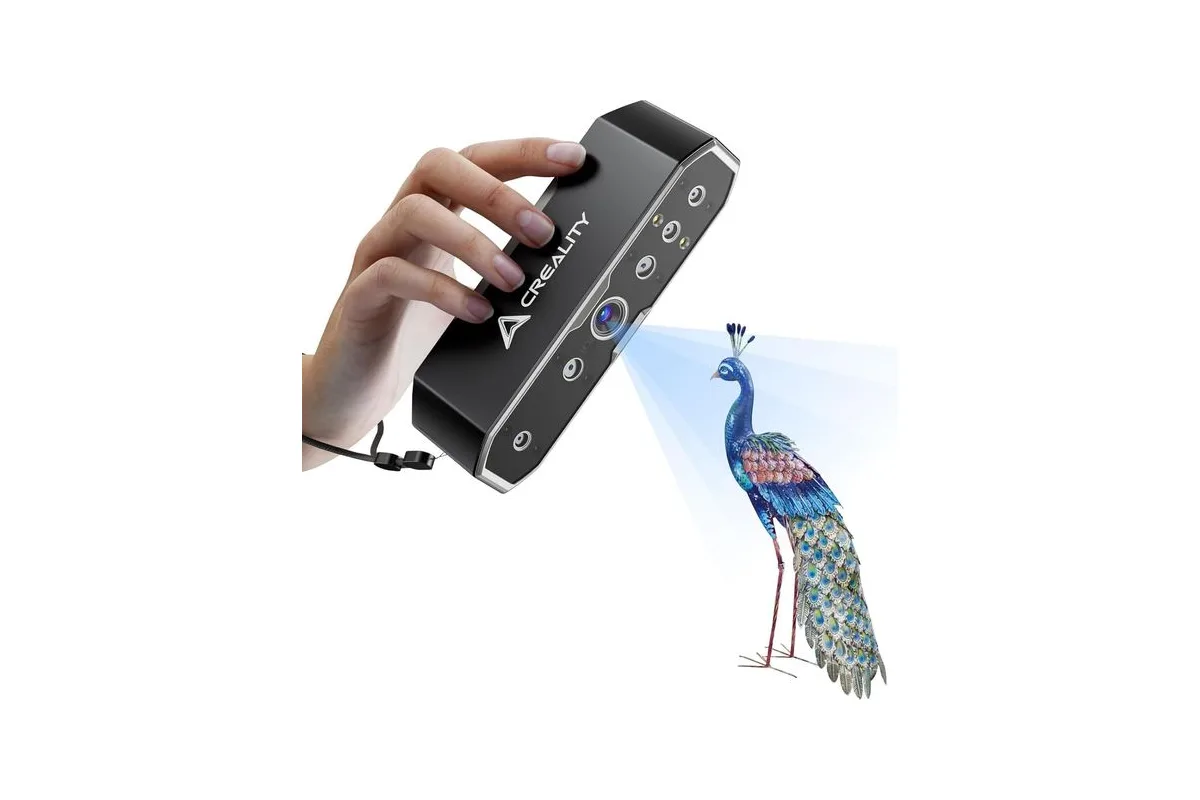
Creality CR-Scan Raptor
A blue-laser and infrared scanner rated to 0.02 mm that handles black and metal objects without spray, for $824.
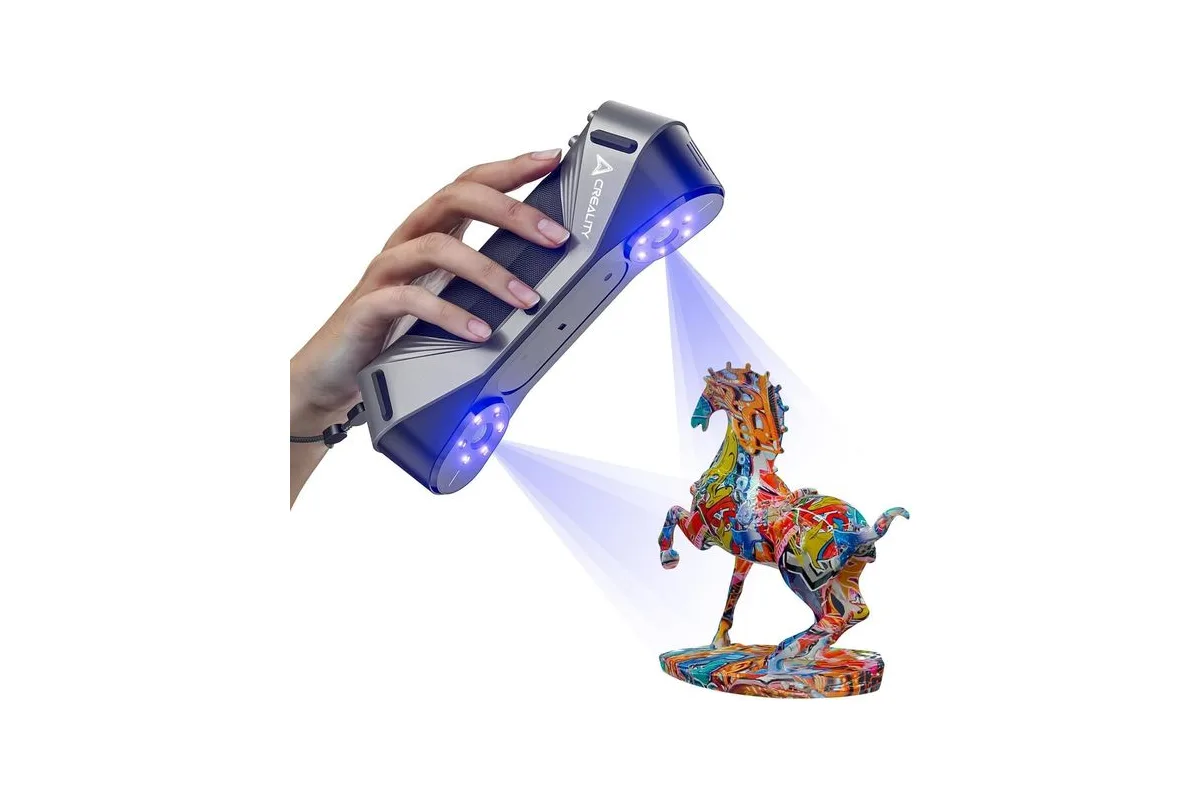
The best 3D scanner for most people who print. Seven blue parallel laser lines handle fine detail, and a near-infrared mode covers bigger objects, so one scanner takes parts from 5 mm to 2,000 mm. Creality rates it "metrology grade" at up to 0.02 mm, at up to 60 frames per second, and says it scans black and metal objects without spray. It weighs 372 g. It was $824 on Amazon and at Creality in November 2026, against a regular $1,499.
Creality's store pages have no full spec table; its own blog gives the point distance (0.02–2 mm) and an approximate 170–1,000 mm working distance. Nothing Creality publishes claims it scans clear objects without spray. If you need more speed, the [Raptor Pro](https://www.amazon.com/dp/B0DT422KGY?tag=theprinterreview-20) ($1,274) adds 22 cross laser lines and is rated 0.02 mm + 0.08 mm per meter of object.
Good for
- 7 blue laser lines plus infrared, rated up to 0.02 mm
- Scans black and metal objects without spray, Creality says; objects from 5 to 2,000 mm
- $824 on Amazon and at Creality in November 2026 (regular $1,499)
Consider
- Accuracy is Creality's own "up to" rating
- Needs a capable computer for laser scans
02Best value for small and medium objects
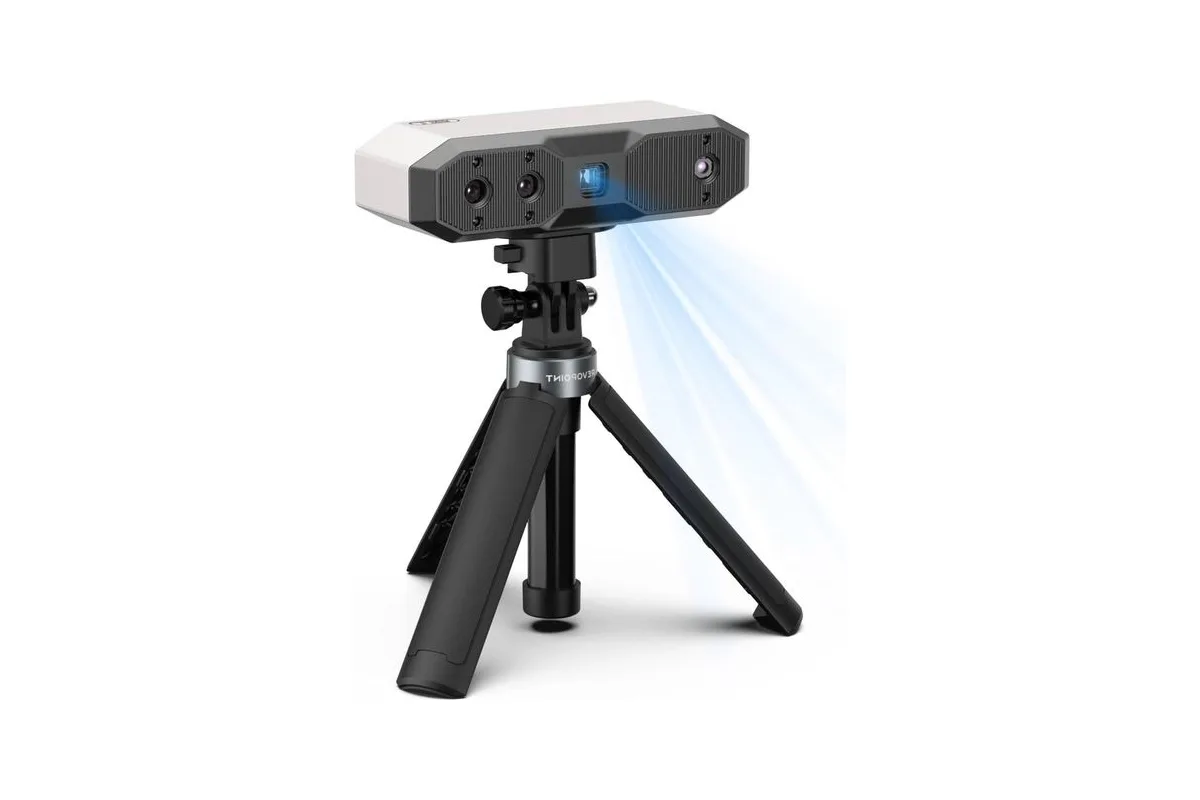
Revopoint POP 3 Plus
The successor to the POP 3: an infrared structured-light scanner for small and medium objects, with color and Wi-Fi.
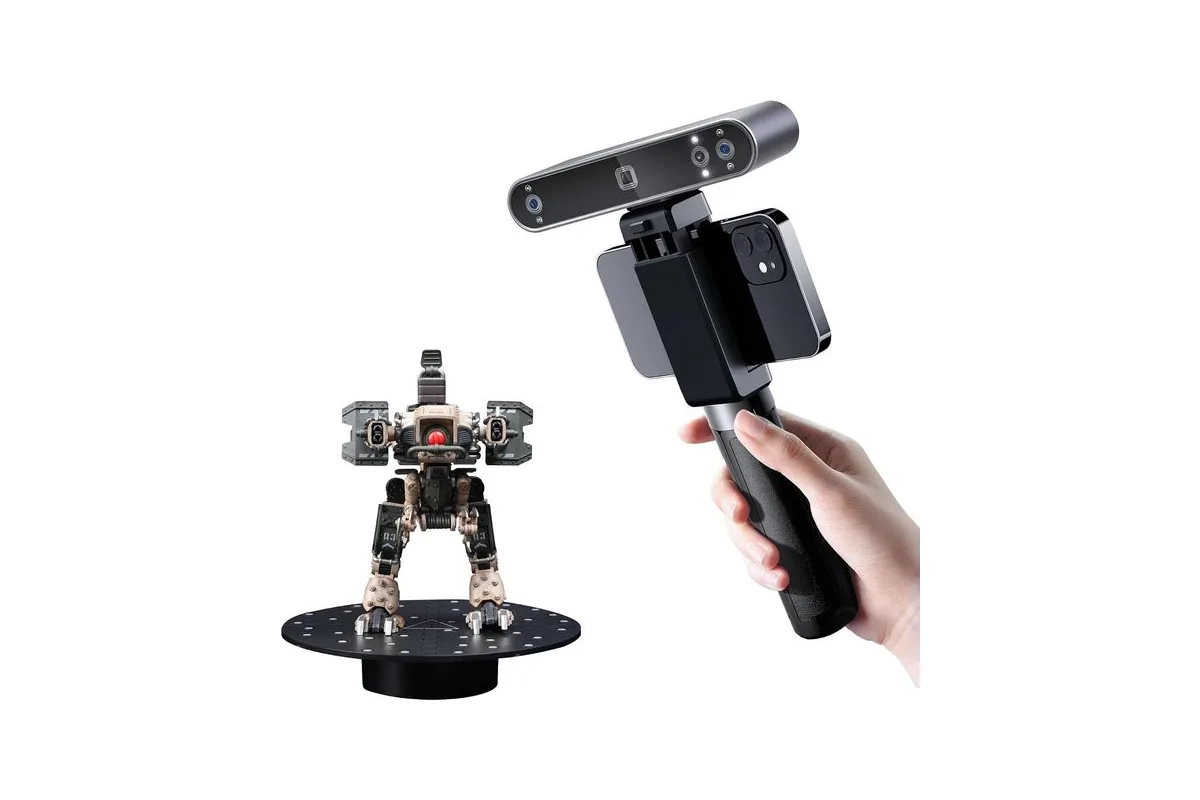
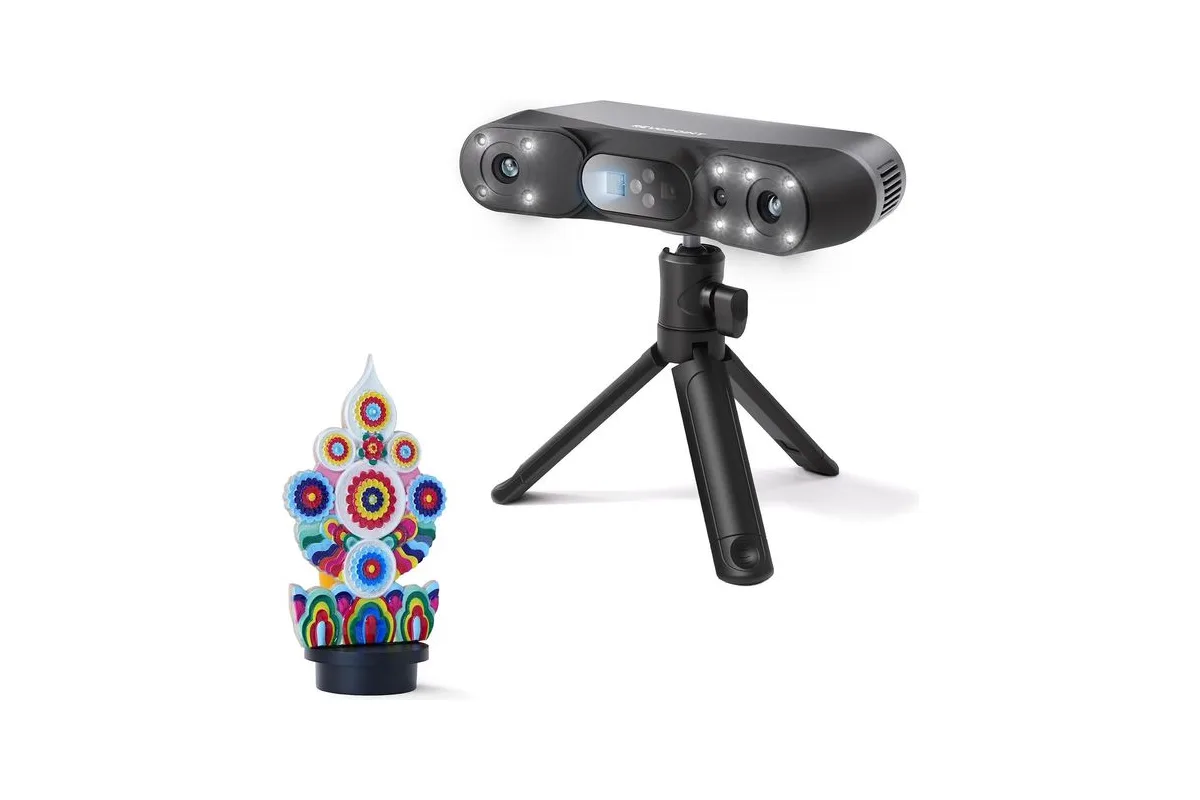
The value pick, and the replacement for the original POP 3. Revopoint rates it 20% more accurate and precise than the POP 3: 0.08 mm single-frame accuracy, 0.04 mm precision and up to 0.05 mm point distance, for objects from 20 × 20 × 20 mm at 150–400 mm away. It weighs 190 g and scans over USB-C or Wi-Fi 6, including from a phone. It was $499.84 on Amazon in November 2026, below the $577–$679 Revopoint's own store showed in search results.
It's infrared only, and Revopoint says to use scanning spray on "transparent, dark, or highly reflective objects," so black plastic and metal parts take extra prep. Read our [Revopoint POP 3 Plus review](/reviews/revopoint-pop-3-plus-review).
Good for
- Revopoint rates it 20% more accurate than the POP 3: 0.08 mm single-frame accuracy, 0.04 mm precision
- Objects down to 20 mm, at 150–400 mm from the scanner; 190 g
- $499.84 on Amazon in November 2026, sold by Revopoint's own store
Consider
- Needs scanning spray for dark, shiny or clear objects
- Infrared only; no laser mode for fine edges
03Best Revopoint for fine detail and dark parts
Revopoint POP 4
Revopoint's hybrid blue-laser and infrared scanner, rated to 0.03 mm and down to 10 mm objects.
Revopoint's hybrid scanner: 30 blue cross laser lines plus a single line for deep holes, and two infrared modes for larger objects. The laser mode is rated up to 0.03 mm, and the smallest object drops to 10 mm, half the POP 3 Plus's. Revopoint markets it as needing no spray on dark or shiny surfaces, and it works outdoors in up to 100,000 lux. It weighs 286 g and was $671.20 on Amazon in November 2026, $171.36 more than the POP 3 Plus.
Revopoint still says to spray "transparent or specular" surfaces. Its fastest laser mode, 105 frames per second, needs an NVIDIA graphics card (60 on the processor alone). For $152.80 more, the Raptor is rated tighter and scans down to 5 mm.
Good for
- Blue laser mode rated up to 0.03 mm; objects down to 10 mm
- Works outdoors up to 100,000 lux
- $671.20 on Amazon in November 2026
Consider
- Still needs spray for clear or mirror-like surfaces
- Fastest laser mode (105 fps) needs an NVIDIA graphics card
04Best budget 3D scanner
Creality CR-Scan Ferret Pro
Creality's cheapest wireless scanner, rated to 0.1 mm, for objects bigger than a fist.
The cheapest scanner worth buying for printing: $359 on Amazon and at Creality in November 2026 (regular $449). Creality rates it at 0.1 mm, with Wi-Fi 6, anti-shake tracking, 24-bit color and apps for iPhone, Android, Mac and Windows. It scans black and metal objects and works outdoors, Creality says.
Its smallest object is 50 mm, with a 0.16 mm point distance and a 150–700 mm working distance (figures from Creality's blog rather than a spec sheet). That's fine for a shoe, a helmet or a bracket, too coarse for miniatures or small hardware. For smaller objects at a similar price, Revopoint's [INSPIRE 2](https://www.amazon.com/dp/B0G4LXXB5W?tag=theprinterreview-20) was $440.30 on Amazon, with a 20 mm minimum.
Good for
- $359 on Amazon and at Creality in November 2026 (regular $449)
- Wi-Fi 6, color capture, and phone, Mac and Windows apps
- Scans black and metal objects, Creality says, and works outdoors
Consider
- 0.1 mm accuracy and a 50 mm smallest object: too coarse for miniatures
- Infrared only, no laser mode
05Best for tiny objects
Revopoint MINI 2
A blue-light scanner for small parts, with 0.02 mm point distance and objects down to 10 mm.
The scanner for coins, jewelry, keys and small parts. It uses Class 1 blue structured light with up to 0.02 mm point distance and 0.05 mm single-frame accuracy, for objects from 10 mm. It captures a 52 × 64 mm patch at 120 mm away, up to 168 × 132 mm at 250 mm, and weighs 175 g. It was $630.04 on Amazon in November 2026.
The small capture area makes anything bigger than a shoe slow to cover, it still needs spray for dark, shiny or clear objects, and Revopoint asks for a fast computer: an Apple M1 Pro or a 12th-gen Intel Core i7 with 16 GB of memory.
Good for
- Blue structured light with up to 0.02 mm point distance for coins, jewelry and small parts
- Objects from 10 mm, at 120–250 mm
- $630.04 on Amazon in November 2026
Consider
- Small capture area: slow for anything larger than a shoe
- Needs a fast computer: Revopoint lists an M1 Pro or 12th-gen Core i7 with 16 GB
06Best for large parts
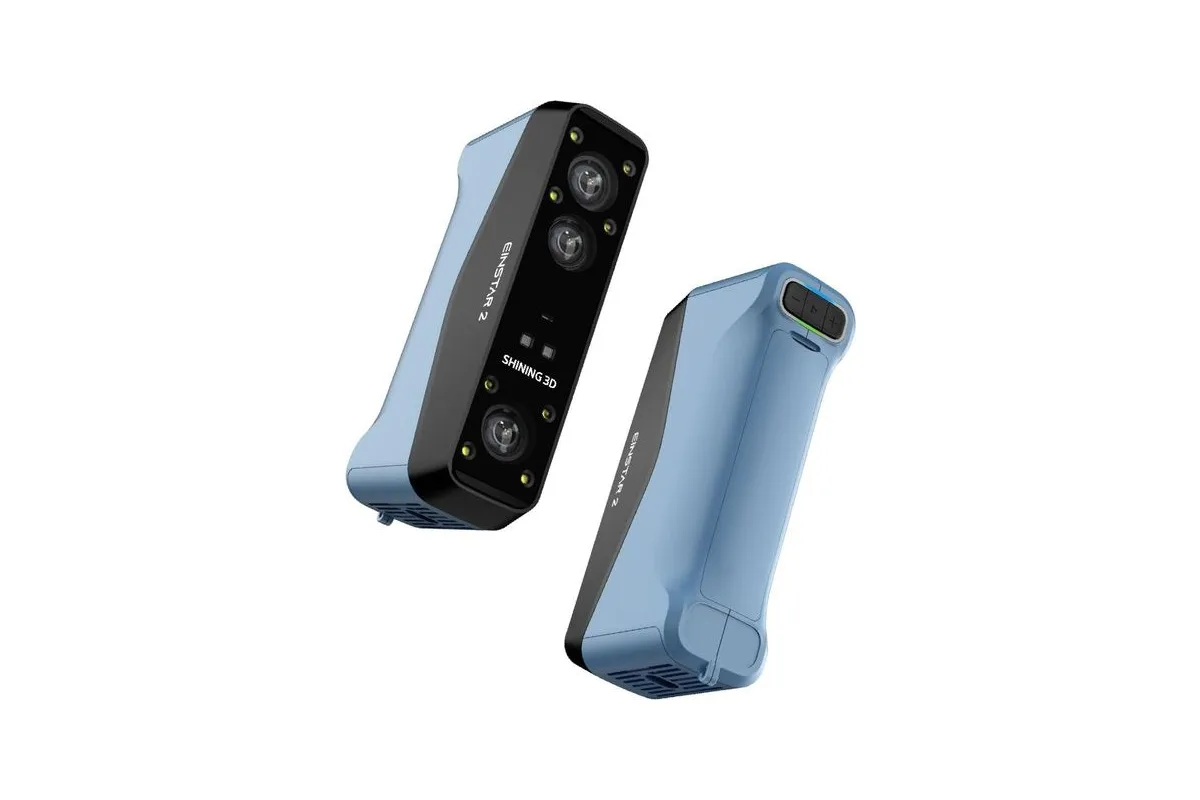
Shining 3D Einstar 2
A wireless scanner with 17 blue laser lines and an infrared mode, for parts from 10 mm up to car-part size.
The scanner for large parts, like car trim, helmets and furniture, that can still do small ones. Its 17 blue laser lines capture 2.5 million points a second over a field of view up to 490 × 580 mm, for objects from 10 mm; its infrared mode captures 4.8 million points a second over up to 1,170 × 1,385 mm, at 160–1,400 mm away. Shining 3D says it scans black or reflective objects with "no spray required." It was $854 on Amazon in November 2026 (regular $1,249), and Einstar sells refurbished units for $799.
Shining 3D publishes no accuracy figure for it, only a 0.05–10 mm laser resolution. Its modeling software, EXModel, costs $225 a year, though the scanner exports STL, OBJ, PLY, 3MF and ASC without it. It weighs 420 g and uses a Class 2 laser.
Good for
- 17 blue laser lines for detail plus a fast infrared mode for big objects
- Scans black or reflective objects with no spray, Shining 3D says
- $854 on Amazon in November 2026 (regular $1,249)
Consider
- Shining 3D publishes no accuracy figure for it
- Its modeling software, EXModel, costs $225 a year
07Infrared scanner for mixed sizes
Creality CR-Scan Otter
A four-lens infrared scanner for objects from 10 mm to 2 meters that scans black and metal without spray.
A four-lens infrared scanner for objects from 10 to 2,000 mm that, Creality says, scans black and metal without spray. It was $674 on Amazon and at Creality in November 2026 (regular $899); Creality sells it with a manual turntable for $902, or the turntable alone for $9.90.
Creality's pages disagree on its accuracy: "up to 0.02mm" on the store, "up to 0.05 mm" in its own blog, and its working distance is given as 110–1,000 mm or 120–1,200 mm. With no laser mode, it's hard to choose over the Raptor for $150 more. The [Otter Lite](https://www.amazon.com/dp/B0F8N9R4SG?tag=theprinterreview-20) ($569 on Amazon) is rated 0.05–0.1 mm.
Good for
- Four-lens stereo infrared for objects from 10 to 2,000 mm
- Scans black and metal without spray, Creality says
- $674 on Amazon and at Creality in November 2026 (regular $899)
Consider
- Creality's own pages disagree on accuracy: up to 0.02 mm on the store, 0.05 mm in its blog
- No laser mode; the Raptor costs $150 more with one
How to choose
Build size
Match the build volume to the largest parts you plan to print.
Materials
PLA, PETG, and TPU print on open machines. ABS, ASA, and engineering filaments need an enclosure.
Multicolor and waste
Single-nozzle multicolor systems purge filament at every color change. Toolchangers waste far less.
Best 3D scanners compared
| Scanner | Amazon (Nov 28, 2026) | Light | Accuracy (maker rating) | Smallest object | Working distance | Black or shiny without spray? |
|---|---|---|---|---|---|---|
| Creality CR-Scan Raptor | $824 | 7 blue laser lines + infrared | Up to 0.02 mm | 5 mm | About 170–1,000 mm | Yes, Creality says |
| Revopoint POP 3 Plus | $499.84 | Infrared structured light | 0.08 mm single frame (0.04 mm precision) | 20 mm | 150–400 mm | No: spray dark, shiny and clear |
| Revopoint POP 4 | $671.20 | Blue laser + infrared | Up to 0.03 mm (laser) | 10 mm | 170–370 mm (laser) | Yes in laser mode, Revopoint says; spray clear and mirror-like |
| Creality CR-Scan Ferret Pro | $359 | Infrared | 0.1 mm | 50 mm | 150–700 mm | Black and metal, Creality says |
| Revopoint MINI 2 | $630.04 | Blue structured light | 0.05 mm single frame (0.02 mm point distance) | 10 mm | 120–250 mm | No: spray dark, shiny and clear |
| Shining 3D Einstar 2 | $854 | 17 blue laser lines + infrared | None published (0.05 mm resolution) | 10 mm (laser) | 100–600 mm laser, 160–1,400 mm infrared | Yes, Shining 3D says |
| Creality CR-Scan Otter | $674 | Four-lens infrared | 0.02 mm (store) or 0.05 mm (blog) | 10 mm | 110–1,000 mm or 120–1,200 mm | Black and metal, Creality says |
Sources: Creality’s, Revopoint’s and Shining 3D’s product and spec pages, and Amazon prices, read November 28, 2026, the day after Black Friday. Several are sale prices. No maker claims its scanner handles clear glass or acrylic without spray.
What is the best 3D scanner for 3D printing?
The Creality CR-Scan Raptor, for $824. It pairs blue laser lines for fine detail with an infrared mode for big objects, and it covers the widest size range here: 5 mm to 2 meters. Creality rates it at up to 0.02 mm and says it scans black and metal parts without spray, which matters because most things you’d copy, from car trim to tool handles, are dark or shiny.
Spend less if your objects are easy. The Revopoint POP 3 Plus ($499.84) is rated 0.08 mm for objects from 20 mm, but it’s infrared only and needs spray on dark or shiny surfaces. The Creality Ferret Pro ($359) is rated 0.1 mm and starts at 50 mm. A phone can do rough shapes for free; see how to 3D scan with an iPhone.
Which 3D scanner fits the size of your object?
Pick by the smallest thing you’ll scan first, then by surface. A scanner can’t capture an object smaller than its minimum, however good its accuracy figure.
| What you’ll scan | Rough size | Scanners rated for it |
|---|---|---|
| Miniatures, coins, rings, small hardware | 5–20 mm | Raptor (from 5 mm); POP 4, MINI 2, Einstar 2 laser mode and Otter (from 10 mm) |
| Figurines, knobs, brackets, game pieces | 20–50 mm | All of the above, plus the POP 3 Plus and INSPIRE 2 (from 20 mm) |
| Shoes, tools, helmets, household parts | 50–500 mm | Every scanner here, including the Ferret Pro (from 50 mm) |
| Car parts, furniture, people | 500 mm and up | Einstar 2 infrared mode (up to 1,170 × 1,385 mm per frame); Raptor and Otter (up to 2,000 mm) |
Small-object scanners are slow on big ones. The MINI 2 sees a 168 × 132 mm patch at most, so covering a car seat would take many passes; the Einstar 2’s infrared mode sees about 1.2 by 1.4 meters at once.
Which 3D scanners handle black, shiny and clear objects?
Blue-laser scanners handle black and shiny objects best; nothing handles clear ones without spray. Here’s what each maker says its scanner needs.
- No spray for black or shiny, by the maker’s account: Creality Raptor, Otter and Ferret Pro (“scan black/metal”), Shining 3D Einstar 2 (“no spray required”), and the Revopoint POP 4 in laser mode.
- Spray needed: Revopoint POP 3 Plus and MINI 2, for “transparent, dark, or highly reflective objects.”
- Clear objects: spray, on every scanner. Revopoint says so for the POP 4, and Creality doesn’t mention transparent objects at all.
Scanning spray coats the object in a thin, matte layer. Einstar sells AESUB Blue, 400 mL for $39.99, which it says evaporates within a few hours with no cleanup; apply it from 15–20 cm away. Revopoint sells its own sprays too.
How accurate are 3D scanners, really?
Treat every figure as the maker’s best case. Each is an “up to” number from the maker’s lab, and Revopoint says its figures were “acquired in a controlled lab environment. Actual results might vary.” Creality’s own pages give the Otter two different ratings, 0.02 and 0.05 mm. Don’t choose between two scanners on accuracy alone.
The terms differ too. Single-frame accuracy is how close one capture is to the true shape. Precision is how consistent repeated captures are, so it’s usually the smaller number (the POP 3 Plus: 0.08 mm accuracy, 0.04 mm precision). Point distance is the spacing of measured points, which sets how small a detail can show. Volumetric accuracy adds error as the object grows: Revopoint rates the POP 4 at 0.03 mm + 0.05 mm per meter, which works out to about 0.045 mm across a 300 mm part (our estimate: 0.03 + 0.05 × 0.3).
For 3D printing, any of these is finer than you need for the shape. A 0.4 mm nozzle lays down lines about ten times wider than a 0.04 mm scan error. Accuracy matters most for parts that have to fit something else, and even then you should check key dimensions with calipers (below).
Two habits help, according to the makers. Revopoint says “one scan close to the object will result in the best accuracy,” and that repeated passes make a model worse. Creality says “the closer the scanner is to the target while still obtaining point clouds, the higher the accuracy.”
How do you turn a 3D scan into a printable STL?
Scan, mesh, repair, export, check, slice. Every scanner here exports STL, the format slicers open, but a raw scan usually has holes and stray points.
- Scan and fuse in the maker’s free app: Revo Scan for Revopoint, Creality Scan for Creality, Shining 3D’s software for the Einstar. Use a turntable for small objects; Revopoint’s dual-axis turntable holds up to 5 kg, and Creality’s manual one is $9.90.
- Mesh, fill holes and simplify in the same app. Cut away the table or turntable the scan picked up.
- Export STL or 3MF. Revo Scan exports STL, 3MF, OBJ, PLY, ASC, GLTF and FBX; Creality Scan exports STL, OBJ, PLY and ASC; the Einstar 2 exports STL, OBJ, PLY, 3MF and ASC.
- Check that the mesh is watertight. Blender’s free 3D Print Toolbox puts it plainly: to slice a mesh correctly, it “needs to be ‘watertight’.” Its Solid check finds non-manifold edges, and Make Manifold tries to fill holes and fix bad faces. Your slicer’s repair tool can fix small problems too.
- Check the scale. Measure one feature of the real object with calipers and compare it with the scan before you print.
- Slice and print. See the best 3D printing slicer.
A note on Meshmixer. Many older guides send you to Autodesk Meshmixer for repair. Autodesk’s Marketplace page, as shown in search results, says development has ended and Autodesk no longer provides support, though it’s still downloadable; Autodesk points users to Fusion instead. Blender is the free, maintained choice.
A scan is a mesh, not an editable design. To change a part’s dimensions or fix a broken tab, you’ll often trace the scan in CAD; see do you need CAD for 3D printing?
How we chose
We compared seven current handheld scanners from Creality, Revopoint and Shining 3D on their makers’ published accuracy, point distance, smallest object, working distance, light source and surface guidance, plus their software, export formats and November 28, 2026 prices on Amazon and the makers’ stores. We favored scanners that cover small objects and dark surfaces, since those are the hardest cases in the makers’ own guidance. We haven’t tested these scanners hands-on, and every accuracy figure is the maker’s rating.
Questions people ask
What is the best 3D scanner for 3D printing?
The Creality CR-Scan Raptor ($824 in November 2026): blue laser plus infrared, rated up to 0.02 mm, for objects from 5 mm to 2 meters, with no spray needed for black or metal parts, Creality says.
What is the best cheap 3D scanner?
The Creality CR-Scan Ferret Pro, $359 in November 2026. It’s rated 0.1 mm for objects from 50 mm. If you only need rough shapes, a phone app is free; see how to 3D scan with an iPhone.
Can a 3D scanner scan miniatures?
Yes, if it’s rated for small objects. The Raptor starts at 5 mm, and the POP 4, MINI 2, Otter and Einstar 2 (laser mode) at 10 mm. The POP 3 Plus starts at 20 mm and the Ferret Pro at 50 mm.
Is the Revopoint POP 3 still worth it?
Revopoint has replaced it with the POP 3 Plus, which it rates 20% more accurate. See our Revopoint POP 3 Plus review for what that means for a used POP 3.
Do you need scanning spray?
For clear objects, always. For black or shiny ones, it depends on the scanner: Revopoint says to spray them for the POP 3 Plus (infrared) and MINI 2 (blue structured light), while the makers say the Raptor, Otter, Ferret Pro, Einstar 2 and the POP 4 in laser mode handle them without spray.
Can you 3D print a scan directly?
Usually after some cleanup. Fill holes, make the mesh watertight (Blender’s 3D Print Toolbox does this for free), check the scale against a caliper measurement, then slice the STL or 3MF as you would any model.
Do 3D scanners need a powerful computer?
The small-detail ones do. Revopoint lists an Apple M1 Pro or 12th-gen Intel Core i7 with 16 GB of memory for the MINI 2, and the POP 4 reaches its top laser speed only with an NVIDIA graphics card. The Ferret Pro and POP 3 Plus can also scan from a phone.
Sources
- Creality: 3D scanner collection (US store), store.creality.com
- Creality CR-Scan Raptor store page, store.creality.com
- Creality Raptor Pro store page, store.creality.com
- Creality CR-Scan Otter store page, store.creality.com
- Creality CR-Scan Ferret Pro store page, store.creality.com
- Creality: 3D scanner technical parameters, store.creality.com
- Creality Wiki: CR-Scan Otter tutorial, wiki.creality.com
- Revopoint POP 3 Plus, revopoint3d.com
- Revopoint POP 4, revopoint3d.com
- Revopoint MINI 2, revopoint3d.com
- Revopoint POP 3 support, revopoint3d.com
- Revopoint INSPIRE 2, revopoint3d.com
- Shining 3D EINSTAR 2 specifications, shining3d.com
- Einstar store product listings, einstar.com
- Blender manual: 3D Print Toolbox, docs.blender.org
- Blender Extensions: 3D Print Toolbox, extensions.blender.org
- Autodesk Marketplace: Meshmixer, marketplace.autodesk.com
Keep exploring

How to
Hardened steel vs brass nozzles, and what nozzle size to use
Brass, or the stainless steel Bambu ships on the A1, is fine for PLA, PETG, ABS, ASA and TPU. Carbon fiber, glass fiber, glow-in-the-dark and sparkle filaments need hardened steel. Use a 0.4 mm nozzle for most prints, 0.6 mm for carbon fiber and big parts, and 0.2 mm for miniatures.
Read story
How to
Can you 3D scan with an iPhone? Yes, but not to tight tolerances
Yes. Any current iPhone can 3D scan objects from photos (photogrammetry), and KIRI Engine's free tier exports STL for printing. Only the iPhone 18 Pro and 18 Pro Max have LiDAR in Apple's current lineup. For parts that must fit, a $359 scanner is about ten times tighter.
Read story