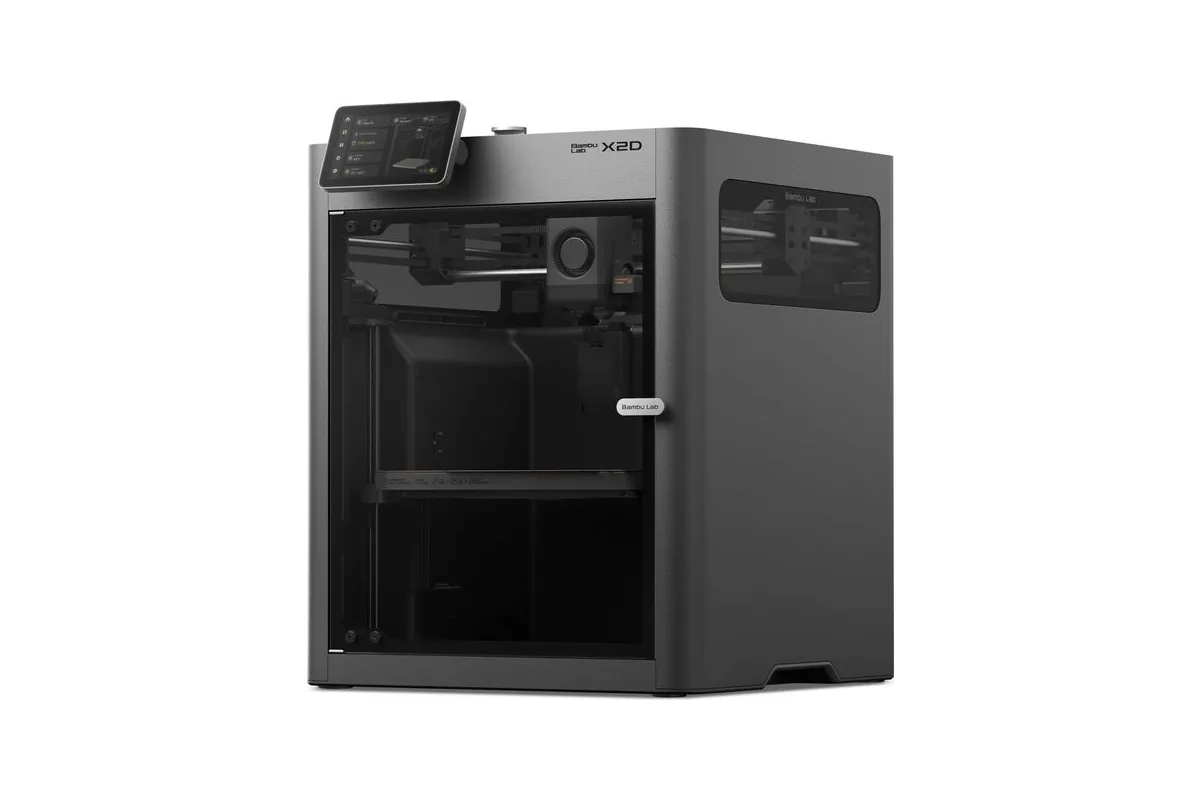
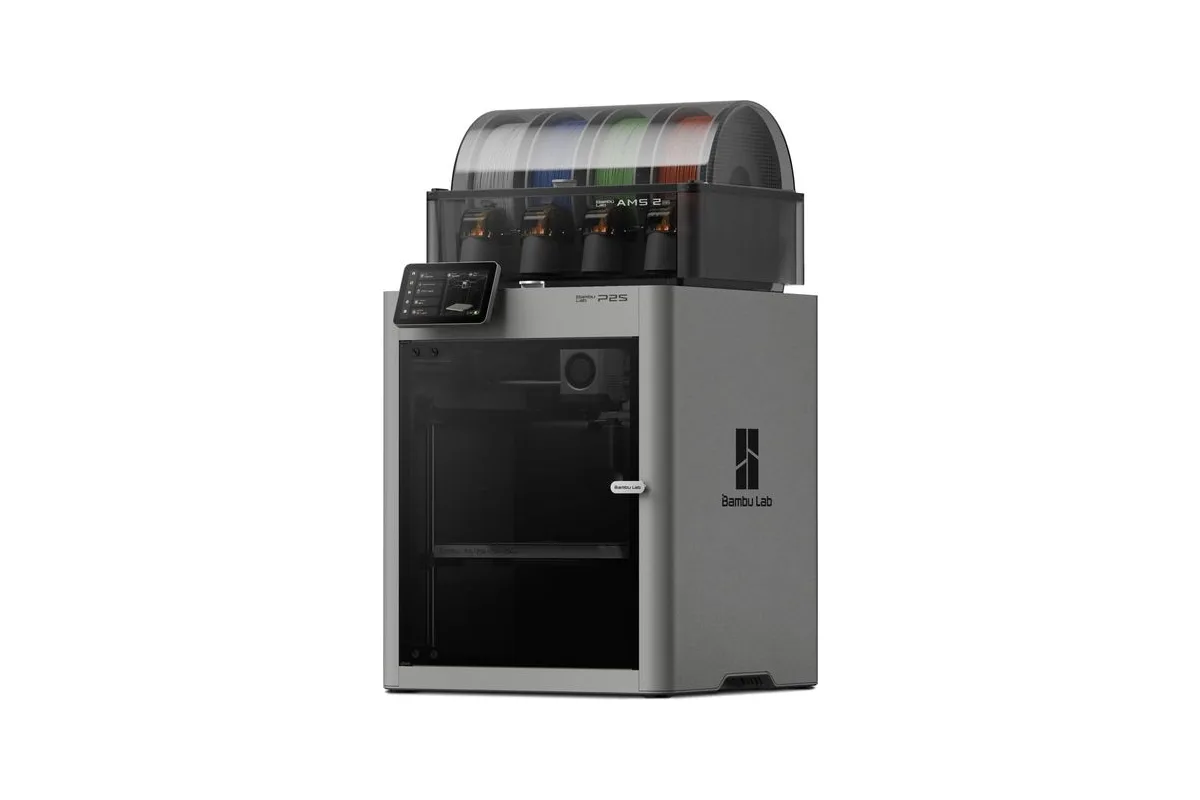
Side by side
| Feature | Bambu LabX2D | Bambu LabP2S Combo |
|---|---|---|
| Build volume | 256 × 256 × 260 mm | 256 x 256 x 256 mm |
| Max nozzle / bed | 300 °C / 120 °C | |
| Chamber | Active, 65 °C | |
| Nozzles | 2 (main + auxiliary) | |
| Where to buy | Check price at Amazon |
Bambu Lab X2D
- Build volume
- 256 × 256 × 260 mm
- Max nozzle / bed
- 300 °C / 120 °C
- Chamber
- Active, 65 °C
- Nozzles
- 2 (main + auxiliary)
Bambu Lab P2S Combo
- Build volume
- 256 x 256 x 256 mm
- Max nozzle / bed
- Chamber
- Nozzles
Bambu Lab P2S vs X2D: which is better?
The X2D is the better printer; the P2S is the better value for everyday PLA. Both have the same 392 × 406 × 478 mm footprint and a 256 mm-class build volume. The X2D, which Bambu calls “X1C’s next chapter”, adds three things for $140 more:
- A second nozzle. Print supports in a separate material, or two colors, without purging between them.
- Active chamber heating to 65 °C and a 120 °C bed, for ABS, ASA, PC and nylon parts that warp in a passive chamber.
- G3 + H12 HEPA + activated carbon filtration, where the P2S has a carbon filter only.
Buy the X2D AMS Combo ($789) if you’ll use any of those. Buy the P2S Combo ($649) if you print mostly PLA and PETG, one color at a time, and want to keep $140.
What do they cost?
Prices on Bambu’s US store, November 28, 2026 (typical price in brackets). Black Friday prices end December 1, 2026, at 2:00 AM ET.
| Bundle | P2S | X2D | Gap |
|---|---|---|---|
| Printer only | $449 ($549) | $589 ($649) | $140 |
| AMS Combo | $649 ($749), with AMS 2 Pro | $789 ($899) | $140 |
| Larger bundles | — | Combo Print with Care $836; Print More Bundle with 2 AMS 2 Pro $1,049 | — |
| Per liter, Combo (our estimate) | $38.68 | $46.30 | — |
| Amazon | Combo $649.99 | Not sold | — |
| Micro Center | Combo $649.99; refurbished $636.99 | Combo $789.99; refurbished $764.99 | — |
Per-liter figures divide the Combo price by the build volume: 16.8 liters for the P2S, 17.0 for the X2D (our estimates). The X2D launched in April 2026 at $649, or $899 for the Combo, so the sale takes $110 off the Combo.
The P2S Combo is $649.99 on Amazon; the X2D isn’t sold there. Bambu’s 2-year US warranty applies only to purchases from Bambu’s own US and Canada stores.
How do the specs compare?
| Bambu P2S | Bambu X2D | |
|---|---|---|
| Launched | Oct 14, 2025 | Apr 14, 2026 |
| Build volume | 256 × 256 × 256 mm | 256 × 256 × 260 mm (main nozzle); 235.5 × 256 × 256 mm with both |
| Nozzles | 1, hardened steel, quick swap | 2 (main + auxiliary), identical and interchangeable |
| Max nozzle / bed | 300 °C / 110 °C | 300 °C / 120 °C |
| Chamber | No active heating | Active, 65 °C |
| Speed (Bambu) | 600 mm/s, 20,000 mm/s² | 1,000 mm/s, 20,000 mm/s² (auxiliary nozzle 200 mm/s, 1,000 mm/s²) |
| Flow | 40 mm³/s | 40 mm³/s; 65 mm³/s with the optional high-flow hotend |
| Max colors | 20 | 25 |
| Cameras | 1080p Live View | 1080p Live View + 1600 × 1200 toolhead camera |
| Motion calibration | — | Optional Vision Encoder (“50-micron-class”) |
| Filtration | Activated carbon | G3 + H12 HEPA + activated carbon |
| AI detection | Spaghetti, nozzle blobs, purge-chute jams (2 TOPS NPU) | The same, plus foreign objects and plate placement (2 TOPS NPU) |
| Connectivity | Dual-band Wi-Fi, USB, 8 GB; no Ethernet | Dual-band Wi-Fi, USB, 8 GB; no Ethernet |
| Noise (Bambu, silent mode at 1 m) | Below 50 dB | Below 50 dB |
| PLA power | 200 W | 250 W (PC 550 W) |
| Weight | 14.9 kg | 16.25 kg |
| Updates until | Oct 14, 2030 (security Oct 14, 2032) | Apr 14, 2031 (security Apr 14, 2033) |
| Warranty (Bambu store) | Printer 24 months; hotend and extruder gears not covered | Printer 24 months; auxiliary extruder 3 months; nozzle, hotend heating assembly and extruder gears not covered |
Source: Bambu’s US store, specifications, wiki and compare page, read November 28, 2026. The P2S travel speed rose to 1,000 mm/s in firmware 01.03, but its print speed is still rated 600 mm/s.
What’s the catch with the X2D’s second nozzle?
It isn’t a second main nozzle. The auxiliary hotend is fed by a stepper motor on the back panel through a PTFE tube, while the main one has a servo extruder in the toolhead. Bambu’s own caveats:
- the auxiliary nozzle must not exceed 200 mm/s or 1,000 mm/s²;
- its print quality is “slightly lower” than the main nozzle’s;
- use official Bambu filament on it, and take care with PLA Silk, PETG-CF, ASA-CF, PA6-CF and TPU for AMS;
- flow calibration covers the main nozzle only;
- the auxiliary extruder is covered for 3 months, not 24.
That makes it ideal for support interfaces, breakaway or soluble supports, and small areas of a second color. Using both nozzles also narrows the build width to 235.5 mm.
Which wastes less filament?
The X2D on two-material prints, but Bambu gives no figure for it. Switching nozzles needs no purge, so a part with a second-color logo or a separate support material wastes little. Bambu says the X2D produces “significantly less filament waste” and, in its P3C FAQ, that on the X2D “printing with more than 2 colors requires purging.” On the P2S, Bambu says multicolor “requires purging old filament to avoid color bleeding” at every change.
For a sense of scale, Bambu’s own slicer figures for its bigger dual-nozzle H2D show 10% to 31% less purge than single-nozzle Bambu printers on three demo models (our estimate from Bambu’s figures). If you want low waste across many colors, neither is the answer; a tool changer like the P3C is. See P3C vs H2C and the best tool-changer 3D printers.
Which prints better?
For single-color PLA and PETG, expect little difference: both are enclosed CoreXY printers running Bambu’s tuned profiles. The X2D pulls ahead on:
- Warp-prone materials. An actively heated 65 °C chamber and 120 °C bed keep ABS, ASA, PC and nylon parts flat.
- Supported surfaces. Support interfaces in a second material peel off more cleanly.
- Accuracy. The optional Vision Encoder calibrates motion, which the P2S doesn’t support.
Neither prints PPS-CF or PPS-GF; for those, you need the 350 °C H2D.
Which costs more to run?
The X2D, slightly. Bambu measures 250 W on PLA against 200 W for the P2S, so a 4-hour PLA print costs about 18.2¢ against 14.5¢ at 18.17¢ per kWh (our estimate). PC prints raise the X2D to about 550 W.
Which should you buy?
| If you… | Buy |
|---|---|
| Print mostly PLA and PETG, one color at a time | P2S Combo |
| Print ABS, ASA, PC or nylon often | X2D Combo |
| Want supports in a different material | X2D Combo |
| Print near pets or in a living space and want HEPA filtration | X2D Combo |
| Print 4+ colors often | Neither; look at the P3C or H2C |
| Want to buy on Amazon | P2S Combo |
The X2D AMS Combo at $789 is the one we’d buy if you can spend the extra $140: the heated chamber and second nozzle are hard to add later, and it gets updates six months longer. Read the full X2D review. The P2S Combo at $649 is still the best enclosed printer for most homes; see the P2S review, P1S vs P2S and the best dual-nozzle 3D printers.
Questions people ask
Is the X2D worth $140 more than the P2S?
Yes, if you’ll use the heated chamber, the second nozzle or the HEPA filter. If you print PLA in one color, the P2S does the same job for less.
Is the X2D bigger than the P2S?
No. The footprint is the same, and the build volume is nearly the same: 256 × 256 × 260 mm against 256 × 256 × 256 mm. With both nozzles in use, the X2D’s width drops to 235.5 mm.
Does the P2S have a heated chamber?
No. Bambu says it has no active chamber heating and regulates temperature with its enclosure and an automatic airflow flap. The X2D heats its chamber to 65 °C.
Is the X2D faster than the P2S?
On paper: Bambu rates the X2D at 1,000 mm/s against 600 mm/s for the P2S, both at 20,000 mm/s². Real print times depend on the model and filament, and the X2D’s auxiliary nozzle is capped at 200 mm/s.
Can the P2S use H2D nozzles?
Yes. Bambu says the P2S takes H2D nozzles but not A1 nozzles. That’s a nozzle swap, not a second hotend: for two nozzles you need the X2D.
Which has the longer warranty and updates?
Both printers have 24 months from Bambu’s store. The X2D’s auxiliary extruder has only 3 months. The X2D gets bug and feature updates until April 14, 2031, six months longer than the P2S.
Sources
- Bambu Lab P2S product page and FAQ, us.store.bambulab.com
- Bambu Lab P2S specifications, bambulab.com
- Bambu Lab P2S FAQ, wiki.bambulab.com
- Bambu Lab X2D product page and FAQ, us.store.bambulab.com
- Bambu Lab X2D specifications, bambulab.com
- Bambu Lab X2D FAQ, wiki.bambulab.com
- Bambu Lab: Bambu Lab presents the X2D, blog.bambulab.com
- Bambu Lab P3C FAQ (P3C vs P2S and X2D), wiki.bambulab.com
- Bambu Lab printer comparison (software update support), bambulab.com
- Bambu Lab printer power consumption, wiki.bambulab.com
- Bambu Lab multi-AMS compatibility guide, wiki.bambulab.com
- Bambu Lab warranty policy, bambulab.com
- Bambu Lab H2C product page (purge calculations), bambulab.com
- Micro Center Bambu Lab listings, microcenter.com
- Amazon: Bambu Lab P2S Combo, amazon.com
Keep exploring

How to
Hardened steel vs brass nozzles, and what nozzle size to use
Brass, or the stainless steel Bambu ships on the A1, is fine for PLA, PETG, ABS, ASA and TPU. Carbon fiber, glass fiber, glow-in-the-dark and sparkle filaments need hardened steel. Use a 0.4 mm nozzle for most prints, 0.6 mm for carbon fiber and big parts, and 0.2 mm for miniatures.
Read story
How to
Can you 3D scan with an iPhone? Yes, but not to tight tolerances
Yes. Any current iPhone can 3D scan objects from photos (photogrammetry), and KIRI Engine's free tier exports STL for printing. Only the iPhone 18 Pro and 18 Pro Max have LiDAR in Apple's current lineup. For parts that must fit, a $359 scanner is about ten times tighter.
Read story