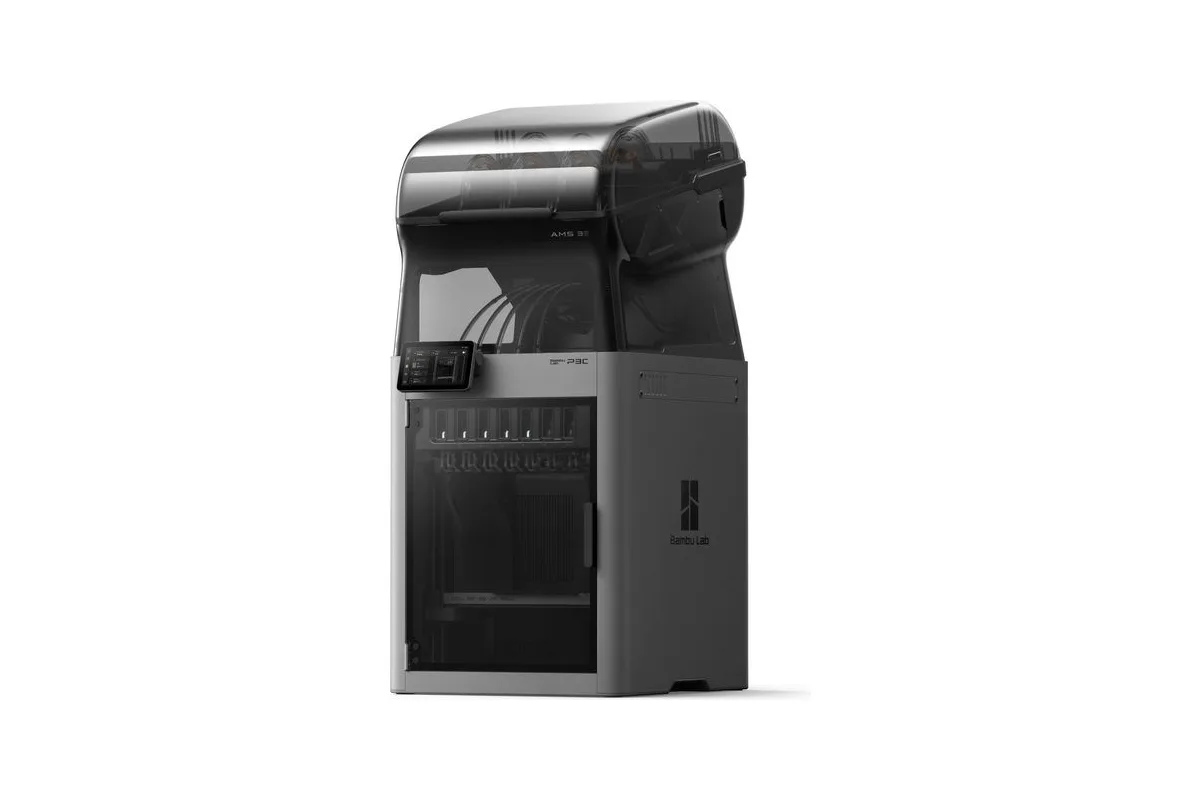
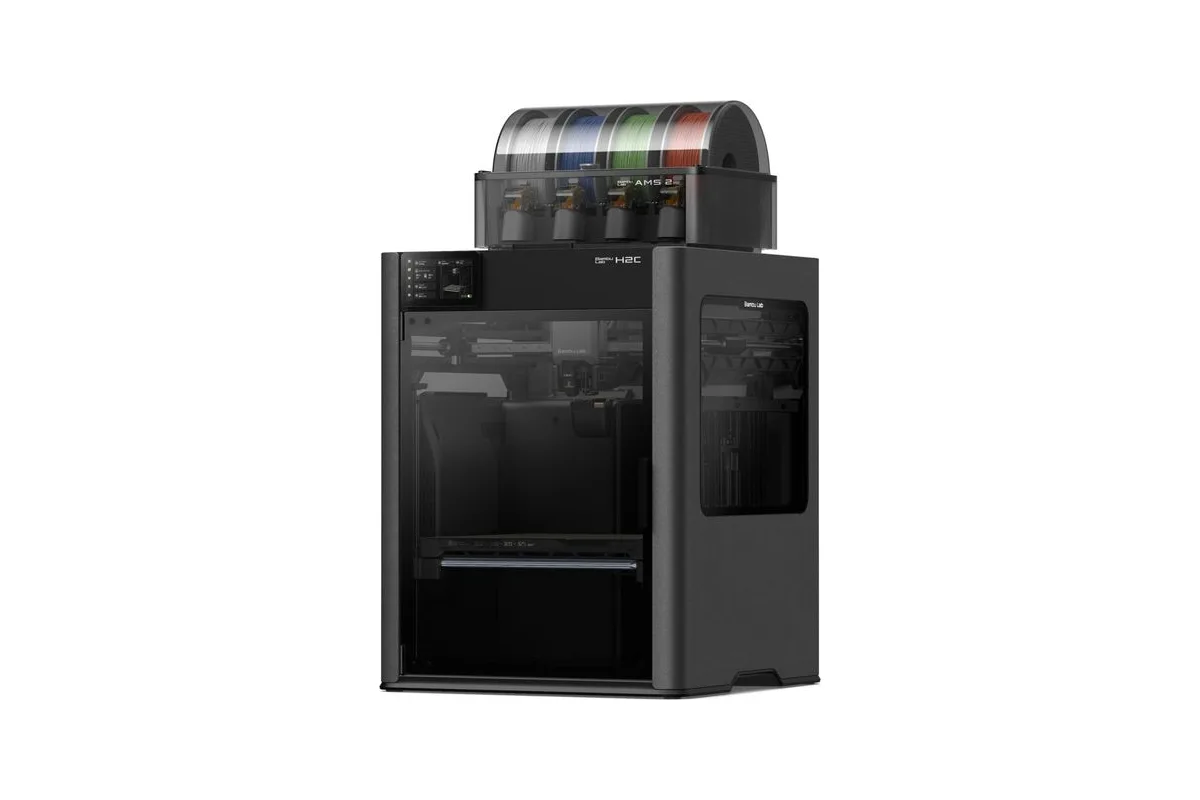
Side by side
| Feature | Bambu LabP3C Combo | Bambu LabH2C AMS Combo |
|---|---|---|
| Build volume | 256 × 256 × 260 mm | 330 × 320 × 320 mm |
| Max nozzle / bed | 300 °C / 110 °C | 350 °C / 120 °C |
| Tools | 5 included, 7 slots | |
| Chamber | Enclosed, no active heating | Active, 65 °C |
Bambu Lab P3C Combo
- Build volume
- 256 × 256 × 260 mm
- Max nozzle / bed
- 300 °C / 110 °C
- Tools
- 5 included, 7 slots
- Chamber
- Enclosed, no active heating
Bambu Lab H2C AMS Combo
- Build volume
- 330 × 320 × 320 mm
- Max nozzle / bed
- 350 °C / 120 °C
- Tools
- Chamber
- Active, 65 °C
Bambu Lab P3C vs H2C: which should I buy?
The P3C for most people; the H2C for engineering materials and big parts. Both cut multicolor purge waste by giving each filament its own hot nozzle instead of flushing one nozzle at every color change. They get there differently, and they’re built for different jobs:
- The P3C Combo ($1,149 at Bambu’s US store in November 2026, not discounted) is a true tool changer. It ships with five PrintTools, has room for seven, and includes the 7-spool AMS 3P. It has no heated chamber and a 256 mm build area.
- The H2C AMS Combo ($1,899, typical $2,199) is an H2D-class machine with Bambu’s Vortek system: one fixed left hotend plus a rack of six induction-heated hotends that swap in. It has a 350 °C nozzle, an active 65 °C chamber and about twice the P3C’s build volume.
If you print PLA and PETG in color, the P3C does the low-waste part for $750 less. Pay for the H2C when you need what the P3C can’t do: ABS, ASA, nylon and carbon-fiber parts at size, or a laser. One caution: the P3C was announced on November 24, 2026, and Bambu hasn’t confirmed a ship date. See our P3C review and H2C review.
What’s the difference between the P3C and H2C?
| Bambu Lab P3C Combo | Bambu Lab H2C AMS Combo | |
|---|---|---|
| Price (Bambu US, Nov 28, 2026) | $1,149 (no discount) | $1,899 (typical $2,199) |
| Status | Announced Nov 24, 2026; orderable, no ETD shown | Current since Nov 18, 2025 |
| Multicolor system | SwapTek tool changer: 7 slots, 5 PrintTools included | Vortek: 1 left hotend + rack of 6 induction hotends |
| Filament box in the bundle | AMS 3P, 7 spools (no auto-feed; dryer optional) | AMS 2 Pro, 4 spools, with drying |
| Max colors | 7 low-waste (with 2 more tools); 22 with 4 extra AMS | 7 low-waste; 24–25 with AMS units |
| Build volume | 256 × 256 × 260 mm (about 17.0 L) | 330 × 320 × 320 mm total (about 33.8 L) |
| Max nozzle / bed | 300 °C / 110 °C | 350 °C / 120 °C |
| Chamber | Enclosed, no active heating | Enclosed, active 65 °C |
| Speed / acceleration (Bambu) | 1,400 mm/s / 25,000 mm/s² | 1,000 mm/s / 20,000 mm/s² |
| Tool or nozzle change (Bambu) | 3.4 s tool switch; 6 s material switch | Induction hotend heats in 8 s (PLA Basic) |
| Cameras | 1080p live view; BirdsEye optional; no toolhead camera | Live view and nozzle (1080p) plus toolhead camera |
| Filtration | H11 HEPA + carbon | G3 + H12 HEPA + carbon |
| Laser | No (blade, pen, deboss and foil CraftTools) | 10W or 40W laser bundles (out of stock Nov 28) |
| Noise (Bambu) | 43.65 dBA standard, 40.16 dBA silent | 50 dB average, 61 dB peak on a speed Benchy |
| Power, PLA (Bambu) | 210 W | 200 W |
| Weight | 26.5 kg with AMS 3P | 32.5 kg |
| Warranty (Bambu US store) | 24 months; hotend not covered | 24 months; hotends not covered |
| Bug and feature updates until | Nov 24, 2031 | Nov 18, 2030 |
Source: Bambu’s US store, specification pages, wiki FAQs, warranty policy and compare page, read November 28, 2026. Liters are our estimate from Bambu’s dimensions. Bambu’s two noise figures come from different test rooms (about 30 dBA for the P3C, 40 dB for the H2C), so they don’t compare directly.
Which wastes less filament?
Both waste far less than a single-nozzle printer, and Bambu’s own figures for each are claims made under different conditions:
- P3C: Bambu claims 0.038 g per tool swap, “based on internal testing under optimal conditions”. While a print uses no more colors than you have PrintTools, Bambu says color changes come “close to ‘no purging’”, with a small wipe on the tower.
- H2C: Bambu gives slicer-calculated purge and prime-tower waste on three models. On its Geminaraptor print (two parts, six colors each), the H2C uses 532 g against 3,032 g on the H2D and 3,917 g on the single-nozzle H2S. That’s about 86% less than the H2S (our estimate). Bambu notes these figures assume all six induction hotends are the same size and fully used.
Bambu hasn’t published both machines on the same test model, so we can’t say which wastes less. What matters more: either one beats an AMS on a single nozzle, and both start purging again once a print uses more colors than they have hotends. Colors beyond the tool count share a filament path and purge like any AMS printer.
How much does each color cost?
Counted as low-waste slots, our estimate:
- P3C Combo: $1,149 for 5 PrintTools is about $230 per tool.
- P3C Multi-Colorist Combo: $1,269 for all 7 PrintTools is about $181 per tool until December 3, then $1,299 (about $186). The two extra tools work out to about $60 each at launch pricing.
- H2C AMS Combo: $1,899 for up to 7 hotend positions is about $271 per position. The box includes eight hotends, but Bambu says full seven-hotend swapping at 0.4 mm needs three more 0.4 mm induction hotends, another AMS 2 Pro and an AMS HT. We didn’t find US prices for those, and the firmware “does not yet support mixing nozzle sizes” in one print.
So the P3C costs less per color before you count any add-ons, and its bundle feeds all seven tools from one 7-spool AMS 3P.
Which is better for engineering materials?
The H2C. Its active 65 °C chamber, 350 °C hotends and 120 °C bed are built for ABS, ASA, nylon and fiber-filled filaments, especially on large parts that warp as they cool. Its G3, H12 HEPA and carbon filter stack is also the more thorough setup for fumes.
The P3C is enclosed, and Bambu lists ABS, ASA, PA, PC, PPA and carbon- and glass-fiber blends among its materials. But Bambu says it “does not support active chamber temperature control” and relies on heat from the bed and hotend. In that respect Bambu puts it alongside the P2S: the same 300 °C and 110 °C limits, and no chamber heater on either. That’s enough for ABS and ASA, but the H2C’s heated chamber is the safer bet for large engineering parts.
Which is bigger and faster?
The H2C is about twice the size inside (about 33.8 L against 17.0 L, our estimate). The P3C has the higher rated speed and acceleration (1,400 mm/s and 25,000 mm/s² against 1,000 mm/s and 20,000 mm/s²). Real print times depend more on the model and color changes than on top speed.
What do you give up with the P3C?
- No heated chamber, a 300 °C nozzle limit and a 256 mm build area.
- No toolhead camera, so no Vision Encoder motion calibration. The H2C has three cameras.
- No laser. The P3C does blade cutting, drawing, debossing and cold foil with CraftTools; a Crafting Complete Kit with BirdsEye is $140.
- The AMS 3P doesn’t auto-feed, and its 75 °C dryer is an optional module that needs a separate 24 V adapter.
- It’s brand new. The store shows it in stock with no ETD, and the printer and AMS 3P ship in separate boxes. Until Bambu confirms shipping, treat the arrival date as unknown.
Which should you buy?
The P3C if your goal is multicolor PLA and PETG with almost no purge pile, and you can wait for shipping. Get the Multi-Colorist bundle before December 3 if you want all seven tools. The H2C if you print functional parts in engineering filaments, need the bigger build volume, or want a 10W or 40W laser. If you don’t need multicolor at all, the single-nozzle H2S gives you the same chamber and a larger build for less. For the H2-family trade-offs, see H2C vs H2D and the Bambu lineup explained. For other options, see the best tool changer 3D printers.
Questions people ask
Is the P3C a tool changer?
Yes. It has seven PrintTool slots on Bambu’s SwapTek system, with five tools in the box, all with 0.4 mm hardened-steel nozzles.
Is the H2C a tool changer?
Not in the same way. The H2C keeps one fixed left hotend and swaps the right one from a rack of six induction-heated hotends, which reach temperature in about 8 seconds (Bambu). That gives each filament its own hot nozzle, so it cuts purge waste the way a tool changer does.
Does the P3C replace the H2C?
No. Bambu says the H3C, the P3C’s bigger sibling, doesn’t replace the H2C either: the H2C is for users who want automatic pairings of many filaments and nozzle sizes. All three are current.
Is the H2C worth $750 more than the P3C?
Only if you need its heated chamber, 350 °C nozzle, bigger build area or laser. For multicolor PLA and PETG, the P3C does the job for less.
Can I buy either on Amazon?
No. Bambu sells only the A1, A1 mini, P1S and P2S on Amazon. The P3C is sold at Bambu’s store; the H2C AMS Combo is also at Micro Center and Best Buy for $1,899.99, though Bambu’s 2-year US warranty covers only purchases from its own store.
When does P3C launch pricing end?
December 3, 2026. The Multi-Colorist bundle goes from $1,269 to $1,299; the base Combo stays $1,149. The H2C’s sale price ends December 1 at 2:00 AM ET.
Sources
- Bambu Lab: P3C brings home its H3C technology at half the price, blog.bambulab.com
- Bambu Lab US store: P3C, us.store.bambulab.com
- Bambu Lab P3C specifications, bambulab.com
- Bambu Lab wiki: P3C FAQ, wiki.bambulab.com
- Bambu Lab US store: H2C, us.store.bambulab.com
- Bambu Lab H2C product page, bambulab.com
- Bambu Lab H2C specifications, bambulab.com
- Bambu Lab wiki: H2C FAQ, wiki.bambulab.com
- Bambu Lab: H2C, where multi-material Vortek meets engineering precision, blog.bambulab.com
- Bambu Lab printer comparison (software update support), bambulab.com
- Bambu Lab warranty policy, bambulab.com
- Bambu Lab wiki: power consumption, wiki.bambulab.com
Keep exploring

How to
Hardened steel vs brass nozzles, and what nozzle size to use
Brass, or the stainless steel Bambu ships on the A1, is fine for PLA, PETG, ABS, ASA and TPU. Carbon fiber, glass fiber, glow-in-the-dark and sparkle filaments need hardened steel. Use a 0.4 mm nozzle for most prints, 0.6 mm for carbon fiber and big parts, and 0.2 mm for miniatures.
Read story
How to
Can you 3D scan with an iPhone? Yes, but not to tight tolerances
Yes. Any current iPhone can 3D scan objects from photos (photogrammetry), and KIRI Engine's free tier exports STL for printing. Only the iPhone 18 Pro and 18 Pro Max have LiDAR in Apple's current lineup. For parts that must fit, a $359 scanner is about ten times tighter.
Read story