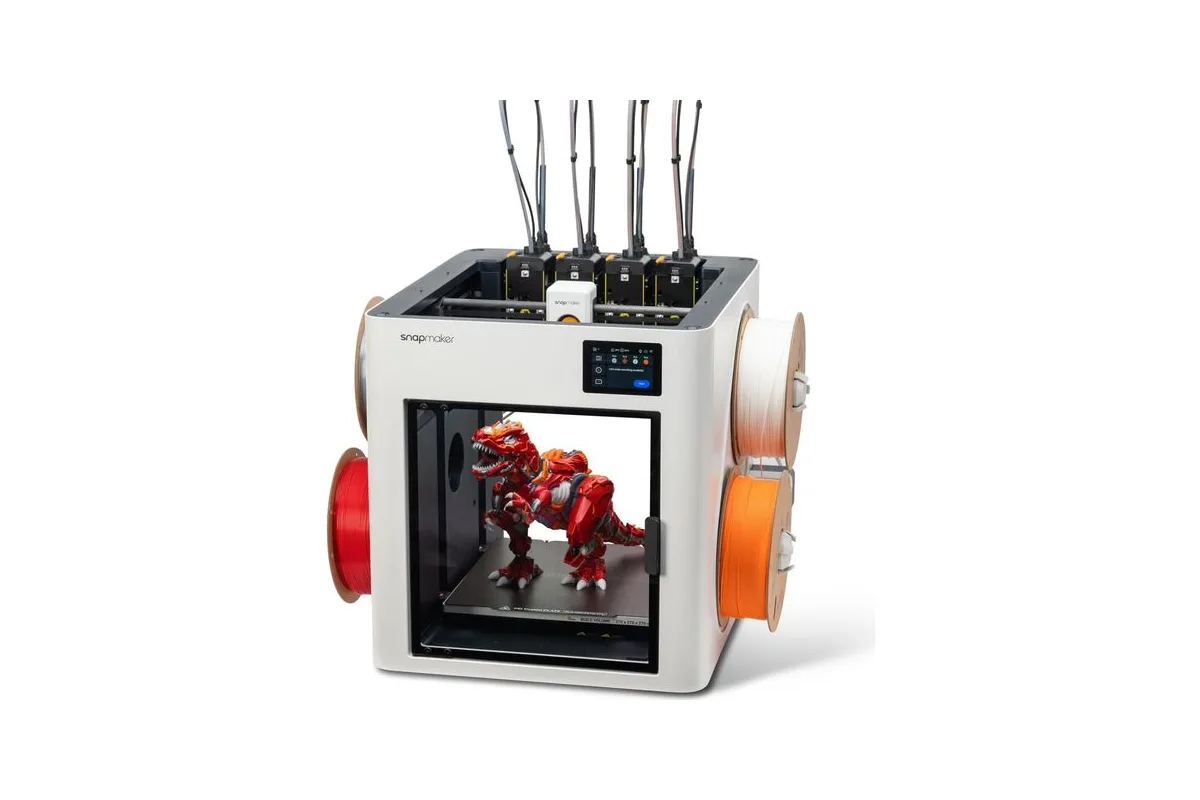
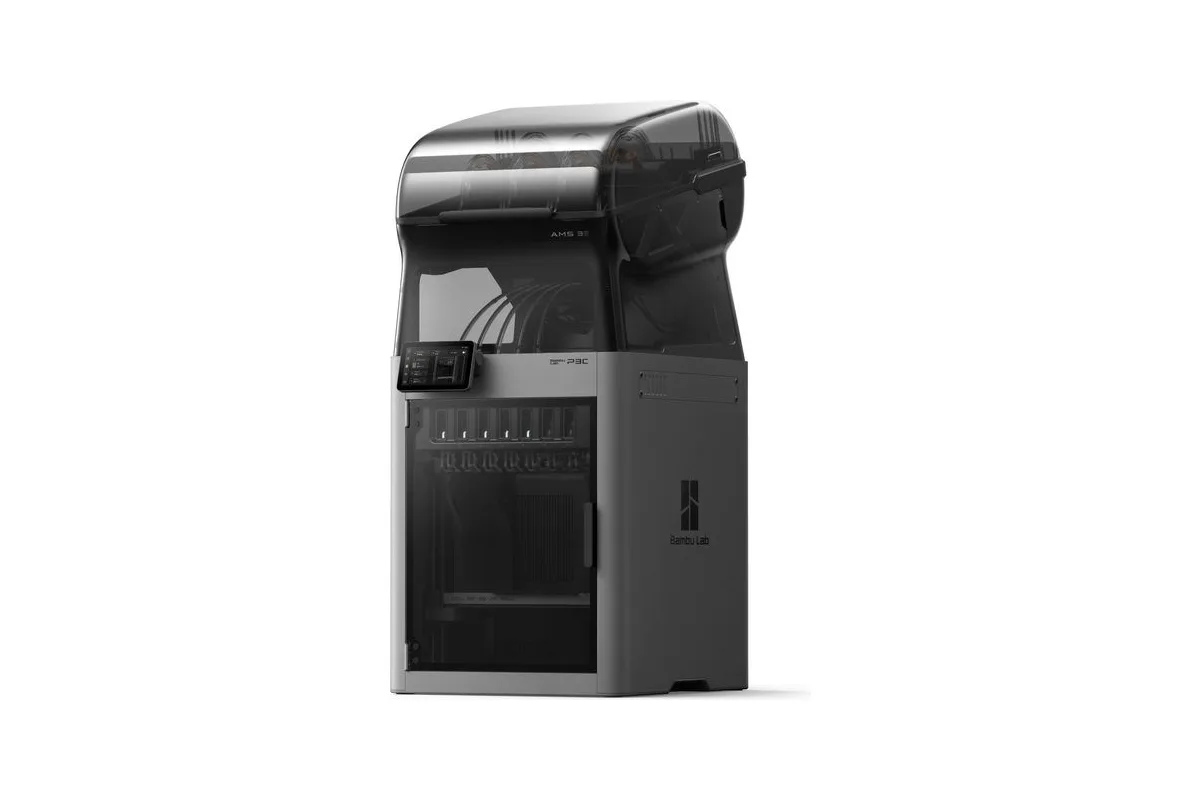
Side by side
| Feature | SnapmakerU1 | Bambu LabP3C Combo |
|---|---|---|
| Frame | CoreXY, open top | |
| Build volume | 270 x 270 x 270 mm | 256 × 256 × 260 mm |
| Multicolor | 4 toolheads (tool changer) | |
| Materials | PLA, PETG, TPU (ABS/ASA with top cover) | |
| Where to buy | Check price at Amazon |
Snapmaker U1
- Frame
- CoreXY, open top
- Build volume
- 270 x 270 x 270 mm
- Multicolor
- 4 toolheads (tool changer)
- Materials
- PLA, PETG, TPU (ABS/ASA with top cover)
Bambu Lab P3C Combo
- Frame
- Build volume
- 256 × 256 × 260 mm
- Multicolor
- Materials
Snapmaker U1 vs Bambu Lab P3C: which multicolor printer is better?
The P3C is the better printer; the U1 is the better deal. Both are true tool changers: each color gets its own nozzle, so a color change is a tool swap of a few seconds instead of a purge. That’s why both waste far less filament than an AMS-style single-nozzle printer.
- The Snapmaker U1 is $699 at Snapmaker’s US store in November 2026 (list $999), and $699 on Amazon. It has four toolheads, a 270 mm cube build volume and an open top. It’s in stock now.
- The Bambu P3C Combo is $1,149 at Bambu’s US store, not discounted. It’s enclosed, ships with five PrintTools and room for seven, and comes with the sealed 7-spool AMS 3P. Bambu announced it November 24, 2026, and hasn’t confirmed a ship date.
If you want four colors in PLA and PETG and $450 matters, buy the U1. If you want an enclosed machine with more tools, better filament storage and a longer warranty, the P3C is worth the extra once it ships. Read our U1 review and P3C review.
What’s the difference between the U1 and P3C?
| Snapmaker U1 | Bambu Lab P3C Combo | |
|---|---|---|
| Price (maker US store, Nov 28, 2026) | $699 (list $999) | $1,149 (no discount) |
| Other stores | $699 on Amazon (Nov 24); $699.99 at Micro Center | Bambu only |
| Status | In stock | Announced Nov 24, 2026; orderable, no ETD shown |
| Tools | 4 toolheads | 5 PrintTools included, 7 slots |
| Swap time (maker) | About 5 s | 3.4 s tool switch; 6 s material switch |
| Max colors | 4 | 7 low-waste; 22 with 4 extra AMS units |
| Spool storage | Open, on the sides | AMS 3P: 7 spools, sealed, RFID (no auto-feed; dryer optional) |
| Build volume | 270 × 270 × 270 mm (about 19.7 L) | 256 × 256 × 260 mm (about 17.0 L) |
| Max nozzle / bed | 300 °C / 100 °C | 300 °C / 110 °C |
| Enclosure | Open top; Top Cover $149 (list $249) | Enclosed; no active chamber heating |
| Filtration | With the Top Cover only | H11 HEPA + carbon |
| Speed / acceleration (maker) | 500 mm/s / 20,000 mm/s² | 1,400 mm/s / 25,000 mm/s² |
| Nozzles | 0.4 mm stainless steel | 0.4 mm hardened steel |
| Camera | 2 MP, AI failure detection | 1080p, AI detection; BirdsEye optional |
| Crafting | None | Blade, pen, deboss and foil CraftTools |
| Connectivity | 2.4 GHz Wi-Fi, USB, 26 GB | Wi-Fi 6, 64 GB; no Ethernet on either |
| Firmware / slicer | Klipper; Snapmaker Orca, OrcaSlicer | Bambu’s own firmware and software |
| Noise (maker) | No figure published | 43.65 dBA standard, 40.16 dBA silent |
| Size / weight | 584 × 499 × 730 mm, 18.2 kg | 413 × 538 × 935 mm with AMS 3P, 26.5 kg |
| Warranty | 1 year; $99 Care plan | 2 years from Bambu’s US store; hotend not covered |
| Price per tool (our estimate) | $175 | $230; $181 with 7 tools ($1,269) |
Source: Snapmaker’s US store, product and specification pages; Bambu’s US store, launch post, specification page, wiki FAQ, warranty policy and compare page. Read November 24–28, 2026. Liters and price per tool are our estimates from the makers’ figures and sale prices.
Which wastes less filament?
Both make little waste while a print uses no more colors than they have tools, and each maker’s figure is a claim under its own conditions:
- Snapmaker U1: “up to 85% less waste” than shared-nozzle printers, from Snapmaker’s lab tests. On its Castle Tower model, Snapmaker reports 87.42 g of filament in total on the U1 against 586.02 g on a single-nozzle printer; on a Hexagon Vase, 241.96 g against 1,452.26 g. Snapmaker says the U1 still prints a small prime tower.
- Bambu P3C: “0.038 g” per tool swap, “based on internal testing under optimal conditions”. Bambu says color changes come “close to ‘no purging’”, with a small amount extruded at the wipe tower.
The two makers measure different things (whole-print totals against per-swap purge), so the figures can’t be compared directly. The practical difference is the tool count. With four colors or fewer, both do the job. For a five-color print, the U1 can’t, while the P3C Combo has five tools. With two more PrintTools it does seven. Beyond its tool count, the P3C can feed up to 22 colors from extra AMS units, but those share a filament path and purge like any AMS printer.
How much does each color cost?
Our estimate, counting low-waste tools:
- U1: $699 for 4 toolheads is about $175 per tool. With the $149 Top Cover, $848 works out to $212.
- P3C Combo: $1,149 for 5 PrintTools is about $230 per tool.
- P3C Multi-Colorist Combo: $1,269 for 7 PrintTools is about $181 per tool until December 3, then $1,299 (about $186).
So per tool, the U1 and a seven-tool P3C come out close. The U1 is cheaper because it has fewer tools, not because each one costs less. A spare U1 toolhead is $64.99; the P3C’s two extra PrintTools work out to about $60 each in the Multi-Colorist bundle at launch pricing (our estimate).
What does it cost to make the U1 match the P3C?
You can’t fully. Adding the $149 Top Cover (list $249) encloses the U1 and adds what Snapmaker calls three-stage air filtration. That opens up PET, ABS, ASA, nylon and PC. With a hardened-steel nozzle, it opens up carbon- and glass-fiber blends too. That’s $848, still $301 less than the P3C Combo (our estimate).
What the U1 still lacks: a fifth tool, sealed spool storage and a 2-year warranty. Its spools hang open on the sides, which matters for PETG, TPU and nylon in a humid room; the P3C’s AMS 3P keeps seven spools sealed and offers an optional 75 °C dryer, though it doesn’t feed filament automatically and the dryer needs its own 24 V adapter.
Which is more reliable?
Too early to say for the P3C, which wasn’t shipping when we checked. The U1 has been on sale since April 2026, and we found no recall. Snapmaker says it has tested the swap mechanism over a million cycles, and it calibrates toolhead offsets automatically to within 0.04 mm with clean nozzles.
On paper, Bambu backs the P3C longer: 24 months from its US store, covering the SwapTek rack and PrintTools but not the hotends, plus bug and feature updates until November 24, 2031. The U1 has a 1-year warranty; Snapmaker’s $99 Care plan (list $119) extends wear-part cover from 3 to 6 months.
Which should you buy?
The Snapmaker U1 if you want low-waste four-color printing now, at the lowest price. It’s $699 on Amazon and at Snapmaker, whose sale timer pointed to about the night of November 29–30 when we checked (our estimate). Budget $149 more for the Top Cover if you’ll print ABS or ASA.
The Bambu P3C if you want an enclosed, filtered tool changer with more tools and sealed spool storage, and can wait. Buy the Multi-Colorist bundle before December 3 if you want seven tools. If you need a heated chamber or a bigger build, see P3C vs H2C.
More choices in the best tool changer 3D printers and the best multicolor 3D printers.
Questions people ask
Is the P3C better than the Snapmaker U1?
On paper, yes: it’s enclosed, has more tools, sealed spool storage and a longer warranty. It also costs $450 more and wasn’t confirmed shipping on November 28.
How many colors can the U1 print?
Four, one per toolhead. Snapmaker lists up to four colors or materials per print.
How many colors can the P3C print?
Five with the tools in the box, seven with two more PrintTools, and up to 22 with four external AMS units. Colors beyond the tool count purge like a normal AMS printer.
Can the U1 print ABS?
Only with the Top Cover. Without it, Snapmaker lists PLA, PETG, TPU, PVA and PCTG.
Does the P3C have a heated chamber?
No. Bambu says it doesn’t support active chamber temperature control; it’s enclosed and holds heat from the bed and hotend.
Is the P3C on Amazon?
No. Bambu sells only the A1, A1 mini, P1S and P2S on Amazon. The P3C is sold at Bambu’s own store.
Sources
- Snapmaker US store: U1, us.snapmaker.com
- Snapmaker U1 product page, snapmaker.com
- Snapmaker U1 specifications, snapmaker.com
- Snapmaker U1 Top Cover, us.snapmaker.com
- Bambu Lab: P3C brings home its H3C technology at half the price, blog.bambulab.com
- Bambu Lab US store: P3C, us.store.bambulab.com
- Bambu Lab P3C specifications, bambulab.com
- Bambu Lab wiki: P3C FAQ, wiki.bambulab.com
- Bambu Lab warranty policy, bambulab.com
- Bambu Lab printer comparison (software update support), bambulab.com
Keep exploring

How to
Hardened steel vs brass nozzles, and what nozzle size to use
Brass, or the stainless steel Bambu ships on the A1, is fine for PLA, PETG, ABS, ASA and TPU. Carbon fiber, glass fiber, glow-in-the-dark and sparkle filaments need hardened steel. Use a 0.4 mm nozzle for most prints, 0.6 mm for carbon fiber and big parts, and 0.2 mm for miniatures.
Read story
How to
Can you 3D scan with an iPhone? Yes, but not to tight tolerances
Yes. Any current iPhone can 3D scan objects from photos (photogrammetry), and KIRI Engine's free tier exports STL for printing. Only the iPhone 18 Pro and 18 Pro Max have LiDAR in Apple's current lineup. For parts that must fit, a $359 scanner is about ten times tighter.
Read story