Printers in this guide
What is the best food-safe 3D printer filament?
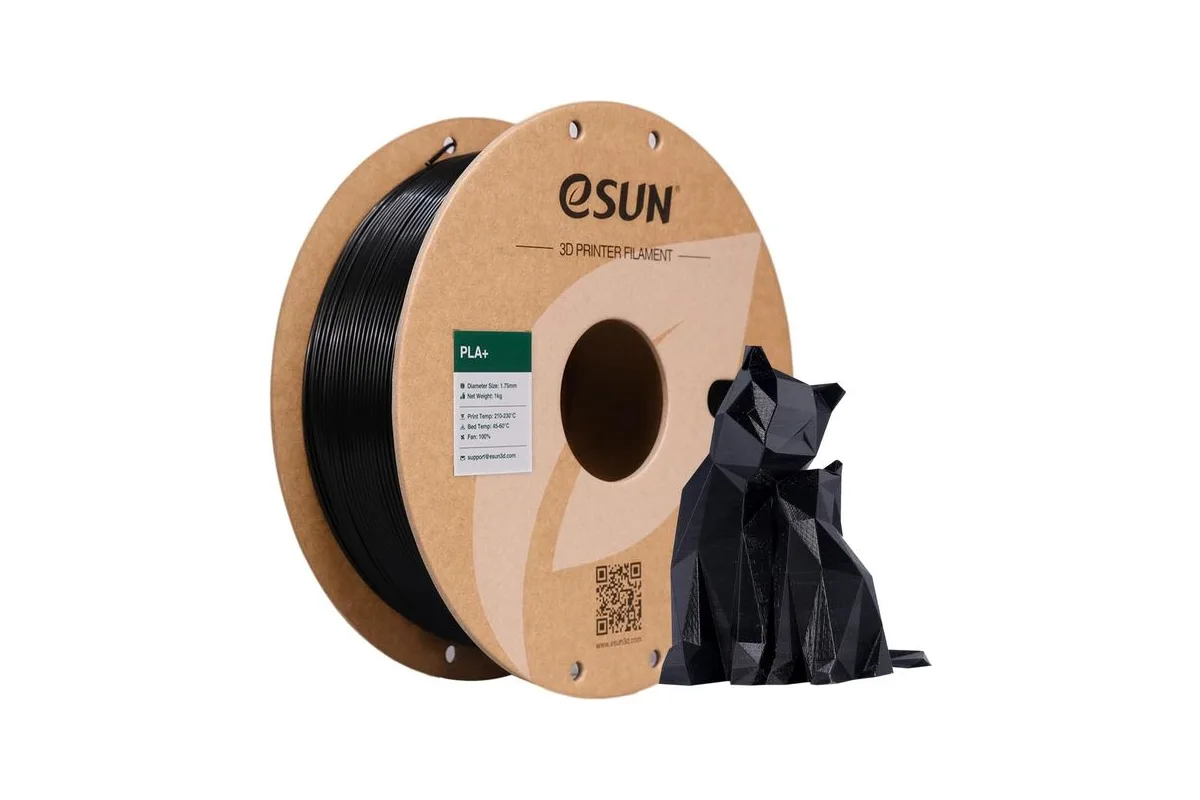
No filament makes a 3D print food-safe, but two have real test paperwork: Bambu Lab PLA Pure and eSun PLA+. Bambu PLA Pure, new in 2026, passed testing against the EU’s food-contact plastics rules (Regulation 10/2011) in an SGS report dated March 13, 2026. eSun PLA+ has an SGS test under the FDA’s 21 CFR 175.300 extractives rule, with nothing detected, and an EU 10/2011 overall migration pass.
Those reports cover the filament, not what comes out of your printer. Bambu itself says PLA Pure prints aren’t suitable for liquid foods, shouldn’t go above 60 °C and shouldn’t be printed with glue. Bambu, Prusa and Polymaker each say the same thing in their own words: layer lines, the nozzle and anything on the build plate decide whether a print is safe to touch food, and a home printer can’t guarantee any of them.
Which filaments have food-contact test reports?
| Filament | What was tested | Maker’s limits | Price, November 2026 |
|---|---|---|---|
| Bambu PLA Pure | SGS report CANEC26004685501 (Mar 13, 2026): EU 1935/2004, EU 10/2011 with its 2025 amendment (overall migration, heavy metals, aromatic amines), EU bisphenol rules, odor and taste. All “Pass”, including tests at 60 °C and 70 °C for 2 hours on a repeated-use basis | No liquid foods; keep prints under 60 °C; no glue; nozzle hygiene matters | $16.99 refill, $19.99 with spool at Bambu; $12.99 a roll at 10+ |
| eSun PLA+ | SGS report (May 23, 2025): FDA 21 CFR 175.300 total extractives, not detected. SGS report (Jun 18, 2025): EU 10/2011 overall migration and odor/taste, Pass. Both on a white sample | Colors other than the tested white aren’t stated | $16.99 on Amazon; $12.75 a roll at 10+ at eSun |
| Prusament PLA and PETG | No certification. Prusa says its coloring supplier “confirmed that these colors should be safe for food contact” for 12 PLA and 10 PETG colors | “No print is food-safe without surface coating” | — |
| Other Bambu filaments | None. PLA Basic, Matte, Silk+, Tough+, PETG and TPU pages all say the filament “is not food-grade” | “Avoid using finished prints for food storage or contact” | — |
Polymaker’s food safety page names no Polymaker filament as compliant.
Bambu PLA Pure is built around food contact: Bambu says all five of its ingredients are EU food-contact certified. Its store page also says the certification “applies to the filament itself” and depends on “equipment hygiene (particularly the nozzle),” and that Bambu makes no warranty about the safety of prints you make.
eSun PLA+ calls itself an “FDA-certified material” on its data sheet. The document behind that is an SGS test report, not an FDA certification, and 21 CFR 175.300 is the FDA’s rule for coatings (our reading of the report). It’s still more testing than most filaments have.
Does the FDA approve food-safe filament?
No. The FDA doesn’t approve filaments. US food-contact plastics are regulated substance by substance, as indirect food additives under 21 CFR parts 174 to 178, food contact notifications and the threshold of regulation. Under 21 CFR 174.5, any substance in a food-contact article “shall be of a purity suitable for its intended use,” made under good manufacturing practice. Under 21 CFR 170.39, a substance can be exempt when it migrates into the diet at or below 0.5 parts per billion.
Polymaker puts it plainly: in the US, a filament’s status “depends on the status of each substance that may migrate to food,” including “the specific substance, manufacturer, and conditions of use.” A 2022 university food science fact sheet on 3D-printed parts for food contact (FAPC-244) says an FDA status of “compliant” means a material meets food-contact requirements “but has not been expressly approved.”
In the EU, the rule is Regulation (EU) No 10/2011 for plastics in contact with food, under the framework Regulation (EC) 1935/2004. That’s what Bambu’s PLA Pure report tests against.
Why isn’t a food-contact filament enough?
Four things stand between the spool and your food:
- Layer lines. Prusa calls the grooves between layers “a seedbed for bacteria.” Polymaker says they “can trap residue.”
- The nozzle. The FAPC-244 fact sheet warns that “some brass print nozzles may contain lead.” Prusa says a standard brass nozzle “is not considered food-safe, as it wears out,” and that you’d need a stainless steel or titanium nozzle. Polymaker adds that brass wear “can introduce metal residue.”
- Colorants and additives. Polymaker notes that a base plastic may be compliant while its “colorants, modifiers, or processing aids are not.” eSun’s reports cover a white sample; Prusa’s confirmations cover specific colors.
- Glue and heat. Bambu’s PLA Pure data sheet marks glue stick “Not Recommended” because residue “may compromise the contact safety of finished parts.” PLA softens early: heat deflection is 54–61 °C across Bambu, Prusament and Polymaker sheets, and Bambu says to keep PLA Pure prints under 60 °C.
What can you print for the kitchen?
Makers draw the line at short, dry, cool contact:
- Polymaker calls cookie cutters, cake decorations and display pieces reasonable uses.
- The FAPC-244 fact sheet suggests using prints as molds, printing at the lowest layer height to avoid narrow crevices, and cleaning with “lukewarm water and mild detergents.”
- Prusa says, “We do not recommend using 3d-prints as food-containers etc!” Where it made kitchen prints, it sealed them with Efkoresin Art UV, an epoxy certified to EU 10/2011, and still ruled out chopping boards, hot soups, microwaves and dishwashers.
The same fact sheet also lists coatings people use, including epoxies, shellac, waxes and polyurethane. A coating is only as good as its own food-contact rating for your use, so check the coating maker’s documents.
If you print something that will touch food, these steps follow the makers’ own guidance:
- Use a filament with a test report for that exact product, and the color that was tested where the maker says.
- Use a stainless steel or titanium nozzle, not brass, as Prusa advises. Bambu’s A1, A1 mini and P1S ship with stainless steel nozzles.
- Skip the glue stick, as Bambu advises for PLA Pure.
- Keep it dry, brief and cool: no liquids, no hot food, nothing above 60 °C, no dishwasher.
- Wash by hand in lukewarm water with mild detergent, and don’t keep reusing it: Prusa discourages repeated use because bacteria can build up in small fractures.
Questions people ask
Is PLA food safe?
The plastic can pass food-contact tests, as Bambu PLA Pure’s report shows, but a PLA print isn’t food-safe on its own account. Every other Bambu PLA page we read says “not food-grade,” and PLA’s heat deflection is only 54–61 °C on maker sheets.
Is PETG food safe?
PETG handles more heat than PLA (62–78 °C heat deflection across Bambu, Prusament and Polymaker sheets), but the same print problems apply, and Bambu labels its PETG “not food-grade.” Prusa’s coloring supplier confirmed 10 Prusament PETG colors for food contact without certification. What matters is the paperwork for the specific product, not the plastic family.
Are 3D-printed cookie cutters safe?
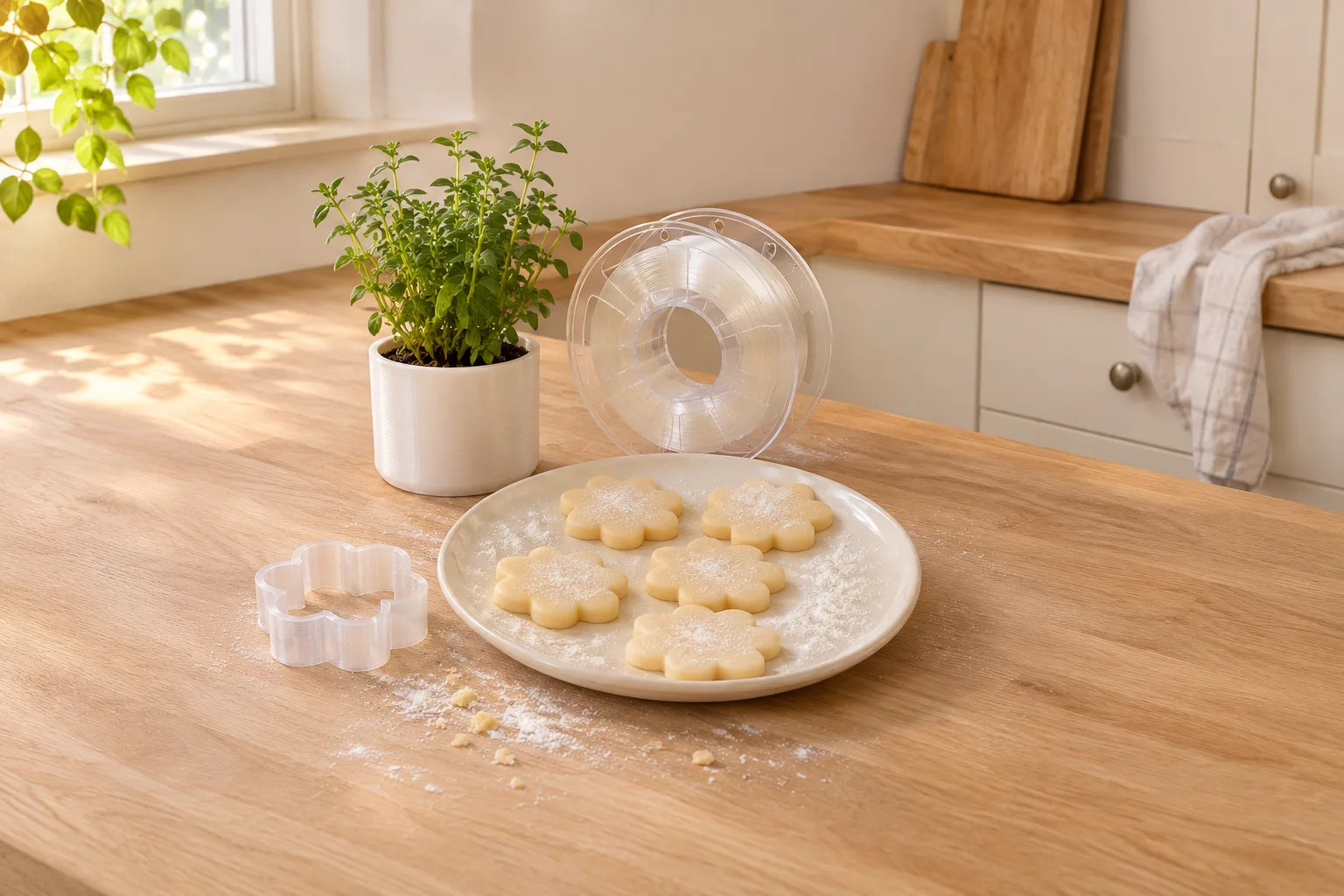
They’re the use makers are most comfortable with: Polymaker names cookie cutters as a reasonable use. Contact with dough is brief, dry and cold. Use a filament with a food-contact test, a non-brass nozzle and no glue, and wash it by hand.
Can you put a 3D print in the dishwasher?
No. The FAPC-244 fact sheet’s table marks none of the PLA filaments it lists as dishwasher-safe, Bambu says to keep PLA Pure prints under 60 °C, and Prusa rules out dishwashers even for its epoxy-coated prints.
Does an epoxy coating make a print food safe?
It closes the layer lines, which is why Prusa used one, but Prusa still says coated prints aren’t for chopping boards, hot soups, microwaves or dishwashers. Use an epoxy with its own food-contact certification, as Prusa did.
Is Bambu PLA Pure FDA compliant?
Bambu’s report covers EU rules (Regulations 1935/2004 and 10/2011). We didn’t find an FDA test for PLA Pure on Bambu’s pages. eSun PLA+ is the filament here with an FDA-rule test.
What else should I read?
For fumes and general printer safety, see are 3D printers safe? For the plastics themselves, see PLA vs PETG and is PLA biodegradable?
Sources
- Bambu Lab store: PLA Pure, us.store.bambulab.com
- Bambu Lab PLA Pure EU food-contact test report (SGS CANEC26004685501), store.bblcdn.com
- Bambu Lab PLA Pure technical data sheet, store.bblcdn.com
- Bambu Lab store: PLA Basic, us.store.bambulab.com
- eSun PLA+ technical data sheet, esun3d.com
- eSun PLA+ FDA 21 CFR 175.300 test report (SGS), esun3d.com
- eSun PLA+ EU food-contact test report (SGS), esun3d.com
- eCFR: 21 CFR 174.5, general provisions for indirect food additives, ecfr.gov
- eCFR: 21 CFR 170.39, threshold of regulation, ecfr.gov
- University extension fact sheet FAPC-244: 3-D printed parts for food contact (2022), extension.okstate.edu
- Prusa Knowledge Base: food-safe FDM printing, help.prusa3d.com
- Prusa blog: how to make food-grade 3D printed models, blog.prusa3d.com
- Polymaker wiki: food safety, wiki.polymaker.com
- Bambu Lab PLA Basic technical data sheet, store.bblcdn.com
- Prusament PLA, prusament.com
- eSun PLA+ on Amazon, amazon.com
Keep exploring

How to
Hardened steel vs brass nozzles, and what nozzle size to use
Brass, or the stainless steel Bambu ships on the A1, is fine for PLA, PETG, ABS, ASA and TPU. Carbon fiber, glass fiber, glow-in-the-dark and sparkle filaments need hardened steel. Use a 0.4 mm nozzle for most prints, 0.6 mm for carbon fiber and big parts, and 0.2 mm for miniatures.
Read story
How to
Can you 3D scan with an iPhone? Yes, but not to tight tolerances
Yes. Any current iPhone can 3D scan objects from photos (photogrammetry), and KIRI Engine's free tier exports STL for printing. Only the iPhone 18 Pro and 18 Pro Max have LiDAR in Apple's current lineup. For parts that must fit, a $359 scanner is about ten times tighter.
Read story