How it scores
- Print quality20%7.5
Scored from specs: a CoreXY frame, a 300 °C nozzle and a 110 °C bed, with Orca-based slicer profiles. Flashforge publishes no accuracy figures we can cite, and the open frame keeps it to PLA, PETG, TPU and carbon-fiber PLA or PETG.
- Setup and ease of use20%7.5
The four-color IFS is built in and it also prints single colors with the IFS disconnected. There's no camera in the box, so no remote monitoring until you add the $39.99 kit.
- Speed10%8.5
Rated 300 mm/s printing, 600 mm/s travel and 20,000 mm/s² acceleration, twice the Bambu A1's 10,000 mm/s². Flashforge gives no time per color change.
- Features and materials20%6.5
Four colors and a hotter bed than the A1, plus Ethernet. But the 220 mm cube is small, there's no enclosure, camera or filtration in the box, and Flashforge lists no ABS or ASA.
- Reliability and ownership20%6.5
12-month warranty, with the extruder covered for only 3 months and the build plate excluded; 30-day returns. Flashforge doesn't say what firmware the AD5X runs. We found no CPSC recall of any Flashforge printer.
- Value and running costs10%7.0
$329 in November 2026 is about $82 per color, but about $31 per liter of build volume against $21 for the A1 Combo (our estimates). No maker purge-waste figure.
Overall 7.2/10, the weighted average.How we score →
Is the Flashforge AD5X worth it?
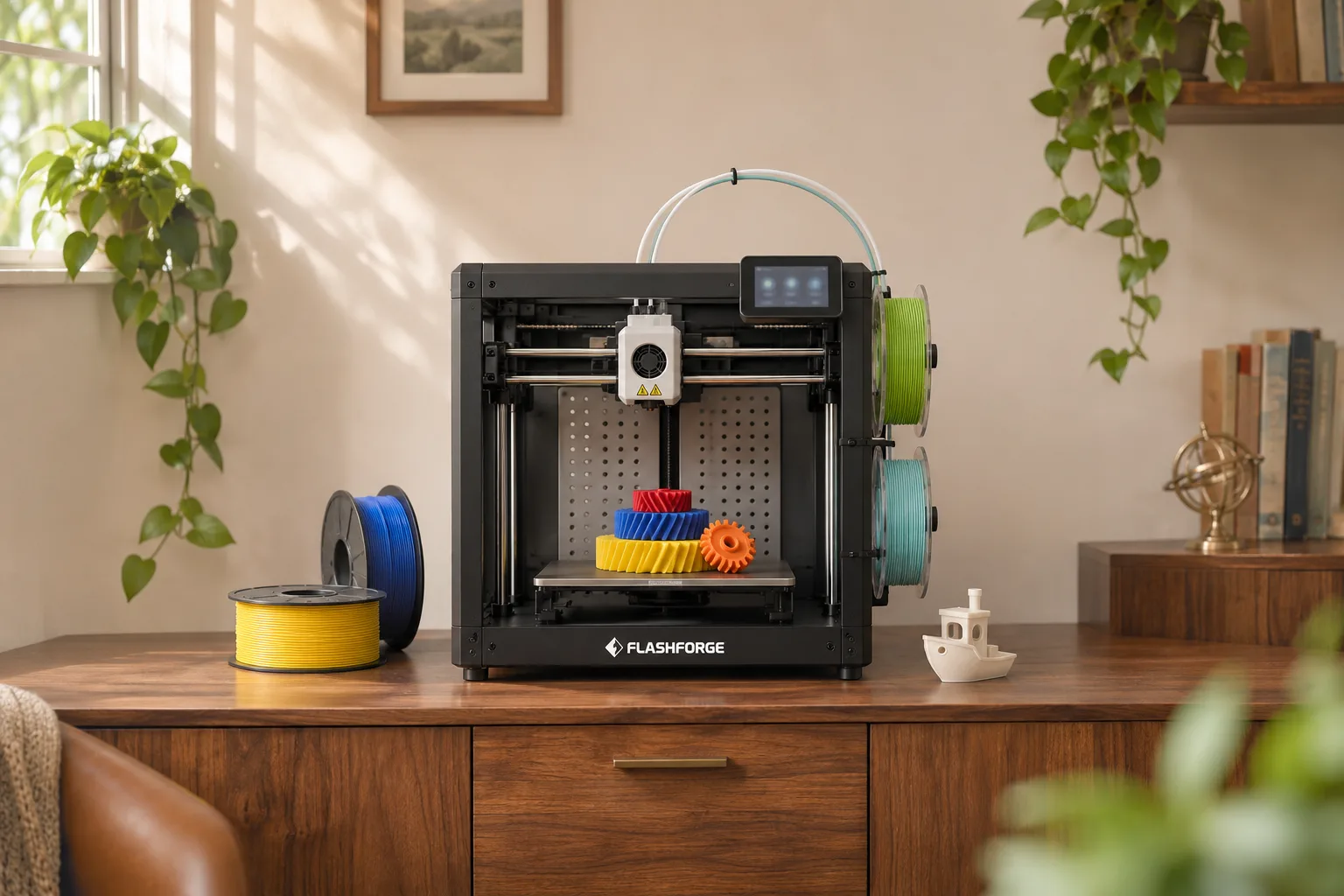
Yes, if you want four-color printing for as little as possible and your prints are small. The AD5X cost $349 at Flashforge in November 2026 (list $499), with an extra $20 taken off in the cart for $329, and it’s $329 on Amazon. For that you get an open CoreXY printer with Flashforge’s IFS feeding four filaments through one nozzle.
For most first-time buyers, though, the Bambu Lab A1 Combo is the better buy at $359. It has a 256 mm build area, about 58% more volume than the AD5X’s 220 mm cube (our estimate), plus a built-in camera and a 2-year warranty from Bambu’s store. The AD5X wins on rated acceleration, a hotter bed, Ethernet and an optional $49 enclosure kit.
| Spec | Flashforge AD5X |
|---|---|
| Price (Nov 2026) | $349 at Flashforge (list $499), $329 after the extra $20 cart discount; $329 on Amazon; refurbished $299 at Flashforge |
| Frame | Open CoreXY |
| Build volume | 220 x 220 x 220 mm (about 10.6 liters, our estimate) |
| Max nozzle / bed | 300 °C / 110 °C |
| Chamber | None (open frame; $49 enclosure kit) |
| Colors | 4, through one nozzle (IFS, included) |
| Speed (Flashforge) | 300 mm/s print, 600 mm/s travel, 20,000 mm/s² |
| Materials (Flashforge) | PLA, PETG, TPU 95A (single color), TPU 64D–75D, PLA-CF, PETG-CF |
| Camera | Not included ($39.99 kit) |
| Filtration | None |
| Connectivity | Wi-Fi, Ethernet, USB |
| Slicers | Orca-Flashforge, OrcaSlicer |
| Warranty | 12 months (extruder 3 months); 30-day returns |
Source: Flashforge’s AD5X product page, store and warranty policy, read November 28, 2026. Flashforge’s Black Friday sale runs through November 30.
What do you get for $329?
Four colors on a small, quick machine. The IFS (Intelligent Filament System) is built in, so there’s nothing extra to buy for multicolor. Flashforge’s own pitch is that four colors “already cover most of common multicolor print needs”, and that’s fair for signs, toys, keychains and two-tone parts.
The trade-off is size. A 220 mm cube holds about 10.6 liters, against 16.8 liters for the 256 mm cube on the Bambu A1 and most mid-range printers (our estimates). That matters for helmets, organizers and printing several parts on one plate.
The AD5X has been on sale since November 2024, so it’s an established model, not a new launch.
How much filament does the AD5X waste in multicolor?
Flashforge doesn’t publish a figure. The IFS works like Bambu’s AMS lite: each color change withdraws the old filament, feeds the new one and purges the transition through the single nozzle. Flashforge’s own advice is to check the slicer’s time and material estimates before a multicolor print.
If you print a lot of multicolor, waste adds up on any single-nozzle printer. Flashforge’s answer is the Creator 5 Pro ($649), which switches between four independent toolheads instead. Flashforge’s blog says separate toolheads “reduce that kind of purge waste” without removing every source of it. See is a multicolor 3D printer worth it?
How fast is it?
Quick for the price. Flashforge rates it at 300 mm/s printing, 600 mm/s travel and 20,000 mm/s² acceleration. The headline 600 mm/s is travel speed, not printing speed. On a CoreXY frame the print head moves and the bed only drops, so the print isn’t swung back and forth as it is on a bed slinger like the A1.
Flashforge doesn’t say how long a color change takes, so we can’t estimate multicolor print times.
What does it cost to add a camera and enclosure?
The AD5X ships open, with no camera. Flashforge sells both as kits:
| Setup | Price (our estimate) |
|---|---|
| AD5X | $329 |
| + camera kit ($39.99) | $369 |
| + camera and enclosure kit ($49) | $418 |
| Bambu A1 Combo, camera included | $359 |
Even with the enclosure, Flashforge lists no ABS or ASA among the AD5X’s materials. If you want ABS, buy an enclosed printer. Flashforge’s own Adventurer 5M Pro ($359 after the cart discount, regular $529) is enclosed, with a camera and HEPA and carbon filtration, but it has no multicolor option: Flashforge says the IFS doesn’t work with the 5M or 5M Pro.
Is the AD5X reliable?
There’s less to go on than with Bambu. Flashforge gives a 12-month warranty, but the extruder is covered for only 3 months, and the build plate, tools and accessories are excluded. You get 30 days to return it, and you pay return shipping if nothing is wrong with it.
Flashforge doesn’t say what firmware the AD5X runs. Its open-source Klipper project names only the Adventurer 5M series. It connects by Wi-Fi, Ethernet or USB and works with the free OrcaSlicer as well as Flashforge’s own Orca build. We found no CPSC recall of any Flashforge printer.
Flashforge AD5X vs Bambu Lab A1 Combo
| Flashforge AD5X | Bambu Lab A1 Combo | |
|---|---|---|
| Price (Nov 2026) | $329 | $359 (typical $399) |
| Build volume | 220 mm cube (10.6 L) | 256 mm cube (16.8 L) |
| Price per liter (our estimate) | $31 | $21 |
| Frame | CoreXY | Bed slinger |
| Acceleration | 20,000 mm/s² | 10,000 mm/s² |
| Bed | 110 °C | 100 °C |
| Camera | $39.99 kit | Included |
| Enclosure | $49 kit | No option |
| Warranty | 12 months | 2 years from Bambu’s store |
The A1 Combo is the safer first printer; the AD5X suits someone who wants CoreXY motion and Ethernet for less. Full breakdown: Flashforge AD5X vs Bambu Lab A1 Combo.
Should you buy the Flashforge AD5X?
Buy the AD5X if you want four colors under $350, mostly print small objects, and like the idea of an enclosure kit later. Buy the Bambu A1 Combo if you want a bigger build area, a camera and Bambu’s longer warranty for $30 more. On a tighter budget, the A1 mini Combo is $299 at Bambu, with a smaller 180 mm cube. See the best multicolor 3D printers and the best cheap 3D printers.
Questions people ask
Is the AD5X good for beginners?
Yes, with limits. Multicolor is built in, and it uses OrcaSlicer, a free slicer with wide printer support. But without a camera you can’t check prints remotely, and the A1 Combo’s bigger bed and 2-year warranty make it the easier first printer.
Can the AD5X print ABS?
Flashforge doesn’t list ABS or ASA for it. Its materials are PLA, PETG, TPU, PLA-CF and PETG-CF. For ABS, look at an enclosed printer such as the Adventurer 5M Pro; see open-frame vs enclosed 3D printers.
Can I add the IFS to an Adventurer 5M?
No. Flashforge says the IFS isn’t compatible with the Adventurer 5M or 5M Pro, and an AD5M can’t be converted into an AD5X.
Does the AD5X have a camera?
Not in the box. Flashforge sells a $39.99 camera kit that fits both the AD5X and the Adventurer 5M.
What slicer does the AD5X use?
Flashforge lists Orca-Flashforge, its own version of OrcaSlicer, and OrcaSlicer itself. See the best 3D printing slicer.
How big can the AD5X print?
220 x 220 x 220 mm, about 10.6 liters (our estimate). That’s smaller than the 256 mm cube on the Bambu A1 and P2S.
Key specifications
| Feature | Flashforge AD5X | Bambu LabA1 Combo | Flashforge Adventurer 5M Pro |
|---|---|---|---|
| Build volume | 220 × 220 × 220 mm | 256 x 256 x 256 mm | 220 x 220 x 220 mm |
| Colors | 4 (IFS, single nozzle) | ||
| Max nozzle / bed | 300 °C / 110 °C | ||
| Enclosure | Open (optional kit) | ||
| Where to buy | Check price at Amazon | Check price at Amazon | Check price at Amazon |
Flashforge AD5X
- Build volume
- 220 × 220 × 220 mm
- Colors
- 4 (IFS, single nozzle)
- Max nozzle / bed
- 300 °C / 110 °C
- Enclosure
- Open (optional kit)
Bambu Lab A1 Combo
- Build volume
- 256 x 256 x 256 mm
- Colors
- Max nozzle / bed
- Enclosure
Flashforge Adventurer 5M Pro
- Build volume
- 220 x 220 x 220 mm
- Colors
- Max nozzle / bed
- Enclosure
Sources
- Flashforge AD5X product page, flashforge.com
- Flashforge Adventurer 5M Pro product page, flashforge.com
- Flashforge warranty and return policy, flashforge.com
- Flashforge: what does AMS stand for in 3D printing?, flashforge.com
- Flashforge 3D printer model comparison, flashforge.com
- Flashforge Creator 5 Pro product page, flashforge.com
- Flashforge on GitHub, github.com
- Bambu Lab A1 product page, us.store.bambulab.com
- Bambu Lab A1 technical specifications, bambulab.com
- Bambu Lab A1 mini product page, us.store.bambulab.com
Keep exploring

How to
Hardened steel vs brass nozzles, and what nozzle size to use
Brass, or the stainless steel Bambu ships on the A1, is fine for PLA, PETG, ABS, ASA and TPU. Carbon fiber, glass fiber, glow-in-the-dark and sparkle filaments need hardened steel. Use a 0.4 mm nozzle for most prints, 0.6 mm for carbon fiber and big parts, and 0.2 mm for miniatures.
Read story
How to
Can you 3D scan with an iPhone? Yes, but not to tight tolerances
Yes. Any current iPhone can 3D scan objects from photos (photogrammetry), and KIRI Engine's free tier exports STL for printing. Only the iPhone 18 Pro and 18 Pro Max have LiDAR in Apple's current lineup. For parts that must fit, a $359 scanner is about ten times tighter.
Read story