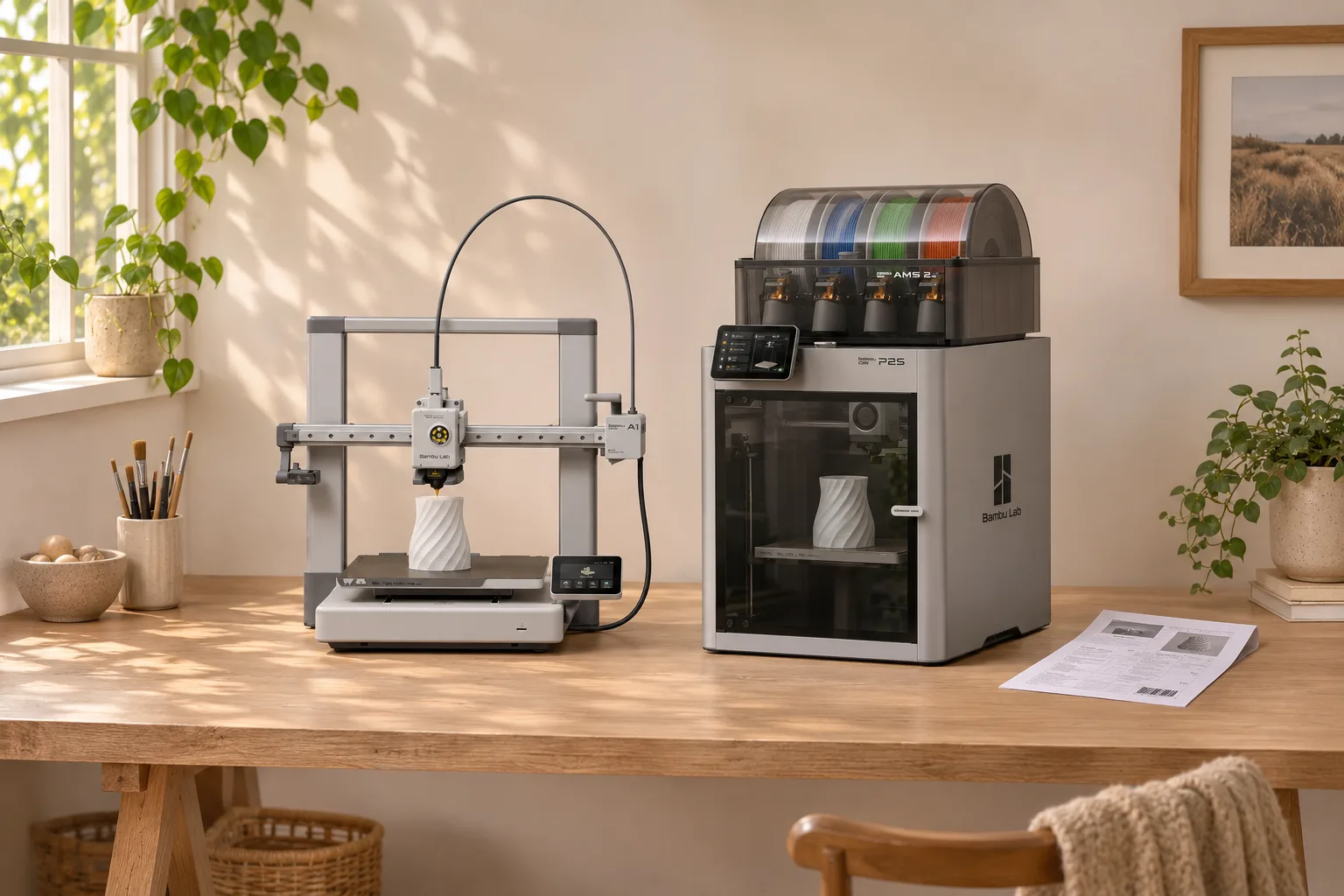
Printers in this guide
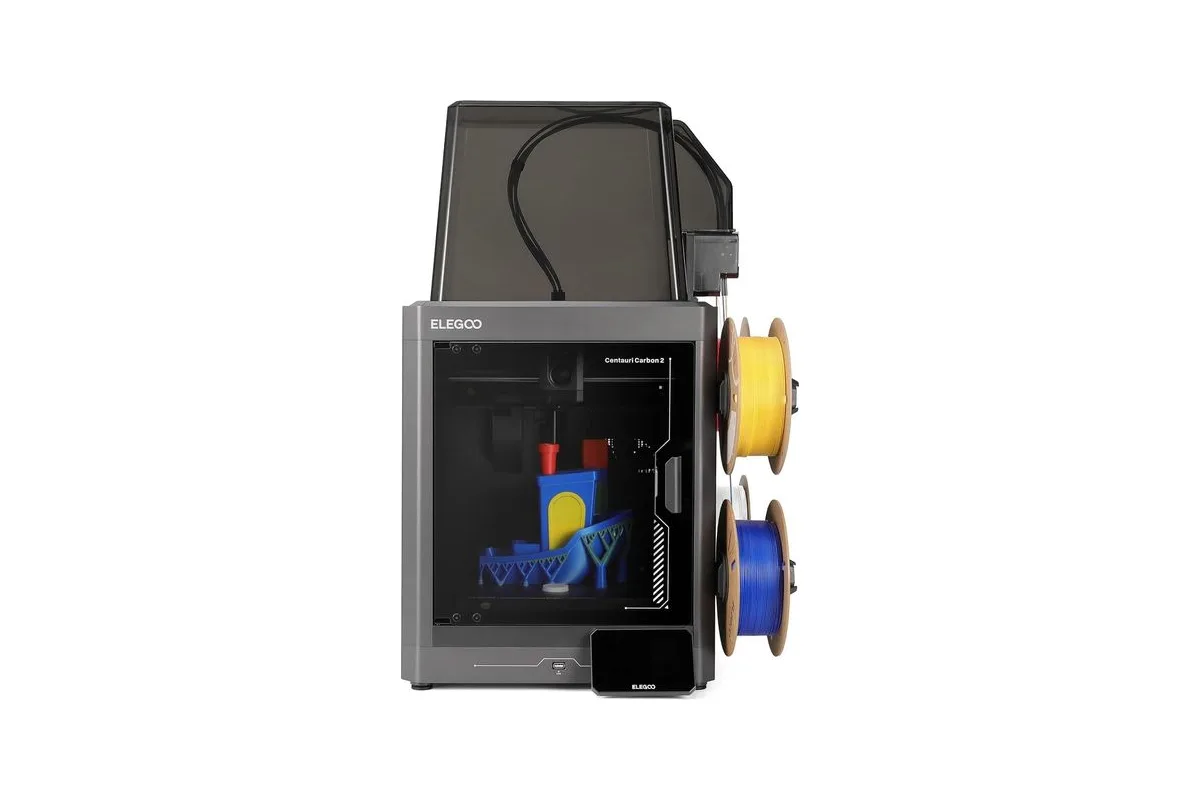
Is an open-frame or enclosed 3D printer better?
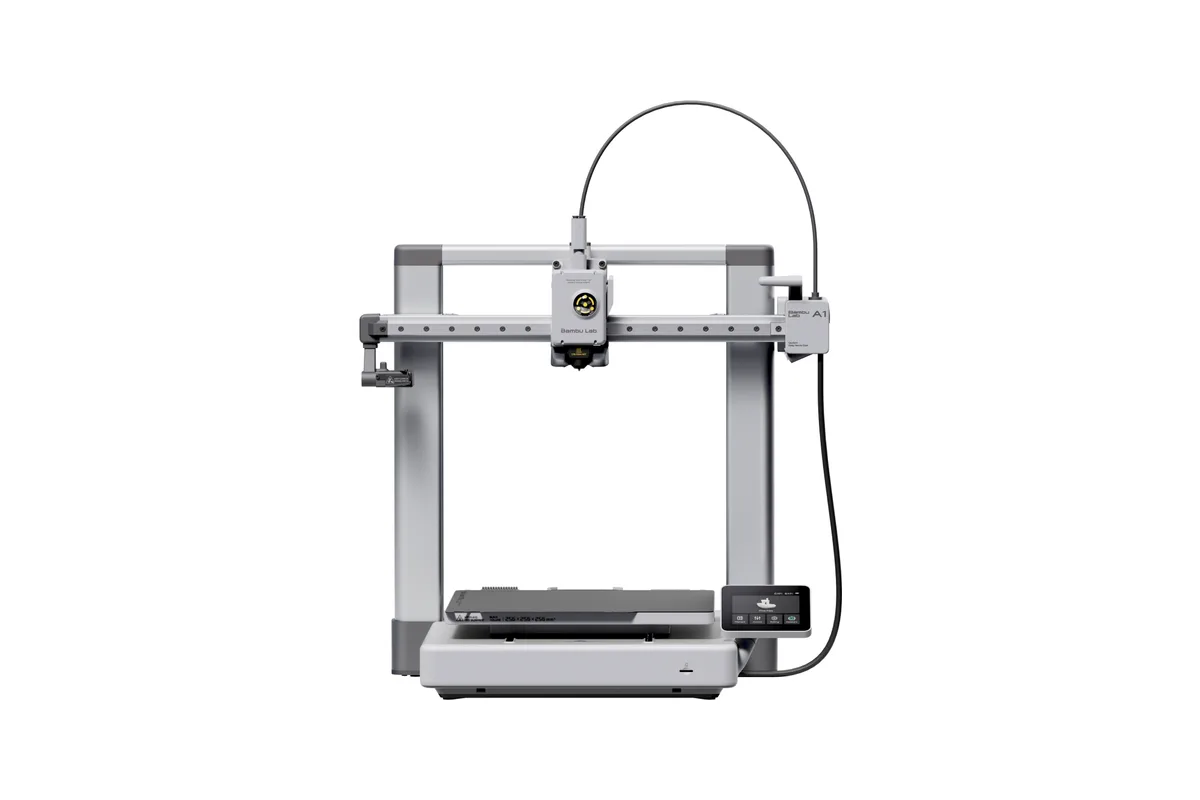
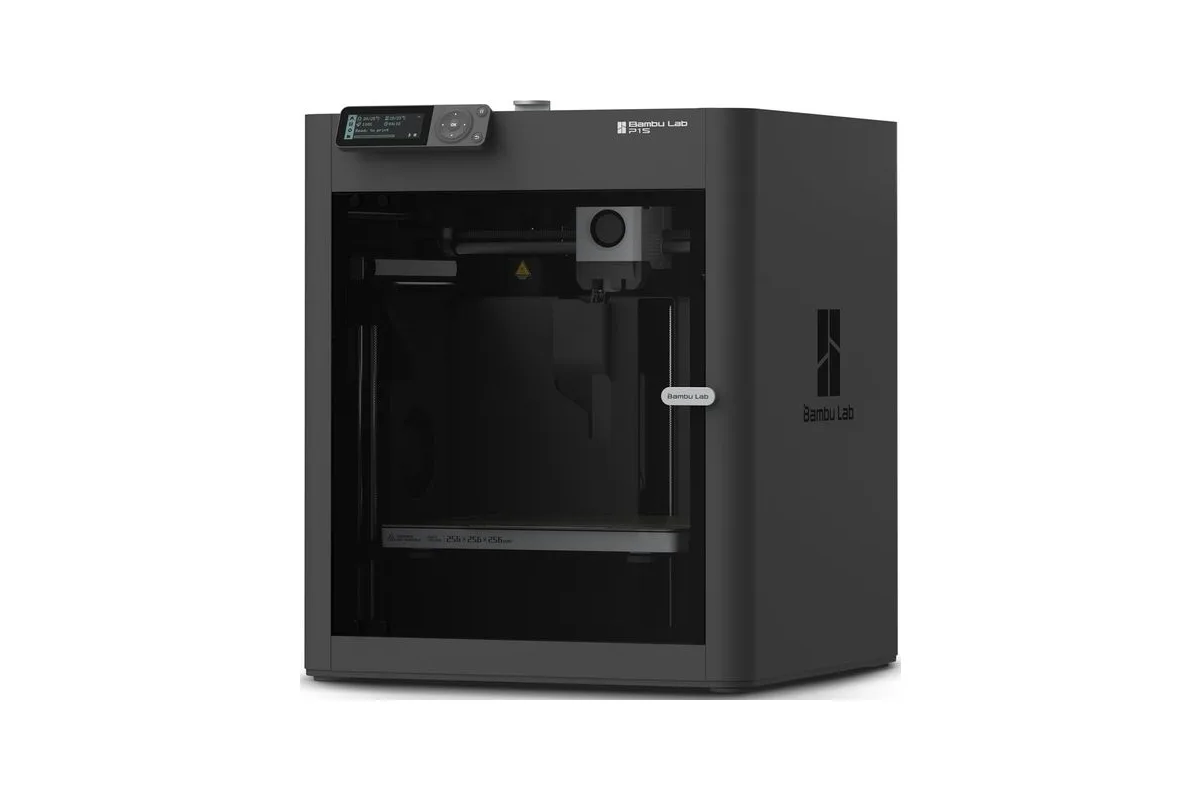
Enclosed is better if you’ll print ABS, ASA or nylon, or if the printer will sit where people live, work or play. Open-frame is better if you’ll print PLA and PETG, and it costs $75–$130 less for the same class of machine. The Bambu Lab A1 ($259 in November 2026) and P1S ($349) show the trade: the same 256 mm build area and automatic calibration, with the P1S adding walls, a door and the ability to print ABS.
Most beginners print PLA, so an open printer is the cheaper, simpler start. If you think you’ll want tougher materials within a year, buy the enclosure now: most open printers can’t be closed in later.
How much more does an enclosed 3D printer cost?
About $75–$130 more, comparing a maker’s open and enclosed models side by side.
| Open-frame | Price | Enclosed | Price | Difference |
|---|---|---|---|---|
| Elegoo Centauri 2 | $244 | Elegoo Centauri Carbon 2 | $319 | $75 |
| Bambu Lab A1 | $259 | Bambu Lab P1S | $349 | $90 |
| Flashforge Adventurer 5M | $229 | Flashforge Adventurer 5M Pro | $359 | $130 |
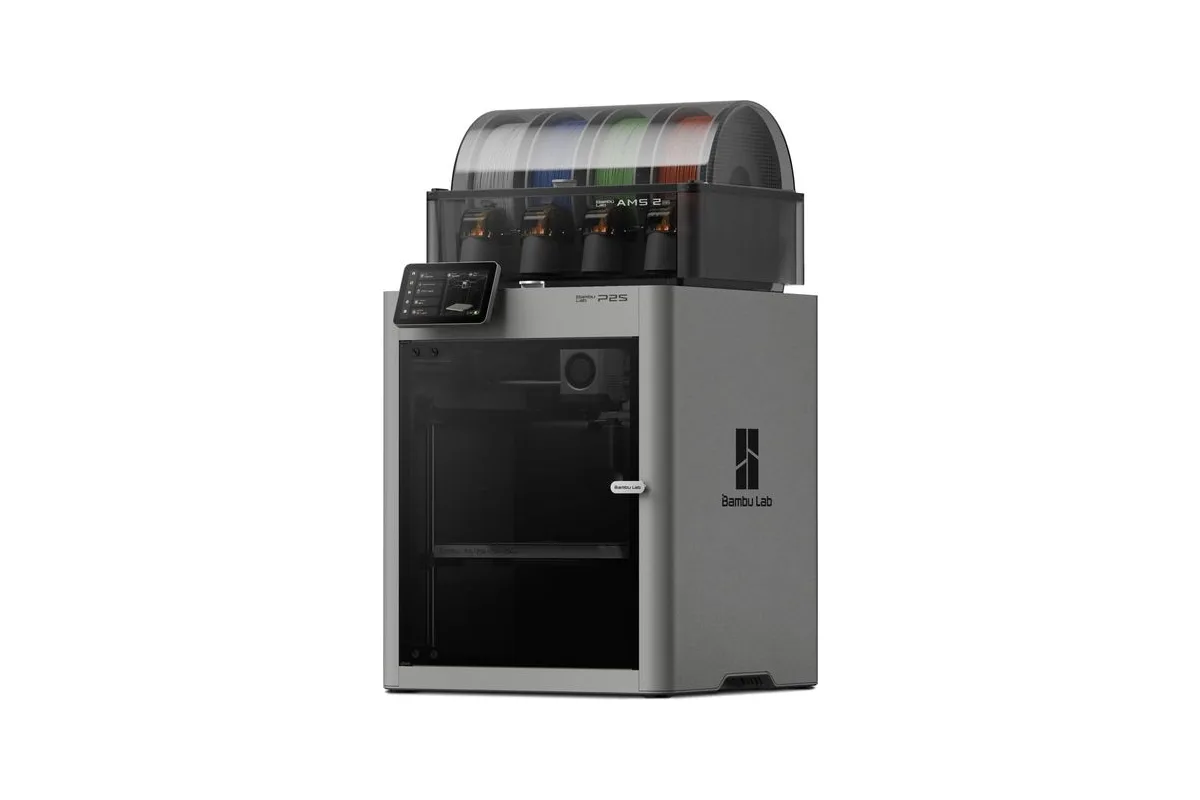
| Bambu Lab A1 Combo (4 colors) | $359 | Bambu Lab P2S Combo (4 colors) | $649 | $290 |
Prices are the makers’ November 2026 Black Friday prices. The P2S gap is bigger because it’s a newer, higher-end printer, with a touchscreen, 1080p camera and an AMS 2 Pro that dries filament. The cheapest enclosed multicolor printer here is the Elegoo Centauri Carbon 2 Combo at $369.
What can an enclosed printer print that an open one can’t?
ABS, ASA, nylon and most engineering filaments. These shrink as they cool, so on an open printer drafts and uneven cooling make parts warp at the corners, crack between layers or pop off the bed. An enclosure keeps the air around the part warm and still.
| Material | Open-frame | Enclosed |
|---|---|---|
| PLA | Yes, ideal | Yes, often with the door or lid open |
| PETG, TPU | Yes | Yes |
| ABS, ASA | Not recommended | Yes |
| Nylon, PC, carbon-fiber blends | No | Yes, best with a hardened nozzle and heated chamber |
Bambu’s filament table marks ABS as not recommended on its open-frame printers and recommended on enclosed ones, and Flashforge says ABS isn’t compatible with the open Adventurer 5M. Large nylon and polycarbonate parts do best with an actively heated chamber, like the 55 °C chamber on the Prusa CORE One+ ($1,299). See the best enclosed 3D printers.
Do enclosed 3D printers reduce fumes?
Yes, a lot, if the enclosure is filtered or vented. All filament printers release ultrafine particles and volatile organic compounds (VOCs), most with ABS and least with PLA. UL’s Chemical Insights research found that a ventilated enclosure cut particle concentration by 99.7% and VOCs by 69.5%.
Public health agencies treat the enclosure as the first control:
- The Washington State Department of Health calls enclosing printers and venting emissions directly outside “the best practice for ventilation”, and recommends PLA as the lowest-emitting filament. It notes that HEPA and charcoal filters help but don’t replace exhaust ventilation.
- NIOSH recommends ventilated enclosures and local exhaust for schools and makerspaces, and says local exhaust “could reduce or eliminate” the ultrafine particles it measured in an office.
Most home enclosed printers recirculate air through a carbon or HEPA filter rather than venting outdoors, so ventilate the room anyway. See are 3D printers safe? and where to put a 3D printer.
Is an open-frame printer better for PLA?
Often, yes. PLA softens at a low temperature and prints best with lots of cooling. In a closed box, heat can build up and soften filament before it reaches the nozzle, which is called heat creep. Bambu says heat buildup inside the enclosure is the most common cause of hotend and extruder clogs on its enclosed P1S and X1 Carbon, and recommends printing PLA on them with the front door and/or top cover open.
Newer enclosed printers deal with this. Bambu says the P2S’s Adaptive Airflow lets it print PLA with the doors closed. But if you’ll print only PLA, an open printer avoids the issue for less money.
Are enclosed printers quieter and safer around kids?
Safer, yes. Quieter, not always.
- Safety: a door keeps fingers away from a nozzle at 190–240 °C for PLA and from moving belts, and keeps pets from knocking prints off. That’s why the enclosed Flashforge Adventurer 5M Pro is one of our picks in the best 3D printers for kids.
- Noise: the enclosure muffles fans, but the machine inside matters more. Bambu rates the open A1 at about 48 dB in silent mode, while the enclosed P1S, with no Bambu rating, is loud. The enclosed P2S is rated under 50 dB in silent mode and the Flashforge Adventurer 5M Pro at 50 dB in low-noise mode. See the best quiet 3D printers.
Can you add an enclosure to an open 3D printer?
On some printers, at a cost. Snapmaker sells a Top Cover for the open-top U1 for $149–$249, and Prusa sells an enclosure for its open MK4S. Bambu doesn’t offer one for the A1 or A1 mini. Third-party tents and boxes exist; if you use one, check whether it filters or vents the air, because a closed box on its own holds fumes in rather than removing them. If ABS matters to you, a printer designed with an enclosure is the cleaner buy.
Which should you buy?
- Printing PLA and PETG, on a budget: an open-frame printer. The Bambu A1 ($259) or A1 mini ($199) are the easiest. See the best cheap 3D printers.
- Printing ABS or ASA, or printing in a living space: the Bambu P2S Combo ($649) for most people, the Centauri Carbon 2 Combo ($369) for value, or the P1S ($349) for the cheapest enclosed Bambu. Compare the A1 and P1S directly in A1 vs P1S.
Frame type also decides how the printer moves: most open printers are bed slingers and most enclosed ones are CoreXY. See CoreXY vs bed slinger.
Questions people ask
Do I need an enclosed 3D printer for PLA?
No. PLA prints well on open printers, and many enclosed printers print it best with the door or lid open. Bambu’s P2S is designed to print PLA with its doors closed.
Can an open-frame 3D printer print ABS?
Not reliably. ABS warps and cracks without warm, still air, and Bambu lists it as not recommended on its open printers. Use an enclosed printer such as the $349 P1S.
Is an enclosed 3D printer safer?
Yes. It keeps hands away from the 190–240 °C nozzle and, when vented or filtered, cuts emissions; UL measured a 99.7% drop in particles with a ventilated enclosure. You should still print in a ventilated room.
Are enclosed 3D printers worth the extra cost?
If you’ll print ABS, ASA or nylon, or share the room with kids or pets, yes: the enclosure usually costs $75–$130 more. For PLA only, an open printer is the better value.
Is the Bambu A1 or P1S better?
The A1 ($259) for PLA beginners: it’s quieter and has a touchscreen. The P1S ($349) for ABS, ASA and enclosed printing.
Sources
- Bambu Lab Wiki: filament guide material table, wiki.bambulab.com
- Bambu Lab Wiki: heat creep, wiki.bambulab.com
- Bambu Lab P2S launch post, blog.bambulab.com
- Bambu Lab US store: A1, us.store.bambulab.com
- Bambu Lab US store: P1S, us.store.bambulab.com
- Elegoo US: Centauri Carbon 2 Combo, us.elegoo.com
- Flashforge: Black Friday sale 2026, flashforge.com
- UL Chemical Insights: 3D printing emissions and its impact on human health, chemicalinsights.ul.org
- UL Chemical Insights: 10 ways to promote healthy indoor air quality while using a 3D printer, chemicalinsights.ul.org
- Washington State Department of Health: 3D printers, doh.wa.gov
- NIOSH Science Blog: characterizing 3D printing emissions and controls in an office environment, cdc.gov
- NIOSH: Approaches to Safe 3D Printing, cdc.gov
- Snapmaker U1 Top Cover, matterhackers.com
Keep exploring

How to
Hardened steel vs brass nozzles, and what nozzle size to use
Brass, or the stainless steel Bambu ships on the A1, is fine for PLA, PETG, ABS, ASA and TPU. Carbon fiber, glass fiber, glow-in-the-dark and sparkle filaments need hardened steel. Use a 0.4 mm nozzle for most prints, 0.6 mm for carbon fiber and big parts, and 0.2 mm for miniatures.
Read story
How to
Can you 3D scan with an iPhone? Yes, but not to tight tolerances
Yes. Any current iPhone can 3D scan objects from photos (photogrammetry), and KIRI Engine's free tier exports STL for printing. Only the iPhone 18 Pro and 18 Pro Max have LiDAR in Apple's current lineup. For parts that must fit, a $359 scanner is about ten times tighter.
Read story