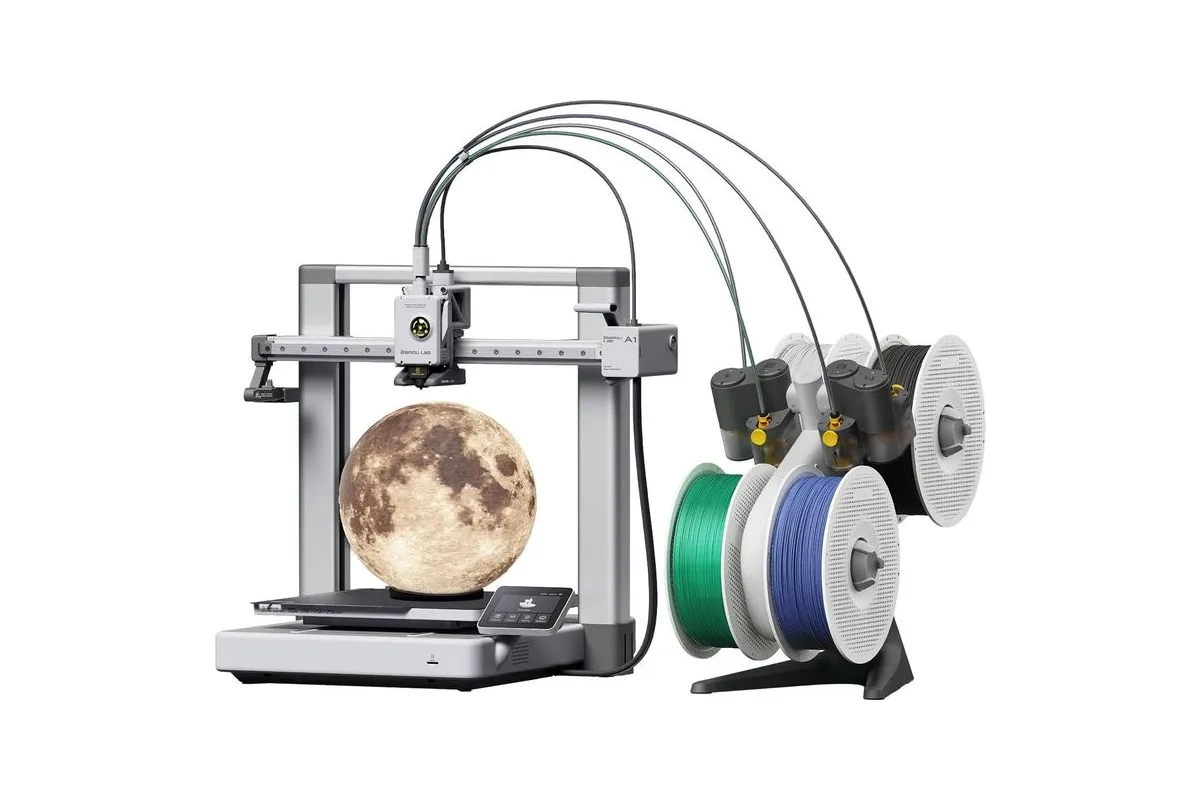
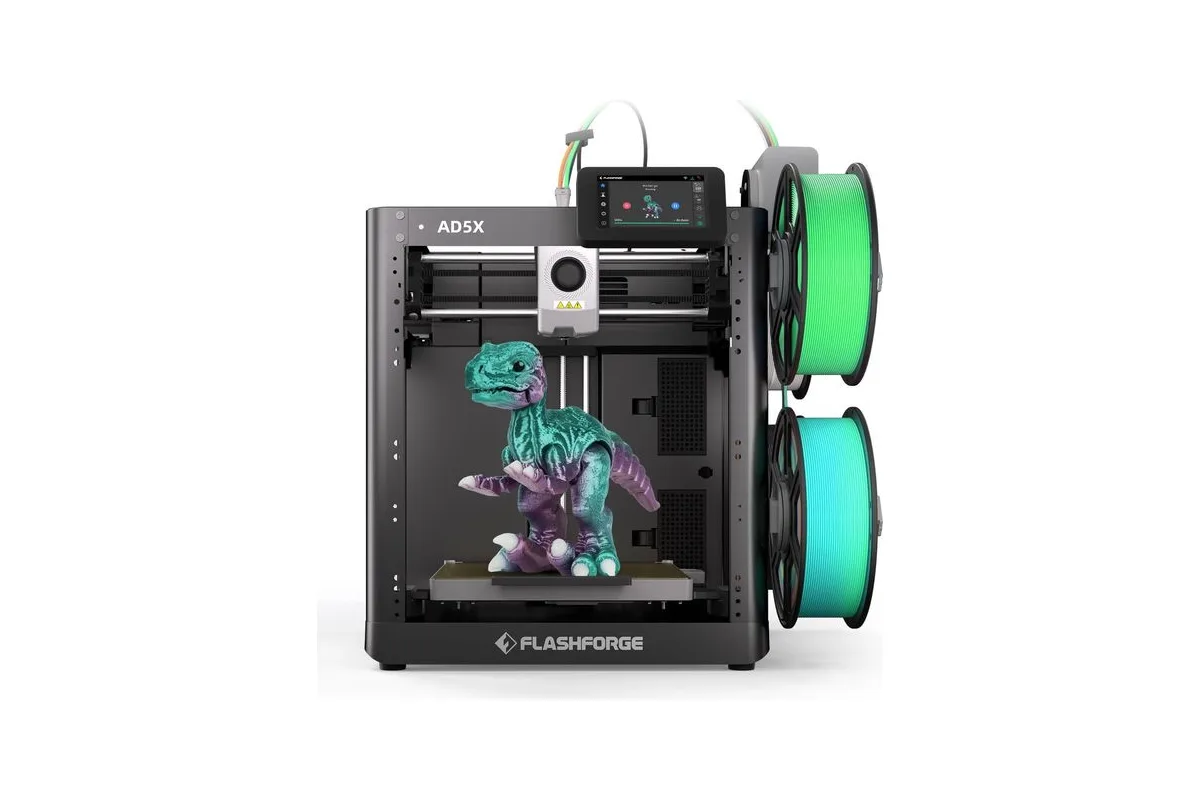
Side by side
| Feature | Bambu LabA1 Combo | Flashforge AD5X |
|---|---|---|
| Frame | Open (bed slinger) | |
| Build volume | 256 x 256 x 256 mm | 220 × 220 × 220 mm |
| Multicolor | 4 colors (AMS lite, included) | |
| Materials | PLA, PETG, TPU | |
| Where to buy | Check price at Amazon | Check price at Amazon |
Bambu Lab A1 Combo
- Frame
- Open (bed slinger)
- Build volume
- 256 x 256 x 256 mm
- Multicolor
- 4 colors (AMS lite, included)
- Materials
- PLA, PETG, TPU
Flashforge AD5X
- Frame
- Build volume
- 220 × 220 × 220 mm
- Multicolor
- Materials
Flashforge AD5X or Bambu Lab A1 Combo: which is better?
The Bambu A1 Combo, for most people. Both are open-frame printers that do four colors through one nozzle, and they’re $30 apart in November 2026:
- The Bambu A1 Combo is $359 at Bambu’s store (typical $399), with the four-spool AMS lite. It prints a 256 mm cube, about 58% more volume than the AD5X (our estimate), and has a camera built in. Bought from Bambu’s US store, it carries a 2-year warranty.
- The Flashforge AD5X is $329 ($349 at Flashforge with an extra $20 off in the cart, or $329 on Amazon), with the built-in four-color IFS. It’s a CoreXY printer with twice the A1’s rated acceleration, a 110 °C bed and Ethernet, and Flashforge sells a $49 enclosure kit for it.
Pick the AD5X only if those strengths matter more to you than build size, the camera and the longer warranty. Our reviews: Bambu A1 and Flashforge AD5X.
What’s the difference between the AD5X and the A1 Combo?
| Flashforge AD5X | Bambu Lab A1 Combo | |
|---|---|---|
| Price (Nov 2026) | $329 ($349 at Flashforge before the $20 cart discount; list $499) | $359 at Bambu (typical $399); $359.99 at Micro Center and Best Buy |
| Frame | Open CoreXY | Open bed slinger |
| Build volume | 220 x 220 x 220 mm (10.6 L) | 256 x 256 x 256 mm (16.8 L) |
| Max nozzle / bed | 300 °C / 110 °C | 300 °C / 100 °C |
| Rated speed | 300 mm/s print, 600 mm/s travel | 500 mm/s |
| Acceleration | 20,000 mm/s² | 10,000 mm/s² |
| Colors | 4 (IFS, built in) | 4 (AMS lite, included); up to 16 with four full-size AMS units instead (our estimate) |
| Camera | $39.99 kit | Built in, up to 1080p, timelapse |
| Enclosure | $49 kit | No option |
| Materials | PLA, PETG, TPU, PLA-CF, PETG-CF | PLA, PETG, TPU; ABS, ASA and PC only for small, low-infill parts |
| Connectivity | Wi-Fi, Ethernet, USB | Wi-Fi |
| Noise (maker) | Not published | About 48–49 dB in silent mode |
| Slicer | Orca-Flashforge, OrcaSlicer | Bambu Studio |
| Warranty | 12 months (extruder 3 months) | 2 years from Bambu’s US store |
| Returns | 30 days | 30 days |
Volumes are our estimates (length x width x height). Sources: Flashforge’s AD5X page and warranty policy; Bambu’s A1 store page, specifications, wiki and warranty policy, read November 28, 2026. Flashforge’s Black Friday sale ends November 30; Bambu’s ends December 1 at 2:00 AM ET.
Which gives more for the money?
The A1 Combo, once you count size and the camera:
| Our estimate | Flashforge AD5X | Bambu A1 Combo |
|---|---|---|
| Price per liter of build volume | $31 | $21 |
| Price per color | $82 | $90 |
| With a camera | $369 (adding the $39.99 kit) | $359 |
| With a camera and enclosure | $418 | Not possible |
Adding Flashforge’s camera kit to the AD5X costs more than the A1 Combo already does. The AD5X stays ahead only if you want an enclosure, and even then Flashforge lists no ABS or ASA for it, so the kit is about keeping drafts, dust and curious hands away, not about engineering filament.
For four colors on an even smaller budget, Bambu’s A1 mini Combo is $299 (typical $329), with a 180 mm cube.
Which prints faster?
On paper, the AD5X. Its CoreXY frame moves the print head instead of swinging the bed back and forth, and Flashforge rates it at 20,000 mm/s² acceleration, twice the A1’s 10,000 mm/s². Its headline 600 mm/s is travel speed; Flashforge rates printing at 300 mm/s. Bambu rates the A1 at 500 mm/s.
Neither maker says how long a color change takes, so we can’t say which finishes a four-color print first.
Which wastes less filament in multicolor?
Neither maker publishes a figure. Both are single-nozzle systems: at each color change, the printer pulls back the old filament, feeds the next one and purges the leftover color. Flashforge’s own advice is to check your slicer’s material estimate before a multicolor print. Bambu Studio lets you flush into infill or supports to cut waste.
If waste matters to you, both are the wrong type of printer. A tool changer such as the Snapmaker U1 or Flashforge’s own Creator 5 Pro keeps each color in its own nozzle. See the best tool changer 3D printers.
Which is easier for a beginner?
The A1 Combo. The A1 calibrates itself, and its built-in camera lets you check prints from your phone. The AD5X is straightforward too, with multicolor built in and support in the free OrcaSlicer, but there’s no camera until you buy one.
Bambu’s software has one string attached: remote printing and the Bambu Handy app use Bambu’s cloud. You can switch the A1 to LAN Only Mode and print with no internet, but Bambu says that turns off remote printing from outside your network, the Handy app and print history. See can you use a Bambu Lab printer offline? Flashforge doesn’t say what firmware the AD5X runs or which features, if any, need its cloud.
Which is more reliable?
The A1 has the longer track record and the longer warranty, plus one blemish. In 2024 Bambu recalled every A1 on the market over heatbed cables whose insulation could be damaged where they meet the base; in the US, the CPSC recall covered about 12,800 units sold in December 2023 and January 2024. Bambu now ships the A1 with a reinforced heatbed cable. Bambu also publishes how long it will update each printer: the A1 gets bug and feature updates until December 14, 2028 and security patches until December 14, 2030.
Flashforge gives a 12-month warranty with only 3 months on the extruder, and excludes the build plate. It publishes no update-support dates. We found no CPSC recall of any Flashforge printer.
Which should you buy?
The Bambu A1 Combo if you want the bigger build area, a camera and the 2-year warranty. It’s our top multicolor pick for beginners in the best multicolor 3D printers.
The Flashforge AD5X if your prints are small, you want CoreXY motion or Ethernet, or you want to enclose the printer later. Considering a different open-frame four-color printer? See Anycubic Kobra X vs Bambu Lab A1 Combo.
Questions people ask
Is the AD5X better than the A1 Combo?
Only on speed specs, bed temperature, Ethernet and enclosure options. The A1 Combo has the bigger build area, a built-in camera and a longer warranty for $30 more, which makes it the better buy for most people.
Is the AD5X CoreXY?
Yes. The print head moves in X and Y and the bed moves only down, unlike the A1, which moves the bed back and forth.
Can either print ABS?
Not well. Flashforge lists no ABS or ASA for the AD5X, and Bambu says the A1 can print ABS, ASA and PC only for small parts with low infill. For ABS, choose an enclosed printer such as the Bambu P2S; see the best enclosed 3D printers.
Can the A1 Combo do more than four colors?
Yes, with full-size AMS units instead of the AMS lite. Bambu says A1-series printers take up to four AMS, AMS 2 Pro or AMS HT units through the AMS Hub, or one AMS lite, but not both. That’s 16 slots with four four-slot units (our estimate). The AD5X tops out at the IFS’s four.
Which is quieter?
Bambu rates the A1 at about 48–49 dB in silent mode. Flashforge doesn’t publish a noise figure for the AD5X.
Which uses less electricity?
Bambu puts the A1 at about 95 W on average when printing PLA, or about 7¢ for a 4-hour print at the US average of 18.17¢ per kWh (our estimate). Flashforge doesn’t publish an average figure for the AD5X.
Sources
- Flashforge AD5X product page, flashforge.com
- Flashforge warranty and return policy, flashforge.com
- Flashforge: what does AMS stand for in 3D printing?, flashforge.com
- Flashforge 3D printer model comparison, flashforge.com
- Bambu Lab A1 product page, us.store.bambulab.com
- Bambu Lab A1 technical specifications, bambulab.com
- Bambu Lab multi-AMS compatibility guide, wiki.bambulab.com
- Bambu Lab power consumption, wiki.bambulab.com
- Bambu Lab compare page (software update support), bambulab.com
- Bambu Lab warranty policy, bambulab.com
- Bambu Lab LAN mode guide, wiki.bambulab.com
- CPSC: Bambu Lab recalls A1 3D printers, cpsc.gov
Keep exploring

How to
Hardened steel vs brass nozzles, and what nozzle size to use
Brass, or the stainless steel Bambu ships on the A1, is fine for PLA, PETG, ABS, ASA and TPU. Carbon fiber, glass fiber, glow-in-the-dark and sparkle filaments need hardened steel. Use a 0.4 mm nozzle for most prints, 0.6 mm for carbon fiber and big parts, and 0.2 mm for miniatures.
Read story
How to
Can you 3D scan with an iPhone? Yes, but not to tight tolerances
Yes. Any current iPhone can 3D scan objects from photos (photogrammetry), and KIRI Engine's free tier exports STL for printing. Only the iPhone 18 Pro and 18 Pro Max have LiDAR in Apple's current lineup. For parts that must fit, a $359 scanner is about ten times tighter.
Read story