Printers in this guide
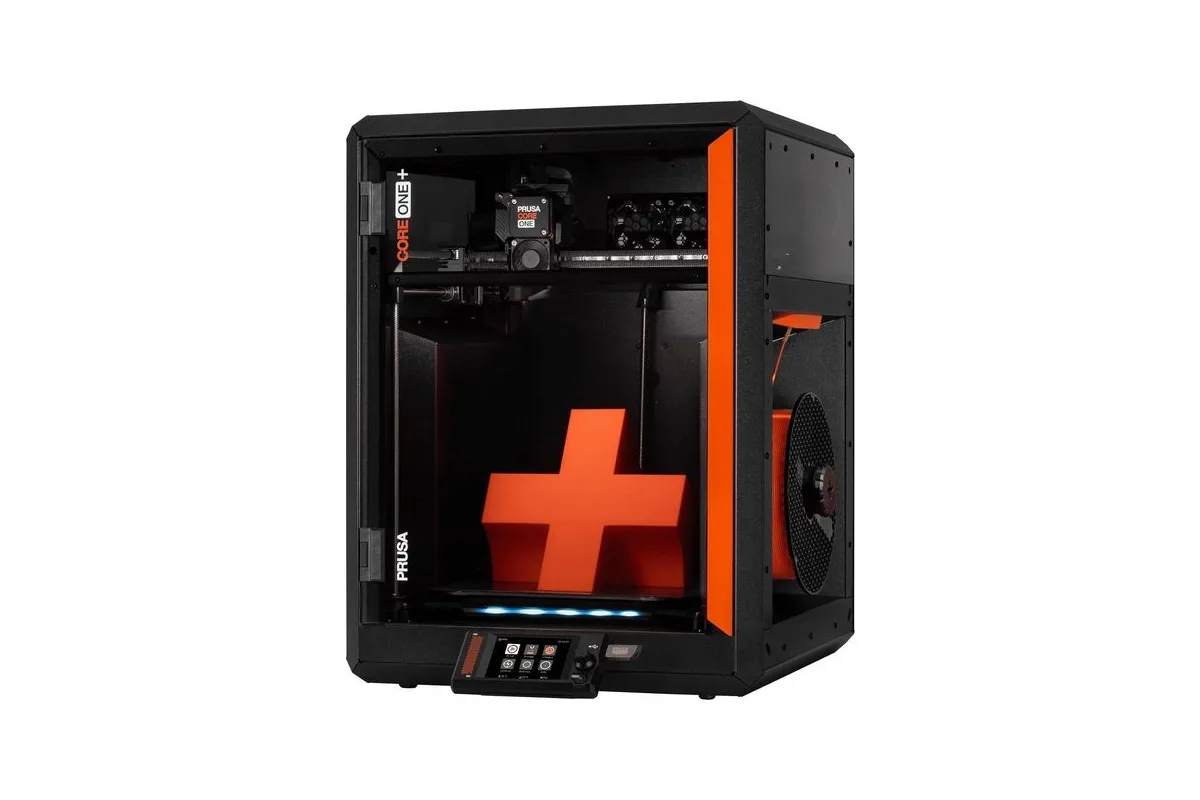
Do 3D printers need a lot of maintenance?
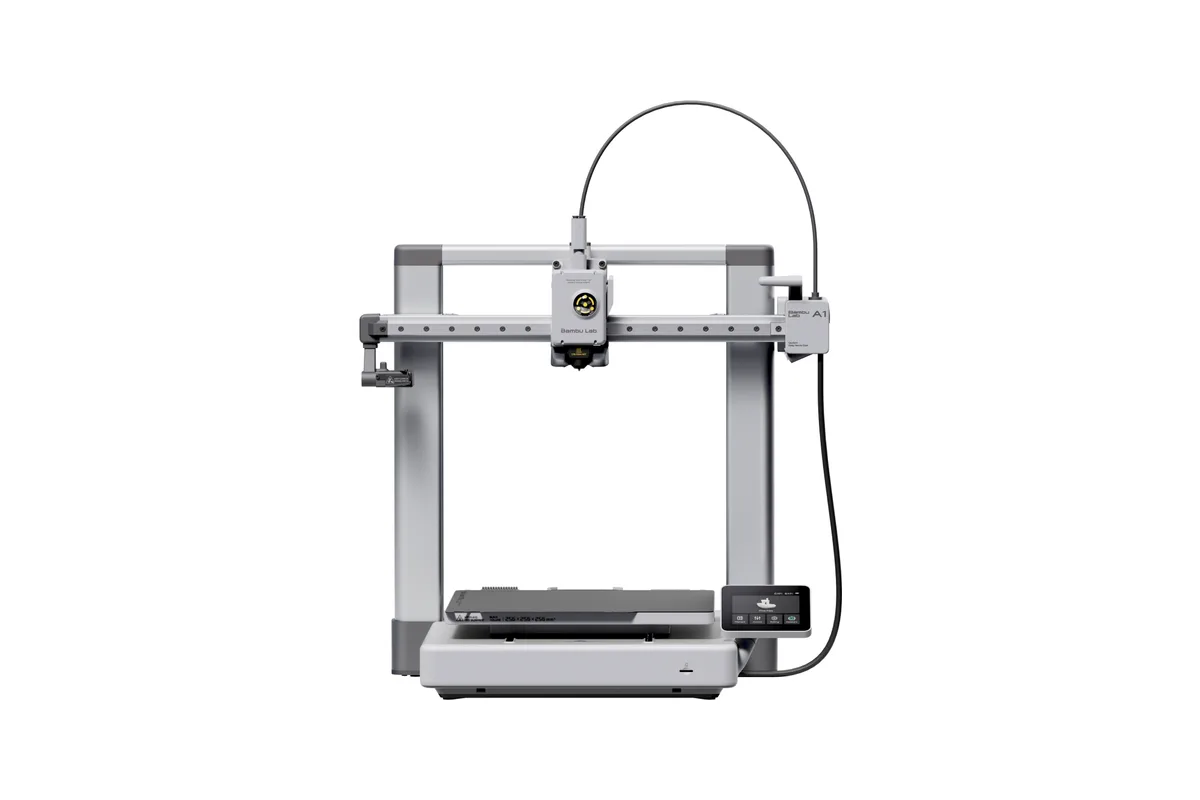
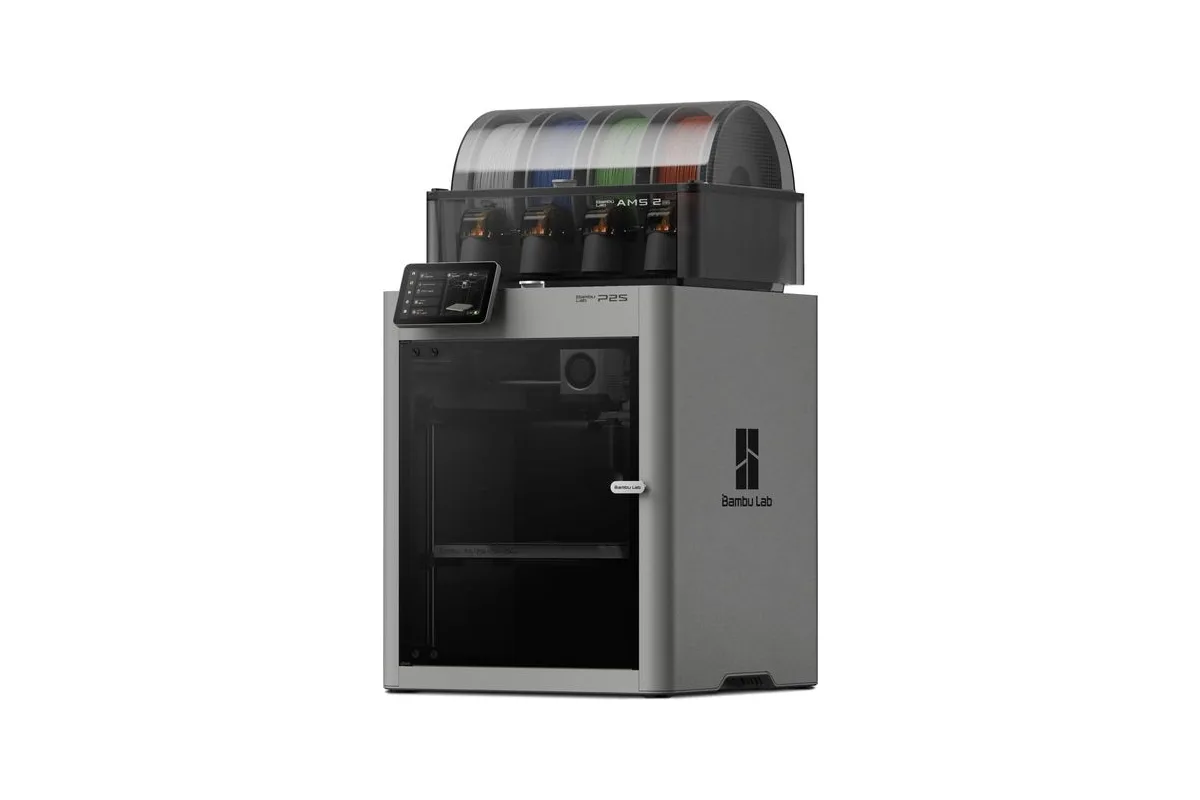
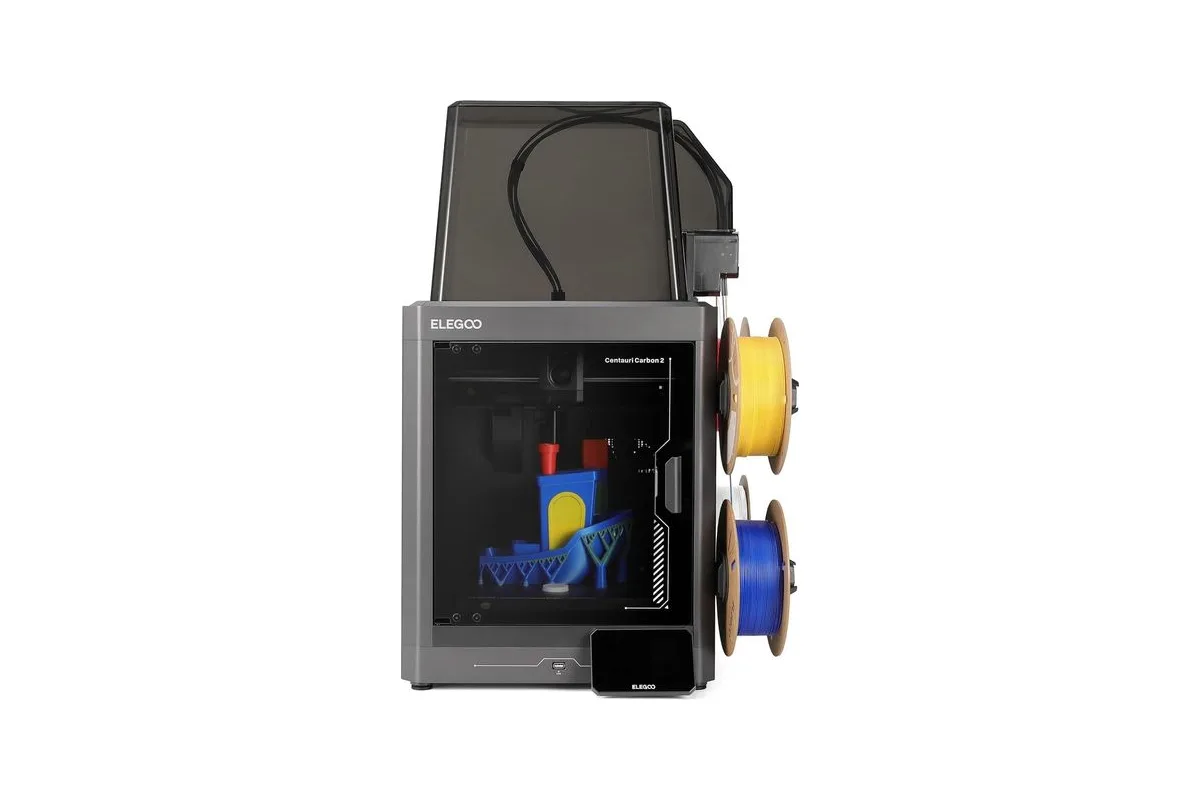
No. A current printer needs a quick clean before prints, oil on its rails every one to three months, and a new nozzle, build plate or PTFE tube every few hundred print hours. Prusa says its printers average about 800 print hours between maintenance, and the parts that wear out cost about $3–$37 each. Printers with automatic calibration, like the Bambu A1, P2S and Elegoo Centauri Carbon 2, level their own beds and check their own belts, which removed most of the old chores.
How often do you need to maintain a 3D printer?
Lightly every print, more thoroughly every one to three months. This schedule combines the makers’ own guidance for the Bambu A1 and P2S and the Prusa CORE One+.
| How often | Task | Whose guidance |
|---|---|---|
| Before each print | Clear debris from the bed and printer, wipe the build plate, brush the nozzle | Prusa |
| Every week | Check the part-cooling and hotend fans for dust and filament strands | Bambu (A1) |
| Every month | Clean and oil the X and Y rails; clean the hotend heating block | Bambu (A1) |
| Every 1–3 months | Clean and oil the X and Y axes: monthly at 5+ hours a day, every 2 months at 1–5 hours, every 3 months under 1 hour | Bambu (P2S) |
| Every 3 months | Grease the Z lead screws; oil the idler pulleys | Bambu (A1) |
| Every 3–6 months | Lubricate the X linear rail | Prusa (CORE One) |
| Every 3–5 months | Clean and grease the Z axis, by how much you print | Bambu (P2S) |
| Every 200 print hours | Clean rails and rods, check belt tension, clear the extruder gear | Prusa (CORE One) |
| Every 600–800 print hours | Check and reseat electronics connectors | Prusa (CORE One) |
| When the printer prompts | Re-tension belts | Bambu (A1 checks tension itself) |
Bambu also gives intervals by filament used on the A1. Clean the nozzle and extruder gear every 5 spools (every 2 with carbon-fiber filament), check the filament cutter blade every 3 rolls, and replace the PTFE tube every 6 rolls of PLA (every 2 rolls of carbon-fiber or other abrasive filament). If you print one 1 kg spool a month, that’s a nozzle cleaning about every five months and a new PTFE tube twice a year.
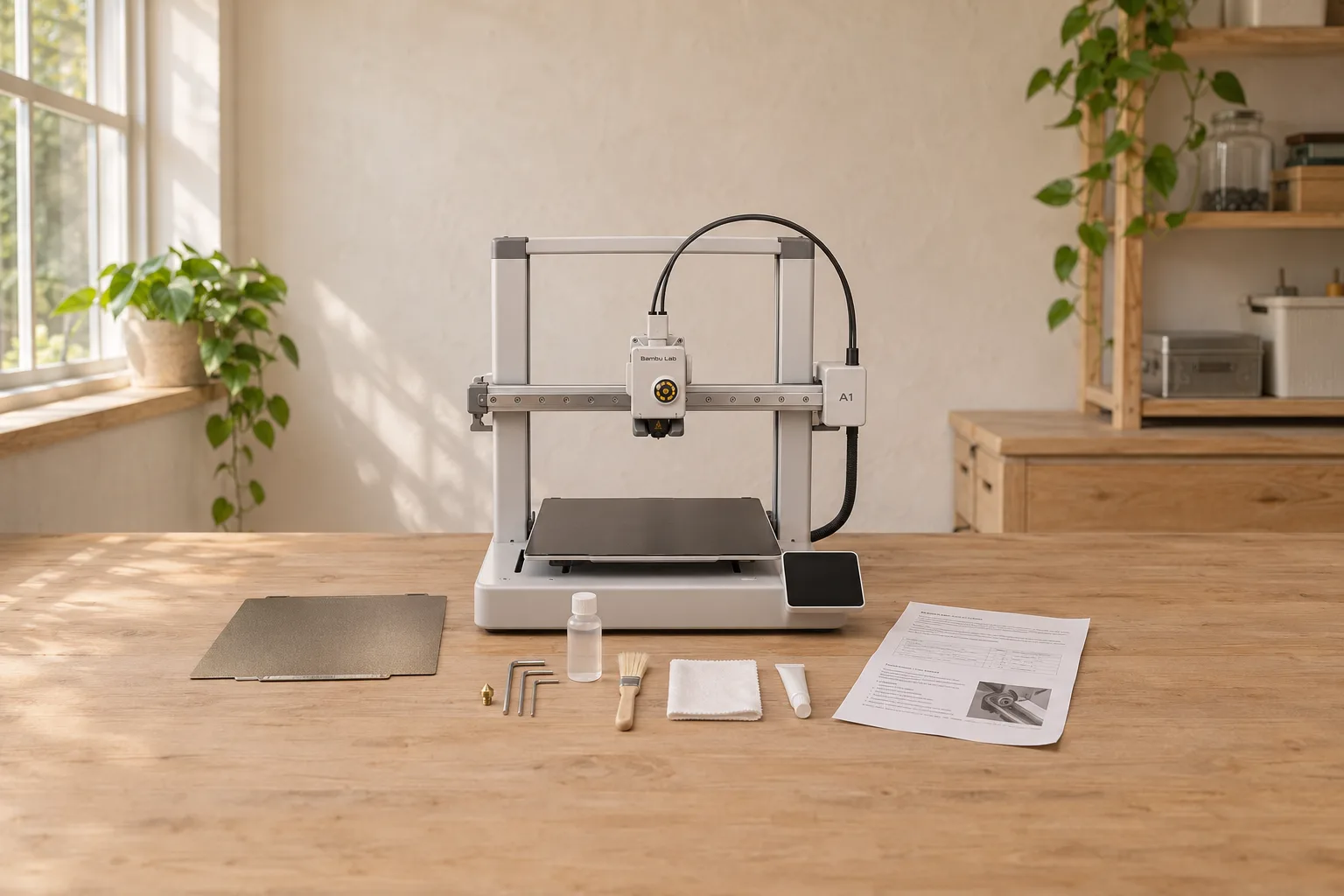
Bambu ships both lubricant oil and grease in the A1’s accessory box: oil for the rails, grease for the lead screws and extruder gears. It warns never to put grease on the X-axis rail.
How much do 3D printer replacement parts cost?
Most wear parts cost $3–$37 at the makers’ own stores. Prices on November 25, 2026, during Black Friday sales:
| Part | Bambu Lab | Prusa | Elegoo |
|---|---|---|---|
| Nozzle or hotend (0.4 mm) | A1/A1 mini complete hotend $9.99 (stainless) or $11.99 (hardened); P1S hotend $14.99; P2S hotend from $17.99 | CHT brass nozzle $26.99; hardened nozzle $36.99 | Hotend kit for Centauri 2/Carbon 2, 2 pcs, $29.99; hardened nozzle kit $22.99 |
| Build plate | Textured PEI: A1 mini $15.99, A1/P1S/P2S $27.99 (typical $19.99 and $34.99) | CORE One textured sheet $36.99 (list $43.99); smooth PEI $32.99 ($37.99) | Dual-sided Centauri plate $23.99 |
| Belts | A1 X or Y $5.99, Z $3.99; A1 mini X $4.99, Y $5.99; P2S XY $11.99 | GT1.5 belt $8.99–$10.99 | Not listed |
| PTFE tube | From $2.99 | — | — |
| Other | Silicone hotend sock from $1.99; P2S air filter $12.99 | — | — |
Bambu sells the whole hotend (nozzle, heat break and heater mount) as one quick-swap part, which is why its A1 hotend costs less than a bare Prusa nozzle. Prusa says a nozzle swap takes 1–2 minutes and that its nozzles and print sheets each last hundreds of print hours, and its sheets are double-sided, so you can flip a worn one.
What does maintenance cost in a year?
About $40–$50 for a typical hobbyist. Take an A1 owner printing two 1 kg spools of PLA a month, 24 spools a year:
- PTFE tube every 6 rolls: 4 x $2.99 = $11.96
- One replacement hotend: $9.99
- One replacement build plate: $27.99
- Total: $49.94
The hotend and plate lifetimes are our assumptions, not measured figures. Prusa says most owners spend $25–$50 a month on filament, so parts are a small share of the cost of printing.
Does the warranty cover worn parts?
No. Nozzles, hotends and build plates are consumables at every major brand. Bambu lists the hotend and its parts (nozzle, heater, thermistor, silicone sock) as “No Warranty” on its A1 and P2S warranty pages, though it may replace a part that fails from a manufacturing defect while the printer is under warranty. Prusa covers nozzles, belts, bearings, PTFE tubes and print sheets only for defects. Elegoo gives no warranty on its FDM nozzle, PEI plates, heater or hotend. See how long 3D printers last.
What causes most 3D printer problems?
Clogs and dirty build plates. Common clog causes are wet or dusty filament, debris in the extruder, and heat creep, where heat climbs above the nozzle and softens PLA too early; a warm, closed enclosure makes that more likely, which is why Prusa vents the CORE One+ chamber automatically for PLA. Dry PETG and TPU before printing, keep spools sealed with desiccant, and clean the nozzle and extruder gear on schedule. For bed adhesion, keep fingers off the plate: Bambu notes skin oils weaken adhesion. Wash the plate as the maker directs; Prusa warns that acetone permanently damages its textured and satin sheets.
Which 3D printers need the least maintenance?
Fully automatic printers from Bambu Lab, Elegoo and Prusa. The A1, P2S, Centauri Carbon 2 and CORE One+ level their own beds, and the A1 checks its own belt tension. Enclosed printers like the P2S add a carbon filter to replace when it gets dirty. Budget printers like the Ender-3 V3 SE need more hands-on tuning.
Resin printers need more. You clean the vat and wash parts after every print, and the release film and LCD screen wear out: Elegoo gives no warranty on release film and only three months on resin printer LCDs. See resin vs filament 3D printers.
Questions people ask
How often should I change my 3D printer nozzle?
When it wears or leaks and cleaning doesn’t fix extrusion. Prusa says its nozzles last hundreds of print hours; abrasive carbon-fiber filaments wear them much faster, so use a hardened-steel nozzle for those.
How often should I lubricate my 3D printer?
Every one to three months for the rails, depending on how much you print. Bambu recommends monthly on the A1, and every 1–3 months on the P2S. Prusa recommends every 3–6 months for the CORE One’s X rail.
Do I need to level the bed on a modern 3D printer?
Not on most. The Bambu A1 and P2S, Elegoo Centauri Carbon 2 and Prusa CORE One+ level automatically. Budget printers with manual leveling need it after moving the printer.
How do I clean a 3D printer build plate?
Wipe it between prints with a lint-free cloth and keep your fingers off it. Prusa recommends 91% isopropyl alcohol for its sheets and says to keep acetone away from textured and satin sheets.
How long does a 3D printer build plate last?
Hundreds of print hours, by Prusa’s estimate. A replacement costs $15.99–$27.99 for a Bambu textured PEI plate and $36.99 for a Prusa CORE One textured sheet.
What maintenance does a 3D printer need when you first get it?
Check the lubrication. Bambu ships the A1 with only a little oil on the Y rail, to avoid drips in shipping, and recommends checking it after unboxing.
Sources
- Bambu Lab wiki: regular cleaning and maintenance recommendations for the A1, wiki.bambulab.com
- Bambu Lab wiki: A1 Y-axis lubrication and maintenance, wiki.bambulab.com
- Bambu Lab wiki: P2S regular cleaning and maintenance recommendations, wiki.bambulab.com
- Prusa: regular printer maintenance (CORE One/+), help.prusa3d.com
- Prusa: frequently asked questions (maintenance interval), help.prusa3d.com
- Prusa CORE One+ product page (running costs), prusa3d.com
- Bambu Lab store: Bambu Hotend - A1/A2, us.store.bambulab.com
- Bambu Lab store: Bambu Hotend - H2/P2S/X2D, us.store.bambulab.com
- Bambu Lab store: Bambu Hotend - P1 Series, us.store.bambulab.com
- Bambu Lab store: Bambu Textured PEI Plate, us.store.bambulab.com
- Bambu Lab store: belts search, us.store.bambulab.com
- Prusa store: nozzles, print sheets and belts, prusa3d.com
- Elegoo store: Centauri series hotends, nozzles and build plates, us.elegoo.com
- Bambu Lab warranty policy, bambulab.com
- Prusa warranty, help.prusa3d.com
- Elegoo refund and warranty policy, us.elegoo.com
Keep exploring

How to
Hardened steel vs brass nozzles, and what nozzle size to use
Brass, or the stainless steel Bambu ships on the A1, is fine for PLA, PETG, ABS, ASA and TPU. Carbon fiber, glass fiber, glow-in-the-dark and sparkle filaments need hardened steel. Use a 0.4 mm nozzle for most prints, 0.6 mm for carbon fiber and big parts, and 0.2 mm for miniatures.
Read story
How to
Can you 3D scan with an iPhone? Yes, but not to tight tolerances
Yes. Any current iPhone can 3D scan objects from photos (photogrammetry), and KIRI Engine's free tier exports STL for printing. Only the iPhone 18 Pro and 18 Pro Max have LiDAR in Apple's current lineup. For parts that must fit, a $359 scanner is about ten times tighter.
Read story