How it scores
- Print quality20%8.5
Load-cell first-layer calibration, input shaping, GT1.5 belts and a heated enclosure on a steel CoreXY frame, with Prusa's own slicer profiles. We score from the hardware and Prusa's documentation, not our own test prints, so we stop short of 9.
- Setup and ease of use20%8.0
The assembled printer calibrates its first layer automatically. There's no AI failure detection, the camera is optional, and the $999 kit needs building, so it's easy with a few manual steps.
- Speed10%8.5
CoreXY motion with input shaping puts it in the fast class, but Prusa publishes no speed or acceleration figure to compare against Bambu's.
- Features and materials20%8.0
Enclosure, chamber up to 55 °C, 120 °C bed, engineering materials, Ethernet and Wi-Fi. Multicolor (MMU3 or INDX), the camera and HEPA filtration all cost extra, and the stock nozzle is brass.
- Reliability and ownership20%9.0
No recall found, nothing glued, published CAD and printable parts, and it prints fully offline with no account. The US warranty is 1 year (2 with Prusa's Black Friday gift), shorter than Bambu's 2.
- Value and running costs10%6.0
$1,299 assembled is about $87 per liter of build volume against about $39 for a P2S Combo (our estimates), and four-color printing adds $749 or more.
Overall 8.2/10, the weighted average.How we score →
Is the Prusa CORE One+ worth it?
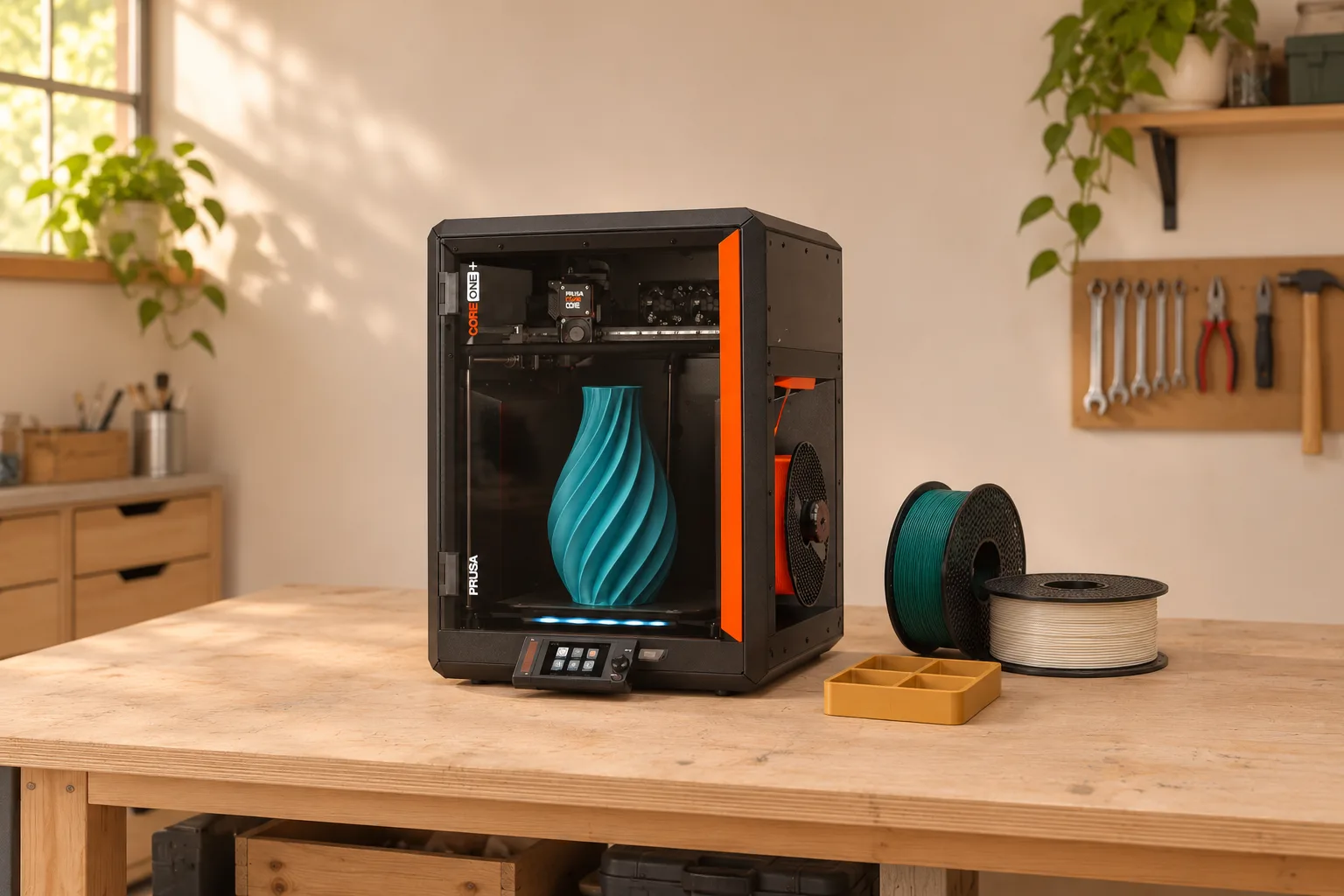
Yes, if you want a printer you’ll own, repair and upgrade for years rather than replace. The CORE One+ (Gen 2) cost $1,299 assembled or $999 as a kit at Prusa’s US store in November 2026. It’s an enclosed CoreXY printer with a chamber that reaches 55 °C, a 120 °C bed and a steel frame held together with screws, not glue. It prints fully offline with no account, and Prusa publishes its CAD files and firmware.
For most homes, though, it’s not the best value. The Bambu Lab P2S Combo was $649 the same week, with a camera, AI failure detection and four-color printing in the box. The Prusa matches it on the basics and beats it on chamber heat, bed temperature, Ethernet and repairability, but you pay twice as much and add the camera and multicolor yourself.
Prusa didn’t cut the price for Black Friday. Instead, through November 30, 2026 (11:59 p.m. Pacific), it adds gifts it values at up to $450, including a free extra year of warranty, a spool of PLA and a $50 INDX voucher.
| Spec | Prusa CORE One+ (Gen 2) |
|---|---|
| Price (Prusa US, Nov 28, 2026) | $1,299 assembled (in stock); $999 kit (1–2 weeks). No discount; gifts instead |
| Other listings | Ultimate Edition $1,699 assembled / $1,399 kit; Amazon about $1,317 assembled (Nov 24) |
| Type | Enclosed CoreXY, all-steel frame |
| Build volume | 250 x 220 x 270 mm (about 14.9 liters, our estimate) |
| Max nozzle / bed | 290 °C / 120 °C |
| Chamber | Heated chamber up to 55 °C (no separate chamber heater; see below) |
| Stock nozzle | High-flow brass CHT, 0.4 mm |
| Calibration | Load-cell first layer and Z offset, input shaping |
| Multicolor | Optional: MMU3 (up to 5 materials) or INDX tool changer (4 or 8 tools) |
| Camera | Optional 1080p camera; no AI detection claimed |
| Filtration | Optional HEPA |
| Connectivity | Ethernet, Wi-Fi (removable module), USB |
| Speed | No figure from Prusa |
| Size / weight | 415 x 444 x 555 mm, 22.5 kg |
| Warranty (US) | 1 year, plus a free extra year with Black Friday orders through Nov 30 |
Source: Prusa’s US store and CORE One+ product pages, read November 28, 2026. Volume is our arithmetic.
What is the CORE One+ (Gen 2), and is the original CORE One still sold?
Prusa has revised the CORE One twice, and the names overlap:
- CORE One: the original enclosed CoreXY model.
- CORE One+ (2nd release), announced January 16, 2026, added an automatic top vent that opens for PLA and PETG and closes for ABS, an easier flex-loading point, a spool holder for 2 kg spools and a new drybox.
- CORE One+ (Gen 2), shipping since August 13, 2026, added an integrated nozzle wiper, finer GT1.5 belts that make fine repeating patterns on smooth walls less visible, a heatbed mount that removes the “absorbing heat” wait at bed temperatures of 85 °C or lower, and the tool-less snap-on top panel from the CORE One L.
Prusa kept the price the same for Gen 2 and upgraded unshipped orders automatically. Its store now sells only the Gen 2 version. If you own an older CORE One, Prusa sells upgrade kits in sequence: CORE One to CORE One+, then CORE One+ to Gen 2. There’s also a direct conversion kit from the MK4S (see our MK4S vs CORE One+ comparison).
Is the CORE One+ chamber actively heated?
It’s heated, but not by a separate chamber heater. Prusa’s own pages describe it two ways: the CORE One+ page says “Active Chamber Temperature Control” up to 55 °C, while the comparison table on the CORE One L+ page calls it “Passive (up to 55°C)” and reserves “Active Convection” for the bigger L+. Our reading: the heatbed warms the chamber and fans and the vent manage it, with no dedicated heater element.
In practice that matters less than the number. A chamber that holds 55 °C is warmer than any enclosure that just traps heat, which helps large ABS, ASA, nylon and polycarbonate parts resist warping. The Bambu P2S, by comparison, has no chamber heating at all; Bambu says it regulates temperature with the enclosure and a circulation flap.
How good are the prints?
The hardware is built for clean, accurate prints. A load cell in the Nextruder measures the nozzle touching the bed, so first-layer and Z-offset calibration are fully automatic. Input shaping cancels vibration at speed, the GT1.5 belts reduce fine wall patterns, and the integrated wiper cleans the nozzle before each print. Prusa tunes its own PrusaSlicer profiles for the printer.
This review is research-led: we score from Prusa’s specifications and documentation, not from our own test prints. Prusa supports PLA, PETG, ASA, ABS, PC, carbon-fiber PC, nylon and TPU. The stock nozzle is brass, which abrasive carbon- and glass-filled filaments wear quickly; Prusa’s hardened ObXidian nozzle costs $57.99 in its US store. See our nozzle guide.
Prusa’s 400 °C HT Hotend is now on sale as an upgrade, according to its October 21, 2026 post, though the CORE One+ page still lists it as “coming soon.” It isn’t compatible with INDX.
How fast is the CORE One+?
Prusa doesn’t give a speed or acceleration figure, only “fast CoreXY kinematics.” CoreXY moves the print head while the bed only drops, which is why enclosed CoreXY printers finish long prints well ahead of bed slingers like the MK4S. Bambu rates the P2S at 600 mm/s and 20,000 mm/s², but without a Prusa figure there’s no fair spec-sheet comparison.
What does multicolor cost on the CORE One+?
Nothing comes in the box. You have two add-ons, and they work very differently:
| Option | Price (Nov 2026) | How it works | Ships |
|---|---|---|---|
| MMU3 | Sold separately | One nozzle; swaps up to 5 filaments and purges between colors. Needs CORE One-specific PTFE tubes and buffer | Available |
| INDX 4-tool kit | $749 (about $187 per tool, our estimate) | Tool changer: each filament has its own nozzle | After Feb 2027 |
| INDX 8-tool kit | $999 (about $125 per tool) | Same, with 8 tools | After Feb 2027 |
| CORE One+ INDX 8-Tool, assembled | $2,249 ($950 over the plain printer) | Complete printer with INDX fitted | After Dec 21, 2026 |
| CORE One+ INDX 8-Tool, kit | $1,949 | Complete kit | After Feb 2027 |
Prusa claims INDX purges about 0.013 g per tool change, “about one grain of rice,” takes about 12 seconds per change and needs no wipe tower. It also claims shared-nozzle systems can use up to 30–50% of a spool on complex multicolor prints. Both are Prusa’s claims, not our measurements. INDX shrinks the usable area to 248 x 205 x 270 mm, and its nitrocarburized nozzles are rated for 10 kg of PETG-CF, 5 kg of PC-CF or 0.5 kg of Prusament Ultraglow. INDX isn’t covered by the Black Friday free shipping.
To match the P2S Combo’s four colors with INDX, a CORE One+ costs about $2,048 assembled ($1,299 + $749), or $1,748 as a kit (our estimates), against $649 for the P2S Combo. You’d also wait until at least February 2027. The trade is waste: the P2S purges filament at every swap. See is a multicolor 3D printer worth it?
Does the CORE One+ work offline?
Yes, completely. It prints over USB, Ethernet or Wi-Fi with no account, and the Wi-Fi module can be removed. PrusaLink, built in, controls it over your local network. Prusa Connect is optional; a local-first version now runs on your own computer, NAS or Raspberry Pi with no cloud and no Prusa account (firmware 6.4.0 or later, free for personal and small-business use).
One exception: Prusa says the optional 1080p camera “requires an active Wi-Fi connection to function.”
Prusa’s firmware is open source, and it publishes the printer’s printable parts, schematics and full CAD. Since 2023 it has withheld some circuit-board manufacturing files to discourage clone boards, so it’s open but not fully open hardware.
What does it cost to own?
- Warranty: 1 year in the US, the same as any non-EU buyer. Black Friday orders through November 30 get a free extra year (worth up to $154, Prusa says). Extended cover must be bought in the same cart as the printer. Nozzles, belts, bearings and steel sheets are covered only for defects.
- Repairs: nothing is glued and the printer comes apart with a screwdriver. Prusa sells spare parts and many plastic parts can be reprinted; a brass CHT nozzle is $26.99.
- Electricity: Prusa lists about 90 W printing PLA and 110 W printing ABS. A 4-hour PLA print uses about 0.36 kWh, roughly 6.5¢ at the September 2026 US average of 18.17¢ per kWh (our estimate). The P2S, at Bambu’s 200 W PLA figure, uses about 14.5¢.
- Noise: Prusa publishes no decibel figure. Its stealth mode lowers noise by capping speed and acceleration, at the cost of longer prints.
See how much does 3D printing cost?
Is the CORE One+ better than the Bambu Lab P2S?
It’s different more than better. The CORE One+ wins on chamber heat (55 °C vs none), bed temperature (120 °C vs 110 °C), Ethernet, offline use and repairability. The P2S wins on price, a slightly larger build volume (256 mm cube), the included 1080p camera and AI detection, a hardened nozzle, four colors in the Combo and a 2-year warranty from Bambu’s store. Our full comparison: Prusa CORE One+ vs Bambu Lab P2S.
Kit or assembled?
The $999 kit saves $300 and teaches you how the printer works, which helps with repairs later. With a kit, Prusa warrants each part; with the assembled printer, its warranty also covers the assembly. The assembled printer was in stock on November 28, while the kit had a 1–2 week lead time. If you value your weekend more than $300, buy it assembled.
Should you buy the Prusa CORE One+?
Buy it if you want an enclosed printer that doesn’t depend on a company’s cloud, that you can fix yourself, and that handles ABS, ASA and nylon with a warm chamber. It’s the printer to keep for a decade and grow into INDX later.
Skip it if you want the most printer for the money or easy four-color printing today: the P2S Combo does more out of the box for half the price. If you need a bigger enclosed Prusa, the CORE One L+ ($1,999) has a 300 x 300 x 330 mm volume and a 60 °C chamber; see our Prusa lineup guide. More enclosed picks: the best enclosed 3D printers.
Questions people ask
Is the original Prusa CORE One worth buying?
Prusa no longer sells it new; its store lists only the CORE One+ (Gen 2). If you find a used original at a good price, Prusa sells upgrade kits that bring it to the current version, installed in sequence.
Does the Prusa CORE One+ come with a camera?
No. A 1080p camera with night vision is optional, connects to the mainboard by USB-C and needs Wi-Fi. The bigger CORE One L+ includes one.
Can the CORE One+ print ABS and nylon?
Yes. Its enclosed chamber reaches 55 °C and the bed 120 °C, and Prusa lists ASA, ABS, PC and nylon. Use a hardened nozzle for carbon-fiber blends.
How many colors can the CORE One+ print?
One as sold. The MMU3 adds up to 5 materials through one nozzle; INDX adds 4 or 8 separate tools.
Is the CORE One+ discounted for Black Friday?
No. Prusa keeps the $1,299 and $999 prices and adds gifts, including a free extra warranty year, through November 30, 2026.
Where is the CORE One+ made?
Prusa builds it in its own factories in the Czech Republic and the US.
Key specifications
| Feature | PrusaCORE One+ | Bambu LabP2S Combo |
|---|---|---|
| Frame | Enclosed CoreXY | Enclosed CoreXY |
| Build volume | 250 x 220 x 270 mm | 256 x 256 x 256 mm |
| Multicolor | Optional (MMU3 or INDX) | 4 colors (AMS 2 Pro), expandable |
| Materials | PLA, PETG, TPU, ABS, ASA, PC, CF blends | PLA, PETG, TPU, ABS, ASA, CF blends |
| Where to buy | Check price at Amazon | Check price at Amazon |
Prusa CORE One+
- Frame
- Enclosed CoreXY
- Build volume
- 250 x 220 x 270 mm
- Multicolor
- Optional (MMU3 or INDX)
- Materials
- PLA, PETG, TPU, ABS, ASA, PC, CF blends
Bambu Lab P2S Combo
- Frame
- Enclosed CoreXY
- Build volume
- 256 x 256 x 256 mm
- Multicolor
- 4 colors (AMS 2 Pro), expandable
- Materials
- PLA, PETG, TPU, ABS, ASA, CF blends
Sources
- Prusa CORE One+ (Gen 2) product page, prusa3d.com
- Prusa CORE One overview, prusa3d.com
- Prusa 3D printers (US store), prusa3d.com
- Prusa: XL+, CORE One L+ and CORE One+ (Gen 2) update, blog.prusa3d.com
- Prusa: introducing the CORE One+, blog.prusa3d.com
- Prusa: HT Hotend is out, blog.prusa3d.com
- Prusa Black Friday 2026, blog.prusa3d.com
- Prusa CORE One L+ product page (comparison table), prusa3d.com
- Prusa INDX 4-tool conversion kit, prusa3d.com
- Prusa INDX 8-tool conversion kit for CORE One+ (Gen 2), prusa3d.com
- Prusa CORE One+ (Gen 2) INDX 8-Tool, prusa3d.com
- Prusa: CORE One upgrade paths, help.prusa3d.com
- Prusa warranty, help.prusa3d.com
- Prusa Connect, prusa3d.com
- Prusa: open source at Prusa Research, prusa3d.com
- Prusa nozzles (US store), prusa3d.com
- Prusa power modes, help.prusa3d.com
- EIA Electric Power Monthly, Table 5.6.A, eia.gov
- Bambu Lab P2S product page, us.store.bambulab.com
- Prusa CORE One+ on Amazon, amazon.com
Keep exploring

How to
Hardened steel vs brass nozzles, and what nozzle size to use
Brass, or the stainless steel Bambu ships on the A1, is fine for PLA, PETG, ABS, ASA and TPU. Carbon fiber, glass fiber, glow-in-the-dark and sparkle filaments need hardened steel. Use a 0.4 mm nozzle for most prints, 0.6 mm for carbon fiber and big parts, and 0.2 mm for miniatures.
Read story
How to
Can you 3D scan with an iPhone? Yes, but not to tight tolerances
Yes. Any current iPhone can 3D scan objects from photos (photogrammetry), and KIRI Engine's free tier exports STL for printing. Only the iPhone 18 Pro and 18 Pro Max have LiDAR in Apple's current lineup. For parts that must fit, a $359 scanner is about ten times tighter.
Read story