Printers in this guide
How do you dry 3D printer filament?
Heat it at the filament maker’s drying temperature for about 6–8 hours, then seal it straight away. For the common filaments that means roughly 45–55 °C for PLA, 55–65 °C for PETG, 60–70 °C for TPU and 80 °C or more for nylon, using the figures below. A filament dryer is the easy way, because it holds a set temperature and moves air past the spool. A food dehydrator works for PLA and usually PETG. A kitchen oven is the riskiest option: Elegoo says never to use one, and Prusa says most can’t hold a low enough temperature accurately.
Your filament is wet if it pops, hisses or bubbles at the nozzle, strings more than usual, or prints rough, pitted surfaces with weak layers. If it snaps when you bend it, drying may not save it.
Filament drying temperatures by material
Four makers publish drying settings for their own filaments. They mostly agree, with a few gaps worth knowing:
| Filament | Bambu Lab (convection oven) | Prusa (Prusament) | Polymaker (data sheets) | Sunlu |
|---|---|---|---|---|
| PLA | 50 °C, 8 h | 45 °C, 6 h | 55 °C, 6 h | 50–55 °C, 6–8 h |
| Silk PLA | 55 °C, 8 h | — | 55 °C, 6 h (Panchroma Silk) | 50–55 °C, 6–8 h |
| PETG | 60–65 °C, 8 h | 55 °C, 6 h | 60 °C, 6 h (Polymaker PETG); 65 °C (PolyLite PETG) | 60–65 °C, 6–8 h |
| TPU | 70 °C, 8 h | 60 °C, 4–6 h | 70 °C, 8 h (PolyFlex TPU95) | 50–60 °C, 6–8 h |
| ABS | 75–85 °C, 8 h | — | — | 75–85 °C, 6–8 h |
| ASA | 75–85 °C, 8 h | 80 °C, 4 h | 70 °C, 7 h | 80 °C |
| PC | 75–85 °C, 8 h | 85 °C, 5 h (PC Blend) | 75 °C, 6 h (PolyLite PC) | 70–80 °C, 6–8 h |
| Nylon (PA, PA-CF) | 75–85 °C, 8–12 h (PA6-CF/GF) | 90 °C, 6 h (PA11 CF) | 100 °C, 10 h (Fiberon PA6-CF20) | 80–110 °C, 4–12 h |
| PVA | 75–85 °C, 8–12 h | — | — | 50–60 °C, 8–12 h |
Sources: Bambu’s filament drying recommendations, Prusa’s drying guide, Polymaker’s technical data sheets and Sunlu’s drying settings reference, read November 28, 2026. A dash means that maker gives no figure for that material in the pages we read. Bambu says its table is based on its own filaments and that settings “may vary” with third-party filament or equipment.
Bambu’s figures in a drying AMS are different again: 45 °C for 12 hours for PLA, 65 °C for 8 hours for PETG, and in the 85 °C AMS HT, 75 °C for 18 hours for TPU and 85 °C for 12 hours for nylon. Its data sheets match the oven column closely: PLA Basic 50 °C, PETG Basic 65 °C, TPU 95A HF 70 °C, PA6-CF 80 °C, each for 8 hours or more.
Where do the makers disagree?
- PLA: 45 to 55 °C. Prusa is lowest at 45 °C, Polymaker highest at 55 °C. Any of them works; 10 °C is a small spread.
- PETG: Prusa runs lower. Prusa dries Prusament PETG at 55 °C; Bambu, Polymaker and Sunlu use 60–65 °C.
- TPU: the widest spread for a common filament. Sunlu says 50–60 °C and Prusa 60 °C, while Bambu, Polymaker, Elegoo (70 ± 5 °C) and Creality all use 70 °C. A dryer that stops at 60 °C meets two makers’ figures but not the others.
- ASA and PC: 70 to 85 °C. Polymaker dries its ASA at 70 °C and PC at 75 °C; Prusa uses 80 °C for ASA and 85 °C for PC Blend.
- Nylon: depends entirely on the product. Bambu dries its PA6-CF at 75–85 °C, Prusa its PA11 CF at 90 °C, Polymaker its PA6-CF20 at 100 °C, and Sunlu gives a whole 80–110 °C range.
- PVA: the biggest gap. Sunlu says 50–60 °C; Bambu’s oven figure is 75–85 °C.
The rule that resolves all of it: use the number on your spool’s own data sheet. When the maker gives none, start at the low end of the range. Too hot is worse than too cool: Prusa says going over its figures “can soften the filament so it sticks together,” and Bambu rates its plastic spools to 70 °C for low-temperature spools and 90 °C for high-temperature ones. Creality warns that a tray can deform or melt if the drying temperature exceeds its heat resistance.
Can you dry filament in a food dehydrator?
Yes, for PLA and usually PETG; not for nylon or PC. Creality’s own guide describes the method: take out the mesh trays so the spool sits in one open chamber, set the temperature, and run it for 4–6 hours, or 12 hours or more for nylon or very wet filament. Check the real temperature with a separate thermometer or hygrometer, because a dehydrator’s dial isn’t precise.
The catch is the ceiling. Prusa notes that food dehydrators “usually have only low temperatures” and says to check your filament’s drying temperature before you buy one. We couldn’t find a dehydrator maker’s figure to quote, so check the maximum on the one you’re buying. Against the makers’ figures above, PLA at 45–55 °C fits almost any dehydrator, PETG at 55–65 °C usually does, and nylon and PC at 80 °C and up generally won’t (our reading). A dehydrator also has to fit a 1 kg spool, about 200 mm across, once the trays are out.
Can you dry filament in an oven?
Only a convection oven you can set low and check with a thermometer, and makers split on it.
- Elegoo: “Never use a microwave oven or kitchen oven.” Use a forced-air drying cabinet instead.
- Prusa: home ovens “don’t have a very precise temperature measurement,” and many can’t be set low enough to dry filament without damaging it. If you use one, put an external thermometer inside and correct the setting.
- Bambu: lists a convection oven as one of its three drying methods, with the oven temperatures in the table above.
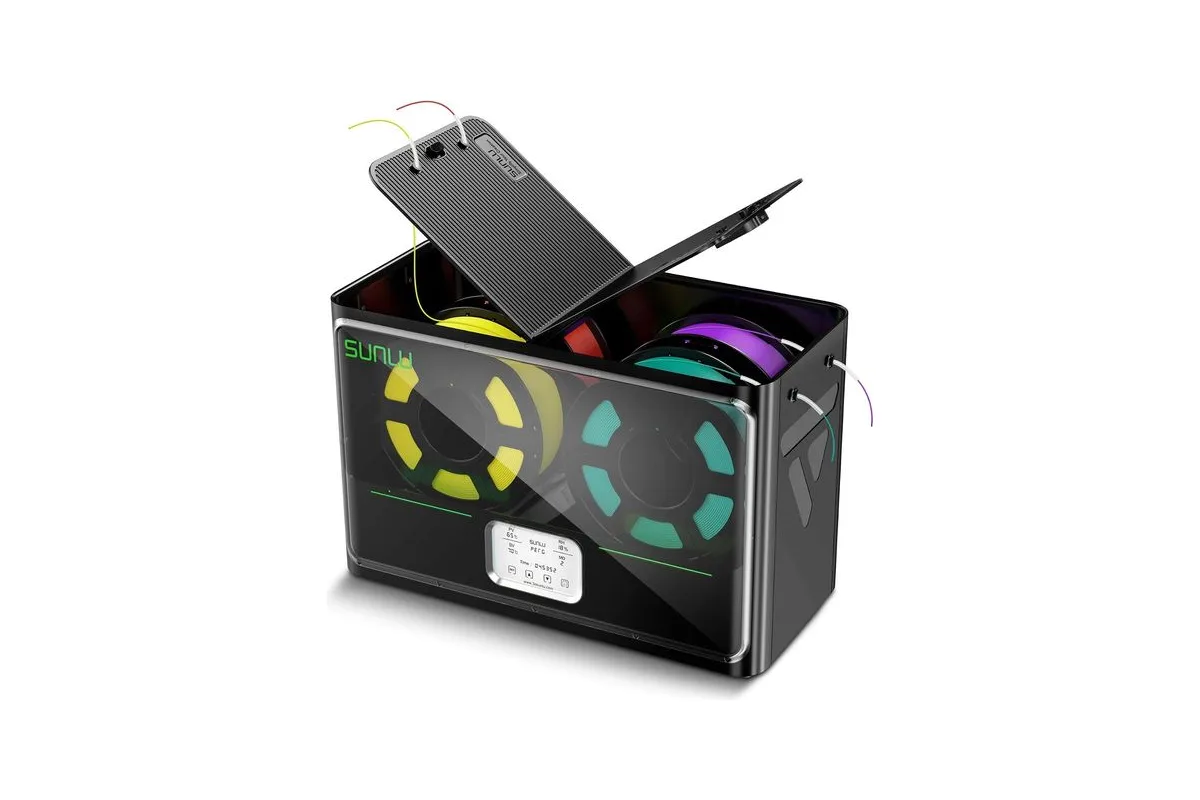
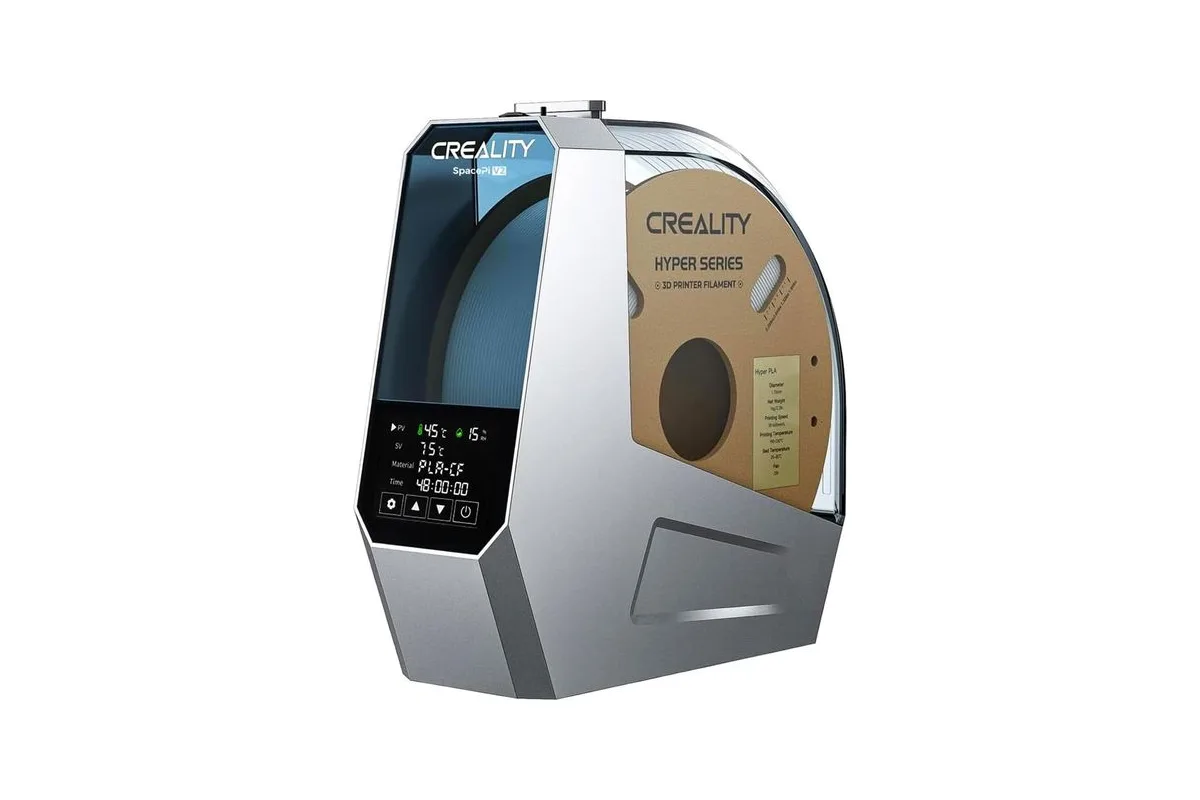
The danger is overshoot. An oven that runs hotter than its dial can soften PLA, which Bambu dries at just 50 °C, and deform its plastic spool. A filament dryer costs $38–$56 for one spool (the Sunlu S2 and Creality Space Pi V2 on Amazon in November 2026), which is cheap insurance against a ruined spool. Never use a microwave; Elegoo rules it out explicitly.
Can you dry filament on the printer’s heated bed?
On an enclosed Bambu printer, yes; on an open one, no. Bambu supports bed drying only on enclosed models and says the P1P, A1, A2L and A1 mini “cannot dry filament with the heatbed.” Unload the filament, put the spool under its cardboard box or a printed drying cover, flip it every 6 hours and wear gloves. Bambu’s bed set-points are higher than oven temperatures because the bed heats the spool indirectly: 60–70 °C for 12 hours for PLA and 75–85 °C for 12 hours for PETG.
Can a Bambu AMS dry filament?
The AMS 2 Pro dries at up to 65 °C, and only reaches that in a room at 25 °C or warmer. The AMS HT dries at up to 85 °C, with a 170 W heater that holds it in a 10–25 °C room. Bambu’s rotating mode turns the spool 30° every 5 minutes; it says static drying isn’t suitable for PLA, PVA or TPU. Take PLA and TPU out of the unit before drying hotter filaments like PETG or ABS. After drying, Bambu says to wait 5–10 minutes until the filament cools and store it immediately in a sealed container or an AMS with fresh desiccant. More in the best filament dryers.
How do you know if filament is wet?
Listen and look at the first layers. The makers describe the same signs:
| Sign | What it looks or sounds like | Who lists it |
|---|---|---|
| Popping, hissing or sizzling | Water boiling off in the nozzle | Bambu, UltiMaker, Sunlu, Creality |
| Bubbles in the extruded plastic | Steam pockets in the melt | Bambu, Prusa, Creality, Sunlu |
| More stringing and oozing than usual | Fine hairs between parts | Bambu, UltiMaker, Elegoo, Sunlu, Creality |
| Rough surface, pits and holes | Poor surface quality is “the first general sign” (Prusa) | Bambu, Prusa, Elegoo, Creality |
| Weak layer adhesion | Parts split along layer lines | Bambu, Prusa, UltiMaker, Sunlu |
| Under-extrusion, clogs or feed problems | In severe cases | Bambu, Sunlu |
| Soft or sticky PVA; cloudy, milky clear nylon | Material-specific | UltiMaker |
A quick check: heat the nozzle, extrude a little filament into the air, and listen for popping and look for bubbles. If you see them, dry the spool and print the same model again; if the problems go away, moisture was the cause.
Brittleness is a different problem. UltiMaker says filament that “snaps or splinters easily” when you bend it should be replaced. Creality’s bend test says the same: if it flexes, it’s likely fine; if it snaps or shatters, it’s degraded.
Before a spool even reaches the printer, Sunlu suggests checking whether the bag is still tightly vacuum-sealed and whether the desiccant packet has changed color. Bambu says to dry filament if you can’t confirm the desiccant is still working.
Which filaments absorb the most water?
Bambu’s data sheets give saturated water absorption at 25 °C and 55% humidity, which shows why some filaments need drying far more than others:
| Bambu filament | Water absorption |
|---|---|
| PC | 0.25% |
| PLA Basic | 0.43% |
| PETG Basic | 0.45% |
| ABS | 0.65% |
| TPU 95A HF | 1.08% |
| PA6-CF (nylon) | 2.35% |
Source: Bambu’s technical data sheets, read November 28, 2026.
Nylon takes up more than five times as much water as PLA. Bambu lists TPU, PETG, PLA Wood, PC, PVA and its nylon and fiber-filled grades as hygroscopic. Prusa says PLA “doesn’t change properties too much” when it absorbs humidity, and that nylon, polypropylene, PVA and BVOH should be dried before every print.
How often should you dry filament?
- Elegoo: highly hygroscopic filaments once a week; standard filaments every 1–2 months, or when signs of moisture appear.
- Bambu: dry PETG Basic if it has spent more than 72 hours above 50% humidity.
- Prusa: nylon, PP, PVA and BVOH before every print; even PLA on multi-tool printers like the Prusa XL.
- Sunlu, Creality and Bambu all list TPU, PC and nylon as filaments you must dry before use; Elegoo marks TPU and PC as mandatory.
Drying only helps if the spool stays dry afterward. See how to store filament, and for the PLA and PETG basics, PLA vs PETG.
Questions people ask
What temperature do you dry PLA at?
45–55 °C for about 6–8 hours: Prusa says 45 °C, Bambu 50 °C, Polymaker 55 °C and Sunlu 50–55 °C.
What temperature do you dry PETG at?
55–65 °C for 6–8 hours. Prusa uses 55 °C; Bambu, Polymaker and Sunlu use 60–65 °C.
Can you dry filament in a microwave?
No. Elegoo says never to use a microwave, and no filament maker we read lists one as a drying method.
How long does it take to dry filament?
Six to eight hours at the right temperature for most filaments, and up to 12 hours for nylon. Bambu’s AMS settings run longer, up to 18 hours for TPU in the AMS HT.
Can you over-dry filament?
You can overheat it. Prusa says going above its temperatures can soften filament so it sticks together, and to stick to the recommended times.
Does new filament need drying?
Often not, if the bag is still vacuum-sealed and the desiccant hasn’t changed color. Bambu recommends drying its silk PLA right after opening, and UltiMaker says to pre-dry its TPU 95A, Nylon CF Slide and PET CF after unboxing.
Can you dry filament without a dryer?
Yes: a food dehydrator, a convection oven with a thermometer, or the heated bed of an enclosed Bambu printer under a cover. A dryer is easier and safer, from $38.24 for a one-spool Sunlu S2 on Amazon.
Sources
- Bambu Lab wiki: filament drying recommendations, wiki.bambulab.com
- Bambu Lab wiki: AMS 2 Pro and AMS HT drying function, wiki.bambulab.com
- Bambu Lab wiki: filament guide material table, wiki.bambulab.com
- Bambu Lab PLA Basic technical data sheet, store.bblcdn.com
- Bambu Lab PETG Basic technical data sheet, store.bblcdn.com
- Bambu Lab TPU 95A HF technical data sheet, store.bblcdn.com
- Bambu Lab PA6-CF technical data sheet, store.bblcdn.com
- Bambu Lab PETG Basic store page, us.store.bambulab.com
- Prusa: drying filament, help.prusa3d.com
- Polymaker PolyLite PLA technical data sheet, cdn.shopify.com
- Polymaker PETG technical data sheet, cdn.shopify.com
- Polymaker PolyFlex TPU95 technical data sheet, cdn.shopify.com
- Polymaker PolyLite ASA technical data sheet, cdn.shopify.com
- Polymaker PolyLite PC technical data sheet, cdn.shopify.com
- Polymaker Fiberon PA6-CF20 technical data sheet, cdn.shopify.com
- Sunlu quick start guide: filament drying settings, sunlu.com
- Elegoo: FDM filament drying and storage guide, wiki.elegoo.com
- Creality wiki: filament drying, wiki.creality.com
- Creality: does 3D printer filament go bad?, creality.com
- UltiMaker: storing materials and shelf life, support.ultimaker.com
Keep exploring

How to
Hardened steel vs brass nozzles, and what nozzle size to use
Brass, or the stainless steel Bambu ships on the A1, is fine for PLA, PETG, ABS, ASA and TPU. Carbon fiber, glass fiber, glow-in-the-dark and sparkle filaments need hardened steel. Use a 0.4 mm nozzle for most prints, 0.6 mm for carbon fiber and big parts, and 0.2 mm for miniatures.
Read story
How to
Can you 3D scan with an iPhone? Yes, but not to tight tolerances
Yes. Any current iPhone can 3D scan objects from photos (photogrammetry), and KIRI Engine's free tier exports STL for printing. Only the iPhone 18 Pro and 18 Pro Max have LiDAR in Apple's current lineup. For parts that must fit, a $359 scanner is about ten times tighter.
Read story