Printers in this guide
How should you store 3D printer filament?
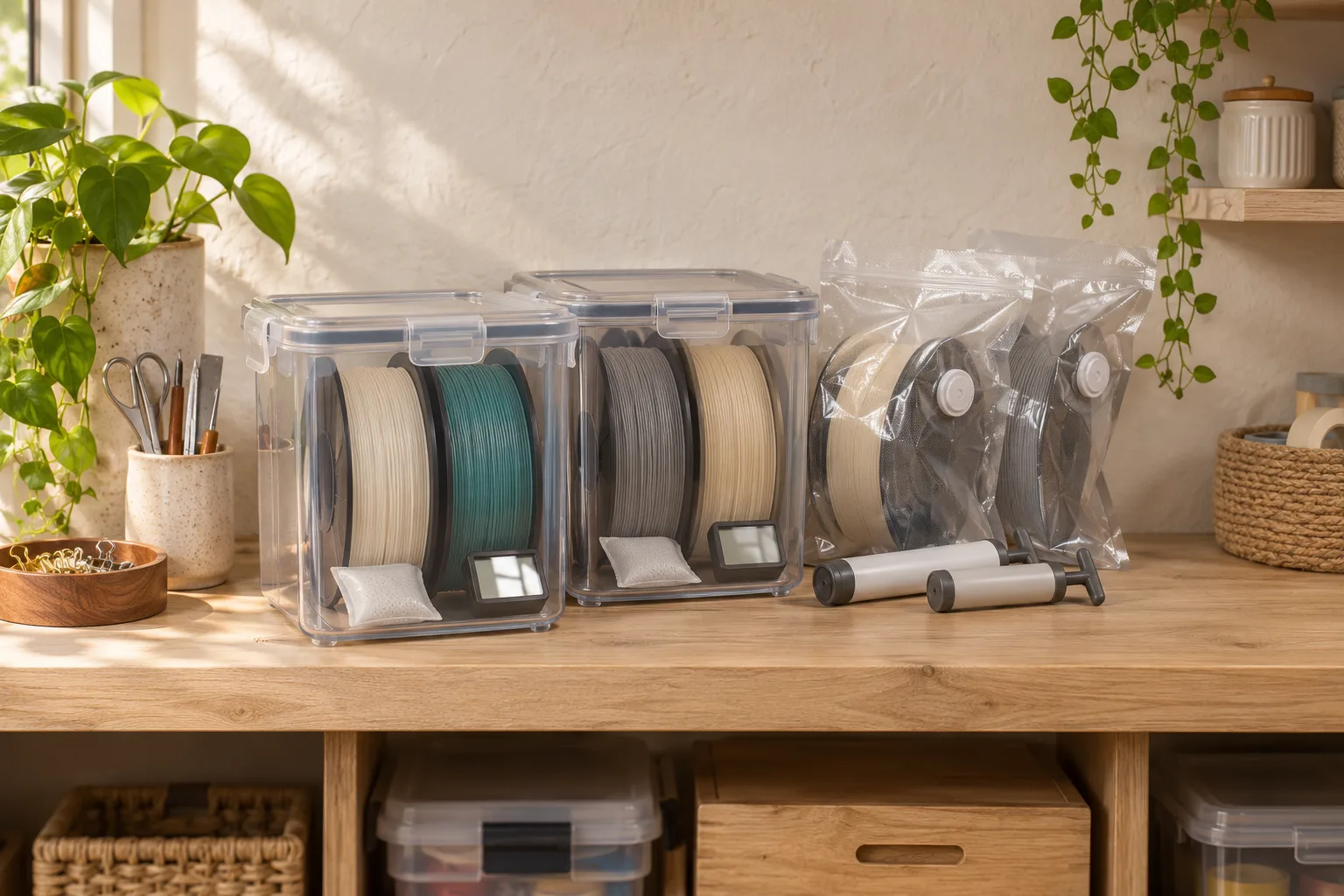
Sealed, with desiccant, below about 30% relative humidity, at room temperature and out of direct sunlight. Elegoo’s ideal is 15–25 °C and under 30% humidity; UltiMaker says most of its materials store best at about 10–30%. Every filament maker we read gives the same basic method: a sealed bag or airtight box with a desiccant pack, ideally with a hygrometer so you can see the humidity inside.
How careful you need to be depends on the material. PLA is the most forgiving: Prusa says it barely changes when it absorbs humidity. PETG, TPU, PC and especially nylon absorb more water and need sealing as soon as you finish printing.
What humidity should you store filament at?
The makers’ own targets:
| Maker | Storage humidity target |
|---|---|
| Elegoo | Under 30% RH, at 15–25 °C |
| UltiMaker | About 10–30% RH for most materials; under 50% for moisture-sensitive ones; near 0% “is not needed” |
| Polymaker | Its PolyDryer box ended at 20–30%, 15–25% or 10–20% RH on the dock’s three power levels in Polymaker’s test |
| Sunlu | No percentage; “a cool, dry place away from direct sunlight,” with desiccant “strongly recommended” for hygroscopic filaments. Its S4 dryer restarts at a set 30–50% and stops at 25% |
| Bambu | Dry PETG Basic if it has spent more than 72 hours above 50% humidity |
| Prusa | No percentage; a closed box with desiccant, such as a dry box or a vacuum bag |
Sources: the makers’ storage, drying and product pages, read November 28, 2026.
So aim for under 30% inside the container. You don’t need to chase single digits; UltiMaker says extremely low humidity isn’t necessary.
What temperature should filament be stored at?
Room temperature, away from heat and sunlight. UltiMaker gives a storage range of −20 to +30 °C for PLA, PETG, nylon, PC and TPU, a narrower 15–25 °C for ABS and 10–30 °C for PVA. Elegoo’s ideal is 15–25 °C. Bambu, Sunlu and UltiMaker all say to keep filament out of direct light. Pick a spot that stays under UltiMaker’s 30 °C limit all year; see where to put a 3D printer.
What’s the best way to store filament?
| Method | What it costs | Best for |
|---|---|---|
| The original bag, resealed with its desiccant and a clip | Free | PLA you’ll use in the next few weeks (Elegoo’s first suggestion) |
| Vacuum bag with a desiccant pack | Low | Long-term storage; Prusa calls it a “popular solution,” and Elegoo sells a vacuum pump for its bags |
| Airtight box with desiccant and a hygrometer | Varies | Several spools at once; Prusa and Creality both suggest a dry box |
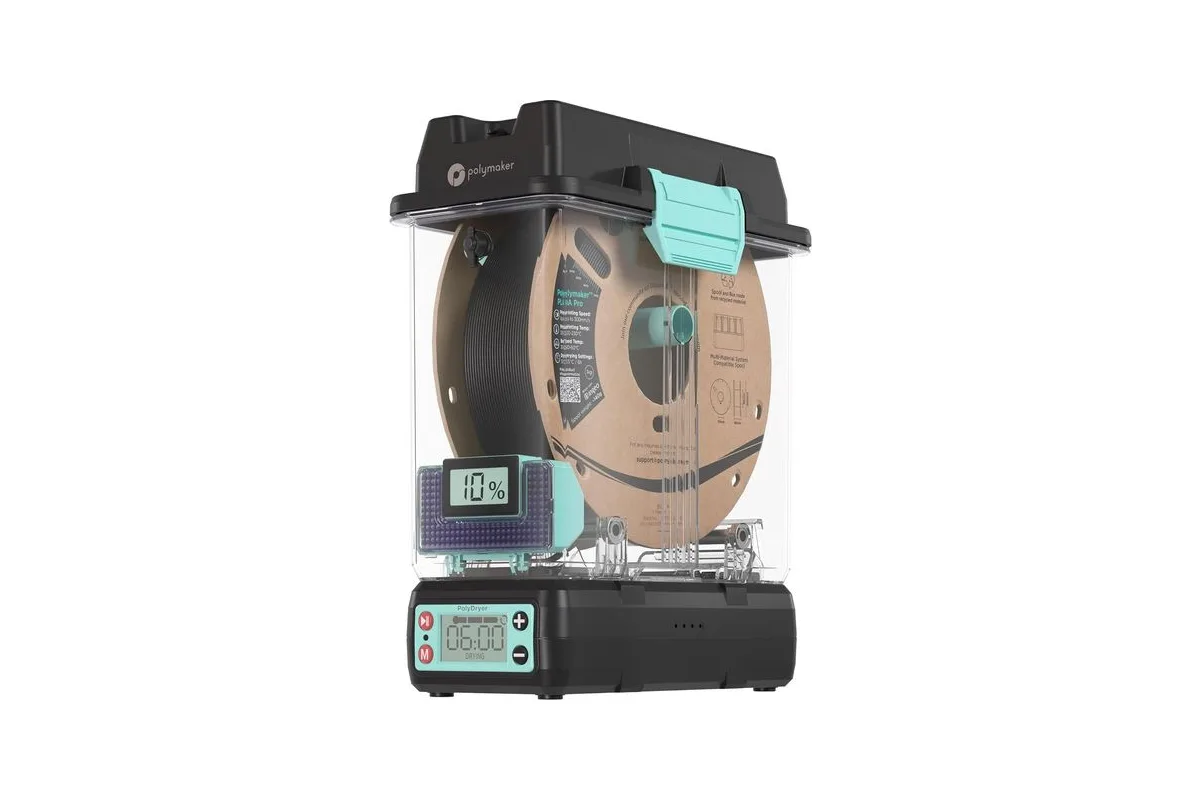
| Polymaker PolyDryer Box | $23.99 on Amazon; $29.99 at Polymaker, or $109.99 for four | One spool per box, with its own hygrometer and color-changing desiccant, that you can heat on the PolyDryer dock |
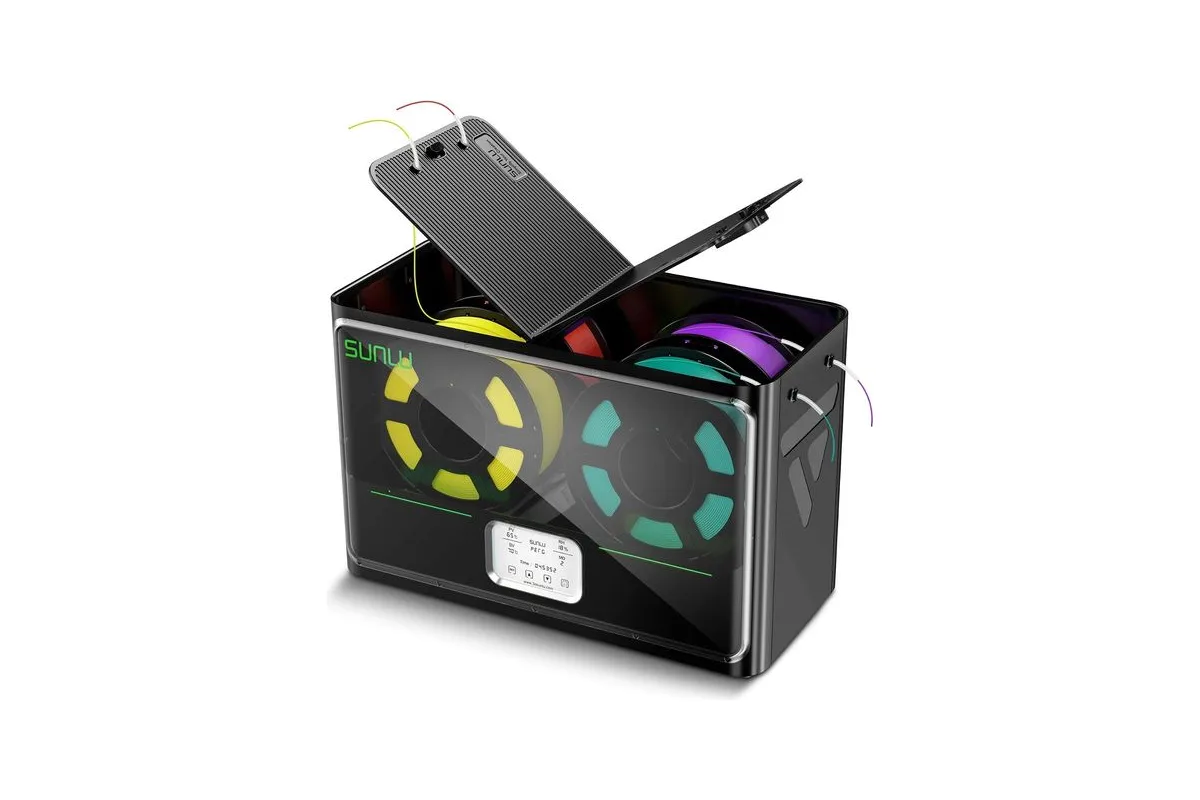
| A heated dryer with humidity control | $99.44 for the four-spool Sunlu S4 on Amazon | Spools you print from often; the S4 keeps its box between your set point and 25% while it’s plugged in |
| Bambu AMS 2 Pro | $229 at Bambu (typical $299) | Bambu owners: Bambu lists “air-tight filament storage” and 65 °C drying while it feeds the printer |
Prices are from November 28, 2026, during Black Friday sales.
Whatever you use, change or recharge the desiccant when it changes color. Sunlu says to check the desiccant packet for a color change, and Bambu says to dry filament if you can’t confirm the desiccant is still working. Polymaker’s dock regenerates the PolyDryer box’s desiccant in about 8 hours on its highest level.
For the most moisture-sensitive materials, sealing isn’t enough on its own. Prusa says to dry nylon, polypropylene, PVA and BVOH before every print, and Polymaker says its PA6-CF20 nylon “should always be stored and used under dry conditions.” Bambu says PLA Wood must be resealed in an airtight container with desiccant right after use. For drying temperatures and times, see how to dry filament.
How long does 3D printer filament last?
About one to two years by UltiMaker’s figures, longer in practice if it stays sealed and dry. Most filament makers don’t state a shelf life at all:
| Source | What it says |
|---|---|
| UltiMaker (support docs) | “Maximum shelf life of 1 year” for moisture-sensitive materials, including PLA, TPU 95A, nylon and PVA; 2 years for more chemically inert materials such as PP and PC. Both assume recommended storage, protected from light |
| Overture (store) | “1-year shelf life for unopened spools” |
| Creality (blog table) | PLA 2–3 years unopened and 5+ years in an airtight container with silica gel; PETG and TPU 2–3 years unopened and 1–2 years properly stored; nylon 1–2+ years unopened and 6–12 months properly stored; ABS 3–5+ years unopened |
| Bambu, Prusa, Sunlu, Elegoo, Polymaker | No shelf-life figure on the pages we read |
Sources: UltiMaker’s storage article, Overture’s store and Creality’s blog, read November 28, 2026.
The figures don’t agree. UltiMaker’s one year for PLA is a specification; Creality’s two to five years is a blog table, not a spec. Our reading: treat UltiMaker’s one year as a conservative guide for opened spools, and expect a sealed, unopened spool to last longer.
Absorbed water is the problem you can fix. It’s what every maker’s drying guide addresses, and drying at the right temperature removes it. Bambu’s data sheets show why some materials go off faster: at 25 °C and 55% humidity, PLA Basic absorbs 0.43% water, TPU 95A HF 1.08% and PA6-CF nylon 2.35%.
How do you know if old filament has gone bad?
Bend it. UltiMaker says filament that “snaps or splinters easily” when bent should be replaced, and Creality’s bend test says the same: if it flexes, it’s likely fine; if it snaps or shatters, it’s degraded.
If it bends but prints badly, with popping, bubbles, stringing or rough, weak layers, it’s probably just wet: dry it at the maker’s temperature and try again. UltiMaker adds two material-specific signs: PVA turns soft or sticky, and clear nylon goes cloudy or milky. The full list is in how to dry filament.
Does new filament need drying?
Usually not if the bag is intact, but check. Overture says its PLA Pro is dried for 24 hours and vacuum-sealed. Sunlu suggests checking that the bag “remains tightly vacuum-sealed” and that the desiccant hasn’t changed color. Some makers recommend drying even new spools of certain materials: Bambu strongly recommends drying its silk PLA right after opening, Bambu’s PETG HF page says it must be dried before use, and UltiMaker says to pre-dry its TPU 95A, Nylon CF Slide and PET CF after unboxing.
Questions people ask
Should you store filament in the original bag?
Yes, if you reseal it with the desiccant and a clip, which is what Elegoo suggests. For anything longer than a few weeks, a vacuum bag or airtight box with desiccant is better.
What humidity is too high for filament?
Bambu says to dry PETG that has spent more than 72 hours above 50% humidity, and UltiMaker keeps moisture-sensitive materials under 50%. For storage, aim under 30%.
Can you store filament in the AMS?
Bambu’s AMS 2 Pro is sold as airtight storage with drying, and Bambu says to store dried filament in a sealed container or an AMS with enough working desiccant. More in third-party filament in a Bambu AMS.
Does PLA expire?
Not on a date, but UltiMaker gives PLA a maximum shelf life of one year under recommended storage, and Overture gives unopened spools one year. If it still bends without snapping and prints cleanly after drying, it’s usable.
Can you revive old filament?
If it’s wet, yes: drying at the maker’s temperature removes the moisture. If it snaps when bent, UltiMaker says to replace it.
Does filament need to be stored in the dark?
Out of direct sunlight, at least. Bambu and Sunlu both say to store it away from direct sunlight, and UltiMaker’s shelf-life figures assume filament is protected from light.
Sources
- UltiMaker: storing materials and shelf life, support.ultimaker.com
- Elegoo: FDM filament drying and storage guide, wiki.elegoo.com
- Prusa: drying filament, help.prusa3d.com
- Bambu Lab wiki: filament drying recommendations, wiki.bambulab.com
- Bambu Lab wiki: PLA, wiki.bambulab.com
- Bambu Lab PETG Basic store page, us.store.bambulab.com
- Bambu Lab PETG HF store page, us.store.bambulab.com
- Bambu Lab AMS 2 Pro store page, us.store.bambulab.com
- Sunlu quick start guide: storage and drying, sunlu.com
- Sunlu FilaDryer S4 store page, store.sunlu.com
- Polymaker wiki: PolyDryer, wiki.polymaker.com
- Polymaker PolyDryer store page, shop.polymaker.com
- Polymaker Fiberon PA6-CF20 technical data sheet, cdn.shopify.com
- Creality wiki: filament drying, wiki.creality.com
- Creality: does 3D printer filament go bad?, creality.com
- Overture store, overture3d.com
- Polymaker PolyDryer Box on Amazon, amazon.com
Keep exploring

How to
Hardened steel vs brass nozzles, and what nozzle size to use
Brass, or the stainless steel Bambu ships on the A1, is fine for PLA, PETG, ABS, ASA and TPU. Carbon fiber, glass fiber, glow-in-the-dark and sparkle filaments need hardened steel. Use a 0.4 mm nozzle for most prints, 0.6 mm for carbon fiber and big parts, and 0.2 mm for miniatures.
Read story
How to
Can you 3D scan with an iPhone? Yes, but not to tight tolerances
Yes. Any current iPhone can 3D scan objects from photos (photogrammetry), and KIRI Engine's free tier exports STL for printing. Only the iPhone 18 Pro and 18 Pro Max have LiDAR in Apple's current lineup. For parts that must fit, a $359 scanner is about ten times tighter.
Read story