The quick answer
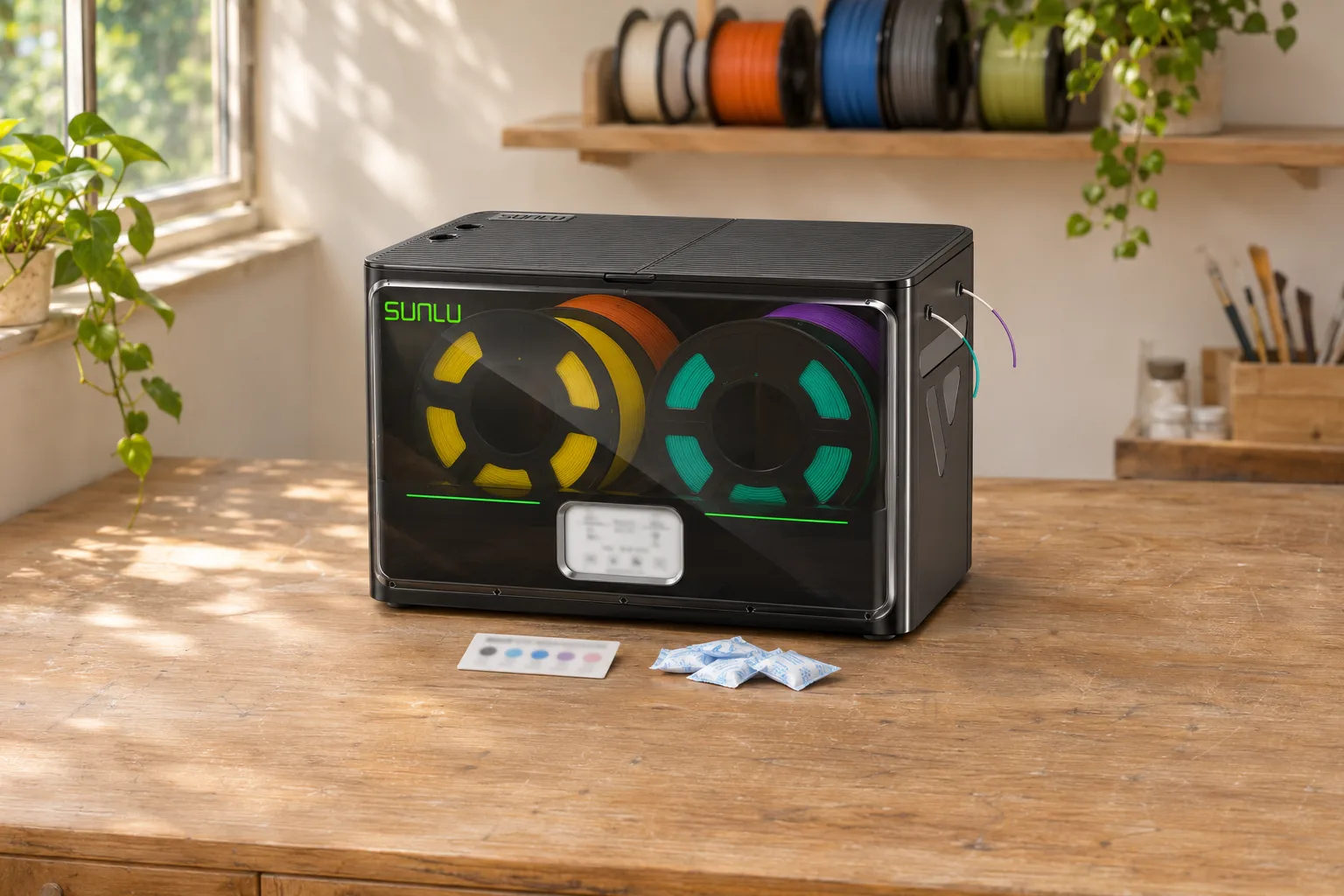
The Sunlu S4 ($99.44 on Amazon in November 2026) is the best filament dryer for most people: four spools at up to 70 °C, about $25 per spool slot, which covers PLA, PETG and TPU. If you print nylon, PC, ABS or ASA, get the Creality SpacePi X4 ($149): 85 °C in two separately heated chambers. For drying and storing in one, the Polymaker PolyDryer ($63.99) has a sealed box you lift off the heater. Bambu's AMS 2 Pro (65 °C) and AMS HT (85 °C) dry filament too, if your printer takes them.
Our quick picks
Compare the picks
| Feature | Best filament dryer for most peopleSunlu FilaDryer S4 | Best for nylon, PC and ABSCreality SpacePi X4 | Best dryer that doubles as storagePolymaker PolyDryer | Best single-spool dryerCreality Space Pi V2 |
|---|---|---|---|---|
| Spools | 4 × 1 kg | 4 (up to 200 mm across) | 1 × 1 kg per box (XL box 3 kg) | 1 × 1 kg |
| Max temperature | 70 °C | 85 °C | 68–73 °C | 70–75 °C |
| Chamber | 450 × 210 × 211 mm | |||
| Weight | 4.8 kg | |||
| Where to buy | Check price at Amazon | Check price at Amazon | Check price at Amazon | Check price at Amazon |
Best filament dryer for most people
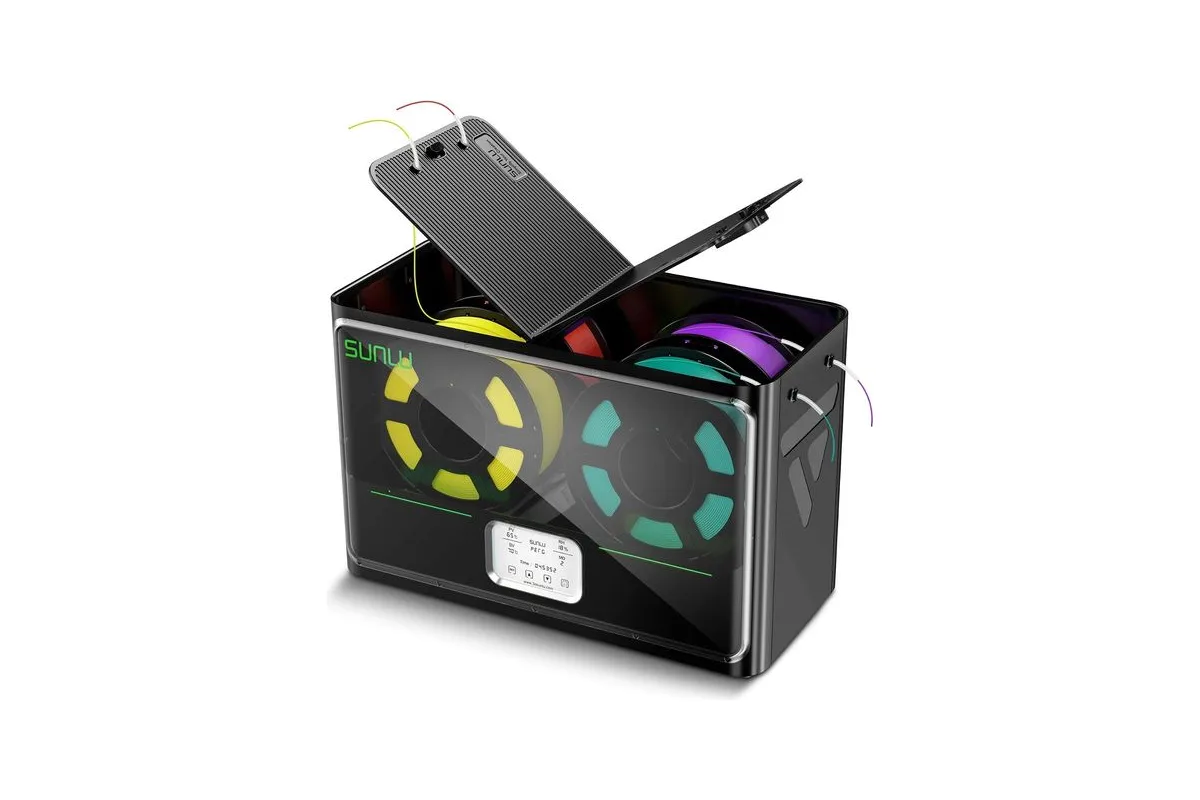
Sunlu FilaDryer S4
- Spools
- 4 × 1 kg
- Max temperature
- 70 °C
- Chamber
- 450 × 210 × 211 mm
- Weight
- 4.8 kg
Best for nylon, PC and ABS
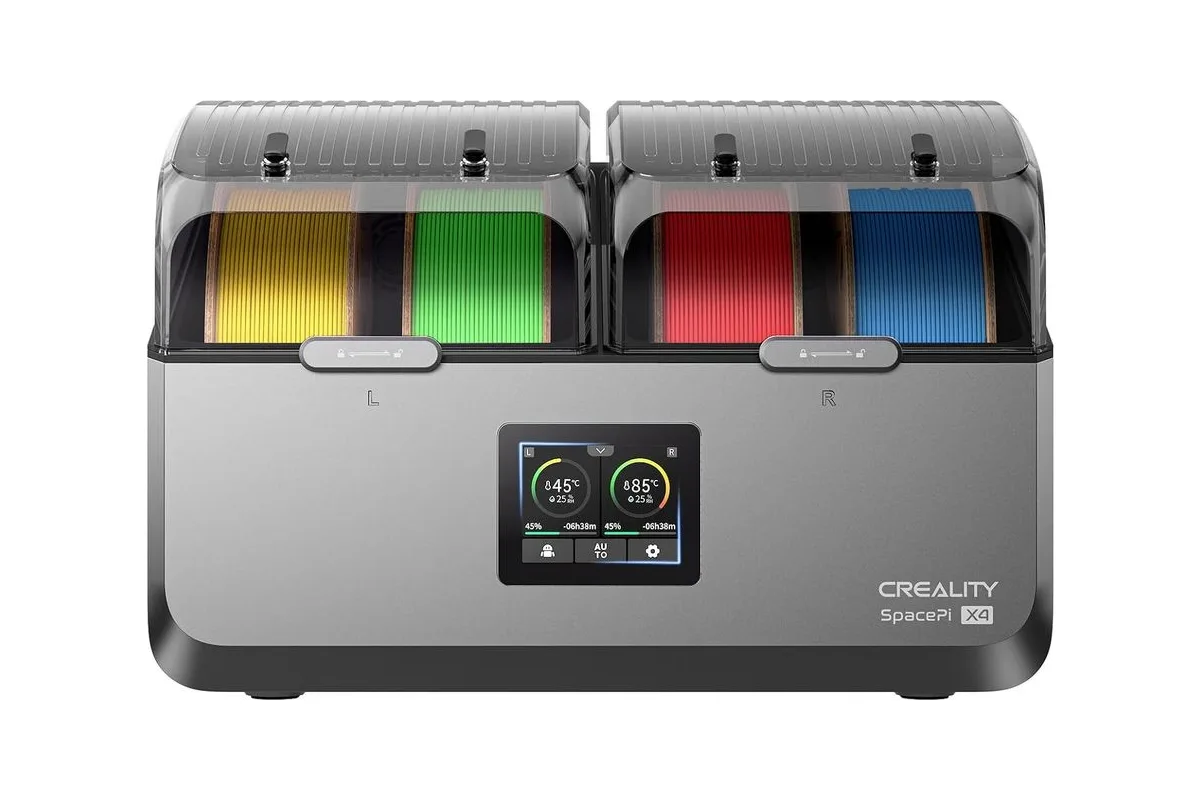
Creality SpacePi X4
- Spools
- 4 (up to 200 mm across)
- Max temperature
- 85 °C
- Chamber
- Weight
Best dryer that doubles as storage
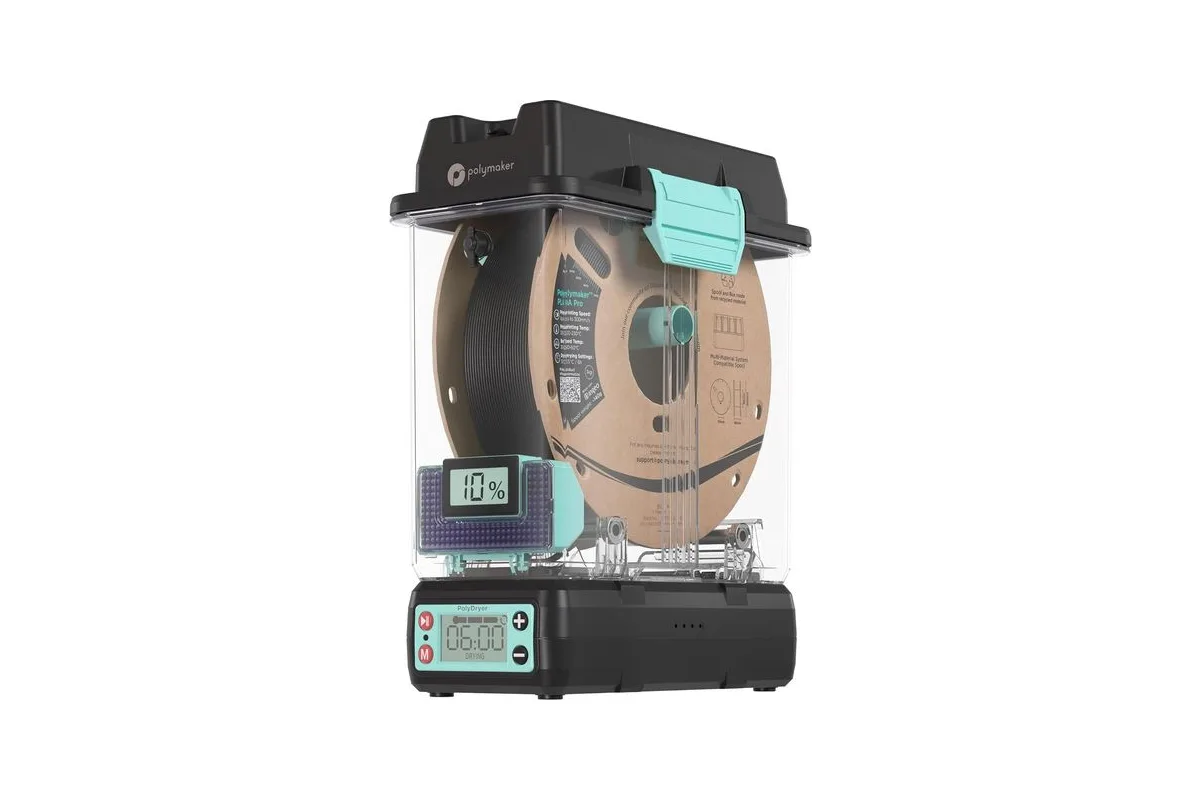
Polymaker PolyDryer
- Spools
- 1 × 1 kg per box (XL box 3 kg)
- Max temperature
- 68–73 °C
- Chamber
- Weight
Best single-spool dryer
Creality Space Pi V2
- Spools
- 1 × 1 kg
- Max temperature
- 70–75 °C
- Chamber
- Weight
01Best filament dryer for most people
Sunlu FilaDryer S4
A four-spool filament dryer that heats to 70 °C and switches itself back on when the humidity inside rises, for about $100 on Amazon.
The best filament dryer for most people: it dries four 1 kg spools at up to 70 °C for $99.44 on Amazon in November 2026, about $25 per spool slot (our estimate). Sunlu's own store had it at $116.99 (regular $139.99). Fans on both sides and one under the heater hold the chamber within ±3 °C, and it switches itself back on when the humidity inside climbs to a level you set between 30% and 50%, then stops at 25%.
70 °C covers every maker's settings for PLA, PETG and TPU, but not Sunlu's own 75–85 °C for ABS or 80–110 °C for nylon. Sunlu's pages list no humidity display or timer, and give three different heater wattages. Read our [Sunlu S4 review](/reviews/sunlu-s4-review).
Good for
- Dries four 1 kg spools at once: $99.44 on Amazon in November 2026, about $25 per spool
- Holds 70 °C within ±3 °C with three fans: enough for PLA, PETG and TPU
- Restarts on its own when humidity climbs to a set 30–50% and stops at 25%
Consider
- Tops out at 70 °C, below Sunlu's own drying settings for ABS, ASA and nylon
- Sunlu lists no humidity display, timer or spool rotation, and its pages give three different heater wattages
02Best for nylon, PC and ABS
Creality SpacePi X4
A four-spool dryer with two independently heated chambers that reach 85 °C, hot enough for nylon, PC and ABS.
The dryer for nylon, PC, ABS and ASA. Two independent chambers, each with its own 200 W heater, run from 45 to 85 °C, so PETG can dry on one side while nylon dries on the other. It takes four spools up to 200 mm across and 150 mm wide, with a 1–48 hour timer. It was $149 on Amazon in November 2026 ($159 at Creality, regular $199), about $37 per spool slot.
It costs about $50 more than the Sunlu S4, and Creality's page mentions no humidity display or spool rotation. Compare them in [Sunlu S4 vs Creality SpacePi X4](/comparisons/sunlu-s4-vs-creality-space-pi-x4).
Good for
- Heats to 85 °C: Creality's range is 45–85 °C, covering nylon and PC
- Two chambers with their own 200 W heaters, so two materials can dry at different temperatures
- $149 on Amazon in November 2026 ($159 at Creality, $199 regular)
Consider
- About $50 more than the Sunlu S4
- Creality's page mentions no humidity display or spool rotation
03Best dryer that doubles as storage
Polymaker PolyDryer
A heated dock and a sealed box with its own hygrometer: dry a spool, then lift the box off and store it dry.
The dryer that doubles as storage: a 68 W heated dock with a sealed box on top that has its own hygrometer and color-changing desiccant. When a spool is dry, lift the box off, shelve it, and put the next box on the dock. In Polymaker's own test the box ended at 10–20% humidity on the highest of three power levels. It was $63.99 for the dock and one box on Amazon in November 2026 ($79.99 at Polymaker), and extra boxes were $23.99 on Amazon.
The dock dries one box at a time, and Polymaker gives its top temperature as a 68–73 °C range that varies around the spool: enough for PLA and PETG, short of ABS and nylon. Polymaker's warranty is one year.
Good for
- Sealed box with a hygrometer and color-changing desiccant keeps filament dry after drying
- Polymaker's tests ended at 10–20% humidity on the highest of three power levels
- $63.99 for the dock and one box on Amazon in November 2026 ($79.99 at Polymaker); extra boxes $29.99
Consider
- One dock dries one box at a time; Polymaker gives a top range of 68–73 °C, varying around the spool
- 68 W heater: slower than larger dryers
04Best single-spool dryer
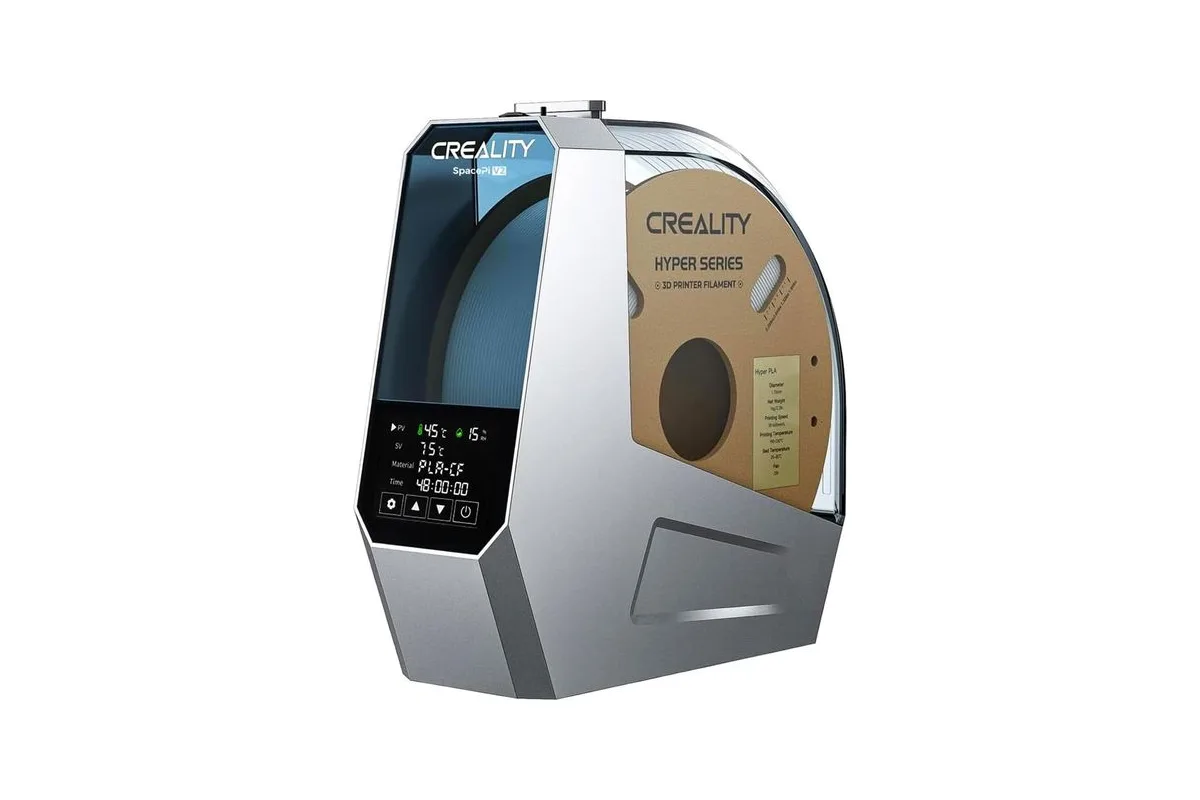
Creality Space Pi V2
A single-spool dryer with a touch screen, material presets and 360° hot air, for $56.
The best single-spool dryer: up to 75 °C by Creality's store (the Amazon listing gives a 70 °C top), 360° hot air, touch controls and material presets, for $56 on Amazon and at Creality in November 2026 (regular $85). That's hot enough for PLA, PETG and TPU on every maker's figures.
It holds one spool, so it costs $56 per slot, more than twice the S4. Sunlu's one-spool S2 is cheaper at $38.24 on Amazon and also reaches 70 °C.
Good for
- Presets for 12 filament types and a 0–48 hour timer
- Remembers its settings after a power cut
- $56 on Amazon and at Creality in November 2026 (regular $85)
Consider
- One spool at a time
- Creality's store says 75 °C, but the Amazon listing gives a 45–70 °C range; neither reaches nylon temperatures
How to choose
Build size
Match the build volume to the largest parts you plan to print.
Materials
PLA, PETG, and TPU print on open machines. ABS, ASA, and engineering filaments need an enclosure.
Multicolor and waste
Single-nozzle multicolor systems purge filament at every color change. Toolchangers waste far less.
What is the best filament dryer?
For most people, the Sunlu S4. It dries four 1 kg spools at once at up to 70 °C, and at $99.44 on Amazon the day after Black Friday 2026 it worked out to about $25 per spool slot, the lowest of any dryer here. 70 °C is enough for the filaments most people print: every maker’s drying temperature for PLA, PETG and TPU sits at or below it.
If you print nylon, PC, ABS or ASA, get the Creality SpacePi X4 ($149 on Amazon). It reaches 85 °C, and its two chambers heat separately, so you can dry two materials at their own temperatures. If you own a Bambu printer that takes the AMS 2 Pro or AMS HT, you may not need a separate dryer at all; see below.
Filament dryers compared
| Dryer | Spools | Max temp | Heater (maker) | Price (Nov 2026) | Cost per spool slot (our estimate) |
|---|---|---|---|---|---|
| Sunlu S4 | 4 × 1 kg | 70 °C | 300 W (Sunlu’s pages also say 330 and 350 W) | $99.44 Amazon; $116.99 Sunlu | $24.86 |
| Creality SpacePi X4 | 4, two chambers | 85 °C | 360 W (two 200 W heaters) | $149 Amazon; $159 Creality | $37.25 |
| Sunlu S4 Pro | 4 × 1 kg, two chambers | 85 °C | 380 W | $139.99 Sunlu | $35.00 |
| Polymaker PolyDryer | 1 per box (XL box 3 kg) | 68–73 °C | 68 W | $63.99 Amazon (dock + box); $79.99 Polymaker | $63.99 for one; $33.99 each with three extra boxes |
| Creality Space Pi V2 | 1 | 75 °C (Creality store) | Not listed | $56 Amazon and Creality | $56.00 |
| Sunlu S2 | 1 | 70 °C | 48 W | $38.24 Amazon; $44.99 Sunlu | $38.24 |
| Sunlu S1 Plus | 1 | 55 °C | 48 W | $39.99 Sunlu | $39.99 |
| Sunlu E2 | 2 × 1 kg or 1 × 2 kg | 110 °C | 325 W | $249.99 Sunlu | $125.00 |
| Bambu AMS 2 Pro | 4 | 65 °C | Not listed | $229 Bambu (typical $299) | $57.25 |
| Bambu AMS HT | 1 (our reading of Bambu’s pages) | 85 °C | 170 W | $119 Bambu (typical $139) | $119.00 |
Cost per slot is the price divided by the number of 1 kg spools it dries at once. The PolyDryer figure for four spools adds three $23.99 PolyDryer boxes from Amazon to the $63.99 kit ($135.96 total), but one dock still dries only one box at a time. Prices are Black Friday weekend snapshots from November 28, 2026; Bambu’s sale runs to December 1.
Which dryer reaches the temperature your filament needs?
This is the spec that matters most. A dryer that can’t reach your filament’s drying temperature will warm it without fully drying it. The makers’ own temperatures, and which dryers reach them:
| Filament | Makers’ drying temperatures | Sunlu S4 (70 °C) | SpacePi X4 (85 °C) | PolyDryer (68–73 °C) | Space Pi V2 (75 °C) | AMS 2 Pro (65 °C) | AMS HT (85 °C) |
|---|---|---|---|---|---|---|---|
| PLA | 45–55 °C (Prusa 45, Bambu 50, Sunlu 50–55, Polymaker 55) | Yes | Yes | Yes | Yes | Yes | Yes |
| PETG | 55–65 °C (Prusa 55, Polymaker 60–65, Bambu and Sunlu 60–65) | Yes | Yes | Yes | Yes | Yes | Yes |
| TPU | 50–70 °C (Sunlu 50–60, Prusa 60, Bambu and Polymaker 70) | Yes | Yes | About at the limit | Yes | Bambu says it may not fully dry | Yes (75 °C) |
| ABS, ASA | 70–85 °C (Polymaker ASA 70, Prusa ASA 80, Bambu and Sunlu 75–85) | No | Yes | No | Low end only | Bambu says it may not fully dry | Yes (80 °C) |
| PC | 70–85 °C (Sunlu 70–80, Polymaker 75, Bambu 75–85, Prusa 85) | Low end only | Yes | No | Partly | No | Yes (80 °C) |
| Nylon (PA, PA-CF) | 75–110 °C (Bambu 75–85, Prusa PA11 CF 90, Polymaker PA6-CF20 100, Sunlu 80–110) | No | Bambu’s figures and the low end of Sunlu’s | No | No | No | Bambu’s own nylons (85 °C) |
Sources: Bambu’s drying recommendations (convection oven and AMS HT columns), Prusa’s drying guide for Prusament, Polymaker’s technical data sheets and Sunlu’s drying settings, read November 28, 2026. The yes and no calls are our reading of those figures. Use the number on your own spool’s data sheet when it has one; nylon varies most by maker.
The practical rule: a 70 °C dryer covers PLA, PETG and TPU. Nylon and PC need 80–85 °C or more. Only the Sunlu E2 (110 °C) reaches the top of Sunlu’s nylon range and Polymaker’s 100 °C for PA6-CF20. For more on those materials, see carbon fiber and nylon filament.
Do you need a filament dryer?
If you print PETG or TPU, yes; for PLA in a normal room, usually not. Prusa says PLA barely changes when it absorbs humidity, while TPU, nylon and PVA need drying far more often, and it tells you to dry nylon, polypropylene, PVA and BVOH before every print. Bambu, Sunlu and Creality all list TPU, PC and nylon as filaments you must dry, and Elegoo says the same of TPU and PC. Bambu’s PETG Basic page says to dry it if it has sat above 50% humidity for more than 72 hours.
Wet filament pops or hisses at the nozzle, strings, and prints rough surfaces and weak layers. Our guide to how to dry filament has the full drying table and the signs, and how to store filament covers keeping it dry afterward.
Does a Bambu AMS 2 Pro or AMS HT replace a filament dryer?
For many Bambu owners, yes. Both are Bambu’s multicolor units with a heater built in, so filament dries in the same box that feeds the printer.
- AMS 2 Pro: 65 °C, $229 (typical $299). Bambu says it’s for filaments that dry at 65 °C or below, such as PLA and PETG, and that 65 °C is only reachable when the room is at least 25 °C. Bambu marks ABS, ASA, TPU, PC and nylon as “may not fully dry” in it. It holds four spools, which works out to $57.25 a slot, but it’s also your multicolor feeder. The Bambu P2S Combo comes with one.
- AMS HT: 85 °C, $119 (typical $139). Its 170 W heater holds 85 °C in a 10–25 °C room, enough for ABS, ASA, PC and Bambu’s nylons. It needs its own power cord to dry. Generic TPU won’t feed through the AMS HT, but it can go through the rear bypass port, and the AMS HT can still dry it.
Limits worth knowing: neither unit dries on its own (each needs the cable to the printer); Bambu says to take PLA and TPU out before drying hotter filaments like ABS or PETG; and printing while drying caps the temperature (drying PETG while printing PLA drops to 45 °C). Starting a dry remotely from Bambu Studio or Bambu Handy works on the H2D, H2S, P2S, X2D and A2L with current firmware, but not yet on the P1S, X1C, A1 or A1 mini. The A1 and A1 mini’s AMS lite doesn’t dry at all, so A1 owners need a standalone dryer. More in third-party filament in a Bambu AMS.
What about the Sunlu S4 Pro, E2, S2 and S1 Plus?
Sunlu makes the widest range, and the names are easy to mix up:
- S4 Pro ($139.99 at Sunlu): the S4’s 85 °C sibling, with two independent chambers of 220 × 210 × 211 mm each, 45–85 °C per chamber, an annealing mode and a 380 W heater. It’s a direct rival to the SpacePi X4, for about $9 less than the X4 on Amazon. Sunlu’s store data flagged it as unavailable in the US on November 28, though the page still showed a price.
- E2 ($249.99, regular $349.99): up to 110 °C for nylon, PC and annealing, but it holds only two 1 kg spools or one 2 kg spool. It’s the only dryer here that reaches Polymaker’s 100 °C setting for PA6-CF20.
- S2 ($38.24 on Amazon, $44.99 at Sunlu): one spool at 35–70 °C, with a screen showing temperature, humidity and a countdown, and built-in programs for filament types. The cheapest way into 70 °C drying.
- S1 Plus ($39.99 at Sunlu): one spool, but only 35–55 °C. That’s below Sunlu’s own 60–65 °C setting for PETG, so skip it unless you print only PLA.
Creality also sells a cheaper SpacePi X4L ($109 on Amazon); we couldn’t confirm its specifications from Creality.
Is a four-spool dryer worth it over a single-spool one?
If you print with more than one spool at a time, yes. A four-spool dryer costs less per slot: the S4 is about $25 a slot against $38 to $64 for the single-spool dryers here (our estimates from November 2026 prices). It matters most with a multicolor printer, where four spools sit open to the air at once; see the best multicolor 3D printers.
A single-spool dryer makes sense if you print one material at a time and want something small. The Space Pi V2 ($56) adds presets and a touch screen; the Sunlu S2 ($38.24) is cheaper with the same 70 °C limit.
How much electricity does a filament dryer use?
Little. At the US average of 18.17¢ per kWh (EIA, September 2026), our upper-bound estimates if each heater ran at its full rated power for the whole drying time:
| Dryer | Rated power | Drying time | Energy | Cost (our estimate) |
|---|---|---|---|---|
| Polymaker PolyDryer | 68 W | 6 h | 0.41 kWh | about 7¢ |
| Sunlu S4 | 300 W | 8 h | 2.4 kWh | about 44¢ |
| Creality SpacePi X4 | 360 W | 8 h | 2.88 kWh | about 52¢ |
Real use should be lower, because the heater doesn’t run flat out once the box is at temperature. Even at the upper bound, drying a spool costs far less than the spool. For the rest of the running costs, see how much 3D printing costs.
How we chose
We compared the four-spool and single-spool dryers sold in the US by Sunlu, Creality and Polymaker, plus Bambu’s drying AMS units, on maximum temperature against the drying temperatures published by Bambu, Prusa, Polymaker and Sunlu, spool capacity, humidity control and storage, and price per spool slot on Amazon and the makers’ stores on November 28, 2026. We haven’t tested these dryers hands-on.
Questions people ask
What is the best filament dryer?
The Sunlu S4 for most people: four spools at 70 °C for $99.44 on Amazon. For nylon and PC, the Creality SpacePi X4 at 85 °C ($149).
What temperature should a filament dryer reach?
At least 65–70 °C for PLA, PETG and TPU, and 80–85 °C or more for ABS, ASA, PC and nylon. Polymaker dries its PA6-CF20 at 100 °C, which only the 110 °C Sunlu E2 reaches here.
Can a filament dryer dry nylon?
Only a hot one. The SpacePi X4, Sunlu S4 Pro and Bambu AMS HT reach 85 °C, which matches Bambu’s nylon settings. Sunlu’s range for nylon runs to 110 °C and Polymaker’s PA6-CF20 wants 100 °C, so check your spool’s data sheet.
Is the Polymaker PolyDryer good for storage?
Yes, that’s its point. Each sealed box has a hygrometer and desiccant, and you can buy as many boxes as you have spools, but one dock dries one box at a time.
Can you print while the filament dries?
Bambu’s AMS 2 Pro and AMS HT dry while they feed the printer, at a lower temperature when printing and drying different filaments. For the standalone dryers here, we couldn’t confirm the feed path details from the makers’ spec pages, so check the outlets before you plan on it.
Do you need a dryer for PLA?
Usually not, in a normal room. Prusa says PLA barely changes when it absorbs humidity. A dryer pays off with PETG, TPU and nylon, in humid rooms, and on multicolor printers.
Sources
- Sunlu FilaDryer S4 specifications, sunlu.com
- Sunlu FilaDryer S4 store page, store.sunlu.com
- Sunlu FilaDryer S4 Pro specifications, sunlu.com
- Sunlu FilaDryer S2 specifications, sunlu.com
- Sunlu FilaDryer S1 Plus specifications, sunlu.com
- Sunlu FilaDryer E2 specifications, sunlu.com
- Sunlu quick start guide: filament drying settings, sunlu.com
- Creality SpacePi X4 product page, creality.com
- Creality SpacePi X4 store page, store.creality.com
- Creality Space Pi V2 store page, store.creality.com
- Polymaker PolyDryer store page, shop.polymaker.com
- Polymaker wiki: PolyDryer, wiki.polymaker.com
- Bambu Lab wiki: filament drying recommendations, wiki.bambulab.com
- Bambu Lab wiki: AMS 2 Pro and AMS HT drying function, wiki.bambulab.com
- Bambu Lab wiki: AMS 2 Pro and AMS HT FAQ, wiki.bambulab.com
- Bambu Lab AMS 2 Pro store page, us.store.bambulab.com
- Bambu Lab AMS HT store page, us.store.bambulab.com
- Prusa: drying filament, help.prusa3d.com
- Polymaker Fiberon PA6-CF20 technical data sheet, cdn.shopify.com
- Elegoo: FDM filament drying and storage guide, wiki.elegoo.com
- EIA Electric Power Monthly, Table 5.6.A, eia.gov
- Sunlu FilaDryer S4 on Amazon, amazon.com
- Creality SpacePi X4 on Amazon, amazon.com
- Polymaker PolyDryer on Amazon, amazon.com
- Creality Space Pi V2 on Amazon, amazon.com
Keep exploring

How to
Hardened steel vs brass nozzles, and what nozzle size to use
Brass, or the stainless steel Bambu ships on the A1, is fine for PLA, PETG, ABS, ASA and TPU. Carbon fiber, glass fiber, glow-in-the-dark and sparkle filaments need hardened steel. Use a 0.4 mm nozzle for most prints, 0.6 mm for carbon fiber and big parts, and 0.2 mm for miniatures.
Read story
How to
Can you 3D scan with an iPhone? Yes, but not to tight tolerances
Yes. Any current iPhone can 3D scan objects from photos (photogrammetry), and KIRI Engine's free tier exports STL for printing. Only the iPhone 18 Pro and 18 Pro Max have LiDAR in Apple's current lineup. For parts that must fit, a $359 scanner is about ten times tighter.
Read story