How it scores
- Print quality20%8.5
Clean, accurate prints with Bambu's default profiles, matching the larger A1.
- Setup and ease of use20%9.5
Automatic calibration, a touchscreen and Bambu's software make first prints easy; light assembly only.
- Speed10%7.5
Rated 500 mm/s with 10,000 mm/s² acceleration; quick for small prints.
- Features and materials20%6.0
Small 180 mm build volume and an 80 °C bed, so PLA, PETG and TPU only; four colors with the AMS lite.
- Reliability and ownership20%8.0
Not affected by the A1's 2024 recall, with a 2-year US warranty; some features use Bambu's cloud.
- Value and running costs10%9.5
$199 in November 2026, or $299 with four-color printing, the cheapest easy printer from a major brand.
Overall 8.1/10, the weighted average.How we score →
Is the Bambu Lab A1 mini worth it?
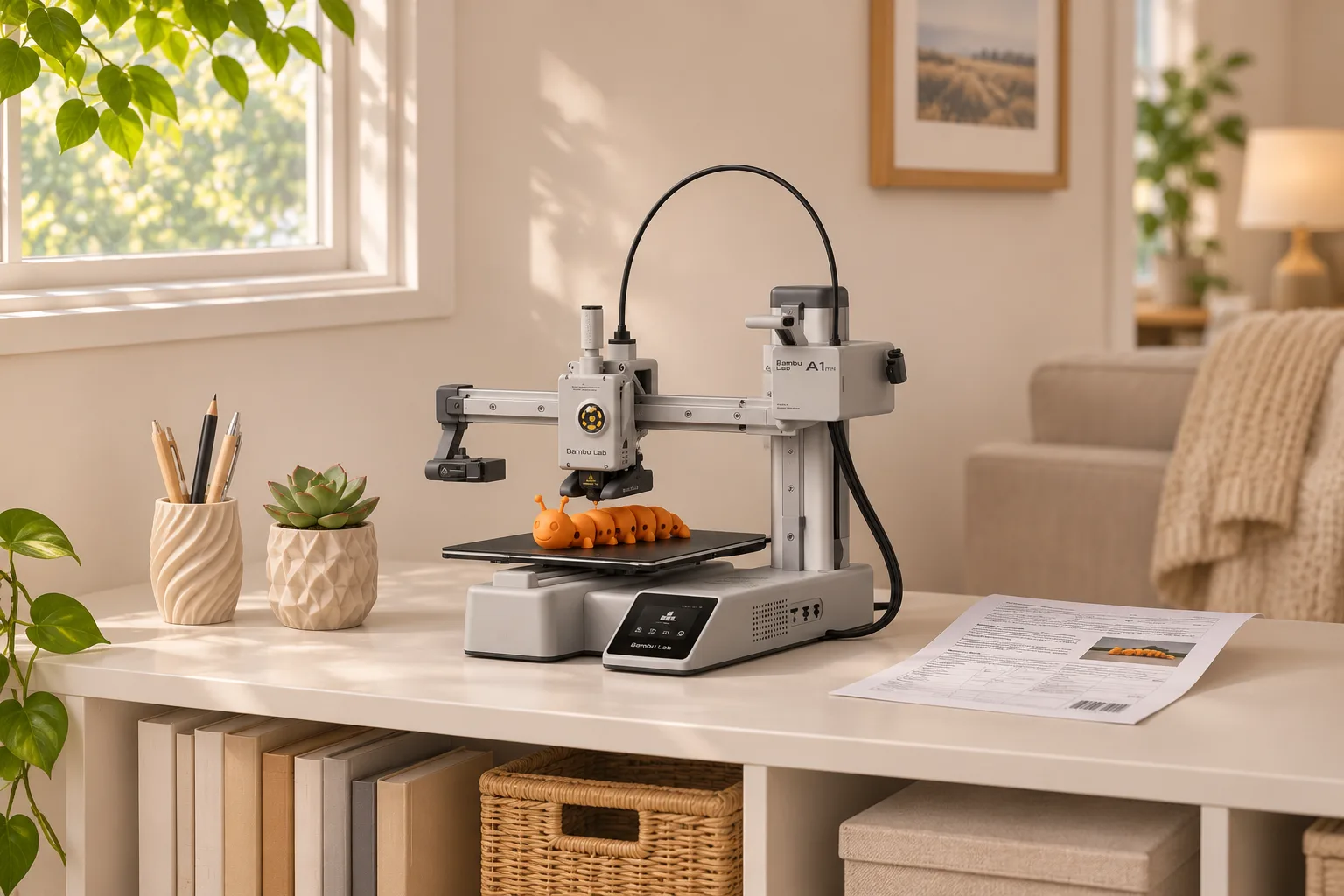
Yes, if what you want to print fits in a 180 mm cube. At $199 at Bambu’s store in November 2026 (typical $219), the A1 mini is the cheapest 3D printer that sets itself up and prints well without tuning. It has the same automatic calibration and software as the full-size A1, and it’s quiet: about 48 dB in silent mode, by Bambu’s rating. For $100 more, the A1 mini Combo prints in four colors.
The catch is size. A 180 x 180 x 180 mm build area fits toys, figurines, organizers, phone stands and most household fixes, but not cosplay helmets, big vases or storage bins. If you’re unsure, the A1 is only $60 more and much larger; see A1 vs A1 mini.
| Spec | Bambu Lab A1 mini |
|---|---|
| Price (Bambu, Nov 2026) | $199 (typical $219); Combo $299 (typical $329) |
| Type | Open-frame bed slinger |
| Build volume | 180 x 180 x 180 mm |
| Max nozzle / bed temperature | 300 °C / 80 °C |
| Rated speed | 500 mm/s, 10,000 mm/s² acceleration |
| Multicolor | 4 colors with the AMS lite (Combo) |
| Noise | About 48 dB in silent mode (Bambu) |
| Power | About 57 W average while printing (Bambu) |
| Size and weight | 347 x 315 x 365 mm, 5.5 kg |
| Storage | 32 GB microSD card included |
| Warranty | 2 years from Bambu’s US store |
Source: Bambu’s specifications and US store, read November 24, 2026.
What can it print?
PLA, PETG and TPU, in anything up to 180 mm on a side. Its bed heats to 80 °C and it has no enclosure, so ABS and ASA, which need a hot bed and a warm chamber, aren’t practical. That’s fine for most beginners: PLA is the easiest, cheapest and lowest-odor filament, and PETG covers parts that need to be tougher or heat-resistant. See PLA vs PETG.
How good are the prints?
As good as the full-size A1’s. Bambu’s default profiles produce clean, accurate prints, and the automatic calibration means you rarely need to adjust anything. It’s quick for its size, too, with a rated top speed of 500 mm/s.
Is the A1 mini Combo worth it?
If you want multicolor prints, yes: at $299 it’s the cheapest four-color Bambu. The AMS lite feeds four spools and switches between them automatically. Color changes are slow and every swap purges filament, so a four-color model can waste as much filament as it uses. See is a multicolor 3D printer worth it? and the best multicolor 3D printers.
Is it safe and reliable?
The A1 mini wasn’t part of the 2024 recall that affected the full-size A1’s heatbed cable, and it comes with a 2-year warranty from Bambu’s US store. It’s an open printer, so keep it out of reach of small children while it’s hot, and print PLA in a ventilated room. See are 3D printers safe?
Should you buy the Bambu Lab A1 mini?
Buy it if you want the easiest cheap printer, print mostly small things, or have limited space; it’s ideal for kids’ projects with supervision and for first-time makers. Buy the A1 if you might print anything bigger than 18 cm. For the absolute lowest price, the Creality Ender-3 V3 SE is $169 but needs more hands-on setup. See the best cheap 3D printers.
Questions people ask
Is the Bambu Lab A1 mini good for beginners?
Yes. It calibrates itself, prints well on default settings, and costs $199. It’s one of the easiest printers to start with.
What is the build volume of the A1 mini?
180 x 180 x 180 mm, about 7 inches on each side. The full-size A1 is 256 mm.
Can the A1 mini print ABS?
Not well. Its bed tops out at 80 °C and it has no enclosure, so ABS and ASA warp. Use PLA, PETG or TPU.
Is the A1 mini quiet?
Bambu rates it at about 48 dB in silent mode, quiet enough for a home office, though it’s louder at full speed.
Was the A1 mini recalled?
No. Bambu said the A1 mini was not affected by the 2024 A1 heatbed-cable recall.
Can I add multicolor to the A1 mini later?
Yes. The AMS lite works with the A1 mini; the larger AMS and AMS 2 Pro don’t.
Key specifications
| Feature | Bambu LabA1 mini | Bambu LabA1 mini Combo |
|---|---|---|
| Frame | Open (bed slinger) | Open (bed slinger) |
| Build volume | 180 x 180 x 180 mm | 180 x 180 x 180 mm |
| Multicolor | Optional: 4 colors (AMS lite) or AMS units via AMS Hub | 4 colors (AMS lite, included) |
| Materials | PLA, PETG, TPU | PLA, PETG, TPU |
| Where to buy | Check price at Amazon | Check price at Amazon |
Bambu Lab A1 mini
- Frame
- Open (bed slinger)
- Build volume
- 180 x 180 x 180 mm
- Multicolor
- Optional: 4 colors (AMS lite) or AMS units via AMS Hub
- Materials
- PLA, PETG, TPU
Bambu Lab A1 mini Combo
- Frame
- Open (bed slinger)
- Build volume
- 180 x 180 x 180 mm
- Multicolor
- 4 colors (AMS lite, included)
- Materials
- PLA, PETG, TPU
Sources
- Bambu Lab A1 mini product page, us.store.bambulab.com
- Bambu Lab A1 mini technical specifications, bambulab.com
- Bambu Lab A1 mini FAQ, wiki.bambulab.com
- Bambu Lab: A1 heatbed cable callback (A1 mini not affected), blog.bambulab.com
- Bambu Lab A1 mini review, tomshardware.com
- Bambu Lab A1 mini review, TechRadar
Keep exploring

How to
Hardened steel vs brass nozzles, and what nozzle size to use
Brass, or the stainless steel Bambu ships on the A1, is fine for PLA, PETG, ABS, ASA and TPU. Carbon fiber, glass fiber, glow-in-the-dark and sparkle filaments need hardened steel. Use a 0.4 mm nozzle for most prints, 0.6 mm for carbon fiber and big parts, and 0.2 mm for miniatures.
Read story
How to
Can you 3D scan with an iPhone? Yes, but not to tight tolerances
Yes. Any current iPhone can 3D scan objects from photos (photogrammetry), and KIRI Engine's free tier exports STL for printing. Only the iPhone 18 Pro and 18 Pro Max have LiDAR in Apple's current lineup. For parts that must fit, a $359 scanner is about ten times tighter.
Read story