How it scores
- Running costs25%3.0
About 7.9¢ per black page and 22¢ per color page with Brother's XL cartridges at its November 2026 prices; real text pages can run about 10.2¢.
- Document quality20%7.0
Very good text, just short of the best printers; graphics are fine for school reports.
- Color and photo quality10%6.5
Good enough for casual photos, but behind many inkjets on glossy paper.
- Features and paper handling20%6.5
20-sheet feeder, automatic two-sided printing and dual-band Wi-Fi at a low price, but the feeder scans one side only, there's no Ethernet and the tray holds 150 sheets.
- Reliability and ownership15%6.5
The Refresh subscription is optional, but the printer stops if any color runs dry, and like any inkjet it isn't ideal for printing only now and then.
- Speed and ease of use10%6.5
Rated 16 ppm with a 6.2-second first page and a 1.8-inch screen; Wi-Fi setup is more tedious than usual.
Overall 5.7/10, the weighted average.How we score →
Is the Brother MFC-J1360DW a good printer?
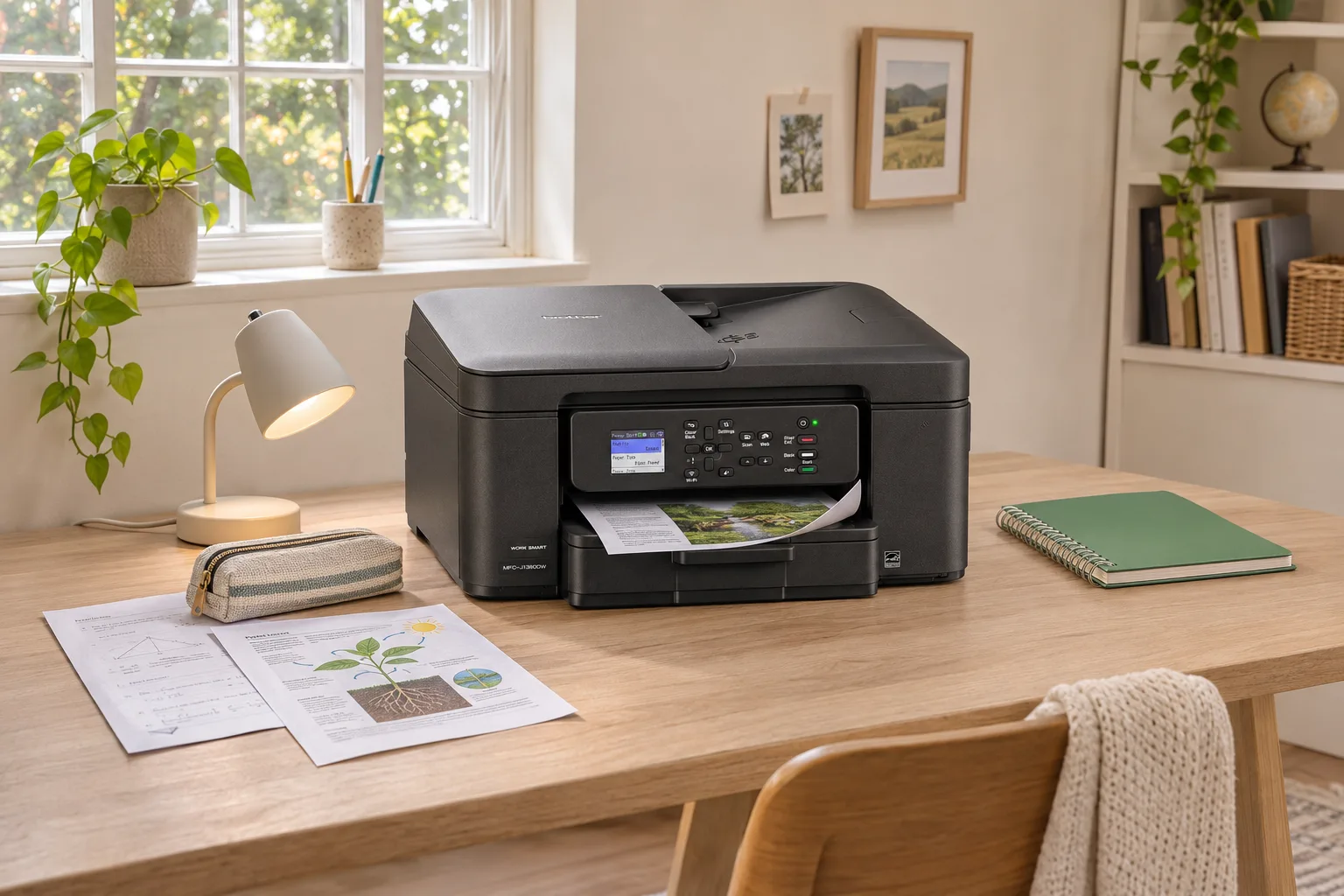
Yes, if you print a few pages a week: it’s the cheapest good all-in-one with a document feeder, at $69.99 on Brother’s store on November 23, 2026 (list $109.99). The catch is ink. With Brother’s XL cartridges, pages cost about 7.9¢ in black and 22¢ in color, roughly 27 times more per black page than an Epson ink tank.
For that price you get printing, scanning and copying, a 20-sheet document feeder, automatic two-sided printing and dual-band Wi-Fi. It’s the budget pick in our home printer guide. If you print regularly, the Epson ET-2980 costs $260 more and pays that back after about 3,400 black pages, about 17 months at 200 pages a month.
How much does a Brother MFC-J1360DW page cost?
About 7.9¢ per black page and 22¢ per color page with XL cartridges, or 6.9¢ in black with the XL twin pack. It uses four separate LC501 cartridges, so you replace only the color that runs out. Here’s the math at Brother’s prices in November 2026, cheapest first:
| Cartridges (Brother, November 2026) | Black page | Color page |
|---|---|---|
| LC501XL twin pack, black ($69.29 ÷ 1,000 pages) | about 6.9¢ | — |
| LC501XL: black $39.29 ÷ 500, each color $23.49 ÷ 500 | about 7.9¢ | about 22¢ |
| LC501 standard: black $23.39 ÷ 250, each color $11.79 ÷ 200 | about 9.4¢ | about 27¢ |
A color page is the black cost plus one page from each of the three color cartridges, the same method we use for ink-tank printers. The twin pack is the cheapest black, but Brother listed it, and the single XL black, as out of stock in November 2026.
Real pages vary. A standard black cartridge can print about 375 pages of text against its 250-page rating, while the color cartridges come in at about 190 against 200. In real use, costs can run about 10.2¢ per text page and 25.6¢ per color graphics page.
For comparison, an Epson ET-2980 or ET-3950 costs about 0.3¢ a black page and 1.1¢ in color. We explain why cartridge ink costs so much more in why printer ink costs so much.
What’s in the box?
The printer, four starter cartridges rated for about 200 pages each (black, cyan, magenta and yellow), a power cord and setup guides. That’s enough for a few months of light printing before you buy cartridges, so budget for an XL set early.
Does the MFC-J1360DW need a Brother Refresh subscription?
No. It ships with standard starter cartridges, and Brother sells LC501 cartridges outright. Brother Refresh EZ Print is a separate sign-up: a monthly plan that ships Refresh cartridges when the printer reports it’s running low, with a two-month free trial and no contract.
Know the terms before you enroll. The printer has to stay powered on and connected to Wi-Fi so Brother can monitor ink levels. While you’re subscribed, swapping in a non-Refresh cartridge stops the printer, and Refresh cartridges stop working immediately when you cancel, so keep a retail cartridge on hand first. Brother says you can cancel at any time without penalty. For how the major makers’ plans compare, see the best printers without a subscription.
How good is the print quality?
Good for documents, passable for photos. Text is very good, just short of the best printers, and color graphics are good enough for school reports and handouts. Photos on glossy paper are fine for casual snapshots but behind many other inkjets.
Automatic two-sided printing works on letter paper only. The 150-sheet tray takes plain and inkjet paper and envelopes, and finished pages land in a 50-sheet output tray.
How fast is it?
Fast enough for home use. Brother rates it at 16 pages per minute in black and 9 in color, with a first black page in 6.2 seconds from ready. Five text pages take about 22 seconds, about the same as Epson’s ET-3950. A laser like the Brother HL-L2460DW is far quicker for long documents.
How good are scanning and copying?
Useful, with limits. The 20-sheet feeder handles letter and legal pages, so you can scan or copy a stack without lifting the lid, which is rare at this price. It scans one side only: two-sided originals mean feeding the stack twice, and copies can’t be two-sided.
Brother rates the feeder at 17 images per minute in black and 7 in color. Scan quality is OK, with a few noticeable flaws, and fine for forms and receipts. You can scan to a computer or straight to Google Drive, Dropbox, Box or OneDrive with Brother’s cloud apps.
Is it easy to set up?
Mostly. Brother Mobile Connect handles setup and printing from a phone, and AirPrint and Mopria work too. Wi-Fi setup is more tedious than usual, and the 1.8-inch color screen is small. It connects over dual-band Wi-Fi, Wi-Fi Direct or USB; there’s no Ethernet port.
Is the MFC-J1360DW reliable?
It’s a sound budget printer with two habits to know. It won’t print at all if any one cartridge is empty. And like every inkjet, it can clog and spends ink on cleaning if it sits unused, so it isn’t a good choice if you print once a month and need it to work on demand. For that, see the best printer for occasional use. Brother covers it with a one-year limited warranty.
MFC-J1360DW vs Epson ET-2980 and ET-3950
Buy the Brother only if you print a handful of pages a week. The Epson ink tanks cost more upfront but far less per page:
| Epson ET-2980 | Epson ET-3950 | Brother MFC-J1360DW | |
|---|---|---|---|
| Price (maker, November 2026) | $329.99 | $399.99 | $69.99 (list $109.99) |
| Black page | about 0.29¢ | about 0.29¢ | about 7.9¢ (XL) |
| Color page | about 1.08¢ | about 1.08¢ | about 22¢ (XL) |
| Ink in the box | up to 6,600 black pages | up to 6,600 black pages | about 200 pages per color |
| Document feeder | None | 30 sheets, scans both sides | 20 sheets, one side |
| Paper input | 100-sheet rear feed | 250-sheet cassette | 150-sheet tray |
The break-even math against the ET-2980: $260 ÷ (7.9¢ − 0.29¢) is about 3,400 black pages. At 50 pages a month that takes nearly six years; at 200 a month, about 17 months. The ET-2980 has no document feeder, so if the feeder is why you’re looking at the Brother, compare it with the Epson ET-3950, which costs $330 more and breaks even after about 4,400 black pages.
If you print only black text, a mono laser like the Brother HL-L2460DW costs about 4¢ a page and never clogs. Our inkjet vs laser comparison goes through that choice.
Questions people ask
Does the Brother MFC-J1360DW need a subscription?
No. It prints with standard LC501 cartridges bought anywhere. Brother’s Refresh EZ Print plan is optional, but Refresh cartridges stop working as soon as you cancel.
What ink does the MFC-J1360DW use?
Brother LC501 cartridges: standard black (250 pages), standard colors (200 pages each), and XL versions of every color (500 pages each). The XL cartridges are the cheapest per page.
How many pages do the starter cartridges print?
About 200 pages each, per Brother’s rating. Plan on buying cartridges within the first few months.
Can the MFC-J1360DW scan double-sided?
No. The 20-sheet feeder scans one side at a time. The Epson ET-3950 scans both sides automatically.
Will the MFC-J1360DW print if one color is empty?
No. It stops printing when any cartridge runs out, so keep a spare of each color if you print regularly.
Does the MFC-J1360DW have Ethernet?
No. It connects over dual-band Wi-Fi, Wi-Fi Direct and USB.
Key specifications
| Feature | BrotherMFC-J1360DW |
|---|---|
| Type | Cartridge inkjet |
| Functions | Print, scan, copy |
| Document feeder | 20-sheet ADF (one side) |
| Auto duplex printing | Yes |
| Color printing | Yes |
| Where to buy | Check price at Amazon |
Brother MFC-J1360DW
- Type
- Cartridge inkjet
- Functions
- Print, scan, copy
- Document feeder
- 20-sheet ADF (one side)
- Auto duplex printing
- Yes
- Color printing
- Yes
Sources
- MFC-J1360DW product page, Brother
- Brother Genuine LC501BKS Standard Yield Black Ink Cartridge, Brother
- Brother Genuine LC501CS Standard Yield Cyan Ink Cartridge, Brother
- Brother Genuine LC501XLBKS High Yield Black Ink Cartridge, Brother
- Brother Genuine LC501XLCS High Yield Cyan Ink Cartridge, Brother
- Brother Genuine LC501XL2PKS Twin Pack High Yield Black Ink Cartridges, Brother
- Brother Refresh subscription, Brother
- Refresh subscription FAQs, Brother
- Brother MFC-J1360DW review, Consumer Reports
- Brother MFC-J1360DW review, RTINGS
- EcoTank ET-2980 product page, Epson
- EcoTank ET-3950 product page, Epson
- Epson 502 Black Ink Bottle, Epson
Keep exploring
Buying guide
The best barcode label printers
The Zebra ZD421 is the best barcode label printer for most businesses: 4-inch labels at 6 inches a second, any brand of label roll and a 24-month warranty, for about $480 to $526 in November 2026. Get the Brother QL-820NWBc ($229.99) for an office or shop counter, and a thermal transfer model for inventory labels that have to last.
Read story
Buying guide
The best check printers for a small business
The TROY 3001dw ($509.15 at TROY, $530 at Amazon in November 2026) is the best check printer for a small business: a 35 ppm Wi-Fi laser with MICR toner, rated for 350 to 2,500 checks a month, at about 5¢ to 7¢ per check three to a page by our estimate. Get the TROY 4001dn for a locking tray, or the VersaCheck M15 MXD ($399.99) for software in the box.
Read story