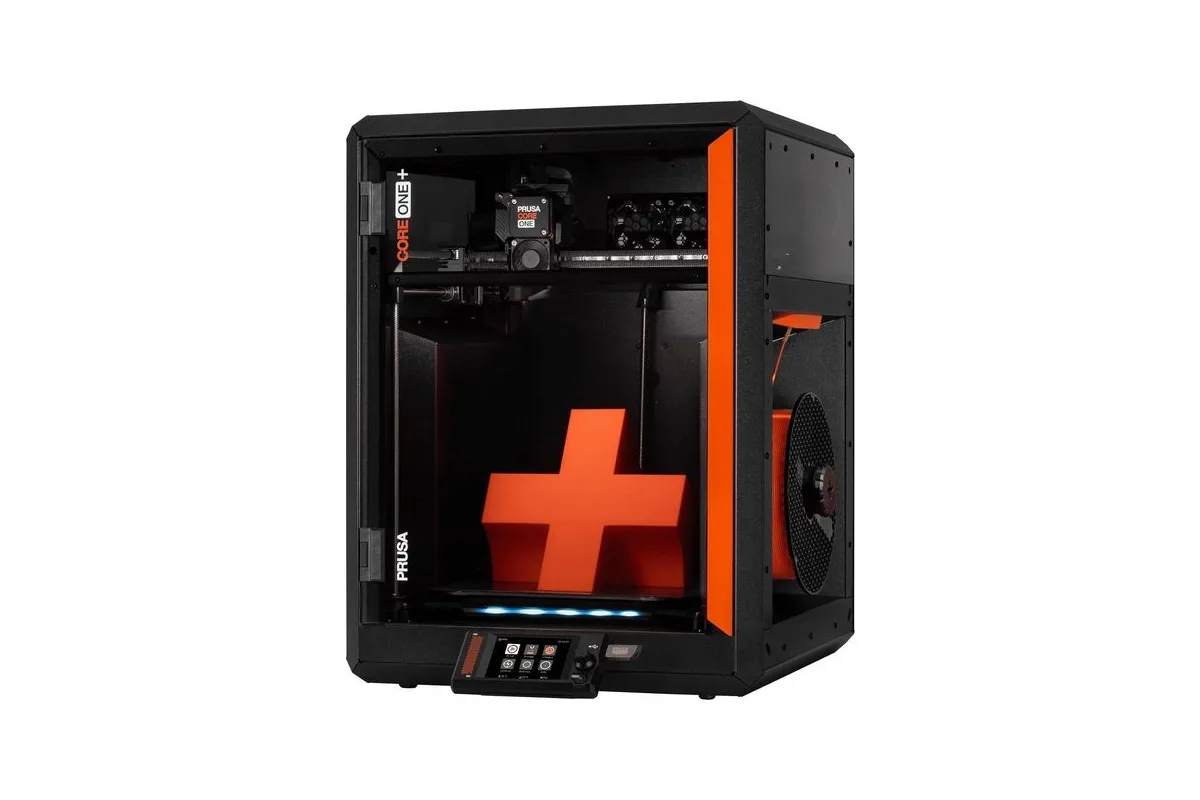
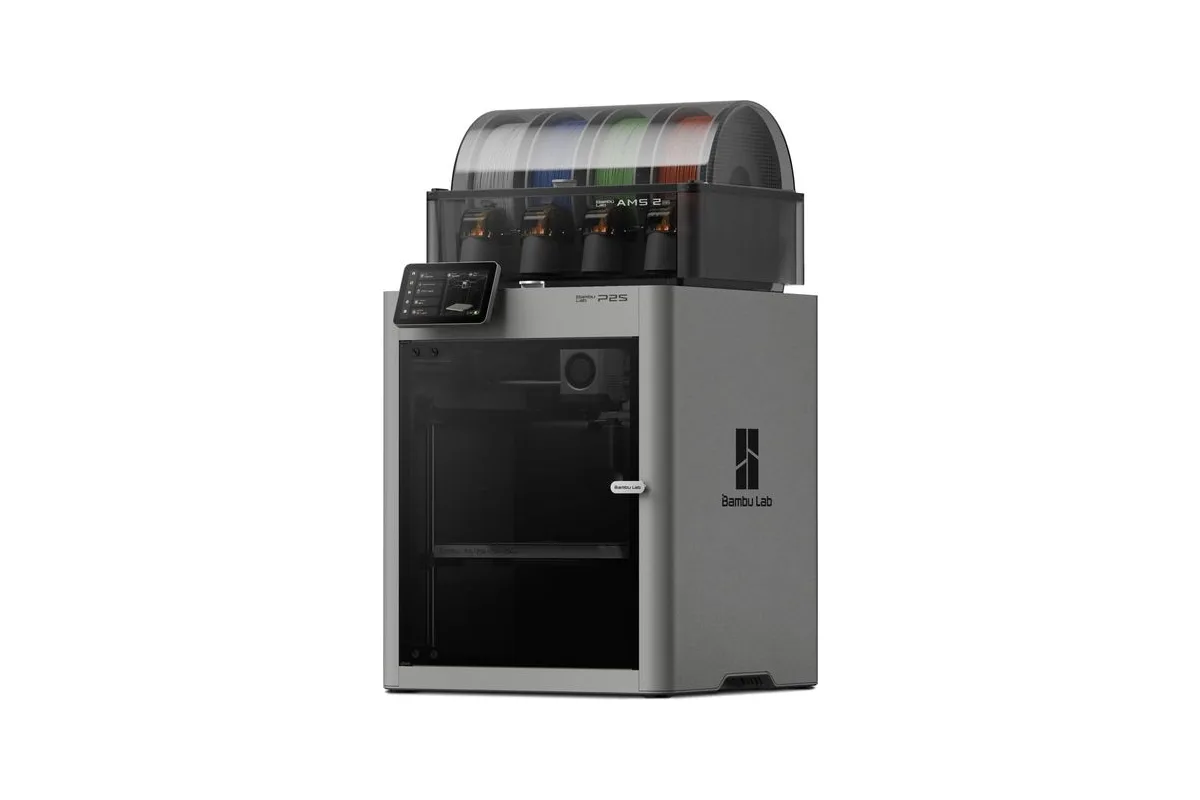
Side by side
| Feature | PrusaCORE One+ | Bambu LabP2S Combo |
|---|---|---|
| Frame | Enclosed CoreXY | Enclosed CoreXY |
| Build volume | 250 x 220 x 270 mm | 256 x 256 x 256 mm |
| Multicolor | Optional (MMU3 or INDX) | 4 colors (AMS 2 Pro), expandable |
| Materials | PLA, PETG, TPU, ABS, ASA, PC, CF blends | PLA, PETG, TPU, ABS, ASA, CF blends |
| Where to buy | Check price at Amazon | Check price at Amazon |
Prusa CORE One+
- Frame
- Enclosed CoreXY
- Build volume
- 250 x 220 x 270 mm
- Multicolor
- Optional (MMU3 or INDX)
- Materials
- PLA, PETG, TPU, ABS, ASA, PC, CF blends
Bambu Lab P2S Combo
- Frame
- Enclosed CoreXY
- Build volume
- 256 x 256 x 256 mm
- Multicolor
- 4 colors (AMS 2 Pro), expandable
- Materials
- PLA, PETG, TPU, ABS, ASA, CF blends
Prusa CORE One+ or Bambu Lab P2S: which is better?
The Bambu Lab P2S, for most people. In November 2026 the P2S Combo cost $649 at Bambu’s US store (typical $749), with the AMS 2 Pro for four colors, a 1080p camera, a 5-inch touchscreen, AI failure detection and a hardened nozzle. An assembled Prusa CORE One+ (Gen 2) cost $1,299, or $999 as a kit, with one color, no camera and a brass nozzle.
The CORE One+ is better if you care how the printer is built and who controls it. Its chamber reaches 55 °C where the P2S has no chamber heating, its bed goes to 120 °C, it has Ethernet, and it’s designed to be repaired with a screwdriver. It prints fully offline with no account, and its firmware is open source.
Both are enclosed CoreXY printers with similar build volumes, so for everyday PLA, PETG, ABS and ASA you’re choosing between value and ownership, not between a good and bad printer.
What’s the difference between the CORE One+ and P2S?
| Prusa CORE One+ (Gen 2) | Bambu Lab P2S | |
|---|---|---|
| Price (maker US store, Nov 28, 2026) | $1,299 assembled / $999 kit (no discount) | $449 printer / $649 Combo (typical $549 / $749) |
| Sale ends | Gifts through Nov 30, 11:59 p.m. PT | Dec 1, 2:00 a.m. ET |
| Frame | Enclosed CoreXY, steel | Enclosed CoreXY |
| Build volume | 250 x 220 x 270 mm (14.9 L) | 256 x 256 x 256 mm (16.8 L) |
| Price per liter (our estimate) | $87 assembled / $67 kit | $27 printer / $39 Combo |
| Max nozzle / bed | 290 °C / 120 °C | 300 °C / 110 °C |
| Chamber | Heated, up to 55 °C (no separate heater) | No chamber heating; circulation flap |
| Stock nozzle | Brass, high-flow 0.4 mm | Hardened steel, 0.4 mm, quick swap |
| Speed (maker) | No figure | 600 mm/s, 20,000 mm/s² |
| Multicolor | Optional MMU3 (5) or INDX (4 or 8 tools) | AMS 2 Pro (4) in the Combo; up to 20 |
| Camera / AI | Optional 1080p; no AI detection | 1080p 30 fps; AI spaghetti, blob and jam detection |
| Filtration | Optional HEPA | Activated carbon |
| Connectivity | Ethernet, Wi-Fi, USB | Dual-band Wi-Fi, USB (no Ethernet) |
| Firmware | Open source | Closed |
| Weight | 22.5 kg | 14.9 kg |
| Noise (maker) | No figure | Under 50 dB in silent mode, at 1 m |
| PLA power (maker) | About 90 W | 200 W |
| US warranty | 1 year (+1 free with Black Friday orders) | 2 years from Bambu’s store |
Sources: Prusa’s and Bambu’s US stores, specification pages, FAQs and wiki, read November 28, 2026. Volumes and per-liter prices are our arithmetic.
Which prints better?
Both are built for clean prints with default profiles. The P2S calibrates flow automatically with an eddy-current sensor and watches each print with AI detection on a 2 TOPS chip. The CORE One+ uses a load cell for its first layer, input shaping and GT1.5 belts, and Prusa tunes its own PrusaSlicer profiles. We compare them on specifications here, not on our own test prints.
The gap opens on hot materials. A chamber held at 55 °C helps large ABS, ASA, nylon and polycarbonate parts resist warping more than an enclosure that only traps heat. Bambu says the P2S “does not have an active chamber heating function”; it manages temperature with its enclosure and a flap that switches between internal and external air. Prusa’s own pages describe the CORE One+ chamber both as “active” and as “passive”, and our reading is that the bed and fans heat it without a separate heater. Either way, it gets warmer than the P2S.
For abrasive carbon- and glass-filled filaments, the P2S comes ready with a hardened-steel nozzle. The CORE One+ needs a hardened nozzle swapped in, such as Prusa’s ObXidian at $57.99.
Which is faster?
Probably the P2S, though there’s no like-for-like figure. Bambu rates it at 600 mm/s and 20,000 mm/s², and firmware 01.03 (September 2026) raised travel moves to 1,000 mm/s. Prusa gives no speed figure for the CORE One+, only “fast CoreXY kinematics.” Both are in the fast CoreXY class.
Which is better for multicolor?
The P2S, unless you’re willing to pay and wait for INDX.
| Four-color setup | Price (Nov 2026) | Waste per color change |
|---|---|---|
| P2S Combo with AMS 2 Pro | $649 | Purges at every change; Bambu publishes no per-change figure |
| CORE One+ + INDX 4-tool kit | about $2,048 assembled / $1,748 kit (our estimates) | About 0.013 g per change (Prusa’s claim) |
INDX gives each filament its own nozzle, so there’s almost nothing to purge, but new kit orders ship after February 2027. The MMU3 is the cheaper Prusa route, but like the AMS it feeds every filament through one nozzle. The P2S grows to 20 slots with more AMS units. If waste is your main worry, compare tool changers and read is a multicolor 3D printer worth it?
Which works better offline?
The CORE One+. It prints over USB, Ethernet or Wi-Fi with no account, the Wi-Fi module can be removed, and Prusa Connect can now run locally on your own computer with no cloud (firmware 6.4.0 or later). The optional camera is the exception: Prusa says it needs Wi-Fi.
The P2S also prints without the cloud, but with limits. In Bambu’s LAN Only mode you can’t start prints from outside your home network, the Bambu Handy app doesn’t work and print history is unavailable; AI detection still runs on the printer. Bambu said in January 2025 that all its future models would carry its authorization controls, which limit what third-party tools can do with the printer. The P2S’s LAN Only page has a Developer Mode toggle that leaves local access open for those tools, a mode Bambu doesn’t support. See can you use a Bambu Lab printer offline?
Which costs less to own?
| Prusa CORE One+ | Bambu Lab P2S | |
|---|---|---|
| Warranty | 1 year US; free +1 year on orders through Nov 30, 2026 | 2 years, only when bought from Bambu’s US or Canada store; hotend and extruder gears not covered |
| Repairs | Nothing glued; printable parts; published CAD | Spare parts sold; takes H2D nozzles; hotend swaps with one clip |
| Updates | Open-source firmware | Bug and feature updates until Oct 14, 2030; security patches until Oct 14, 2032 |
| 4-hour PLA print, electricity (our estimate) | About 6.5¢ (90 W) | About 14.5¢ (200 W) |
Electricity uses the September 2026 US average of 18.17¢ per kWh. It’s pennies either way; filament is the real cost. See how much does 3D printing cost?
Which should you buy?
- P2S Combo ($649) if you want four colors, a camera and the easiest setup for the money. Read our P2S review.
- CORE One+ ($1,299 assembled, $999 kit) if you want a heated chamber, Ethernet, open firmware and a printer you can keep running yourself. Read our CORE One+ review.
- Bambu Lab H2S ($1,049) if you want Bambu’s ease with a heated chamber (65 °C) and a larger build volume. See our H2S review.
More: Bambu Lab vs Prusa and the best enclosed 3D printers.
Questions people ask
Is the Prusa CORE One+ better than the Bambu P2S?
For chamber heat, repairability and offline use, yes. For price, multicolor, the camera and ease of use, the P2S is ahead.
Does the Bambu P2S have a heated chamber?
No. Bambu says it has no active chamber heating; it regulates temperature with its enclosure and a circulation flap. The CORE One+ chamber reaches 55 °C.
Is the P2S bigger than the CORE One+?
Slightly: 256 x 256 x 256 mm (16.8 liters) against 250 x 220 x 270 mm (14.9 liters), our estimates. The CORE One+ is taller.
Why is the Prusa CORE One+ so much more expensive?
Prusa builds it in its own factories in the Czech Republic and the US, with a steel frame, open designs and long-term parts support. It also isn’t discounted for Black Friday; Prusa adds gifts instead.
Which has the better warranty?
The P2S: 2 years if bought from Bambu’s US store, against 1 year for the CORE One+ in the US, or 2 with Prusa’s Black Friday gift.
Sources
- Prusa CORE One+ (Gen 2) product page, prusa3d.com
- Prusa CORE One overview, prusa3d.com
- Prusa 3D printers (US store), prusa3d.com
- Prusa CORE One L+ product page (comparison table), prusa3d.com
- Prusa Black Friday 2026, blog.prusa3d.com
- Prusa INDX 4-tool conversion kit, prusa3d.com
- Prusa warranty, help.prusa3d.com
- Prusa Connect, prusa3d.com
- Bambu Lab P2S product page and FAQ, us.store.bambulab.com
- Bambu Lab P2S specifications, bambulab.com
- Bambu Lab P2S FAQ (wiki), wiki.bambulab.com
- Bambu Lab P2S firmware release history, wiki.bambulab.com
- Bambu Lab compare page (software update support), bambulab.com
- Bambu Lab P2S warranty, bambulab.com
- Bambu Lab: enable LAN mode, wiki.bambulab.com
- Bambu Lab power consumption, wiki.bambulab.com
- EIA Electric Power Monthly, Table 5.6.A, eia.gov
Keep exploring

How to
Hardened steel vs brass nozzles, and what nozzle size to use
Brass, or the stainless steel Bambu ships on the A1, is fine for PLA, PETG, ABS, ASA and TPU. Carbon fiber, glass fiber, glow-in-the-dark and sparkle filaments need hardened steel. Use a 0.4 mm nozzle for most prints, 0.6 mm for carbon fiber and big parts, and 0.2 mm for miniatures.
Read story
How to
Can you 3D scan with an iPhone? Yes, but not to tight tolerances
Yes. Any current iPhone can 3D scan objects from photos (photogrammetry), and KIRI Engine's free tier exports STL for printing. Only the iPhone 18 Pro and 18 Pro Max have LiDAR in Apple's current lineup. For parts that must fit, a $359 scanner is about ten times tighter.
Read story