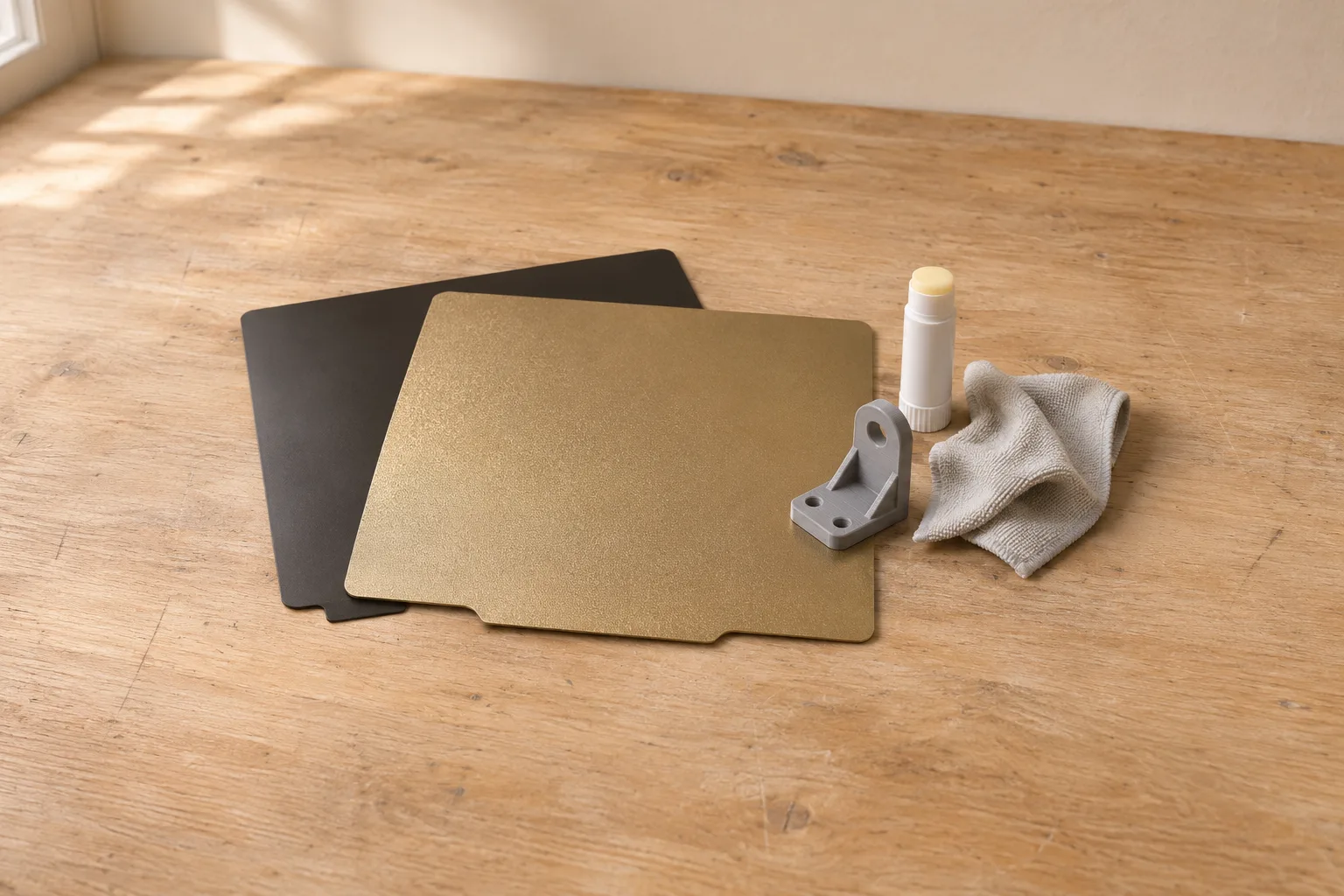
Printers in this guide
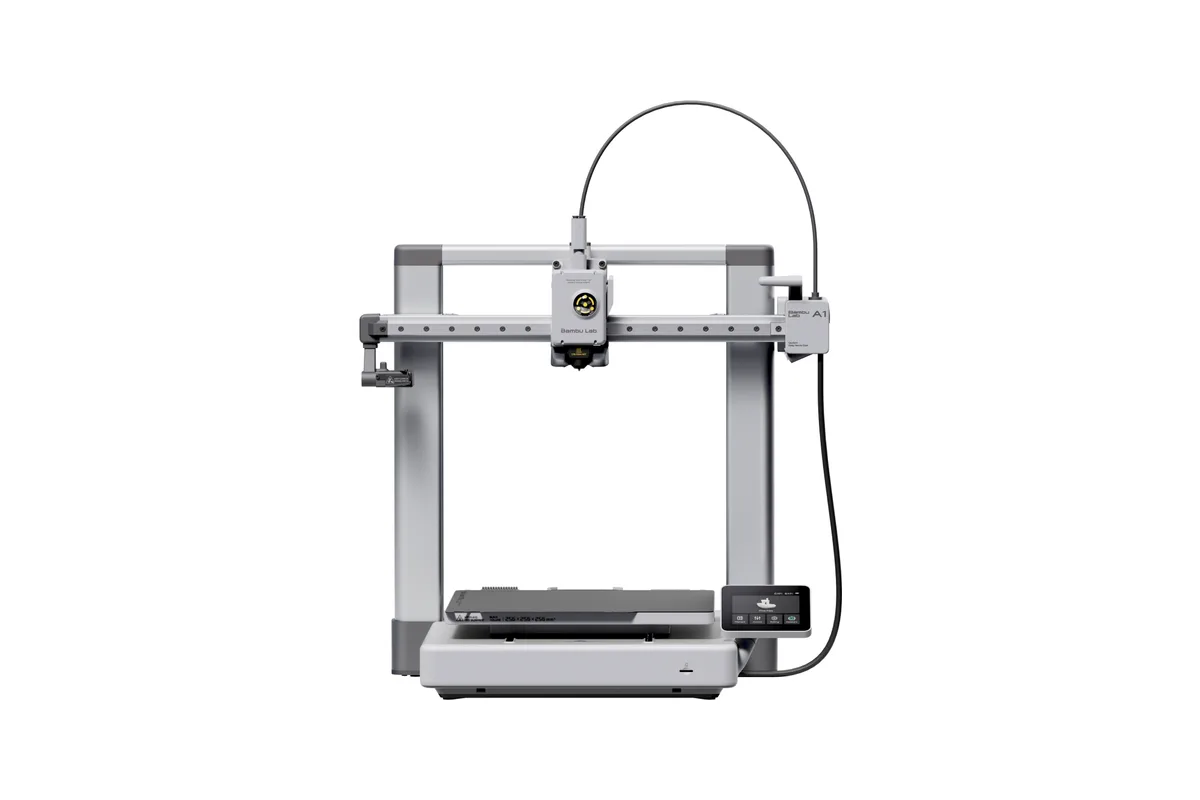
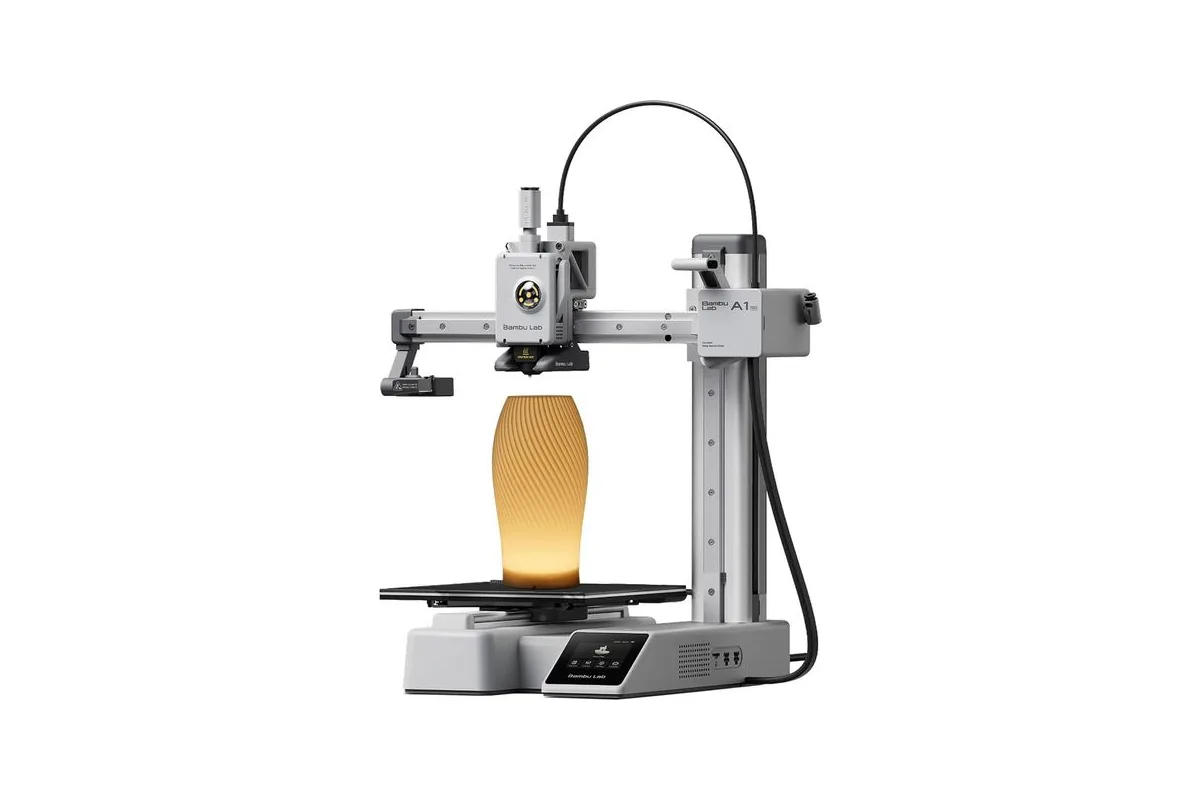
Textured vs smooth PEI build plate: which is better?
Textured PEI is better for most people. It’s the plate Bambu Lab ships with its printers, and Bambu says it gives “excellent adhesion without the need for an adhesive.” PLA, PETG and TPU all stick to it without glue, prints pop off once the plate cools, and it’s rated to 180 °C. The only thing it can’t give you is a smooth underside: the texture prints into the bottom of every part.
Smooth PEI gives a smooth bottom and, Bambu says, “high Z-axis precision,” but it’s fussier. Bambu says “only PLA filament does not require glue” on its smooth plate; everything else needs glue “to prevent the PEI sheet from tearing.” Prusa says PETG and TPU “will adhere too much and can damage the sheet when removed.”
That’s also why Bambu has moved on. Its US store now says the Smooth PEI Plate for the X1, P1, A1, P2S, X2D and H2 series “is no longer available,” and names its new Engineering Plate as the replacement. You can still buy one for the A1 mini, for $21.99.
Textured vs smooth PEI at a glance
| Textured PEI | Smooth PEI | |
|---|---|---|
| Glue for PLA | No | No |
| Glue for PETG | No | Yes (Bambu and Prusa) |
| Glue for TPU | No (Prusa) | Yes (Bambu) |
| Glue for ABS, ASA, PC, nylon | Sometimes (Bambu); yes for ASA, ABS, nylon and PC Blend (Prusa) | Yes |
| Bottom finish | Textured | Smooth (Bambu: “smooth and matte”) |
| Removal | Self-releases when cool | Can bond too hard with PETG and TPU |
| Cleaning | Dish soap and hot water (Bambu); never acetone (Bambu and Prusa) | Dish soap and water (Bambu); ~90% IPA, acetone 1–2 times a month (Prusa) |
| Bambu 256 mm price (Nov 28, 2026) | $27.99, out of stock | Discontinued; A1 mini $21.99 |
Glue and cleaning guidance from Bambu’s build plate guide and Prusa’s sheet articles.
Which Bambu Lab build plate should you use?
Bambu now sells four plate types for its 256 mm printers. Here’s what each is for and what it costs at Bambu’s US store, in the Black Friday sale on November 28, 2026:
| Plate | Best for | Glue | 256 mm (A1, P1, X1, P2S) | A1 mini |
|---|---|---|---|---|
| Textured PEI | Everything; the stock plate | Only sometimes, for PC, PA, ABS, ASA | $27.99 (out of stock) | $15.99 |
| Engineering Plate (new version) | ABS, ASA, PC and nylon; the Smooth PEI replacement | Always, for every filament | $23.99 (typical $29.99) | — |
| Cool Plate SuperTack | Glue-free PLA and PETG only | No | $24.49 (typical $34.99) | — |
| Dual-Texture PEI | Textured on one side, smooth on the other | As for each side | $26.59 (out of stock) | $17.49 |
| Smooth PEI | Smooth-bottomed PLA | For anything but PLA | Discontinued | $21.99 |
A few details that catch people out:
- The Engineering Plate always needs glue. Bambu’s store says “Glue must be applied before printing any material.” Bambu also says the old Engineering Plates are not recommended for PLA.
- SuperTack is PLA and PETG only. Bambu says it holds PLA at a bed temperature of just 40 °C and loses less than 20% of its adhesion after 300 prints (PLA Basic on an A1). Don’t clean it with IPA or acetone, and wet it with alcohol before scraping, because it’s softer than textured PEI. On the X2D, P2S and H2C, turn off build plate position detection when you use it.
- Plate generations matter. The 256 mm Textured PEI, Smooth PEI and SuperTack plates come in two generations, and the P2S and newer printers don’t recognize first-generation plates automatically.
Which filament goes on which plate?
Bambu’s material table, with its bed temperatures:
| Filament | Textured PEI | Smooth PEI | Engineering Plate | Cool Plate |
|---|---|---|---|---|
| PLA | 45–65 °C | 45–65 °C | 45–65 °C, glue required | 35–45 °C |
| PETG | 60–80 °C | 60–80 °C, glue | 60–80 °C, glue | Not recommended |
| TPU | 35–45 °C | 35–45 °C, glue | 30–35 °C, glue | — |
| ABS, ASA | 90–100 °C | 90–100 °C, glue | 90–100 °C, glue | — |
| PC, PA, PA-CF | 100–120 °C | 100–120 °C, glue | 100–120 °C, glue | — |
Bambu’s material table still marks PETG “not recommended” on its Cool Plate, but its SuperTack page says that plate is designed for PLA and PETG, with PETG at 55–60 °C on the second-generation plate. Go by the plate you have.
On enclosed Bambu printers, Bambu also says to open the front door or lift the top glass when printing PLA, PVA or TPU with the bed above 45 °C, or PETG above 60 °C, so the chamber doesn’t get hot enough to soften the filament.
Do you need glue stick for 3D printing?
Not for PLA, PETG or TPU on a textured PEI plate, which is how most people print. You need glue in three situations:
- On a plate that requires it. Bambu’s Engineering Plate needs glue for every filament. Bambu’s Smooth PEI needs it for everything except PLA.
- As a release layer on smooth PEI. Prusa says PETG, ASA, ABS and PC Blend “may need a protective separation layer, like gluestick, applied thinly.” Its PETG article is firmer: don’t print PETG on smooth PEI, and if you do, “apply a glue stick on it before printing.”
- For engineering filaments. Bambu says glue stick may be needed for PC, PA, ABS and ASA even on textured PEI, and specifically recommends glue stick for ASA-CF, PA6-GF and PA6-CF, PAHT-CF, PET-CF, PPA-CF and PPS-CF, and liquid glue for ABS-GF. Prusa says ASA, ABS, nylon and PC Blend “require the application of a glue stick” on its textured sheet.
Glue does two different jobs. On a slick surface it helps a warping filament like ABS hold on; on smooth PEI it stops PETG or TPU from bonding so hard that it tears the sheet. Bambu also recommends glue on its plates because it “helps protect the plate surface.”
What glue stick should you use?
On Bambu plates, use Bambu’s: its glue stick is $2.99 as an add-on at Bambu’s store (typical $3.99), and Bambu says “third-party glues are strongly discouraged and may damage the plate.” Prusa’s guides just say “glue stick” without naming a brand; for non-Bambu sheets, Elmer’s purple glue sticks are $3.99 for three on Amazon. Either way, apply it thinly, in Prusa’s word, rather than caking it on.
How do you clean a PEI build plate?
- Bambu plates: dish soap and hot water. Bambu says “Do not clean the plate with acetone,” and don’t use IPA or other strong solvents on SuperTack.
- Prusa smooth sheet: about 90% isopropyl alcohol; acetone only “1-2 times per month” if IPA isn’t enough.
- Prusa textured sheet: “Never clean the sheet with acetone!”
Wait for the plate to cool before you pull a print. Bambu says textured PEI releases prints on its own and recommends waiting until it’s at 35 °C or lower. For plate wear and replacement prices, see 3D printer maintenance.
Questions people ask
Do you need glue stick for PLA?
No, not on textured PEI, smooth PEI or SuperTack. The one exception on Bambu’s lineup is the Engineering Plate, which needs glue for every filament.
Is PETG safe on smooth PEI?
Only with glue as a separator. Bambu and Prusa both say PETG can bond hard enough to smooth PEI to damage it. Prusa recommends a textured or satin sheet for PETG instead. For the rest of the PETG basics, see PLA vs PETG.
What replaced the Bambu Smooth PEI plate?
The new Bambu Engineering Plate, $23.99 for the 256 mm printers in November 2026. It’s built for ABS, ASA, PC and nylon and Bambu says it’s compatible with all filaments, but it needs glue before every print. If you want glue-free PLA and PETG, the Cool Plate SuperTack ($24.49) is the other option.
Is the textured or smooth plate better for miniatures?
Smooth PEI gives a flatter, cleaner underside on small parts, and Bambu credits it with “high Z-axis precision.” Textured PEI hides first-layer marks and is easier overall. For the smallest figures, a 0.2 mm nozzle matters more than the plate.
Does glue stick affect food-contact prints?
It can. Bambu’s guidance for its PLA Pure, the one Bambu filament tested for EU food contact, includes printing without glue. See food-safe 3D printing.
Should a beginner buy a spare build plate?
It helps: you can start the next print while the last one cools. A spare textured PEI plate is $15.99 for the A1 mini and $27.99 for 256 mm Bambu printers. For other first purchases, see the best 3D printing tools and accessories.
Sources
- Bambu Lab: introduction to Bambu Lab build plates, wiki.bambulab.com
- Bambu Lab filament guide: material table, wiki.bambulab.com
- Bambu Lab Textured PEI Plate, us.store.bambulab.com
- Bambu Lab Engineering Plate, us.store.bambulab.com
- Bambu Lab Cool Plate SuperTack, us.store.bambulab.com
- Bambu Lab Dual-Texture PEI Plate, us.store.bambulab.com
- Bambu Lab Smooth PEI Plate, us.store.bambulab.com
- Prusa: smooth steel sheet, help.prusa3d.com
- Prusa: textured steel sheet, help.prusa3d.com
- Prusa: PETG, help.prusa3d.com
- Prusa: ABS, help.prusa3d.com
- Elmer's purple glue sticks (Amazon), amazon.com
Keep exploring

How to
Hardened steel vs brass nozzles, and what nozzle size to use
Brass, or the stainless steel Bambu ships on the A1, is fine for PLA, PETG, ABS, ASA and TPU. Carbon fiber, glass fiber, glow-in-the-dark and sparkle filaments need hardened steel. Use a 0.4 mm nozzle for most prints, 0.6 mm for carbon fiber and big parts, and 0.2 mm for miniatures.
Read story
How to
Can you 3D scan with an iPhone? Yes, but not to tight tolerances
Yes. Any current iPhone can 3D scan objects from photos (photogrammetry), and KIRI Engine's free tier exports STL for printing. Only the iPhone 18 Pro and 18 Pro Max have LiDAR in Apple's current lineup. For parts that must fit, a $359 scanner is about ten times tighter.
Read story