How it scores
- Print quality20%8.5
300 °C nozzle, PMSM servo extruder and nozzle-clumping detection, but a large moving bed and open frame suit PLA and PETG best. Scored from specs; no lab data.
- Setup and ease of use20%9.0
Bambu's A-series design: run-out, tangle and odometry sensors, power-loss recovery, an AMS lite in the Combo and Bambu Studio and MakerWorld support.
- Speed10%7.5
500 mm/s and 10,000 mm/s² with 28 mm³/s flow (Bambu): quick for a bed slinger, but half the acceleration of Bambu's enclosed CoreXY printers.
- Features and materials20%7.5
Large 330 × 320 × 325 mm volume, up to 19 colors and a blade-cutting module, but no enclosure, an 80 °C bed, 2.4 GHz Wi-Fi only and no laser.
- Reliability and ownership20%8.0
24-month warranty from Bambu's US store, published updates to Jun 2031, and we found no recall or service notice. Remote features use Bambu's cloud.
- Value and running costs10%9.0
About $12.80 per liter of build volume printer-only (our estimate), the lowest in Bambu's range, though AMS lite multicolor printing still purges filament.
Overall 8.3/10, the weighted average.How we score →
Is the Bambu Lab A2L worth it?
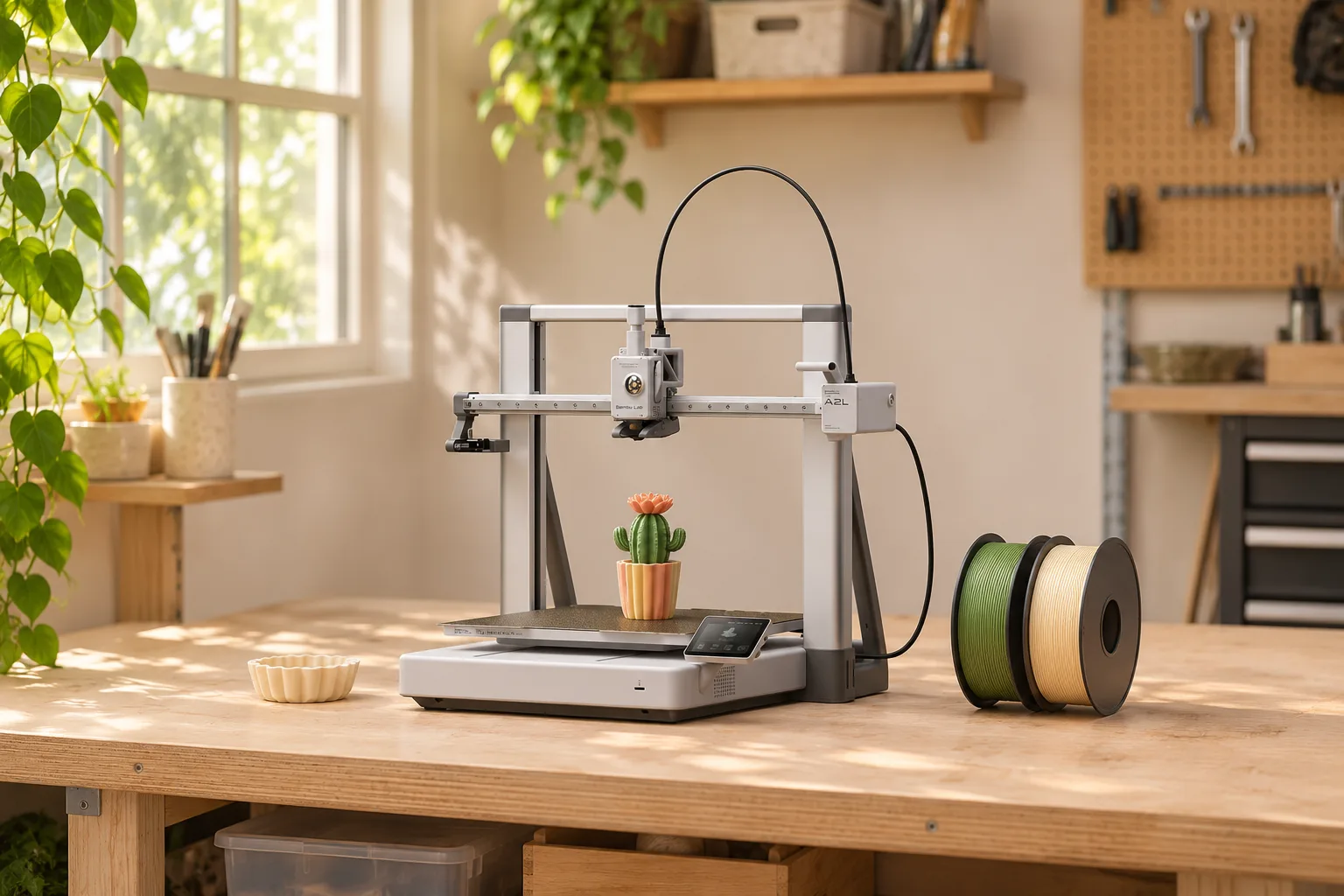
Yes, if you want big prints in PLA, PETG or TPU for as little money as possible. The A2L cost $439 at Bambu’s US store in November 2026 (typical $469), or $519 with the four-color AMS lite (typical $569). Its 330 × 320 × 325 mm build volume is about 34.3 liters, roughly twice the A1’s 16.8 liters (our estimate), for $180 more than an A1.
It’s an open-frame “bed slinger” like the A1, with the same easy Bambu setup and quiet running. Bambu’s launch post calls it “essentially an H2S Lite”: nearly the H2S’s print size for less than half the price. What it gives up is heat. There’s no enclosure, and the bed tops out at 80 °C, so ABS, ASA, nylon and polycarbonate aren’t what it’s for.
| Spec | Bambu Lab A2L |
|---|---|
| Price (Bambu US, Nov 28, 2026) | $439 (typical $469); Combo with AMS lite $519 ($569); Cutting Full Combo $579 (value $629) |
| Elsewhere | Combo $519.99 at Micro Center and Best Buy ($569.99); not on Amazon |
| Type | Open-frame bed slinger |
| Build volume | 330 × 320 × 325 mm (about 34.3 L, our estimate) |
| Max nozzle / bed | 300 °C (stainless steel) / 80 °C |
| Chamber | None |
| Speed (Bambu) | 500 mm/s, 10,000 mm/s²; 28 mm³/s flow |
| Colors | 4 with the AMS lite; up to 19 with four AMS units plus the AMS lite |
| Sensors | PMSM servo extruder, run-out, tangle, odometry, power-loss recovery, contact-switch nozzle-clumping detection |
| Camera | Low-frame-rate, up to 1080p; no BirdsEye |
| Cutting | Blade cutting and pen plotting, 300 × 300 mm, up to 0.5 mm thick; no laser |
| Noise (Bambu) | Under 49 dB in silent mode; about 52 dB peak in standard mode |
| Power (Bambu) | 0.145 kWh over an hour of PLA (about 145 W); 1,000 W max |
| Connectivity | 2.4 GHz Wi-Fi only; no Ethernet; 32 GB microSD |
| Size / weight | 544 × 529 × 505 mm, 12.8 kg |
| Emissions | UL 2904 GREENGUARD certified (Bambu) |
| Warranty | 24 months from Bambu’s US store |
| Updates (Bambu) | Bug and feature fixes to Jun 1, 2031; security patches to Jun 1, 2033 |
Source: Bambu’s US store, specifications, wiki and compare page; Micro Center and Best Buy listings; read November 28, 2026.
A2L vs A1: what does the extra money buy?
Mainly size. Both are open-frame Bambu bed slingers with 300 °C nozzles and the same 500 mm/s, 10,000 mm/s² rating.
| Bambu Lab A2L | Bambu Lab A1 | |
|---|---|---|
| Price (Bambu, Nov 28, 2026) | $439; Combo $519 | $259; Combo $359 |
| Build volume | 330 × 320 × 325 mm (34.3 L) | 256 mm cube (16.8 L) |
| Price per liter, printer only (our estimate) | $12.80 | $15.44 |
| Bed max | 80 °C | 100 °C |
| Max colors | 19 (4 AMS + AMS lite) | 16 with four AMS units (our estimate) or 4 with the AMS lite |
| Cutting module | Yes | No |
| Power, PLA (Bambu) | About 145 W | 95 W |
| Weight | 12.8 kg | 8.3 kg |
| On Amazon | No | Yes, $259 |
Bambu says the A2L’s volume is “105% more space than the 256 mm class”. If your prints fit in a 256 mm cube, the A1 is the better buy: it’s $180 cheaper, lighter and uses less power. If you keep splitting helmets, cosplay pieces, storage bins or tall vases into parts, the A2L earns its price. For the full head-to-head, see A1 vs A2L.
Why is the bed only 80 °C?
Bambu says higher temperatures on a bed this big and open “would consume excessive power”, and the 80 °C cap avoids “overloading home electrical circuits”. The A1 goes to 100 °C on a smaller bed.
That’s fine for PLA, PETG and TPU. Bambu already warns A1 owners that ABS, ASA, PC and nylon warp and lose layer strength on large or dense parts because of the open frame, and the A2L has the same open frame with a cooler bed and much bigger parts. Treat it as a PLA, PETG and TPU printer. For hotter materials, look at an enclosed printer like the P2S or the H2S, or read open-frame vs enclosed 3D printers.
How does multicolor work on the A2L?
The Combo adds the four-slot AMS lite. The A2L can also take up to four box-style AMS units (AMS, AMS 2 Pro or AMS HT) plus the AMS lite, for up to 19 colors. Each box AMS uses one buffer path, so one AMS lite slot becomes unavailable. AMS 2 Pro and AMS HT drying on the A2L needs external power.
All of it runs through one nozzle, so every color change purges filament, as on the A1 and P2S. Bambu publishes no grams-per-change figure for its AMS printers. Bambu also points buyers who want a second nozzle to the X2D. If low-waste multicolor matters more than size, see the best multicolor 3D printers.
Is it quiet, and what does it cost to run?
It’s one of Bambu’s quieter printers: under 49 dB in silent mode, with a peak of about 52 dB in standard mode, by Bambu’s figures. See the best quiet 3D printers.
Bambu measured 0.145 kWh over an hour of PLA printing. A 4-hour PLA print would use about 0.58 kWh, or about 10.5¢ at 18.17¢ per kWh (our estimate). The A1 uses about 6.9¢ for the same print. For filament and other costs, see how much does 3D printing cost?
What’s missing?
- No enclosure or laser. Bambu leaves the laser off “for safety reasons related to its open-frame design”. The Cutting Full Combo ($579) adds blade cutting and pen plotting instead.
- Basic networking. 2.4 GHz Wi-Fi only, no Ethernet, and a microSD card for storage.
- A big footprint. At 544 × 529 × 505 mm and 12.8 kg, it needs a large, sturdy table.
- Low-rate camera. It’s a low-frame-rate camera up to 1080p, not the 30 fps live view of the P2S.
Is the A2L reliable?
We found no recall or Bambu service notice for it, and it launched on June 1, 2026. Bambu covers it for 24 months when bought from its US store; its 2-year US term covers only purchases from Bambu’s own US and Canada stores, not Micro Center or Best Buy. Bambu promises bug and feature updates until June 1, 2031, and security patches until June 1, 2033. The latest firmware we saw, 01.01.06.00, was a security update in November 2026.
Like other Bambu printers, it prints in LAN mode without the cloud, while the Bambu Handy app and remote printing need it. See can you use a Bambu Lab printer offline?
Should you buy the Bambu Lab A2L?
- Buy the A2L Combo ($519) if you want large multicolor PLA prints and don’t need an enclosure. It’s the cheapest big Bambu by far.
- Buy the A1 ($259, also on Amazon) if your prints fit in a 256 mm cube.
- Buy the H2S ($1,049) if you need the same size for ABS, ASA or nylon, with a 65 °C heated chamber.
For more big printers, see the best large 3D printers and the Bambu Lab lineup explained.
Questions people ask
Is the A2L bigger than the A1?
Yes: 330 × 320 × 325 mm against the A1’s 256 mm cube, about twice the volume.
Can the Bambu Lab A2L print ABS?
It isn’t a good fit. It has an open frame and an 80 °C bed, and Bambu warns that open-frame printing warps large ABS and ASA parts. Use an enclosed printer for those.
Does the A2L have a laser?
No. Bambu leaves it out for safety on an open frame. It supports a blade-cutting and pen-plotting module, sold in the $579 Cutting Full Combo.
How many colors can the A2L print?
Four with the AMS lite in the Combo, or up to 19 with four AMS units plus the AMS lite.
Is the A2L quiet?
Bambu rates it under 49 dB in silent mode and about 52 dB at peak in standard mode.
Is the A2L on Amazon?
No. Bambu sells it on its own store, and Micro Center and Best Buy carry the Combo at $519.99.
Key specifications
| Feature | Bambu LabA2L | Bambu LabA1 |
|---|---|---|
| Build volume | 330 × 320 × 325 mm | 256 x 256 x 256 mm |
| Max nozzle / bed | 300 °C / 80 °C | |
| Frame | Open bed slinger | Open (bed slinger) |
| Colors | Up to 19 | |
| Where to buy | Check price at Amazon |
Bambu Lab A2L
- Build volume
- 330 × 320 × 325 mm
- Max nozzle / bed
- 300 °C / 80 °C
- Frame
- Open bed slinger
- Colors
- Up to 19
Bambu Lab A1
- Build volume
- 256 x 256 x 256 mm
- Max nozzle / bed
- Frame
- Open (bed slinger)
- Colors
Sources
- Bambu Lab A2L product page (US store), us.store.bambulab.com
- Bambu Lab A2L specifications, bambulab.com
- Bambu Lab A2L overview, bambulab.com
- Bambu Lab A2L FAQ (wiki), wiki.bambulab.com
- Bambu Lab: A2L, a creative playground, extra large, blog.bambulab.com
- Bambu Lab multi-AMS compatibility guide (wiki), wiki.bambulab.com
- Bambu Lab power consumption by model (wiki), wiki.bambulab.com
- Bambu Lab compare page (software update support), bambulab.com
- Bambu Lab A1 product page (US store), us.store.bambulab.com
- Bambu Lab warranty policy, bambulab.com
- Micro Center Bambu Lab listings, microcenter.com
- Best Buy Bambu Lab listings, bestbuy.com
- Bambu Lab A1 on Amazon, amazon.com
Keep exploring

How to
Hardened steel vs brass nozzles, and what nozzle size to use
Brass, or the stainless steel Bambu ships on the A1, is fine for PLA, PETG, ABS, ASA and TPU. Carbon fiber, glass fiber, glow-in-the-dark and sparkle filaments need hardened steel. Use a 0.4 mm nozzle for most prints, 0.6 mm for carbon fiber and big parts, and 0.2 mm for miniatures.
Read story
How to
Can you 3D scan with an iPhone? Yes, but not to tight tolerances
Yes. Any current iPhone can 3D scan objects from photos (photogrammetry), and KIRI Engine's free tier exports STL for printing. Only the iPhone 18 Pro and 18 Pro Max have LiDAR in Apple's current lineup. For parts that must fit, a $359 scanner is about ten times tighter.
Read story