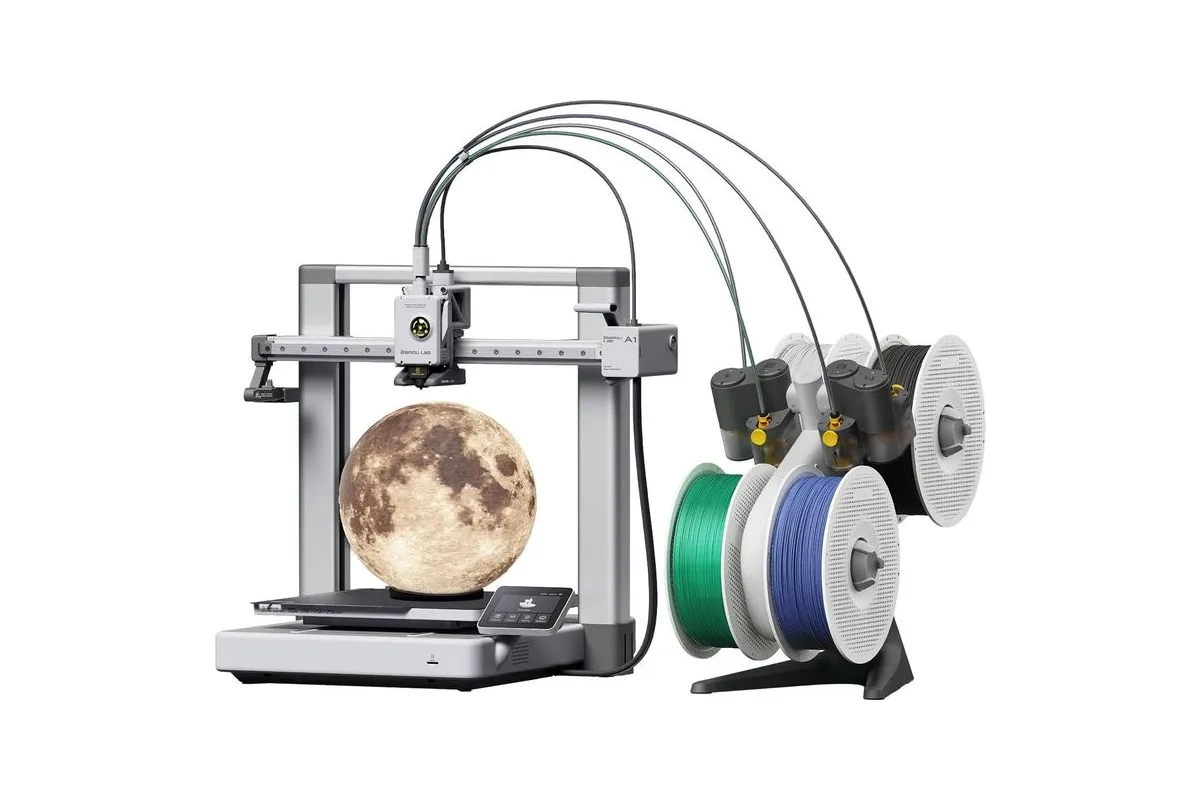
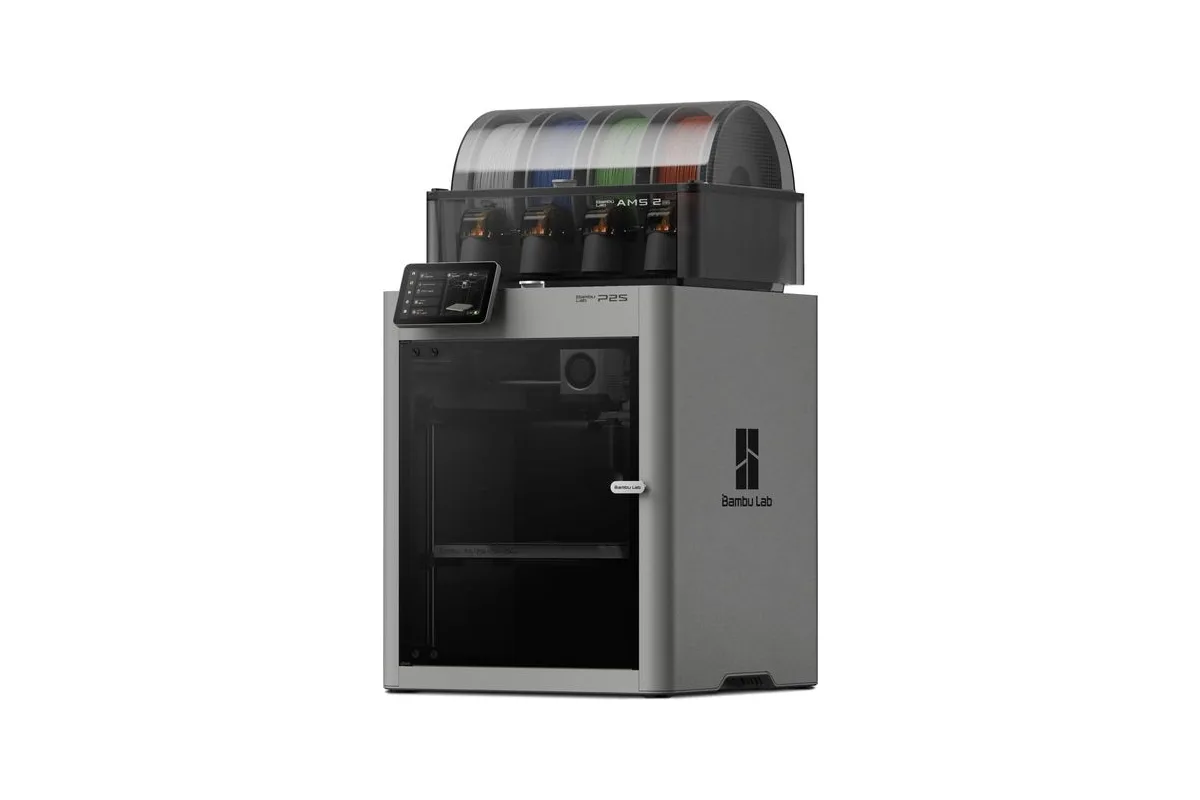
Side by side
| Feature | Bambu LabA1 Combo | Bambu LabP2S Combo |
|---|---|---|
| Frame | Open (bed slinger) | Enclosed CoreXY |
| Build volume | 256 x 256 x 256 mm | 256 x 256 x 256 mm |
| Multicolor | 4 colors (AMS lite, included) | 4 colors (AMS 2 Pro), expandable |
| Materials | PLA, PETG, TPU | PLA, PETG, TPU, ABS, ASA, CF blends |
| Where to buy | Check price at Amazon | Check price at Amazon |
Bambu Lab A1 Combo
- Frame
- Open (bed slinger)
- Build volume
- 256 x 256 x 256 mm
- Multicolor
- 4 colors (AMS lite, included)
- Materials
- PLA, PETG, TPU
Bambu Lab P2S Combo
- Frame
- Enclosed CoreXY
- Build volume
- 256 x 256 x 256 mm
- Multicolor
- 4 colors (AMS 2 Pro), expandable
- Materials
- PLA, PETG, TPU, ABS, ASA, CF blends
Bambu Lab A1 Combo vs P2S Combo: is the upgrade worth it?
Only if you’ll use the enclosure. At Bambu’s US store in November 2026, the A1 Combo is $359 (typical $399) and the P2S Combo is $649 (typical $749). That’s $290 more, about 81% (our estimate), for a printer with the same 256 mm build volume and the same four-color starting point.
What the $290 buys:
- An enclosure, so ABS, ASA, nylon, PC and carbon- or glass-fiber blends print without warping, and the hot parts sit behind a door.
- CoreXY motion: twice the rated acceleration (20,000 against 10,000 mm/s²) and 600 mm/s against 500 mm/s.
- The AMS 2 Pro, which dries filament, instead of the open AMS lite.
- A hardened-steel quick-swap nozzle, a 110 °C bed, a 1080p 30 fps camera, a 5-inch touchscreen and on-board AI print monitoring.
What it doesn’t buy: less purge waste. Both are single-nozzle printers, and both flush filament at every color change. If you’ll print only PLA and PETG, the A1 Combo is the better value. Read our A1 review and P2S review.
What’s the difference between the A1 Combo and P2S Combo?
| Bambu Lab A1 Combo | Bambu Lab P2S Combo | |
|---|---|---|
| Price (Bambu US, Nov 28, 2026) | $359 (typical $399) | $649 (typical $749) |
| Amazon | $369 with LED lamp kit (Nov 24) | $649.99 |
| Printer only | $259 | $449 |
| Frame | Open bed slinger | Enclosed CoreXY |
| Build volume | 256 × 256 × 256 mm (about 16.8 L) | 256 × 256 × 256 mm (about 16.8 L) |
| Max nozzle / bed | 300 °C / 100 °C | 300 °C / 110 °C |
| Nozzle | 0.4 mm stainless steel | 0.4 mm hardened steel, quick swap |
| Chamber | None | Enclosed, no active heating; auto vent flap |
| Speed / acceleration (Bambu) | 500 mm/s / 10,000 mm/s² | 600 mm/s / 20,000 mm/s² (travel to 1,000 mm/s since firmware 01.03) |
| Filament box | AMS lite, 4 slots, open spools | AMS 2 Pro, 4 slots, sealed with drying |
| Max colors | 16 with 4 AMS units (our estimate) | 20 (4 AMS 2 Pro + 4 AMS HT) |
| Camera | Low-rate, up to 1080p | 1080p, 30 fps |
| AI print monitoring | Not listed | Spaghetti, nozzle blobs, purge-chute jams |
| Filtration | None | Activated carbon |
| Connectivity | Wi-Fi, microSD | Dual-band Wi-Fi, 8 GB storage, USB; no Ethernet |
| Noise (Bambu) | About 48–49 dB, silent mode | Under 50 dB, silent mode |
| Power, PLA (Bambu) | 95 W | 200 W |
| Weight | 8.3 kg | 14.9 kg |
| Warranty (Bambu US store) | 2 years | 2 years; hotend and extruder gears not covered |
| Bug and feature updates until | Dec 14, 2028 | Oct 14, 2030 |
| Price per liter, Combo (our estimate) | $21.40 | $38.70 |
Source: Bambu’s US store, specification pages, wiki FAQs and firmware history, power page and compare page, read November 28, 2026. The A1 nozzle and the Amazon A1 Combo price were read November 24.
What do you actually get for $290?
Mostly the enclosure. Bambu lists ABS, ASA, PC and nylon as “Not Recommended” on the A1, though it says small, low-infill parts can work. Large or dense parts warp on an open frame. The P2S prints them with the door closed, and its hardened-steel nozzle and 110 °C bed handle carbon- and glass-fiber blends such as PA6-CF and ASA-CF. If you never plan to print those, most of the upgrade sits unused. See open-frame vs enclosed 3D printers.
The rest is convenience:
- Filament drying. The AMS 2 Pro dries filament, which helps with PETG, TPU and nylon that absorb moisture. One catch: the P2S powers drying for one AMS 2 Pro only while it’s idle. Drying during a print needs a separate power adapter that the Combo doesn’t include.
- Speed on long prints. Doubling acceleration matters more than top speed on real models, which are full of short moves.
- Monitoring. A 1080p, 30 fps camera and AI detection that can stop a failed print. The A1’s camera is low-frame-rate.
- Longer support. Bambu promises P2S bug and feature updates until October 2030, nearly two years past the A1’s December 2028.
Does the P2S waste less filament on multicolor prints?
No. Both feed four colors into one nozzle, so every color change cuts the filament, loads the next one and purges the old color. Bambu says as much on its own wiki: on the P2S, “Multi-color printing requires purging old filament to avoid color bleeding, increasing material consumption and time.” Bambu publishes no grams-per-change figure for the AMS lite or AMS 2 Pro.
If waste is what bothers you about the A1 Combo, the upgrade that fixes it is a tool changer, not the P2S: the P3C ($1,149 Combo) or the Snapmaker U1 ($699). See P3C vs H2C and is a multicolor 3D printer worth it?
Which is quieter and cheaper to run?
The A1 is cheaper to run; on noise they’re close. Bambu rates both under 50 dB in silent mode, but the A1 averages 95 W on PLA against the P2S’s 200 W. On a 4-hour PLA print that’s about 6.9¢ against 14.5¢ of electricity at 18.17¢ per kWh (our estimate). The difference is small next to filament; see how much does 3D printing cost?
Is there something in between?
Yes, two options:
- P1S AMS 2 Pro Combo, $509 (typical $579): an enclosed CoreXY for $150 more than the A1 Combo. It has the older 2.7-inch non-touch screen and a 0.5 fps camera, and Bambu says it has no plans to stop selling it. See P1S vs P2S.
- A2L Combo, $519: still open-frame, but about twice the A1’s build volume. See A1 vs A2L.
Which should you buy?
The A1 Combo if you’re starting out and will print PLA, PETG and TPU. It’s $359 at Bambu, or $369 with an LED lamp kit on Amazon. Bambu’s 2-year US warranty applies only to purchases from its own store.
The P2S Combo if you want ABS, ASA or fiber blends, drying, or an enclosed printer for a shared room. It’s $649.99 on Amazon and $649 at Bambu, and it’s our pick in the best enclosed 3D printers. The Bambu sale ends December 1 at 2:00 AM ET. Compare non-Bambu options in Creality K2 Combo vs P2S Combo.
Questions people ask
Is the P2S worth it over the A1?
For enclosed printing, yes. For PLA and PETG, no: the A1 prints them as well, at the same size, for less.
Can I upgrade the A1 to an enclosure later?
There’s no enclosure option for the A1, so plan on a different printer if you’ll want ABS or ASA at any size.
Does the A1 Combo work with the AMS 2 Pro?
Yes, with the AMS HUB accessory. The A1 series takes up to four AMS, AMS 2 Pro or AMS HT units, or one AMS lite, not both. Drying with an AMS 2 Pro on an A1 needs a power adapter for each unit.
Can the P2S use the AMS lite?
No. The P2S works with the AMS 2 Pro and AMS HT, and a first-generation AMS with an adapter, but not the AMS lite.
Do both have the same build volume?
Yes, 256 × 256 × 256 mm. The P2S is faster and enclosed, not bigger.
Is the A1 safe after the recall?
Bambu recalled A1 heatbed cables in 2024 and now ships an upgraded cable with Kevlar reinforcement and an extended strain relief.
Sources
- Bambu Lab US store: A1, us.store.bambulab.com
- Bambu Lab A1 technical specifications, bambulab.com
- Bambu Lab US store: P2S, us.store.bambulab.com
- Bambu Lab P2S specifications, bambulab.com
- Bambu Lab wiki: P2S FAQ, wiki.bambulab.com
- Bambu Lab wiki: P2S firmware release history, wiki.bambulab.com
- Bambu Lab: meet the P2S, blog.bambulab.com
- Bambu Lab wiki: multi-AMS compatibility guide, wiki.bambulab.com
- Bambu Lab wiki: power consumption, wiki.bambulab.com
- Bambu Lab wiki: P3C FAQ, wiki.bambulab.com
- Bambu Lab printer comparison (software update support), bambulab.com
- Bambu Lab warranty policy, bambulab.com
Keep exploring

How to
Hardened steel vs brass nozzles, and what nozzle size to use
Brass, or the stainless steel Bambu ships on the A1, is fine for PLA, PETG, ABS, ASA and TPU. Carbon fiber, glass fiber, glow-in-the-dark and sparkle filaments need hardened steel. Use a 0.4 mm nozzle for most prints, 0.6 mm for carbon fiber and big parts, and 0.2 mm for miniatures.
Read story
How to
Can you 3D scan with an iPhone? Yes, but not to tight tolerances
Yes. Any current iPhone can 3D scan objects from photos (photogrammetry), and KIRI Engine's free tier exports STL for printing. Only the iPhone 18 Pro and 18 Pro Max have LiDAR in Apple's current lineup. For parts that must fit, a $359 scanner is about ten times tighter.
Read story