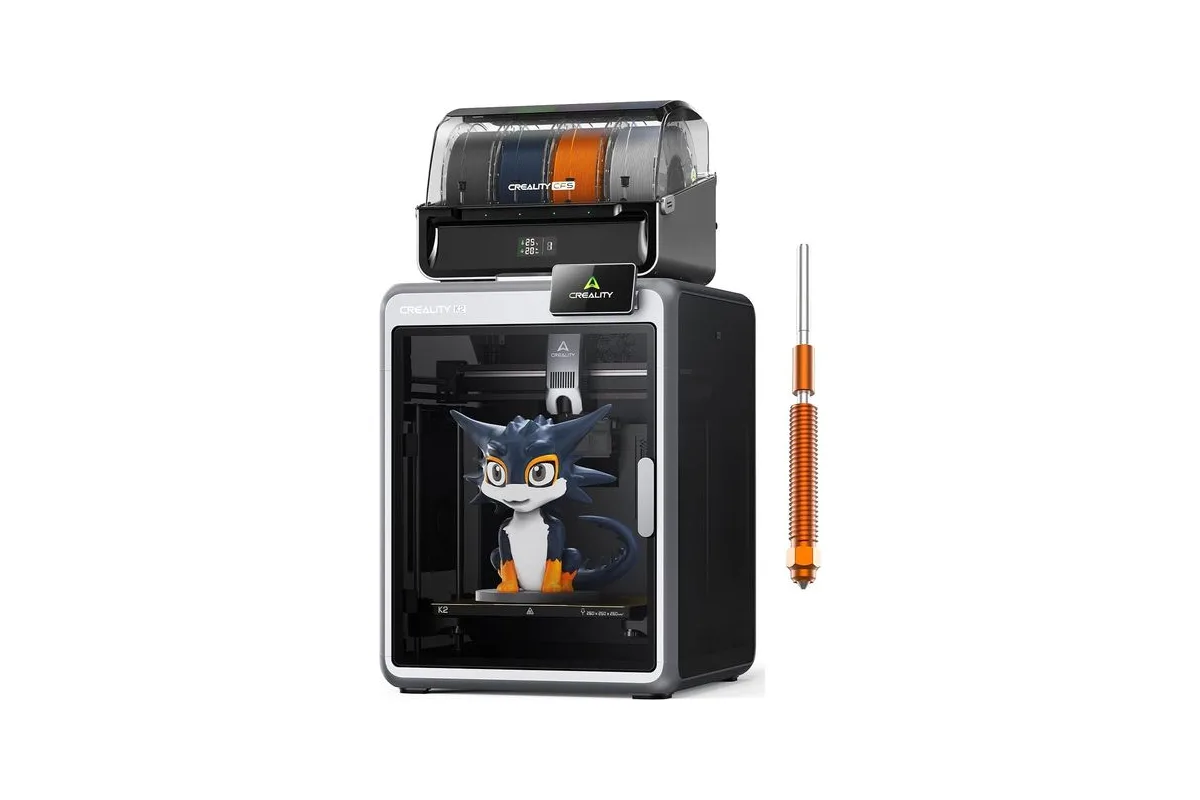
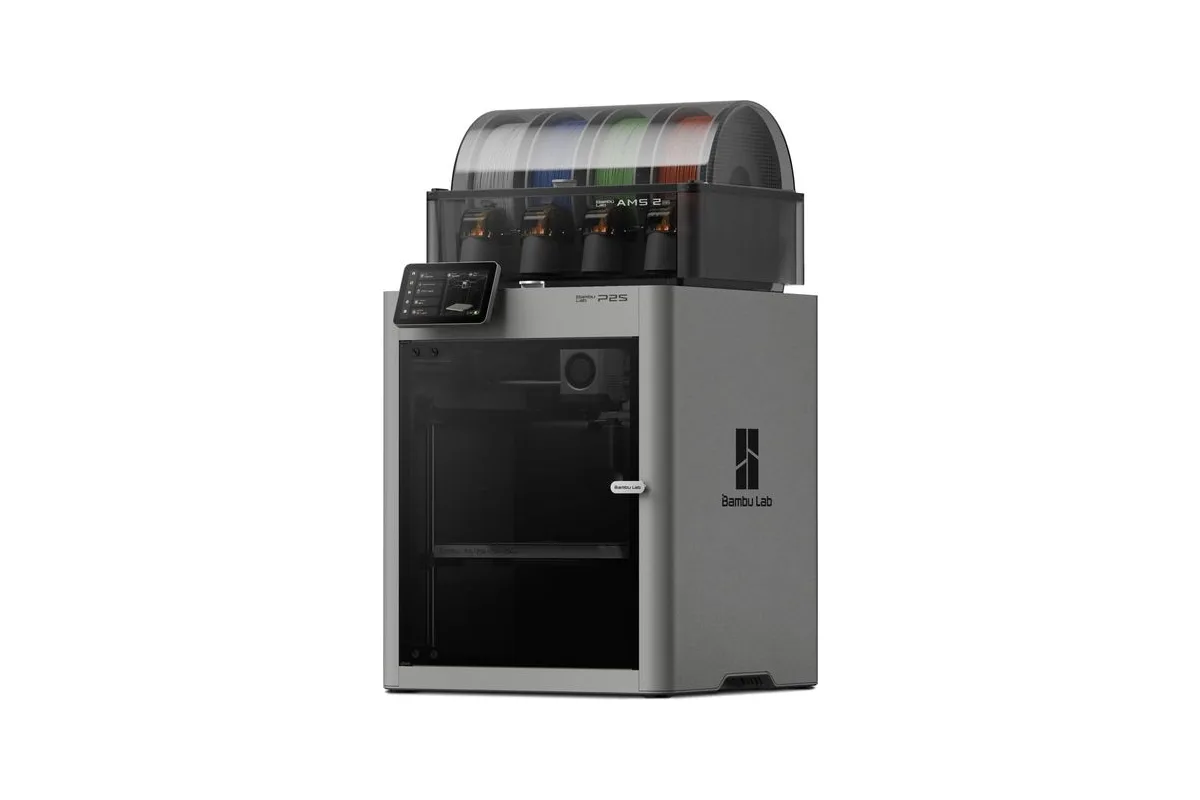
Side by side
| Feature | Creality K2 Combo | Bambu LabP2S Combo |
|---|---|---|
| Frame | Enclosed CoreXY | Enclosed CoreXY |
| Build volume | 260 x 260 x 260 mm | 256 x 256 x 256 mm |
| Multicolor | 4 colors (CFS), up to 16 | 4 colors (AMS 2 Pro), expandable |
| Materials | PLA, PETG, ABS, PLA-CF | PLA, PETG, TPU, ABS, ASA, CF blends |
| Where to buy | Check price at Amazon | Check price at Amazon |
Creality K2 Combo
- Frame
- Enclosed CoreXY
- Build volume
- 260 x 260 x 260 mm
- Multicolor
- 4 colors (CFS), up to 16
- Materials
- PLA, PETG, ABS, PLA-CF
Bambu Lab P2S Combo
- Frame
- Enclosed CoreXY
- Build volume
- 256 x 256 x 256 mm
- Multicolor
- 4 colors (AMS 2 Pro), expandable
- Materials
- PLA, PETG, TPU, ABS, ASA, CF blends
Creality K2 Combo or Bambu P2S Combo: which is better?
The Bambu Lab P2S Combo is the better printer; the Creality K2 Combo is the better deal. In November 2026 the P2S Combo cost $649 at Bambu’s store (typical $749) and $649.99 on Amazon. The K2 Combo cost $449 at Creality and on Amazon, $200 or about 31% less.
Both are enclosed CoreXY printers with a hardened-steel nozzle, 600 mm/s top speed and a four-spool filament box. The P2S earns its premium with a filament box that dries spools, a 110 °C bed, a 1080p camera, dual-band Wi-Fi, automatic flow calibration and a 2-year warranty from Bambu’s store. The K2 gives you a slightly bigger build volume, room for 16 colors and more open Klipper-based firmware for $200 less.
Buy the P2S if you want the least troubleshooting or print PETG, nylon, ABS or ASA often. Buy the K2 if you’ll mostly print PLA, PETG and PLA-CF and the $200 is better spent on filament.
K2 Combo vs P2S Combo specs
| Creality K2 Combo | Bambu Lab P2S Combo | |
|---|---|---|
| Price (Nov 2026) | $449 (reference about $699) | $649 (typical $749) at Bambu; $649.99 on Amazon |
| Printer without the filament box | $349 (list $549) | $449 (typical $549) |
| Frame | Enclosed CoreXY | Enclosed CoreXY |
| Build volume | 260 x 260 x 260 mm (17.6 L) | 256 x 256 x 256 mm (16.8 L) |
| Price per liter, Combo (our estimate) | About $26 | About $39 |
| Max nozzle / bed | 300 / 100 °C | 300 / 110 °C |
| Chamber | No heater; active cooling | No heater; automatic flap between internal and external air circulation |
| Nozzle | Hardened steel | Hardened steel, tool-free quick swap |
| Filament box | CFS, 4 spools, no drying | AMS 2 Pro, 4 spools, with drying |
| Max colors | 16 (four CFS) | 20 (4 AMS 2 Pro + 4 AMS HT) |
| Speed (maker) | 600 mm/s, 20,000 mm/s² (300 mm/s typical) | 600 mm/s, 20,000 mm/s²; travel up to 1,000 mm/s since firmware 01.03 |
| Flow calibration | Manual (no nozzle camera) | Automatic (eddy-current sensor) |
| Camera | 720p, 30 fps, AI detection | 1080p, 30 fps, AI detection on a 2 TOPS chip |
| Filtration | One air filter | Activated carbon filter |
| Screen | 4-inch touchscreen | 5-inch touchscreen |
| Wi-Fi / Ethernet | 2.4 GHz only / no | 2.4 and 5 GHz / no |
| Storage | 8 GB | 8 GB |
| Noise (maker) | No figure | Under 50 dB in silent mode, at 1 m |
| Size / weight | 404 x 436 x 545 mm; 18.3 kg | 392 x 406 x 478 mm; 14.9 kg |
| Warranty (US) | 12 months; 3 months on wear parts | 2 years from Bambu’s store; hotend and extruder gears not covered |
| Published update support | None found | Bug and feature fixes to Oct 14, 2030; security to Oct 14, 2032 |
| Released | August 2025 (launch release) | October 14, 2025 |
Sources: Creality’s K2 series comparison, support page and US store; Bambu’s P2S store page, specifications, FAQ, compare page and warranty policy. All read November 28, 2026. Liters and price per liter are our estimates.
Which prints better?
The P2S, by a little. Both level themselves, and both print PLA and PETG well on default settings. The P2S also calibrates flow automatically with an eddy-current sensor, and its 8.5 kg servo extruder pushes harder, which Bambu says is 70% more force than the P1S. The K2’s flow calibration is manual; Creality saves the nozzle camera that automates it for the K2 Pro and K2 Plus.
For ABS and ASA, neither has a chamber heater. The P2S’s 110 °C bed and its flap, which switches the air between recirculating and venting, give it the edge. Creality’s own K2-series note says ABS, ASA and PPS need a 60 °C chamber, which only its pricier K2 Pro and Plus list. See PLA vs ABS vs ASA.
Which is better for multicolor?
The P2S, because it dries filament. Both feed four spools from a box on top, and both purge filament at every color change, since each has a single nozzle. Neither maker publishes a purge figure for these boxes, so expect similar waste.
The difference is moisture. The AMS 2 Pro heats and dries spools; the CFS only stores them. That matters most for PETG, TPU and nylon. Note the P2S limit: it powers drying for one AMS 2 Pro only while the printer is idle, and drying during a print or on extra units needs a separate power adapter that isn’t in the Combo.
Expansion is close: up to 16 colors on the K2 with four CFS units, and up to 20 slots on the P2S with a mix of AMS 2 Pro and AMS HT units. To match the P2S’s drying on a K2, add a separate filament dryer.
What do the filament boxes cost?
Taking the printer-only price away from each Combo (our estimate):
- Creality CFS: $449 - $349 = $100, about $25 per color slot.
- Bambu AMS 2 Pro: $649 - $449 = $200, about $50 per color slot, with drying.
So half of the $200 gap between the Combos is the filament box. The other $100 is the printer itself.
Which is easier to own?
The P2S. Bambu Studio, the Bambu Handy app and the MakerWorld model library are the smoothest software in home 3D printing, and the P2S has a bigger screen, a quick-swap nozzle and 5 GHz Wi-Fi. Bambu also publishes how long it will update the printer: bug and feature updates until October 14, 2030, and security patches until October 14, 2032. We found no similar commitment from Creality for the K2.
The K2 has had firmware rough edges. After a February 2026 update, some owners reported false “foreign object on plate” pauses and RFID tags that weren’t recognized, and binding the printer to the Creality Cloud app can be unreliable. The P2S drew its own firmware complaints after launch, including under-extrusion and Wi-Fi instability after specific updates.
Warranty: Bambu covers the P2S for 2 years, but only when you buy it from Bambu’s US store; the hotend and extruder gear assembly aren’t covered. Creality covers the K2 and its CFS for 12 months, wear parts such as the hotend kit for 3 months, and nozzles, plates and PTFE tubes not at all.
Do they need the cloud?
Neither needs it to print.
- P2S: LAN Only Mode prints over your network without Bambu’s cloud. You lose remote printing from outside your network, the Bambu Handy app and print history; AI failure detection still runs on the printer. See can you use a Bambu Lab printer offline?
- K2: prints over your network from Creality Print without an account. Remote camera viewing and control away from home need a Creality Cloud account. Its Klipper-based firmware offers root access, which tinkerers like, though third-party firmware voids Creality’s warranty.
Which should you buy?
- Most people: the Bambu Lab P2S Combo ($649). It’s easier, dries filament, has the better camera and screen, and carries twice the warranty.
- On a budget: the Creality K2 Combo ($449). It’s a capable enclosed four-color printer, and a slightly bigger one.
- Need ABS, ASA or a bigger bed? Creality’s K2 Pro Combo ($749) has a 300 mm cube and a 60 °C chamber. Bambu’s H2S has an actively heated 65 °C chamber; see the H2S review.
Bambu’s Black Friday prices end December 1 at 2 a.m. Eastern, and Creality’s around midnight Eastern at the end of November 30 (our reading of its countdown). For more options, see the best enclosed 3D printers, Bambu Lab vs Creality and the best Bambu Lab alternatives.
Questions people ask
Is the Creality K2 better than the Bambu P2S?
No, overall. The P2S has better software, filament drying, a 1080p camera and a longer warranty. The K2 is $200 cheaper and slightly larger.
Is the P2S worth $200 more than the K2 Combo?
For most people, yes: $100 of the gap buys an AMS 2 Pro that dries filament, and the rest buys easier software, automatic flow calibration and a 2-year warranty.
Which has a bigger build volume?
The K2, slightly: 260 mm cube (17.6 liters) against the P2S’s 256 mm cube (16.8 liters), by our estimate.
Do either have a heated chamber?
No. Both are enclosed without a chamber heater. Creality’s K2 Pro and K2 Plus list a 60 °C chamber, and Bambu’s H2 series heats to 65 °C.
Can they print TPU?
The P2S can: Bambu lists TPU among its materials. Creality doesn’t list TPU for the K2, and the CFS can’t feed it.
Which is quieter?
Bambu rates the P2S under 50 dB in silent mode. Creality gives no decibel figure for the K2, only a comparison to typing on a laptop.
Sources
- Creality K2 Combo store page, store.creality.com
- Creality K2 series product page and comparison, creality.com
- Creality K2 series support page, creality.com
- Creality warranty policy, creality.com
- Bambu Lab P2S product page, us.store.bambulab.com
- Bambu Lab P2S specifications, bambulab.com
- Bambu Lab P2S FAQ, wiki.bambulab.com
- Bambu Lab P2S firmware release history, wiki.bambulab.com
- Bambu Lab: meet the P2S, blog.bambulab.com
- Bambu Lab printer comparison (software update support), bambulab.com
- Bambu Lab warranty policy, bambulab.com
- Bambu Lab wiki: LAN Only Mode, wiki.bambulab.com
Keep exploring

How to
Hardened steel vs brass nozzles, and what nozzle size to use
Brass, or the stainless steel Bambu ships on the A1, is fine for PLA, PETG, ABS, ASA and TPU. Carbon fiber, glass fiber, glow-in-the-dark and sparkle filaments need hardened steel. Use a 0.4 mm nozzle for most prints, 0.6 mm for carbon fiber and big parts, and 0.2 mm for miniatures.
Read story
How to
Can you 3D scan with an iPhone? Yes, but not to tight tolerances
Yes. Any current iPhone can 3D scan objects from photos (photogrammetry), and KIRI Engine's free tier exports STL for printing. Only the iPhone 18 Pro and 18 Pro Max have LiDAR in Apple's current lineup. For parts that must fit, a $359 scanner is about ten times tighter.
Read story