Printers in this guide
PLA vs ABS: which is better?
PLA, for almost everything you print indoors. ABS when a part has to survive heat. On Bambu’s own data sheets, PLA Basic starts to deflect at 57 °C and ABS at 87 °C, so ABS buys about 30 °C of headroom. ABS is also about 2.7 times tougher in Bambu’s notched impact test (21.5 against 7.9 kJ/m², our arithmetic).
The price of that is a harder print. ABS needs a 240–270 °C nozzle, an 80–100 °C bed and a warm 45–60 °C chamber, which in practice means an enclosed printer, and it gives off more particles and fumes than PLA. Bambu’s own ABS sheet says it “warps easily and stinks when printing.” PLA prints on any printer, open or enclosed, with the lowest emissions of the common filaments.
PLA isn’t the weak one in a straight pull, either. Its tensile strength (35 MPa) is about the same as ABS’s (33 MPa) on Bambu’s sheets, and it’s stiffer. Its weaknesses are brittleness and heat.
PLA, ABS and ASA compared
All figures from Bambu Lab’s technical data sheets, so the three were tested the same way (ISO 75 heat deflection, ISO 527 tensile, ISO 179 Charpy impact, 100% infill). Prices are Bambu’s US store on November 28, 2026.
| PLA Basic | ABS | ASA | |
|---|---|---|---|
| Heat deflection, 0.45 MPa | 57 °C | 87 °C | 100 °C |
| Heat deflection, 1.8 MPa | 54 °C | 84 °C | 92 °C |
| Vicat softening | 57 °C | 94 °C | 106 °C |
| Tensile strength, X-Y / Z | 35 / 31 MPa | 33 / 28 MPa | 37 / 31 MPa |
| Charpy impact, X-Y (second figure notched) | 26.6 / 7.9 kJ/m² | 39.3 / 21.5 kJ/m² | 41.0 / 19.6 kJ/m² |
| Stiffness (bending modulus) | 2,750 MPa | 1,880 MPa | 1,920 MPa |
| Water absorption | 0.43% | 0.65% | 0.45% |
| Nozzle / bed | 190–230 / 35–45 °C | 240–270 / 80–100 °C | 240–270 / 80–100 °C |
| Chamber | 25–45 °C | 45–60 °C | 45–60 °C |
| Enclosed printer | Not needed | Required | Required |
| UV and weather | Not ideal outdoors (Prusa, for PLA) | Bambu claims UV resistance | Made for outdoor parts |
| Drying (data sheet) | 50 °C, 8 h | 80 °C, 8 h | 80 °C, 8 h |
| Price, refill / with spool | $14.99 / $17.99 | $15.99 / $18.99 | — / $17.99 (typical $29.99) |
Bambu’s ASA price was a Black Friday sale. PETG sits between PLA and ABS: Bambu’s PETG Basic deflects at 71 °C and needs no enclosure. See PLA vs PETG.
ABS vs ASA: what is the difference?
ASA is the outdoor version of ABS. The two print almost the same way, with the same nozzle, bed and chamber temperatures on Bambu’s sheets, and both need an enclosure. ASA comes out a little ahead on Bambu’s own numbers:
- Heat: 100 °C against 87 °C heat deflection at 0.45 MPa, 13 °C more.
- Strength: 37 against 33 MPa tensile; impact is close (19.6 against 21.5 kJ/m² notched).
- Moisture: it absorbs less water, 0.45% against 0.65%.
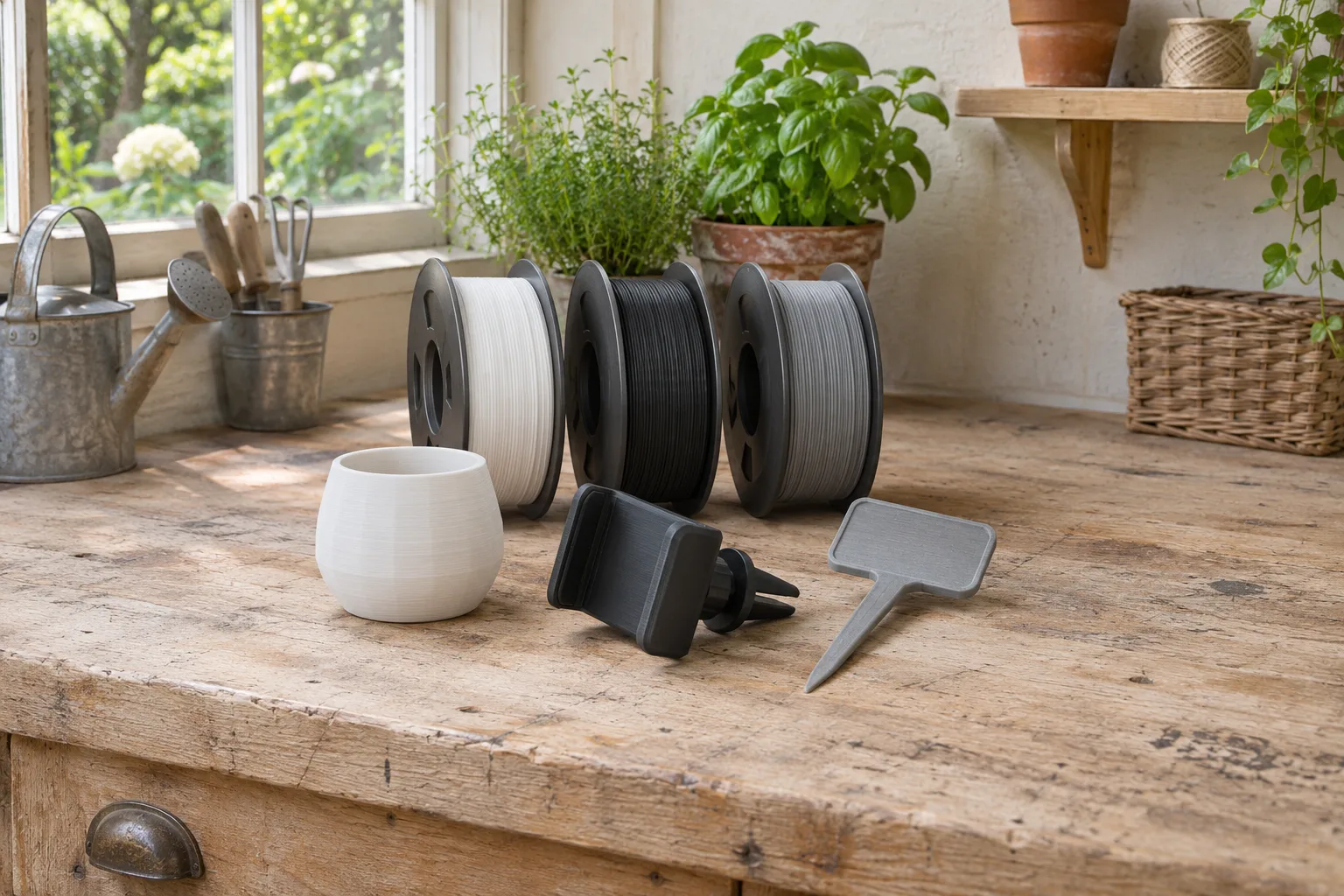
- Weather: this is the real difference. Bambu’s ASA sheet calls it “ideal” for outdoor models such as “plant signs, mailboxes, wind vanes,” citing “exceptional UV, weather, mechanical, and thermal resistance.” Polymaker calls its ASA “an alternative to ABS with an improved weather resistance.” Bambu’s ABS sheet does claim UV resistance too, but every maker we read points outdoor parts to ASA, not ABS.
ASA also smells less while printing. Prusa’s enclosure guide names odor as a reason to enclose “ABS and to a lesser extent ASA.”
Which costs more? It depends on the store. At Bambu’s typical prices ASA ($29.99 with spool) costs $11 more than ABS ($18.99), but on Black Friday it was $17.99, a dollar less. On Amazon, Polymaker’s ASA was $23.27 and its ABS $16.24, a $7.03 difference. Prusament ASA was $20.73 a spool (list $25.92) and Hatchbox ABS $25.00–$28.00.
Buy ABS for indoor parts that get warm, if it’s cheaper where you shop. Buy ASA for anything that will see sun or rain, and for indoor parts if the price is close, since it matches or beats ABS on every figure above except notched impact.
What is the best filament for outdoor use?
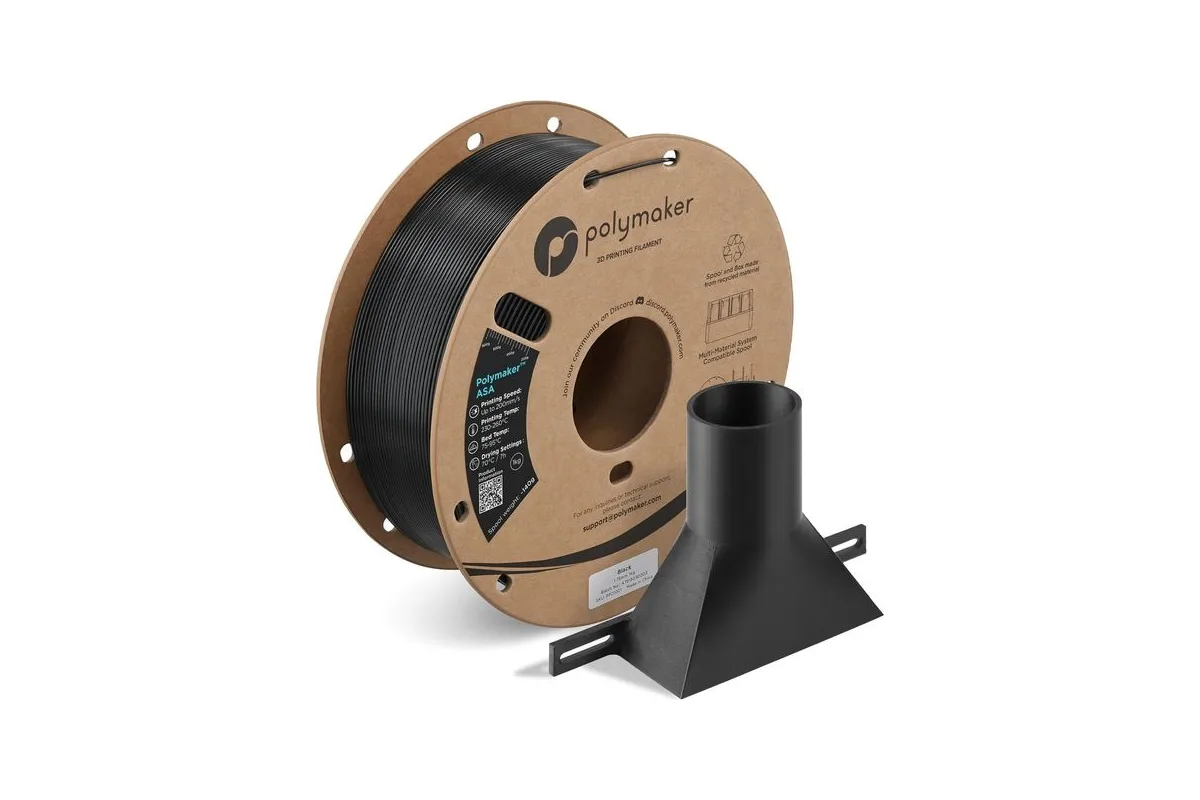
ASA. Bambu, Polymaker and Prusament all position their ASA for UV and weather, and it has the highest heat deflection of the three common materials here. Our pick is Polymaker ASA, $23.27 for 1 kg on Amazon in November 2026. Polymaker’s sheet rates it at 103 °C heat deflection at 0.45 MPa and 100 °C at 1.8 MPa, with 43.8 MPa tensile strength, and says it needs an enclosure, a 75–95 °C bed and drying at 70 °C for 7 hours. Prusament’s ASA sheet lists 93 °C at 0.45 MPa.
What to avoid outside:
- PLA. Prusa says PLA’s “low UV resistance” and low heat resistance mean it’s “not ideal for outdoor use,” and that PLA parts “start to lose mechanical strength at temperatures over 60 °C.” eSun’s PLA+ data sheet lists its UV resistance as “NO.” PLA+ doesn’t change this: no maker sheet we read shows PLA+ resisting more heat than PLA. See PLA vs PLA+.
- ABS, for long sun exposure. It handles heat, but makers reserve the outdoor role for ASA.
If you only have an open-frame printer, PETG is the practical option. It prints without an enclosure and takes more heat than PLA (71 against 57 °C on Bambu’s sheets), but none of the makers we read rates standard PETG for UV the way they rate ASA, so expect it to be the second choice for parts in full sun. See the best PETG filament.
For parts that need more heat than ASA, polycarbonate and the carbon fiber nylons go much higher; see the strongest 3D printer filament.
Do ABS and ASA need an enclosure?
Yes. Bambu’s material table says ABS, ASA, PC and nylon “require higher heatbed and chamber temperatures to suppress warping and layer separation” and marks them “Not Recommended” on open-frame printers. Prusa says an ABS printer “should be inside an enclosure with a higher ambient temperature.”
That rules out the Bambu A1 and A1 mini for regular ABS and ASA. Bambu says the A1 “is prone to reduced interlayer strength when using high-temperature filaments,” says ABS and ASA are not recommended except for small, low-infill models, and doesn’t recommend enclosing the A1. For ABS and ASA, buy an enclosed printer:
| Enclosed printer | Price (Nov 2026) | Note |
|---|---|---|
| Bambu Lab P1S | $349 | Older enclosed CoreXY that prints ABS and ASA |
| Elegoo Centauri Carbon 2 Combo | $369 at Elegoo | Enclosed, hardened 350 °C nozzle, four colors |
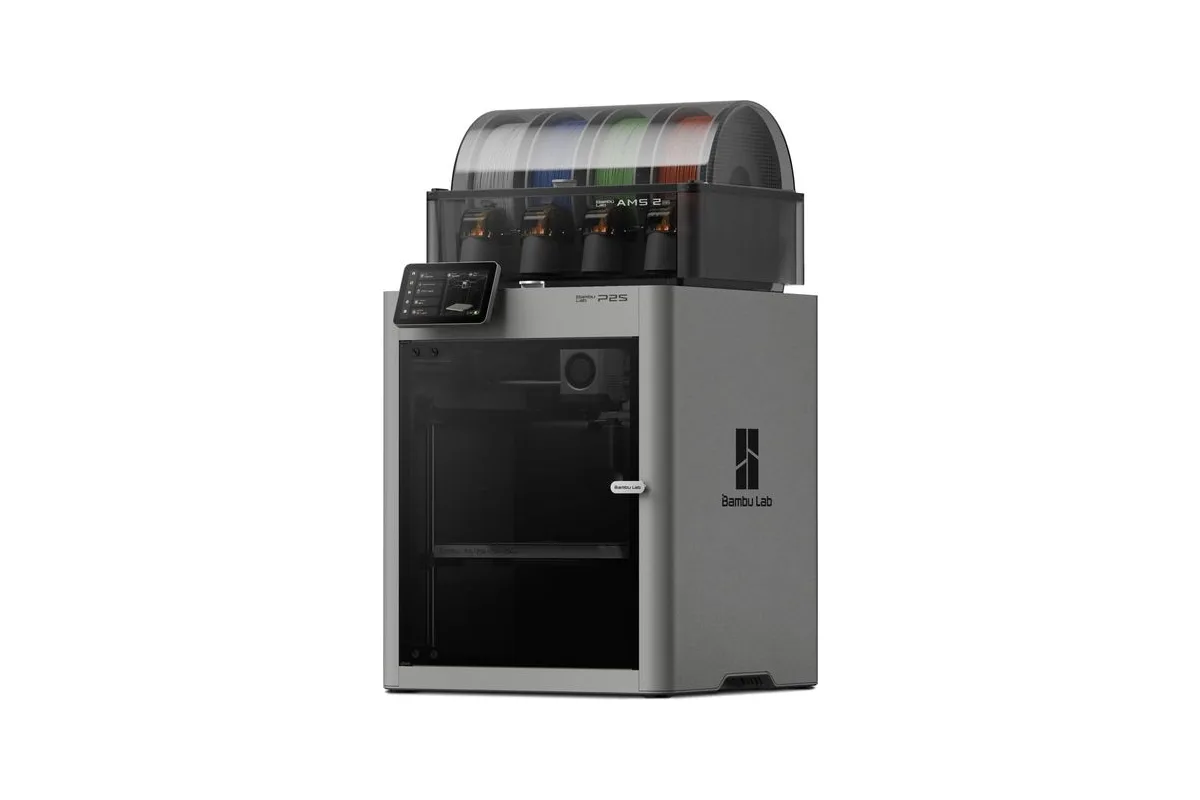
| Bambu Lab P2S Combo | $649 (typical $749) | Enclosed, with the AMS 2 Pro, which dries filament |
| Prusa Core One+ | $1,299 assembled | Actively heated chamber |
See the best enclosed 3D printers and open-frame vs enclosed 3D printers.
Are ABS and ASA fumes dangerous?
They’re the higher-emitting filaments, so treat them with more care than PLA. UL Chemical Insights says “ABS filaments typically have higher emissions, followed by Nylon, and then PLA,” and its five-year emissions data names ABS and ASA among the high emitters. An EPA review of 16 studies found ABS produced more particles than PLA. UL reports that a ventilated enclosure cut particle concentration by 99.7% and total VOCs by 69.5%, though it didn’t give the test conditions.
In practice: print ABS and ASA in an enclosed printer, in a room you can ventilate, away from where people sit, and don’t stand over the printer, especially in the first 20 minutes or so, when UL says particle emissions peak. Bambu says ABS and ASA “release harmful and irritating gases.” See are 3D printers safe? and where to put a 3D printer.
How do you print ABS and ASA?
- Bed and plate: 80–100 °C on Bambu’s sheets (Polymaker ASA 75–95 °C, Prusament ASA 110 ± 5 °C). On a textured PEI plate, Bambu says ABS and ASA may need glue stick, and Prusa says they require it as a separation layer. See PEI build plates and glue stick.
- Drying: both should be dried, at higher temperatures than PLA or PETG. The makers’ settings:
| Maker | ABS | ASA |
|---|---|---|
| Bambu (data sheets) | 80 °C, 8 h | 80 °C, 8 h |
| Bambu (convection oven) | 75–85 °C, 8 h | 75–85 °C, 8 h |
| Bambu (AMS HT) | 80 °C, 8 h | 80 °C, 8 h |
| Bambu (AMS 2 Pro) | 65 °C, 12 h; may not fully dry | 65 °C, 12 h; may not fully dry |
| Prusa | — | 80 °C, 4 h |
| Polymaker (data sheet) | — | 70 °C, 7 h |
| Sunlu | 75–85 °C, 6–8 h | 80 °C |
| Elegoo | 70 ± 5 °C, 4–6 h | 70 ± 5 °C, 4–8 h |
So a dryer that reaches 75–80 °C covers most makers’ ABS and ASA settings; Bambu says a 65 °C unit like the AMS 2 Pro may not fully dry them. See how to dry filament and the best filament dryers.
- AMS: the AMS 2 Pro and AMS HT accept ABS and ASA (the AMS 2 Pro “with conditions”); the AMS lite on the A1 doesn’t. Bambu ships ABS and ASA on PC-ABS spools rated to 90 °C, above the 80 °C drying setting.
Questions people ask
Is ASA stronger than ABS?
Slightly, on Bambu’s sheets: 37 against 33 MPa tensile strength, and 100 against 87 °C heat deflection. Impact is close. The bigger difference is that ASA is made for UV and weather.
Can PLA be used outdoors?
Not for long in the sun. Prusa says PLA isn’t ideal outdoors because of low UV and heat resistance, and Bambu’s PLA Basic deflects at 57 °C. Use ASA, or PETG on an open printer.
Can you print ABS or ASA on a Bambu A1?
Only small, low-infill models, Bambu says, in a well-ventilated room at a distance from people. Bambu doesn’t recommend enclosing the A1. Use an enclosed printer such as the P1S ($349) or P2S Combo ($649).
Which filament is best for car parts?
Not PLA: at 57 °C heat deflection on Bambu’s sheet, it’s the first to soften. ASA (100 °C) and ABS (87 °C) take far more heat, and ASA adds UV resistance for anything mounted outside.
Does ASA need to be dried?
Yes. Bambu says 80 °C for 8 hours, Prusa 80 °C for 4 hours and Polymaker 70 °C for 7 hours.
Is ABS cheaper than ASA?
Usually. Polymaker’s ABS was $7.03 cheaper than its ASA on Amazon in November 2026, and Bambu’s typical ASA price is $11 above its ABS. Sales can flip that: Bambu’s Black Friday ASA was $17.99, a dollar under its ABS with a spool.
What is the best filament for beginners?
PLA. It needs no enclosure, usually needs no drying in normal humidity, and has the lowest emissions of the three. See the best PLA filament.
Sources
- Bambu Lab PLA Basic technical data sheet, store.bblcdn.com
- Bambu Lab ABS technical data sheet V3, store.bblcdn.com
- Bambu Lab ASA technical data sheet, store.bblcdn.com
- Bambu Lab PETG Basic technical data sheet, store.bblcdn.com
- Bambu Lab PLA Basic, us.store.bambulab.com
- Bambu Lab ABS, us.store.bambulab.com
- Bambu Lab ASA, us.store.bambulab.com
- Polymaker ASA technical data sheet, cdn.shopify.com
- Polymaker PolyLite PLA technical data sheet V5.4, cdn.shopify.com
- Prusament ASA technical data sheet, storage.googleapis.com
- Prusament PLA, prusament.com
- eSun PLA+ technical data sheet, esun3d.com
- Bambu Lab filament guide: material table, wiki.bambulab.com
- Bambu Lab A1 FAQ, wiki.bambulab.com
- Bambu Lab: dry filament, wiki.bambulab.com
- Bambu Lab AMS 2 Pro, us.store.bambulab.com
- Prusa: drying filament, help.prusa3d.com
- Prusa: ABS, help.prusa3d.com
- Prusa: enclosure guide, help.prusa3d.com
- Prusament ASA prices, prusa3d.com
- Polymaker store, shop.polymaker.com
- Hatchbox store, hatchbox3d.com
- Sunlu quick start guide (drying settings), sunlu.com
- Elegoo FDM filament drying and storage guide, wiki.elegoo.com
- UL Chemical Insights: 3D printing emissions and its impact on human health, chemicalinsights.ul.org
- UL Chemical Insights: 10 ways to promote healthy indoor air quality while using a 3D printer, chemicalinsights.ul.org
- UL: comprehensive emissions data for material extrusion 3D printing, ul.org
- EPA: researchers continue to study the emissions of 3D printers, epa.gov
- Amazon: Polymaker ASA, amazon.com
- Amazon: Polymaker ABS, amazon.com
Keep exploring

How to
Hardened steel vs brass nozzles, and what nozzle size to use
Brass, or the stainless steel Bambu ships on the A1, is fine for PLA, PETG, ABS, ASA and TPU. Carbon fiber, glass fiber, glow-in-the-dark and sparkle filaments need hardened steel. Use a 0.4 mm nozzle for most prints, 0.6 mm for carbon fiber and big parts, and 0.2 mm for miniatures.
Read story
How to
Can you 3D scan with an iPhone? Yes, but not to tight tolerances
Yes. Any current iPhone can 3D scan objects from photos (photogrammetry), and KIRI Engine's free tier exports STL for printing. Only the iPhone 18 Pro and 18 Pro Max have LiDAR in Apple's current lineup. For parts that must fit, a $359 scanner is about ten times tighter.
Read story