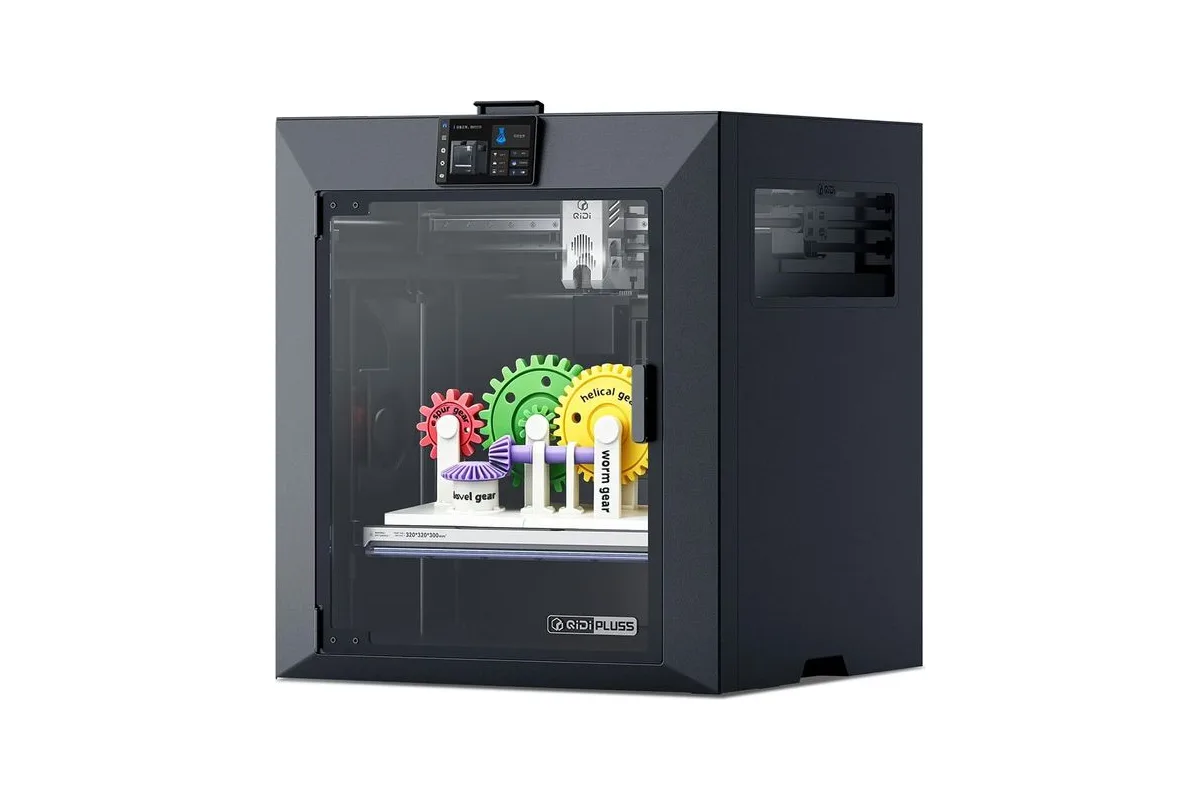
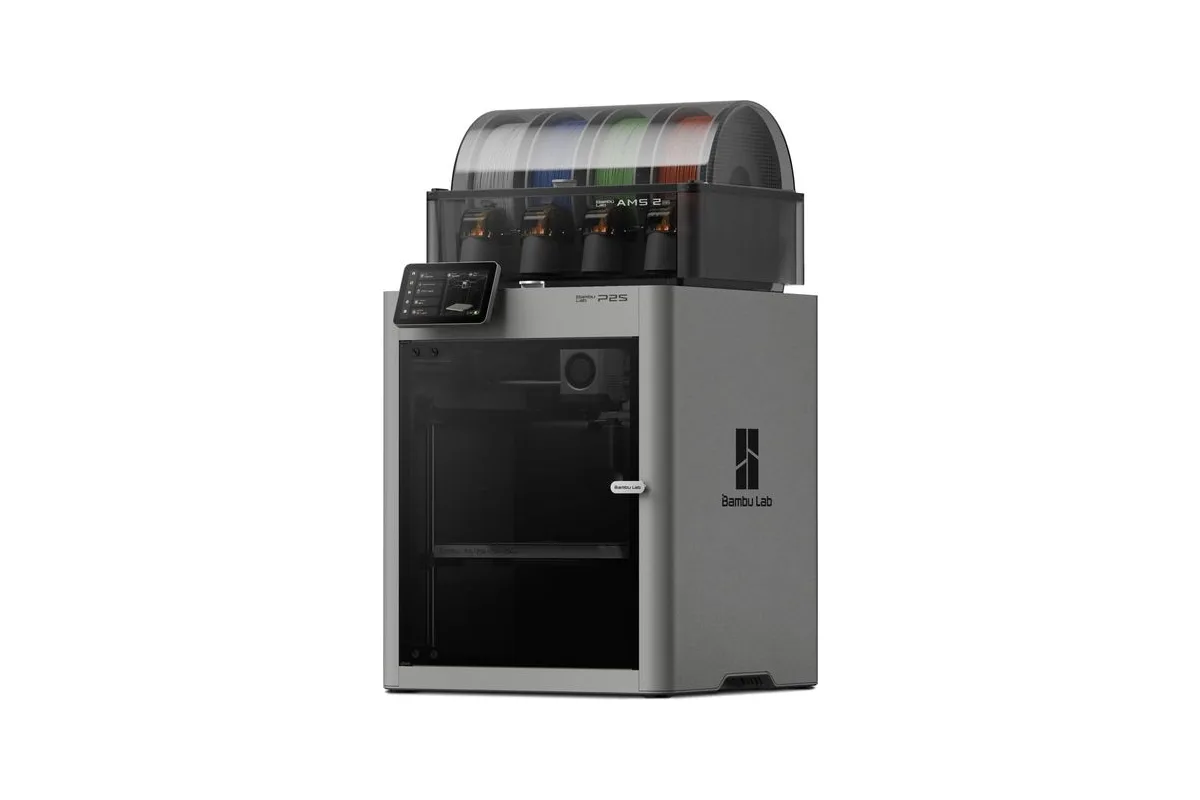
Side by side
| Feature | Qidi Plus5 | Bambu LabP2S Combo |
|---|---|---|
| Build volume | 320 × 320 × 300 mm | 256 x 256 x 256 mm |
| Max nozzle / bed | 370 °C / 120 °C | |
| Chamber | Active, 65 °C | |
| Filtration | G3 + H12 HEPA + carbon | |
| Where to buy | Check price at Amazon | Check price at Amazon |
Qidi Plus5
- Build volume
- 320 × 320 × 300 mm
- Max nozzle / bed
- 370 °C / 120 °C
- Chamber
- Active, 65 °C
- Filtration
- G3 + H12 HEPA + carbon
Bambu Lab P2S Combo
- Build volume
- 256 x 256 x 256 mm
- Max nozzle / bed
- Chamber
- Filtration
Qidi Plus5 or Bambu Lab P2S: which is better?
The Qidi Plus5 for engineering filament and big parts; the Bambu P2S for everyday printing. Both are enclosed printers rated at 600 mm/s, but the Plus5 is built hotter and bigger:
- The Qidi Plus5 is $699 at Qidi in November 2026 (regular $749), or $849 with the four-slot QIDI Box ($899). Its chamber heats actively to 65 °C, its nozzle reaches 370 °C and it builds 320 x 320 x 300 mm, about 83% more volume than the P2S (our estimate).
- The Bambu P2S is $449 at Bambu (typical $549), or $649 as the Combo with the AMS 2 Pro ($749). It’s lighter, cheaper and easier to set up, carries a 2-year warranty from Bambu’s store, and takes up to 20 colors. Its enclosure holds heat passively: Bambu says it “does not have an active chamber heating function”.
If you print mostly PLA and PETG, the P2S is the better buy. If you want nylon, PC or carbon-fiber parts that don’t warp, the Plus5 is. Our reviews: Qidi Plus5 and Bambu P2S.
What’s the difference between the Plus5 and the P2S?
| Qidi Plus5 | Bambu Lab P2S | |
|---|---|---|
| Printer price (Nov 2026) | $699 (regular $749) | $449 (typical $549) |
| With 4-color box | $849 with QIDI Box ($899) | $649 with AMS 2 Pro ($749) |
| Build volume | 320 x 320 x 300 mm (30.7 L) | 256 x 256 x 256 mm (16.8 L) |
| Max nozzle / bed | 370 °C / 120 °C | 300 °C / 110 °C |
| Chamber | Active heating to 65 °C | Enclosed, passive (no heater) |
| Filtration | G3 + H12 HEPA + carbon | Activated carbon |
| Speed (maker) | 600 mm/s, 20,000 mm/s² | 600 mm/s print (travel up to 1,000 mm/s since firmware 01.03), 20,000 mm/s² |
| Flow | 40 mm³/s | 40 mm³/s |
| Max colors | 16 (four QIDI Boxes) | 20 (AMS 2 Pro and AMS HT units) |
| Camera | Up to 1080p, AI detection | 1080p, 30 fps, AI on a 2 TOPS NPU |
| Connectivity | 2.4/5 GHz Wi-Fi, Ethernet, USB | Dual-band Wi-Fi, USB (no Ethernet) |
| Noise (maker) | Not published | Under 50 dB in silent mode |
| PLA power, steady | 190 W | 200 W |
| Size / weight | 500 x 488 x 558 mm, 29 kg | 392 x 406 x 478 mm, 14.9 kg |
| Warranty | 1 year; 14-day returns | 2 years from Bambu’s US store; 30-day returns |
| Update support | Not published | Bug and feature fixes to Oct 14, 2030; security to Oct 14, 2032 |
| Launched | August 2026 | October 2025 |
Volumes are our estimates. Sources: Qidi’s Plus5 page, QIDI Box page and warranty statement; Bambu’s P2S store page, specifications, wiki and warranty policy, read November 28, 2026. Qidi’s sale runs to December 6; Bambu’s ends December 1 at 2:00 AM ET.
Which prints engineering filament better?
The Plus5. ABS, ASA, nylon and polycarbonate shrink as they cool, so they warp and split when the air around the print is cool. The Plus5 heats its chamber to 65 °C with a 550 W heater. The P2S relies on its enclosure and an automatic flap that switches between internal and external air circulation, which Bambu says lets it regulate chamber temperature without a heater.
The Plus5 also has more headroom: a 370 °C nozzle against 300 °C, a 120 °C bed against 110 °C, and a HEPA filter on top of carbon, where the P2S has carbon only. For which materials need what, see carbon fiber and nylon filament and PLA vs ABS vs ASA.
If you want a heated chamber but prefer Bambu, its cheapest is the X2D at $589 ($789 as the AMS Combo), with a 65 °C chamber, 300 °C nozzles and a 256 x 256 x 260 mm build volume. See Bambu Lab P2S vs X2D.
Which is the better value?
It depends on what you print. Counting volume, the Plus5 is cheaper per liter; counting the box you need for color, the P2S Combo is $200 cheaper:
| Our estimate | Qidi Plus5 | Bambu P2S |
|---|---|---|
| Printer only, per liter | $23 | $27 |
| With 4-color box, per liter | $28 | $39 |
| Extra cost of the Plus5 | $250 (printer), $200 (with box) | — |
| With Qidi’s $30 code on the Combo | $819 | — |
Qidi’s code takes $30 off orders over $700, so it applies to the Combo but not the $699 printer.
Running costs are close for PLA: 190 W against 200 W, or about 14¢ to 15¢ for a 4-hour print at the US average of 18.17¢ per kWh (our estimate). The Plus5 draws more on hot materials, about 500 W steady on ABS, or about 36¢ for 4 hours, because it’s heating the chamber.
Which is better for multicolor?
The P2S, by a little. Both use a four-slot box and one nozzle, and neither Qidi nor Bambu publishes how much filament a color change purges. The P2S Combo costs $200 less and expands to 20 colors against the Plus5’s 16.
Drying is where the QIDI Box wins: it dries filament at up to 65 °C while it prints. The P2S powers drying for one AMS 2 Pro only when the printer is idle; drying during a print, or on extra units, needs a separate power adapter that isn’t in the box.
Watch the QIDI Box’s material limits: Qidi says it doesn’t take cardboard spools without an adapter ring, TPU 95A or generic TPU, damp PVA or BVOH, or some silk and glow PLA. A standalone QIDI Box ($228) “will ship within 2 months”, so buy the Combo if you want one. For lower-waste multicolor than either, see the best tool changer 3D printers.
Which is easier to own?
The P2S. At 14.9 kg it’s half the Plus5’s 29 kg and fits a smaller desk. Bambu publishes update-support dates, gives 2 years of warranty from its US store (excluding the hotend and extruder gears) and allows 30-day returns. It also works with no internet in LAN Only Mode, though Bambu says that turns off remote printing from outside your network, the Bambu Handy app and print history. See can you use a Bambu Lab printer offline?
Qidi gives 1 year in the US, excludes the hot end, nozzles, extruder, belts and build plate, and accepts returns for 14 days. It doesn’t say what firmware the Plus5 runs; its Q2 and Max4 run Klipper, and Qidi publishes that code, but there’s no Plus5 repository yet. The Plus5 does have Ethernet, which the P2S lacks. US orders ship from Qidi’s China warehouse.
Which should you buy?
The Qidi Plus5 ($699, or $849 with the QIDI Box) if you print functional parts in engineering filaments or need its 320 mm build area. It’s the Plus4’s successor: Qidi says the Plus4 is no longer in production.
The Bambu P2S Combo ($649) if you mostly print PLA and PETG, want color without fuss, and want the longer warranty. It’s our pick in the best enclosed 3D printers. More options: the best Bambu Lab alternatives and the best large 3D printers.
Questions people ask
Is the Qidi Plus5 better than the Bambu P2S?
For engineering filaments and build size, yes: it has an active 65 °C chamber, a 370 °C nozzle and 83% more volume. For price, weight, warranty and multicolor, the P2S is better.
Does the Bambu P2S have a heated chamber?
No. Bambu says it has no active chamber heating; the enclosure and an automatic air flap hold heat passively. The Qidi Plus5 heats its chamber to 65 °C.
Is the Qidi Plus5 bigger than the P2S?
Yes. It builds 320 x 320 x 300 mm against 256 x 256 x 256 mm, about 30.7 liters against 16.8 (our estimate). The printer itself is bigger too: 500 x 488 x 558 mm and 29 kg.
Which has Ethernet?
The Qidi Plus5. The P2S uses dual-band Wi-Fi only.
Is the Qidi Plus4 still worth buying?
It’s discontinued. Qidi names the Plus5 as its direct successor, at the $699 the Plus4 last sold for, with 18% more build volume.
Can the P2S print nylon?
Yes. Bambu’s spec sheet lists PA (nylon), PC and carbon-fiber grades, and the P2S has a hardened-steel nozzle. But without a heated chamber, large parts in warp-prone materials are harder to keep flat. That’s where the Plus5’s 65 °C chamber helps.
Sources
- Qidi Plus5 product page, qidi3d.com
- QIDI Box product page, qidi3d.com
- Qidi Plus4 product page (discontinued), qidi3d.com
- Qidi Black Friday sale, qidi3d.com
- Qidi warranty statement, qidi3d.com
- Qidi on GitHub, github.com
- Bambu Lab P2S product page, us.store.bambulab.com
- Bambu Lab P2S specifications, bambulab.com
- Bambu Lab P2S FAQ, wiki.bambulab.com
- Bambu Lab multi-AMS compatibility guide, wiki.bambulab.com
- Bambu Lab power consumption, wiki.bambulab.com
- Bambu Lab warranty policy (P2S), bambulab.com
- Bambu Lab compare page (software update support), bambulab.com
- Bambu Lab X2D product page, us.store.bambulab.com
Keep exploring

How to
Hardened steel vs brass nozzles, and what nozzle size to use
Brass, or the stainless steel Bambu ships on the A1, is fine for PLA, PETG, ABS, ASA and TPU. Carbon fiber, glass fiber, glow-in-the-dark and sparkle filaments need hardened steel. Use a 0.4 mm nozzle for most prints, 0.6 mm for carbon fiber and big parts, and 0.2 mm for miniatures.
Read story
How to
Can you 3D scan with an iPhone? Yes, but not to tight tolerances
Yes. Any current iPhone can 3D scan objects from photos (photogrammetry), and KIRI Engine's free tier exports STL for printing. Only the iPhone 18 Pro and 18 Pro Max have LiDAR in Apple's current lineup. For parts that must fit, a $359 scanner is about ten times tighter.
Read story