Printers in this guide
Is carbon fiber filament worth it?
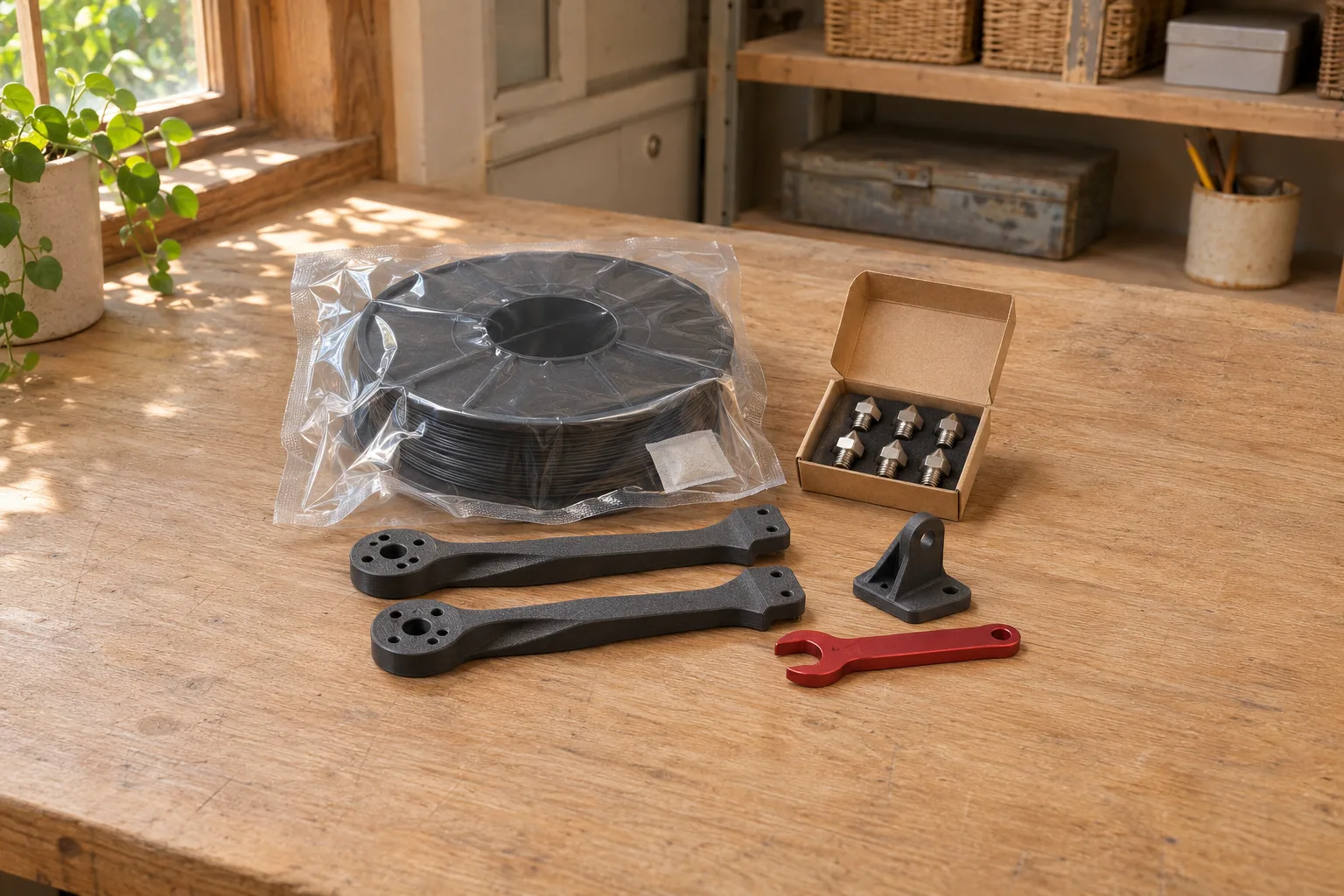
Yes, if you need a stiff part. No, if you want a stronger or more heat-resistant one. On Bambu Lab’s data sheets, its PLA-CF is about 44% stiffer than PLA Basic (3,950 against 2,750 MPa bending modulus, our estimate of the gain) but softens at the same temperature (55 against 57 °C) and costs about twice as much ($31.99 against $14.99 a refill at Bambu’s store). Every carbon fiber filament also needs a hardened steel nozzle.
Carbon fiber in PLA and PETG is chopped fiber that stiffens the plastic. It doesn’t turn PLA into an engineering material. The exception is carbon fiber nylon, which is among the strongest and most heat-resistant filaments you can print; see the strongest 3D printer filament.
What does carbon fiber actually change?
Bambu publishes sheets for plain and carbon fiber versions of the same plastics, tested the same way (ISO 527 tensile, ISO 179 Charpy impact, ISO 178 bending, ISO 75 heat deflection at 0.45 MPa).
| Bambu filament | Tensile X-Y / Z (MPa) | Notched impact (kJ/m²) | Stiffness, bending modulus (MPa) | Heat deflection (°C) | Refill price at Bambu |
|---|---|---|---|---|---|
| PLA Basic | 35 / 31 | 7.9 | 2,750 | 57 | $14.99 |
| PLA-CF | 38 / 26 | 7.6 | 3,950 | 55 | $31.99 |
| PETG Basic | 51 / 35 | — | 1,950 | 71 | $13.99 |
| PETG HF | 34 / 23 | 6.2 | 2,050 | 69 | $15.99 |
| PETG-CF | 35 / 29 | 15.7 | 2,910 | 74 | $31.99 |
Prices at Bambu’s US store in November 2026, during its Black Friday sale.
What the numbers say:
- Stiffness rises about 40%. PLA-CF is about 44% stiffer than PLA Basic and PETG-CF about 42% stiffer than PETG HF (our estimates from the moduli above). This is the real benefit: brackets, frames and mounts that don’t flex.
- Heat resistance barely moves. PLA-CF deflects at 55 °C against 57 for PLA Basic. PETG-CF gains 5 °C over PETG HF. A carbon fiber PLA part will still sag in a hot car.
- Strength doesn’t reliably rise. PLA-CF is slightly stronger along the layers than PLA Basic (38 against 35 MPa) but weaker between them (26 against 31). PETG-CF beats PETG HF on impact, but Bambu’s plain PETG Basic is stronger along the layers than PETG-CF (51 against 35 MPa).
- It costs twice as much at Bambu. Its PLA-CF and PETG-CF refills are $31.99, against $14.99 for PLA Basic, though Bambu’s bulk tiers bring the CF grades down to as little as $20.79 a roll.
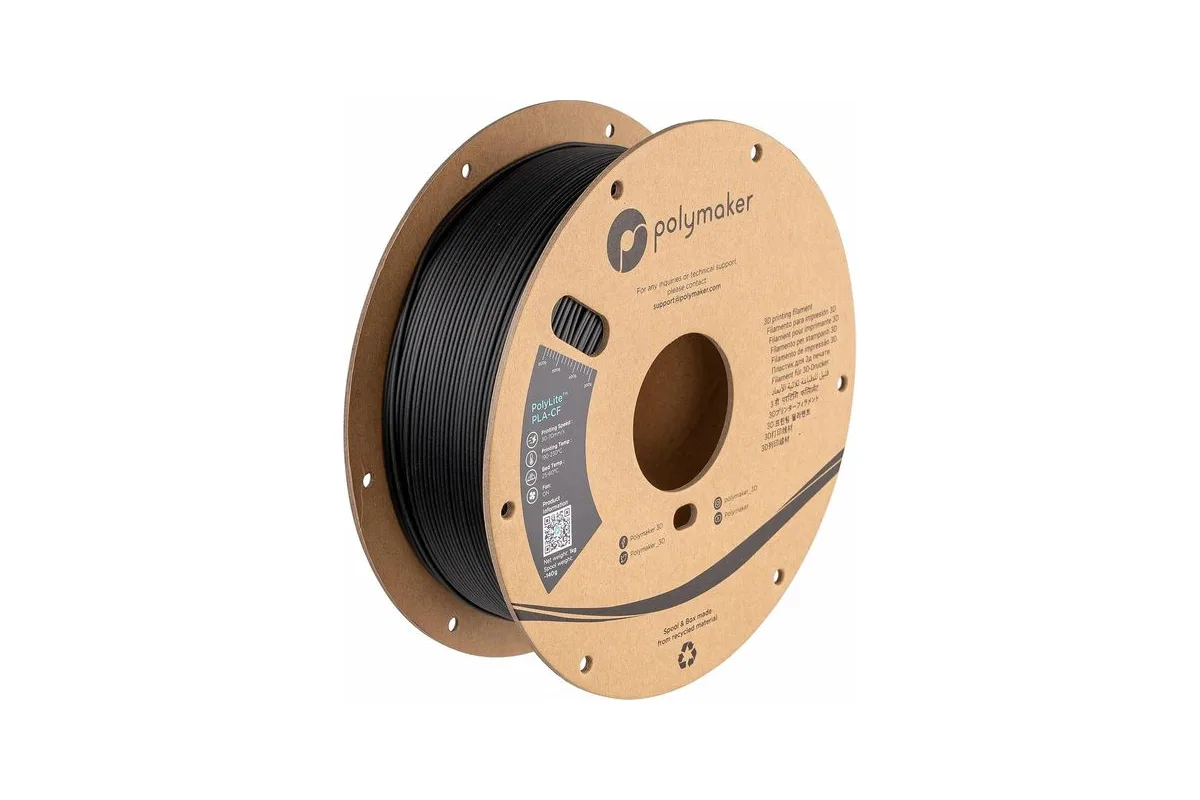
Third-party carbon fiber PLA is cheaper. Polymaker PLA-CF was $19.94 for 1 kg on Amazon in November 2026, and Elegoo’s PLA-CF was $21.99 at Elegoo’s store.
When carbon fiber is worth it
- Parts that must hold shape under load: brackets, camera and tool mounts, drone frames, jigs.
- When you want a matte, even surface and are already set up with a hardened nozzle.
- In nylon or PET, where carbon fiber grades reach 186–205 °C heat deflection on Bambu’s sheets.
When it isn’t
- Decorative prints, toys and figures: plain PLA does the job for half the price, and carbon fiber can’t go through a fine 0.2 mm nozzle.
- Parts that must flex or take impacts: TPU or a toughened PLA absorbs far more energy. Bambu’s PLA Tough+ absorbs 80.6 kJ/m² unnotched against 23.2 for PLA-CF.
- Parts that need heat resistance: carbon fiber PLA is still PLA. Use ASA or PC instead; see PLA vs ABS vs ASA.
What do you need to print carbon fiber filament?
A hardened steel nozzle. Bambu’s filament guide lists a hardened steel nozzle as “Required” for PLA-CF, PETG-CF, PA-CF, PET-CF and every other fiber-filled grade, and says not to use stainless steel or brass because “their hardness is insufficient.” In Bambu’s own example, a stainless nozzle was worn by 10 hours of PETG-CF. Polymaker says a brass nozzle lasts about 9 hours on its PA6-CF20.
Which nozzle size: Bambu’s first choice for fiber-filled filament is a 0.6 mm hardened nozzle, then 0.4 mm. It says never to use 0.2 mm, because “the clogging risk is extremely high.” With a 0.4 mm hardened nozzle it recommends 0.15–0.3 mm layers and about 100 mm/s at most.
Which printers already have one: Bambu’s A1, A1 mini and P1S ship with stainless steel nozzles. The Bambu Lab P2S and X1C ship hardened, as does the Elegoo Centauri Carbon 2. Upgrading is cheap: Bambu sells 0.4, 0.6 and 0.8 mm hardened hotends for the A1 and A1 mini at $11.99 each, and for the X1C at $14.99. More in the 3D printer nozzle guide.
Can you run carbon fiber filament through a Bambu AMS?
Only Bambu’s own grades, and with limits. Bambu says to avoid “third-party fiber reinforcement materials (PA-CF/GF, PET-CF/GF, PLA-CF/GF, etc.)” in the AMS because “they may wear AMS PTFE tubes,” and that abrasive filaments “can eventually grind down the internal PTFE feed channels.”
| Feeder | Carbon fiber it supports |
|---|---|
| AMS lite (A1 series) | Bambu PLA-CF only; not PETG-CF or third-party fiber-filled filament |
| AMS 2 Pro | Bambu PLA-CF, PETG-CF and PAHT-CF, with conditions; no other CF or GF filament |
| AMS HT | Bambu PLA-CF, PETG-CF and PAHT-CF; other CF and GF filament through its bypass port |
Feed a third-party spool such as Polymaker PLA-CF from the printer’s external spool holder. More in third-party filament in a Bambu AMS.
Is nylon filament hard to print?
Yes, harder than PLA, PETG or ABS, and mostly because of water. Bambu’s PA6-CF absorbs 2.35% water at 25 °C and 55% humidity, against 0.43% for PLA Basic, more than five times as much (our estimate). Prusa says to dry polyamide “before every print.” Nylon also needs a hot nozzle, a hot bed, an enclosure and, for the carbon fiber grades, a hardened nozzle.
| Filament (maker sheet) | Nozzle °C | Bed °C | Chamber °C | Drying | Water absorption |
|---|---|---|---|---|---|
| Bambu PLA Basic | 190–230 | 35–45 | 25–45 | 50 °C, 8 h | 0.43% |
| Bambu ABS | 240–270 | 80–100 | 45–60 | 80 °C, 8 h | 0.65% |
| Bambu PA6-CF | 260–290 | 80–100 | 45–60 | 80 °C, 8–12 h | 2.35% |
| Bambu PAHT-CF | 260–290 | 80–100 | 45–60 | 80 °C, 8–12 h | 0.88% |
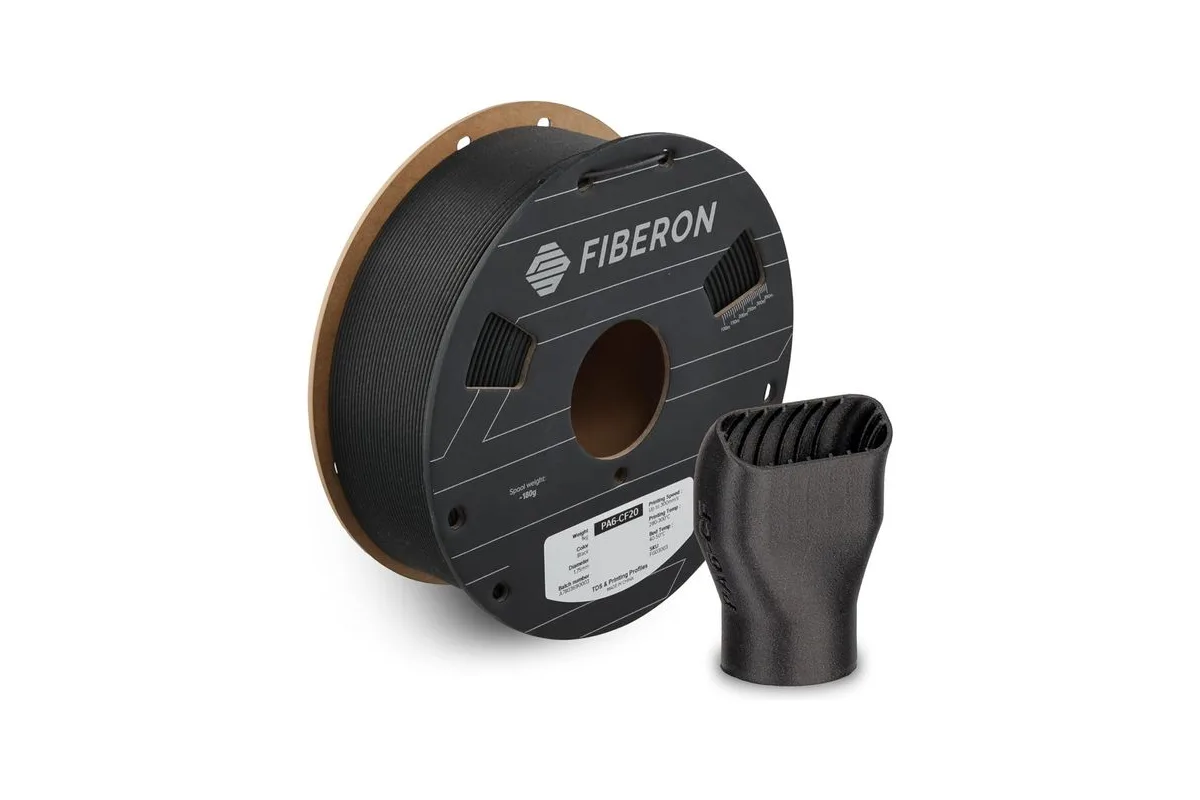
| Polymaker Fiberon PA6-CF20 | 280–300 | 40–50 | — | 100 °C, 10 h | — |
| Prusament PA11 Carbon Fiber | 280–290 | 100–120 | — | 90 °C, 6 h | — |
Bambu’s drying times are for a blast oven. Polymaker says PA6-CF20 is “sensitive to moisture and should always be stored and used under dry conditions.”
Why wet nylon matters so much
Water doesn’t just cause popping and stringing; it changes the plastic. Polymaker tested its PA6-CF20 dry and again after 48 hours in 60 °C water:
| Polymaker Fiberon PA6-CF20 | Dry, annealed | After water conditioning |
|---|---|---|
| Tensile X-Y | 109.3 MPa | 54.7 MPa |
| Tensile Z (between layers) | 54.0 MPa | 25.5 MPa |
| Notched Charpy impact | 11.0 kJ/m² | 35.6 kJ/m² |
Wet nylon loses half its strength and becomes tougher and more flexible. Every strength figure you see for nylon is a dry number.
What you need to print nylon
- An enclosed printer. Bambu’s filament guide says PA and its carbon fiber grades need higher bed and chamber temperatures to stop warping and layer separation, and marks PA-CF “Not Recommended” on open-frame printers. See open-frame vs enclosed 3D printers.
- A hardened steel nozzle for any carbon fiber nylon. Prusa’s PA11 CF sheet: “A hardened nozzle is necessary.”
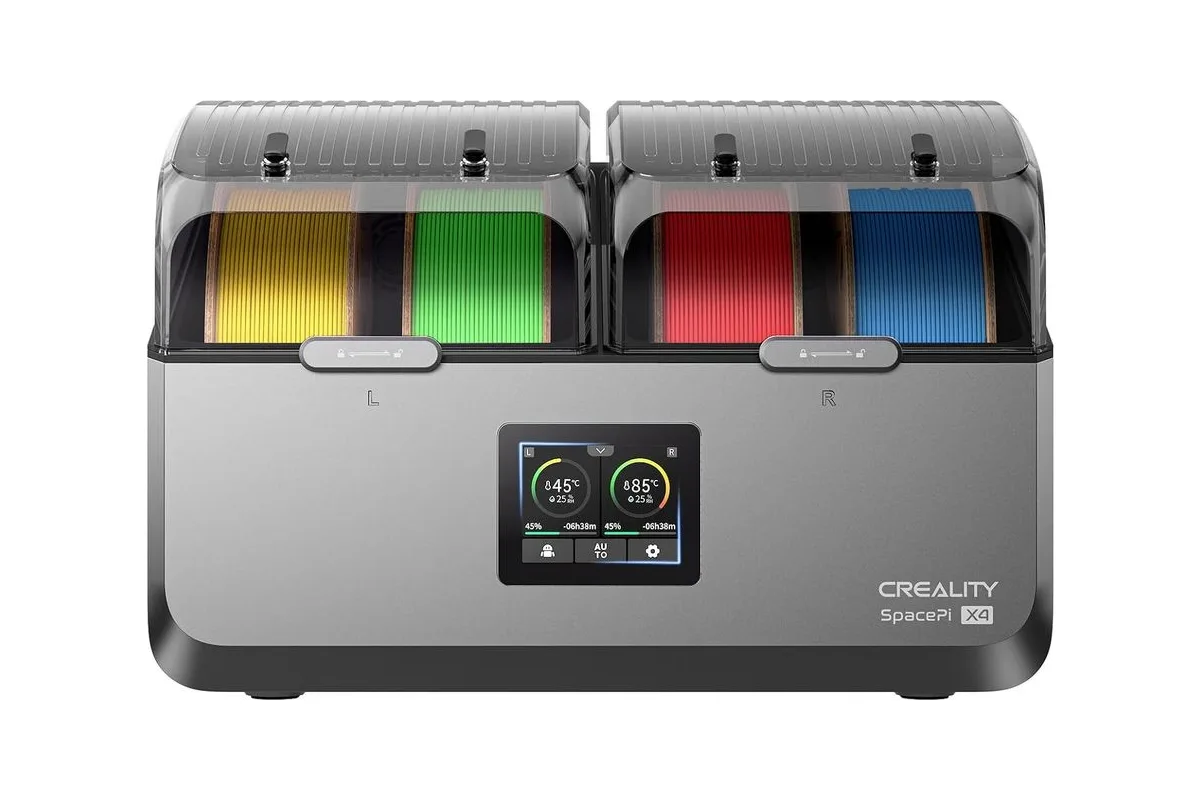
- A dryer that gets hot enough. Bambu calls drying “Required” for PA6-CF and PAHT-CF: 85 °C for 12 hours in its AMS HT, or 75–85 °C for 8–12 hours in a convection oven. It says its AMS 2 Pro, which tops out at 65 °C, “may not fully dry” them. The Creality Space Pi X4 reaches 85 °C and was $149 on Amazon in November 2026; that covers Bambu’s figures but not Polymaker’s 100 °C for PA6-CF20. See the best filament dryers and how to dry filament.
- A spool that survives the heat. Bambu ships its nylon on PC-ABS spools rated to 90 °C; its standard PLA spools are ABS rated to 70 °C.
- Ventilation. UL’s emissions research names nylon among the high-emitting filaments for particles. See are 3D printers safe?
Which nylon to start with
This page covers carbon fiber nylon because those are the nylon grades whose data sheets we read. If humidity is your problem, Bambu’s PAHT-CF absorbs much less water than its PA6-CF (0.88% against 2.35%), deflects at a higher temperature (194 against 186 °C at 0.45 MPa) and takes more impact (22.8 against 13.4 kJ/m² notched). It’s less strong along the layers (92 against 102 MPa) and costs more: $56.99 for 1 kg against $47.99 at Bambu’s store in November 2026.
Polymaker’s Fiberon PA6-CF20 has the highest dry strength we found on any maker’s sheet, 109.3 MPa, and a 215 °C heat deflection at 0.45 MPa, for $52.99 a kilogram on Amazon in November 2026. It’s also the most demanding: a 280–300 °C nozzle and 100 °C drying.
Questions people ask
Can you print carbon fiber filament on a Bambu A1?
Carbon fiber PLA and PETG, yes, once you fit a hardened nozzle: the A1 ships with stainless steel, and Bambu’s hardened A1 hotends cost $11.99. The A1’s AMS lite takes Bambu’s PLA-CF but not PETG-CF. Carbon fiber nylon, no: Bambu doesn’t recommend nylon on open-frame printers.
Is carbon fiber PLA stronger than regular PLA?
Barely, and only in one direction. Bambu’s PLA-CF pulls to 38 MPa along the layers against 35 for PLA Basic, but 26 against 31 between layers, with about the same impact strength (7.6 against 7.9 kJ/m² notched).
Is carbon fiber filament more heat-resistant?
Not in PLA. Bambu’s PLA-CF deflects at 55 °C against 57 for PLA Basic. In nylon and PET it’s a different story: Bambu’s carbon fiber grades of those plastics reach 186–205 °C (0.45 MPa).
Do you need to dry carbon fiber PLA?
Bambu calls it “Recommended,” not required: 50–60 °C for 8 hours in a convection oven, or 45 °C for 12 hours in an AMS 2 Pro or AMS HT. Carbon fiber nylon must be dried.
What’s the difference between PA6, PAHT and PA11 nylon?
They’re different nylons with different moisture behavior. On Bambu’s sheets PA6-CF absorbs 2.35% water and PAHT-CF 0.88%. Prusa sells PA11 carbon fiber, which it dries at 90 °C for 6 hours and which deflects at 192 °C (0.45 MPa).
Does carbon fiber filament wear out the extruder?
It wears the nozzle fastest, but Bambu says that with fiber-filled filaments “the nozzle and extruder gears require more frequent maintenance.” See 3D printer maintenance.
Sources
- Bambu Lab PLA-CF technical data sheet, store.bblcdn.com
- Bambu Lab PLA Basic technical data sheet, store.bblcdn.com
- Bambu Lab PETG-CF technical data sheet, store.bblcdn.com
- Bambu Lab PETG HF technical data sheet, store.bblcdn.com
- Bambu Lab PETG Basic technical data sheet, store.bblcdn.com
- Bambu Lab PA6-CF technical data sheet, store.bblcdn.com
- Bambu Lab PAHT-CF technical data sheet, store.bblcdn.com
- Bambu Lab ABS technical data sheet, store.bblcdn.com
- Bambu Lab filament guide: material table, wiki.bambulab.com
- Bambu Lab: notes on AMS, wiki.bambulab.com
- Bambu Lab: filament drying recommendations, wiki.bambulab.com
- Bambu Lab: P1S extruder upgrade, wiki.bambulab.com
- Bambu Lab store: AMS lite, us.store.bambulab.com
- Bambu Lab store: AMS 2 Pro, us.store.bambulab.com
- Bambu Lab store: AMS HT, us.store.bambulab.com
- Bambu Lab store: PLA-CF, us.store.bambulab.com
- Bambu Lab store: PA6-CF, us.store.bambulab.com
- Bambu Lab store: PAHT-CF, us.store.bambulab.com
- Polymaker Fiberon PA6-CF20 technical data sheet, cdn.shopify.com
- Prusament PA11 Carbon Fiber technical data sheet, prusament.com
- Prusa: drying filament, help.prusa3d.com
- UL: comprehensive emissions data for material extrusion 3D printing, ul.org
- Polymaker PLA-CF on Amazon, amazon.com
- Polymaker Fiberon PA6-CF20 on Amazon, amazon.com
Keep exploring

How to
Hardened steel vs brass nozzles, and what nozzle size to use
Brass, or the stainless steel Bambu ships on the A1, is fine for PLA, PETG, ABS, ASA and TPU. Carbon fiber, glass fiber, glow-in-the-dark and sparkle filaments need hardened steel. Use a 0.4 mm nozzle for most prints, 0.6 mm for carbon fiber and big parts, and 0.2 mm for miniatures.
Read story
How to
Can you 3D scan with an iPhone? Yes, but not to tight tolerances
Yes. Any current iPhone can 3D scan objects from photos (photogrammetry), and KIRI Engine's free tier exports STL for printing. Only the iPhone 18 Pro and 18 Pro Max have LiDAR in Apple's current lineup. For parts that must fit, a $359 scanner is about ten times tighter.
Read story