Printers in this guide
What is PLA+ and is it better than regular PLA?
PLA+ is PLA with additives, and it’s better for parts that take knocks, not for heat. There’s no standard for “PLA+”, “PLA Pro” or “Tough PLA”; each maker uses its own blend. But where one maker publishes sheets for both, the pattern is the same: impact toughness rises sharply, while tensile strength and heat resistance barely move.
Polymaker’s own data sheets show it clearly. Its PolyLite PLA Pro absorbs 17.1 kJ/m² in a notched Charpy impact test, against 3.3 kJ/m² for its plain PolyLite PLA: about 5.2 times as much (our arithmetic). Tensile strength is slightly lower (49.8 vs 52.3 MPa), and both deflect at 58 °C under a 1.8 MPa load.
So choose PLA+ for clips, brackets, toys and anything that gets dropped or flexed. It won’t survive a hot car any better than PLA; for that you need PETG or ASA.
PLA vs PLA+ in the makers’ own tests
Cross-brand numbers aren’t comparable, because makers use different tests (Charpy or Izod, notched or not). These pairs come from one maker’s sheets each, with specimens printed at 100% infill.
| Same-maker pair | Impact | Tensile strength, printed flat | Heat deflection |
|---|---|---|---|
| Polymaker PolyLite PLA → PolyLite PLA Pro | 3.3 → 17.1 kJ/m² (notched Charpy) | 52.3 → 49.8 MPa | 58 → 58 °C (1.8 MPa) |
| Polymaker PolyLite PLA → Polymaker PLA Pro (2026 sheet) | 3.3 → 20.76 kJ/m² (notched Charpy) | 52.3 → 39.93 MPa | 58 → 55.6 °C (1.8 MPa) |
| Bambu PLA Basic → PLA Tough+ | 26.6 → 80.6 kJ/m² (unnotched Charpy) | 35 → 34.9 MPa | 57 → 61 °C (0.45 MPa) |
Polymaker’s newer PLA Pro sheet goes further in the same direction: even more impact resistance, lower tensile strength. That’s the trade most PLA+ makes. It bends and absorbs a blow instead of snapping, but it isn’t a stronger material in every sense.
Heat stays at PLA levels in every sheet. Prusa says PLA parts “start to lose mechanical strength at temperatures over 60 °C,” and no maker sheet we read shows a PLA+ more heat-resistant than its PLA.
What does each brand’s PLA+ claim?
| Brand and product | What the maker says | Numbers behind it | Price, Nov 2026 |
|---|---|---|---|
| Polymaker PolyLite PLA Pro / PLA Pro | “Engineered for high impact resistance” | Full data sheets (above) | $23.99 at Polymaker |
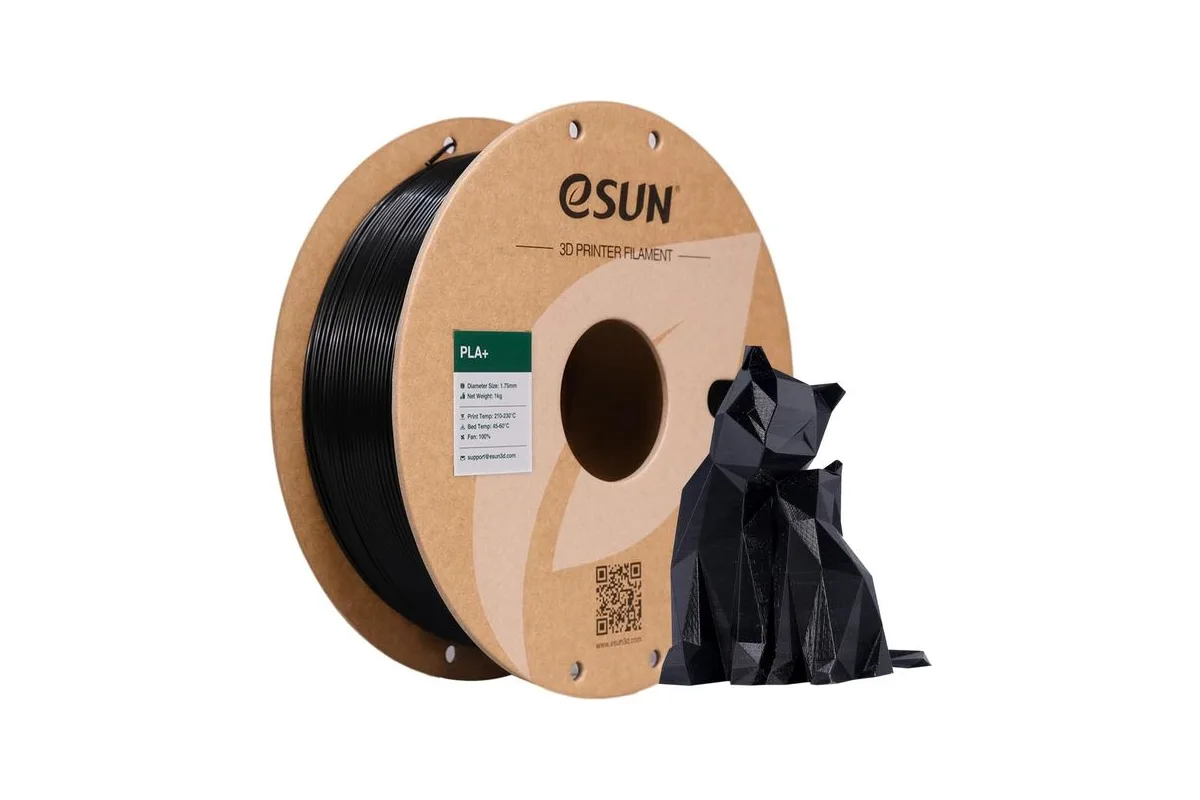
| eSun PLA+ | “Stronger and tougher than standard PLA” | Data sheet: 70.37 MPa tensile printed flat; 7.27 kJ/m² Izod impact; 53.78 °C heat deflection (0.45 MPa); UV resistance “NO” | $16.99 at eSun and on Amazon |
| Bambu PLA Tough+ | Bambu’s toughened PLA | Data sheet (above) | $20.99 refill |
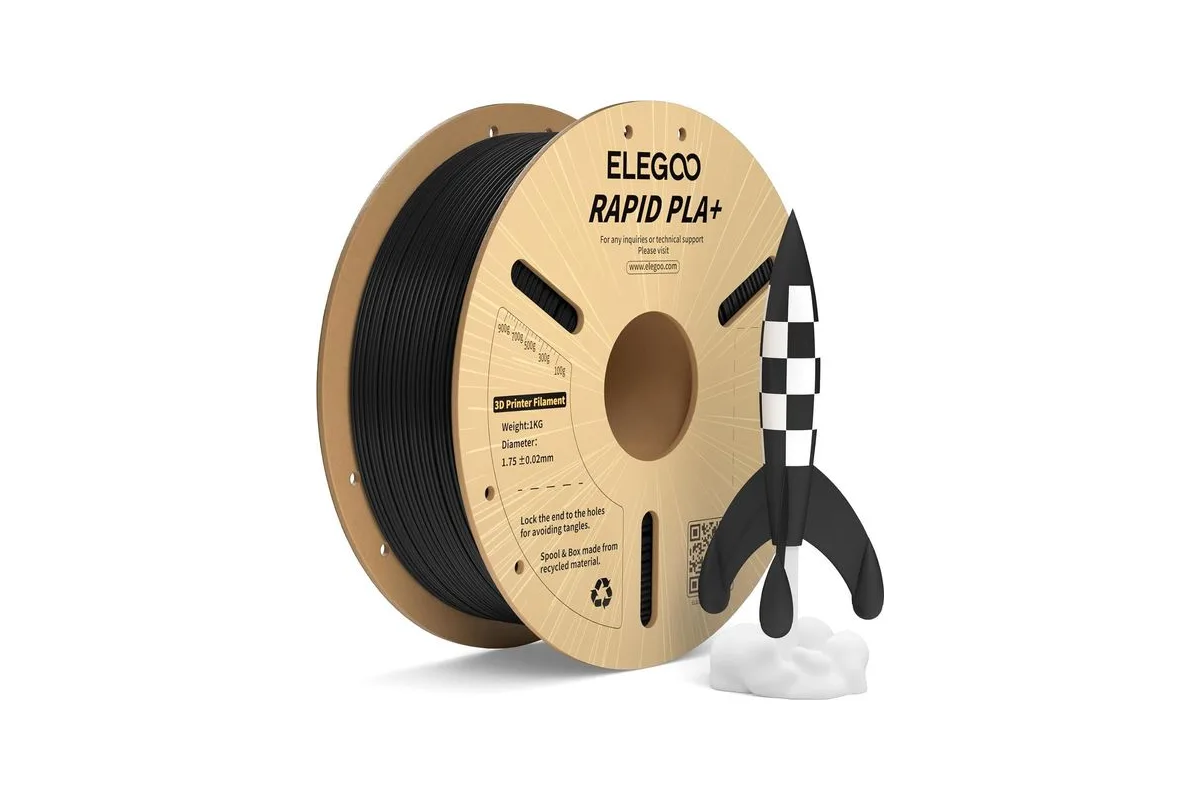
| Elegoo PLA Plus / Rapid PLA+ | “Enhanced toughness and better tensile strength”; Rapid PLA+ up to 600 mm/s | No data sheet on the US store | $14.99 / $15.99 at Elegoo; Rapid PLA+ $11.89 on Amazon |
| Sunlu PLA+ / PLA+ 2.0 | PLA+ 2.0 “10 times stronger than PLA”; PLA+ impact “up to 8KJ/m2” | No test method given | $12.99–$15.99 at Sunlu; PLA+ 2.0 $13.53 on Amazon |
| Overture PLA Pro | “Up to 5× the impact toughness of standard PLA” | No test method given | $21.99 at Overture |
eSun’s 70.37 MPa looks far above Polymaker’s 49.8 MPa, but the two makers test their own specimens their own way, and eSun publishes no plain-PLA sheet to compare against. Treat any “X times stronger” claim without a named test as marketing.
Does PLA+ cost more than PLA?
Barely, and sometimes not at all. On Amazon in November 2026, Elegoo Rapid PLA+ was $11.89 and Overture’s plain High Speed PLA $11.88. At the makers’ stores the gap ranged from about 50 cents to $6 a kilogram:
| Maker | Plain PLA | PLA+ or toughened PLA | Difference |
|---|---|---|---|
| Sunlu | $12.49–$14.99 | $12.99–$15.49 | About $0.50 |
| Elegoo | $13.99 | $14.99 (PLA Plus) | $1.00 |
| eSun | $13.99 (PLA Basic) | $16.99 (PLA+) | $3.00 |
| Polymaker | $19.99 (PolyLite PLA) | $23.99 (PolyLite PLA Pro) | $4.00 |
| Bambu | $14.99 refill (PLA Basic) | $20.99 refill (PLA Tough+) | $6.00 |
During the sale, Overture’s PLA+ refill ($12.99) was even cheaper than its plain PLA refill ($16.99). At a dollar or two, PLA+ is worth it for anything functional. See the best PLA filament for the brand picks and price per kilogram.
Is PLA+ harder to print?
No, but it usually runs a little hotter. Makers’ nozzle ranges:
- eSun PLA+: 210–230 °C, bed 45–60 °C.
- Polymaker PLA Pro (2026): 210–230 °C, against 190–230 °C for PolyLite PLA. Rated to 300 mm/s.
- Bambu PLA Tough+: 220–250 °C, against 190–230 °C for PLA Basic.
- Sunlu PLA+ 2.0: 195–205 °C at 50–100 mm/s, 205–220 °C at 100–300 mm/s.
Neither needs an enclosure. For drying, eSun gives 50 °C for 8–12 hours and Polymaker 55 °C for 6 hours. See how to dry filament.
When should you use plain PLA, PLA+ or something else?
- Plain PLA: display models, figures, prototypes and decor, where nothing gets dropped or flexed.
- PLA+: clips, brackets, hinges, toys, tool holders, anything that might snap.
- PETG: parts that see heat or water. In Polymaker’s own sheets, PolyLite PETG deflects at 78 °C (0.45 MPa) against 59 °C for PolyLite PLA Pro, though PLA Pro has far higher notched impact (17.1 vs 2.6 kJ/m²). See PLA vs PETG.
- ASA: outdoor parts in sun. See PLA vs ABS vs ASA.
- Heat-resistant PLA: Polymaker HT-PLA reaches 107.2 °C heat deflection (0.45 MPa), but only after annealing; as printed it’s 61.4 °C.
Is silk PLA worth it?
For display pieces, yes; for parts that do a job, no reason to. Silk PLA is a looks product: a glossy, metallic sheen for vases, figures and gifts. It costs $1 to $5 more a kilogram, prints hotter and needs drying sooner. In makers’ sheets it isn’t always weaker than plain PLA, but it’s no stronger.
| Silk vs standard, same maker | Tensile, printed flat | Tensile between layers | Heat deflection (0.45 MPa) | Price |
|---|---|---|---|---|
| Bambu PLA Basic → PLA Silk+ | 35 → 33 MPa | 31 → 25 MPa | 57 → 60 °C | $14.99 → $15.99 refill |
| Polymaker Panchroma Basic → Panchroma Silk | 40.4 → 41.1 MPa | Not listed | Not listed | $17.99–$19.99 → $17.99–$24.99 |
| Elegoo PLA → PLA Silk | No data sheet | No data sheet | No data sheet | $13.99 → $18.99 |
Bambu’s Silk+ is about 19% weaker between layers than PLA Basic (25 vs 31 MPa, our arithmetic), which matters for anything loaded across the layers. Polymaker’s Panchroma Silk is as strong as its Basic printed flat and tougher in its notched impact test (13.8 vs 6.76 kJ/m²). On Amazon, Sunlu silk PLA was $13.88 in November 2026.
What silk costs you in printing:
- Hotter nozzle. Bambu gives 210–240 °C for Silk+, against 190–230 °C for Basic.
- More drying. Bambu ships Silk+ “thoroughly dried and vacuum-sealed” and says, “We strongly recommend drying it right after opening.” Its oven setting is 55 °C for 8 hours, against 50 °C for Basic.
Matte PLA is the opposite look with a similar cost: low sheen, and weaker between layers (Bambu Matte 22 vs 31 MPa; Polymaker Panchroma Matte 12.2 vs 27.2 MPa).
Questions people ask
Is PLA+ stronger than PLA?
Tougher, yes: it absorbs much more impact before breaking. Stronger in a pull test, not necessarily. Polymaker’s PLA Pro has slightly lower tensile strength than its plain PLA (49.8 vs 52.3 MPa).
Is PLA Pro the same as PLA+?
Close enough. There’s no standard name: Polymaker calls its toughened line PLA Pro, Bambu calls it Tough+, eSun and Sunlu call it PLA+, and Overture sells both a PLA+ and a PLA Pro. Read each maker’s data sheet, if it has one.
Is PLA+ more heat-resistant than PLA?
No. eSun PLA+ deflects at 53.78 °C (0.45 MPa), and Polymaker’s PLA and PLA Pro both deflect at 58 °C (1.8 MPa). Use PETG or ASA for heat.
Can you use PLA+ outdoors?
Not well. eSun lists UV resistance as “NO” for its PLA+, and Prusa says PLA’s low UV and heat resistance make it “not ideal for outdoor use.” ASA is the outdoor choice.
Does PLA+ work in a Bambu AMS?
Yes, as long as the spool fits. Some PLA+, including Elegoo Rapid PLA+ and eSun PLA+, ships on cardboard spools, which Bambu says need an adapter ring. See third-party filament in a Bambu AMS.
Is silk PLA harder to print?
A little. It prints hotter (210–240 °C for Bambu Silk+) and Bambu recommends drying it as soon as you open it.
Is PLA+ food-safe?
No print is food-safe by default. eSun PLA+ has SGS food-contact test reports for the filament, but layer lines and brass nozzles are still a problem. See food-safe 3D printing.
Sources
- Polymaker PolyLite PLA technical data sheet (V5.4), cdn.shopify.com
- Polymaker PolyLite PLA Pro technical data sheet (V5.4), cdn.shopify.com
- Polymaker PLA Pro technical data sheet (v6.0, 2026), cdn.shopify.com
- Polymaker PolyLite PETG technical data sheet (V5.4), cdn.shopify.com
- Polymaker HT-PLA technical data sheet, cdn.shopify.com
- Polymaker Panchroma technical data sheet (V2), cdn.shopify.com
- Bambu Lab PLA Basic technical data sheet, store.bblcdn.com
- Bambu Lab PLA Tough+ technical data sheet, store.bblcdn.com
- Bambu Lab PLA Silk+ technical data sheet, cdn.shopify.com
- Bambu Lab PLA Silk+ store page, us.store.bambulab.com
- Bambu Lab wiki: filament drying recommendations, wiki.bambulab.com
- eSun PLA+ technical data sheet, esun3d.com
- eSun PLA+ product page, esun3d.com
- Sunlu store, store.sunlu.com
- Overture store, overture3d.com
- Elegoo US store, us.elegoo.com
- Prusament PLA, prusament.com
- Amazon: Sunlu silk PLA, amazon.com
Keep exploring

How to
Hardened steel vs brass nozzles, and what nozzle size to use
Brass, or the stainless steel Bambu ships on the A1, is fine for PLA, PETG, ABS, ASA and TPU. Carbon fiber, glass fiber, glow-in-the-dark and sparkle filaments need hardened steel. Use a 0.4 mm nozzle for most prints, 0.6 mm for carbon fiber and big parts, and 0.2 mm for miniatures.
Read story
How to
Can you 3D scan with an iPhone? Yes, but not to tight tolerances
Yes. Any current iPhone can 3D scan objects from photos (photogrammetry), and KIRI Engine's free tier exports STL for printing. Only the iPhone 18 Pro and 18 Pro Max have LiDAR in Apple's current lineup. For parts that must fit, a $359 scanner is about ten times tighter.
Read story