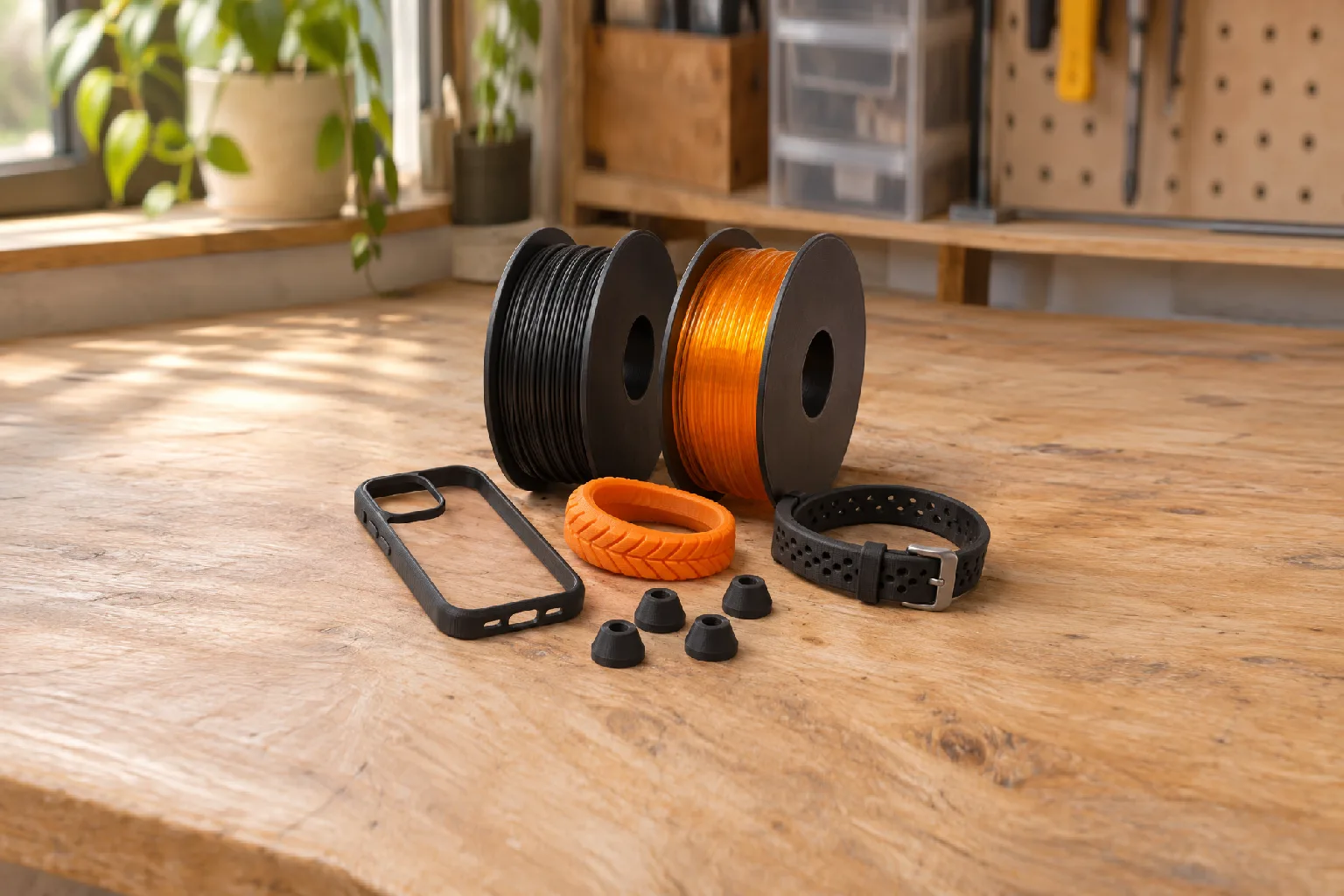
The quick answer
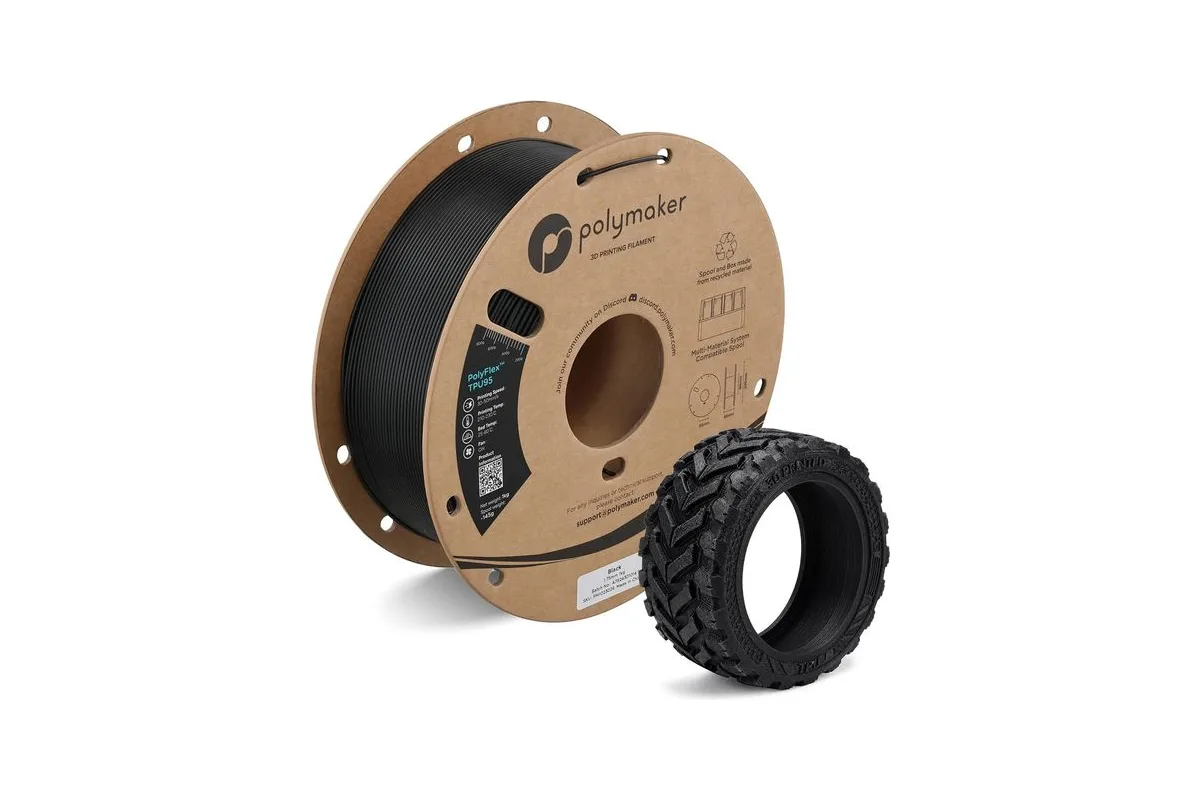
Polymaker TPU 95A ($19.49 for 1 kg on Amazon in November 2026) is the best TPU filament: Shore 95A, the easiest hardness to print, from a maker with a published data sheet. Overture TPU 95A ($19.53) and Sunlu TPU 95A ($19.94, or from $14.99 in 3 kg orders at Sunlu) are close alternatives. Dry TPU at 60–70 °C before printing, and feed it from an external spool: Bambu says generic TPU won't feed in its AMS, AMS lite or AMS 2 Pro.
Our quick picks
Compare the picks
| Feature | Best TPU filamentPolymaker TPU 95A | Best TPU in a 2 kg packOverture TPU 95A | Cheapest TPU in bulkSunlu TPU 95A |
|---|---|---|---|
| Material | TPU | TPU | TPU |
| Hardness | Shore 95A | Shore 95A | Shore 95A |
| Weight | 1 kg | 1 kg | 1 kg |
| Drying | 70 °C, 8 h | ||
| Where to buy | Check price at Amazon | Check price at Amazon | Check price at Amazon |
Best TPU filament
Polymaker TPU 95A
- Material
- TPU
- Hardness
- Shore 95A
- Weight
- 1 kg
- Drying
- 70 °C, 8 h
Best TPU in a 2 kg pack
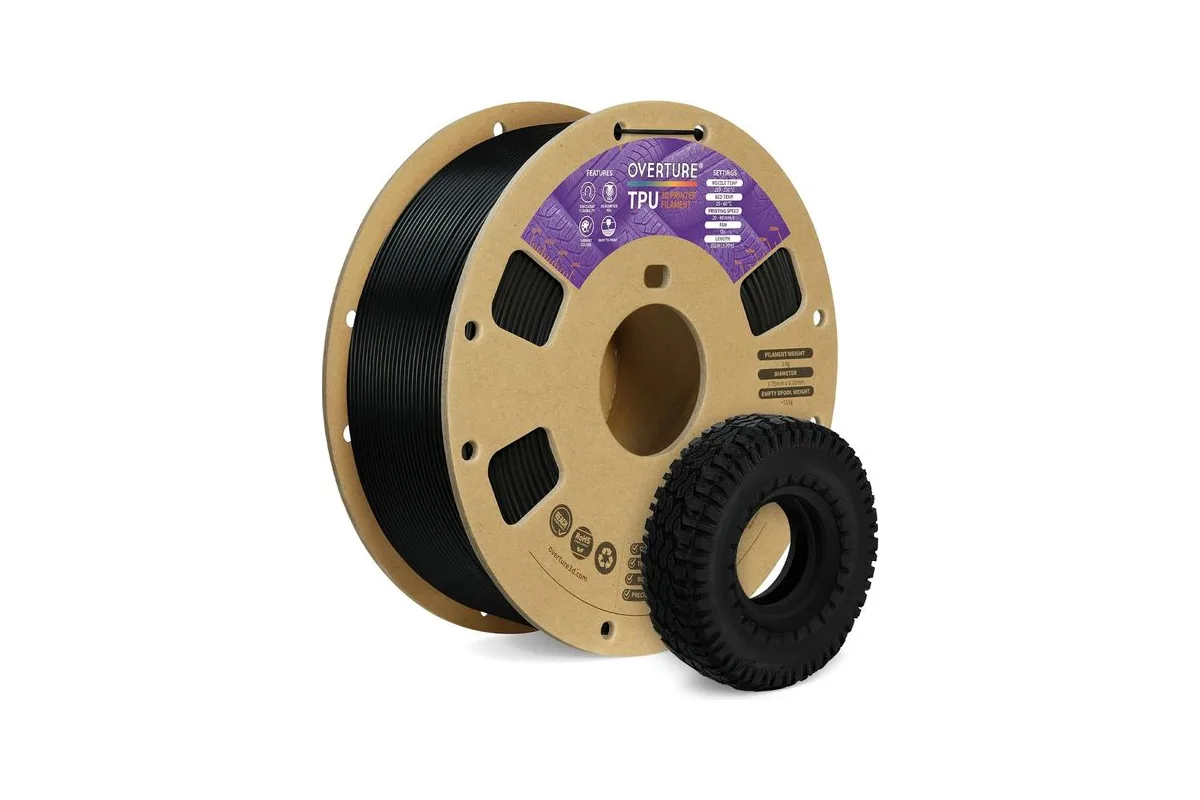
Overture TPU 95A
- Material
- TPU
- Hardness
- Shore 95A
- Weight
- 1 kg
- Drying
Cheapest TPU in bulk
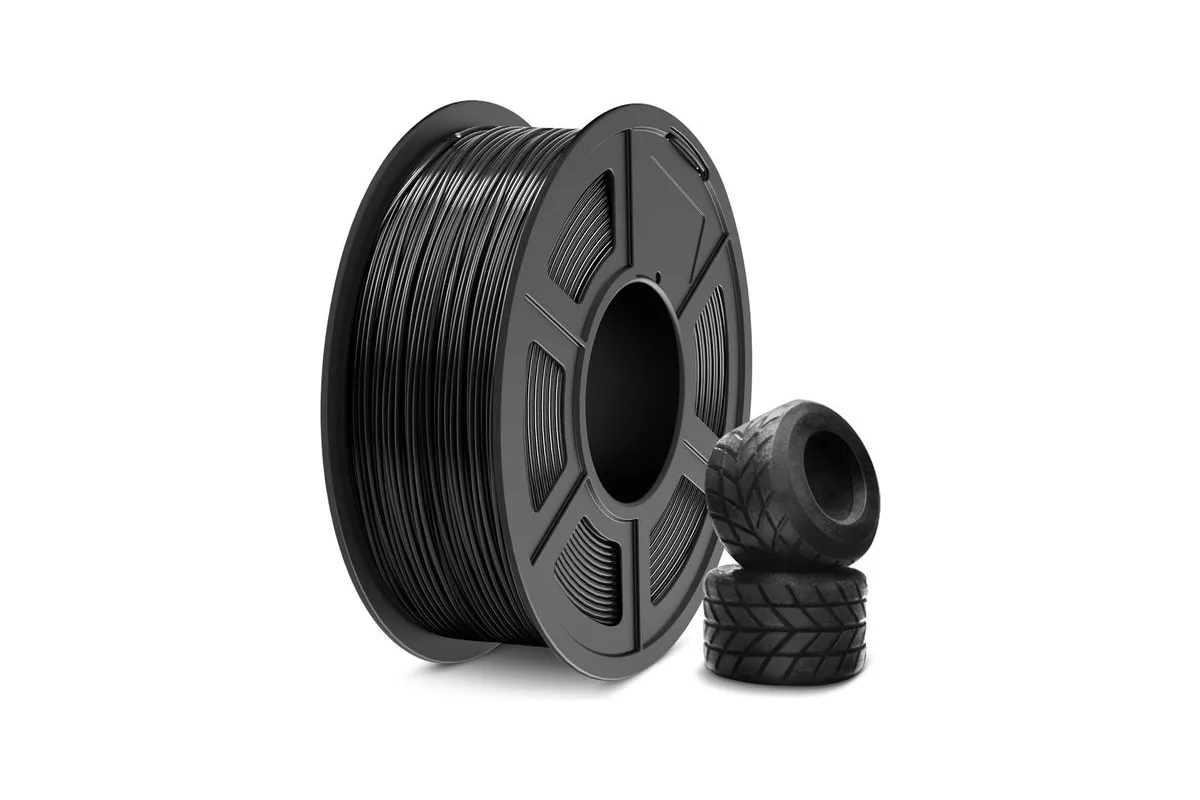
Sunlu TPU 95A
- Material
- TPU
- Hardness
- Shore 95A
- Weight
- 1 kg
- Drying
01Best TPU filament
Polymaker TPU 95A
Polymaker's 95A TPU in a full 1 kg roll for under $20 on Amazon, from a maker that publishes data sheets for its flexible filaments.
The best TPU for most people: Shore 95A, the firmest common flexible grade, from a maker that publishes data sheets for its flexible filament. Polymaker's TPU95 sheet rates it 95A under ISO 7619-1, prints it at 210–230 °C on a 25–60 °C bed, and says no enclosure is needed.
It was $19.49 for a full 1 kg roll on Amazon in November 2026. Polymaker's own store sells PolyFlex TPU95 at $29.99 for 0.75 kg, about $40 a kilogram (our arithmetic), so Amazon is the cheaper way to buy it. Polymaker says to dry it at 70 °C for 8 hours.
Good for
- Shore 95A: flexible but stiff enough to feed on most direct-drive printers
- $19.49 for 1 kg on Amazon in November 2026 (Polymaker's store sells PolyFlex TPU95 at $29.99 for 0.75 kg)
- Polymaker's TPU95 sheet: prints at 210–230 °C with no enclosure
Consider
- TPU must be dry; Polymaker says 70 °C for 8 hours
- Won't feed through a Bambu AMS, AMS lite or AMS 2 Pro; print it from the external spool holder
02Best TPU in a 2 kg pack
Overture TPU 95A
Overture's 95A flexible filament at about $19.50 a kilogram on Amazon.
A close second at almost the same price: $19.53 for 1 kg on Amazon in November 2026, with a ±0.02 mm diameter claim. Overture's own store lists it at $26.99 (compare $31.99) and sells a 2 kg pack for $41.99, about $21 a kilogram (our arithmetic).
Overture publishes no data sheet for it, so there's no tested hardness, strength or heat figure beyond the 95A label. Like any TPU, it needs drying and slow printing.
Good for
- $19.53 for 1 kg on Amazon in November 2026 ($26.99 typical at Overture's store)
- ±0.02 mm diameter claim
- Also sold as a 2 kg pack ($41.99 at Overture)
Consider
- No published data sheet
- Like all TPU, it needs drying and slow, direct-drive printing
03Cheapest TPU in bulk
Sunlu TPU 95A
Sunlu's 95A TPU, about $20 a kilogram on Amazon and as little as $14.99 at Sunlu's store with a 3 kg minimum.
The cheapest TPU if you buy several rolls: $19.94 for 1 kg on Amazon in November 2026, and $14.99–$20.99 at Sunlu's store with a 3 kg minimum order. Sunlu also sells a 90A version and claims ±0.02 mm.
Sunlu links no data sheet. Its drying guide is the outlier among makers: it says TPU "must" be dried, but at 50–60 °C for 6–8 hours, where Bambu, Polymaker, Elegoo and Creality say about 70 °C.
Good for
- $19.94 for 1 kg on Amazon in November 2026
- $14.99–$20.99 at Sunlu's store (3 kg minimum order)
- ±0.02 mm diameter claim
Consider
- No published data sheet
- Needs drying and slow printing like any TPU
How to choose
Build size
Match the build volume to the largest parts you plan to print.
Materials
PLA, PETG, and TPU print on open machines. ABS, ASA, and engineering filaments need an enclosure.
Multicolor and waste
Single-nozzle multicolor systems purge filament at every color change. Toolchangers waste far less.
TPU filament compared
| Polymaker TPU 95A | Overture TPU 95A | Sunlu TPU 95A | |
|---|---|---|---|
| Amazon, 1 kg (Nov 28, 2026) | $19.49 | $19.53 | $19.94 |
| Maker’s store | PolyFlex TPU95: $29.99 for 0.75 kg | $26.99 (compare $31.99); 2 kg $41.99 | $14.99–$20.99 (3 kg minimum) |
| Hardness | Shore 95A (ISO 7619-1, data sheet) | 95A (label) | 95A (label); 90A also sold |
| Published data sheet | Yes | No | No |
| Diameter tolerance (maker claim) | Not found | ±0.02 mm | ±0.02 mm |
| Maker’s drying setting | 70 °C, 8 h | Not found | 50–60 °C, 6–8 h |
Amazon prices were checked the morning after Black Friday; maker-store prices are Black Friday snapshots. Every Amazon listing here ships from Amazon and is sold by the maker’s own store.
What is the best TPU filament?
Polymaker TPU 95A, for most people. All three picks cost within 45 cents of each other on Amazon, so the choice comes down to what you can check. Polymaker publishes a data sheet for its 95A TPU, with the hardness test, temperatures and drying settings; Overture and Sunlu publish none. At $19.49 for a full kilogram, Polymaker’s Amazon roll also costs about half as much per kilogram as Polymaker’s own store charges for its 0.75 kg PolyFlex TPU95 (our arithmetic: $19.49 against $39.99 a kilogram).
Start with 95A. It’s the firmest of the common flexible grades and the most widely sold, and it’s what all three picks are. Softer grades bend more, and they’re pickier: Bambu says its TPU 85A isn’t compatible with a 0.4 mm nozzle, the size most printers ship with.
We left out NinjaTek’s NinjaFlex and Cheetah because we couldn’t confirm their current specs or prices.
What do 85A, 95A and 68D mean?
They’re Shore hardness readings, a durometer test that Polymaker, for one, runs under ISO 7619-1. The number is the hardness on that scale, and higher means harder. The letter is the scale: A for flexible TPU, D for harder material.
The scales aren’t interchangeable. Prusa’s own TPU 95A data sheet gives both readings for the same filament: Shore A 92 and Shore D 39. So a 68D TPU, like Bambu’s TPU for AMS, is far stiffer than any 95A roll. It’s still tough, but it’s not rubbery.
| Grade | Examples sold in November 2026 | What it’s like to print |
|---|---|---|
| 85A | Bambu TPU 85A ($26.99), Siraya Tech Flex TPU 85A (about $32) | Softest common grade. Bambu says it isn’t compatible with a 0.4 mm nozzle |
| 90A | Bambu TPU 90A ($25.19), Sunlu TPU 90A | Between the two |
| 95A | Polymaker, Overture, Sunlu, Elegoo ($17.99), Bambu TPU 95A HF ($25.19), Prusament, Hatchbox ($37.00) | The standard flexible grade and the easiest to print |
| 64D–72D | Siraya Tech Flex TPU 64D (about $28), Bambu TPU for AMS 68D (from $20.99 refill), Elegoo TPU 72D ($21.99) | Stiff, tough TPU. Bambu’s 68D is made to feed through its AMS |
Bambu’s TPU prices are sale prices against a “typical” $41.99 (85A, 90A and 95A HF) and $34.99 (TPU for AMS).
Why won’t TPU feed through a Bambu AMS?
Because it’s too soft. Bambu’s material table says the original AMS and the AMS lite reject filament that is “too soft (e.g., TPU 95A/85A/83A/80A),” and its AMS notes tell you to avoid flexible TPU and TPE. Here’s what each Bambu unit takes:
| Bambu unit | Generic 95A TPU | Bambu TPU for AMS (68D) | Price (Nov 2026) |
|---|---|---|---|
| AMS lite (A1 series) | No | Yes | $159 (typical $199) |
| AMS 2 Pro | No (nor Bambu’s own TPU 95A) | Yes, with conditions | $229 (typical $299) |
| AMS HT | Through the bypass port only | Yes | $119 (typical $139) |
The AMS HT is the one exception: TPU goes through a port at the rear of its top cover. Bambu says that in this mode it “cannot use the automatic feed and return function, but can be used as a drying box.” So it can dry TPU (Bambu’s setting is 75 °C for 18 hours) and pass it to the printer, but it can’t switch to or from TPU automatically.
On every other setup, load TPU from the printer’s external spool holder. If you want TPU-like parts in automatic multicolor prints, Bambu’s 68D TPU for AMS is the only TPU Bambu says will feed, and it’s much stiffer. See third-party filament in a Bambu AMS.
How do you dry TPU?
Dry it before you print it. Bambu, Elegoo, Sunlu and Creality all list drying TPU as required, and Prusa says TPU needs drying more often than PLA. Bambu’s data sheets show why: its TPU 95A HF absorbs 1.08% water at 25 °C and 55% humidity, about 2.5 times PLA Basic’s 0.43% (our arithmetic). Where the makers differ is temperature:
| Maker | Temperature | Time | Method |
|---|---|---|---|
| Bambu Lab (TPU 95A HF data sheet) | 70 °C | 8 h | Blast drying oven |
| Bambu Lab (TPU 85A/90A) | 70 °C | 8 h | Convection oven |
| Bambu Lab | 75 °C | 18 h | AMS HT |
| Bambu Lab | 65 °C | 12 h (may not fully dry) | AMS 2 Pro |
| Polymaker (TPU95 data sheet) | 70 °C | 8 h | — |
| Elegoo | 70 ± 5 °C | 6–10 h | Forced-air dryer |
| Creality | 70 °C / 65–75 °C | 8–12 h / 8 h | Creality dryer / blast dryer |
| Prusa | 60 °C | 4–6 h | Dryer or oven |
| Sunlu | 50–60 °C | 6–8 h | Dryer |
Most say about 70 °C for 8 hours; Prusa and Sunlu go lower. Use the setting from the maker of your roll, and check the spool: Bambu rates its low-temperature spools to 70 °C and its high-temperature spools to 90 °C. A dryer that reaches 70 °C covers the most common setting. See how to dry filament and the best filament dryers.
What settings does TPU need?
- Slow. Prusa rates its TPU 95A at up to 30 mm/s. High-flow grades go faster: Bambu says its TPU 95A HF prints 3 times faster than regular TPU 95A, and Polymaker sells a TPU95-HF ($49.99 a kilogram).
- Temperatures: 210–230 °C (Polymaker), 220–240 °C (Bambu 95A HF) or 230 ± 10 °C (Prusament) at the nozzle, on a 25–75 °C bed, depending on the maker (Polymaker 25–60 °C, Bambu 30–35 °C, Prusament 65 ± 10 °C).
- Build plate: Prusa says TPU adheres too strongly to smooth PEI and can damage the sheet, and needs no glue stick on textured PEI. Bambu sets TPU at 35–45 °C on its textured and smooth PEI plates. See PEI build plates and glue stick.
- Enclosure: not needed. On an enclosed printer, Bambu says to open the door when the bed runs above 45 °C, so the chamber doesn’t soften the filament.
How strong is TPU?
Tough rather than strong. Bambu’s TPU 95A HF sheet lists a Charpy impact figure of 123.2 kJ/m², more than four times the 26.6 on its PLA Basic sheet (our arithmetic), but lower tensile strength: 27.3 MPa against 35. Prusa rates its TPU 95A at 563% elongation at break, so it stretches by more than five times its length before it tears. For rigid strength, see the strongest 3D printer filament.
How we chose
We compared the 95A TPU from the three budget brands sold on Amazon, plus Bambu, Elegoo, Prusament, Siraya Tech and Hatchbox at their own stores, on prices checked November 28, 2026, published data sheets, hardness and drying guidance. We haven’t printed these filaments hands-on. With prices this close, the published data sheet decided first place.
Questions people ask
What is the best TPU for beginners?
A 95A TPU, such as Polymaker TPU 95A ($19.49 on Amazon). It’s the firmest common flexible grade and the easiest to feed.
Is 95A or 85A TPU better?
95A for most prints: it’s easier to print and still flexible. 85A is softer and bends more, but Bambu says it isn’t compatible with a 0.4 mm nozzle, the size most printers ship with.
Can you put TPU in a Bambu AMS?
Not 95A or softer. Bambu says generic TPU won’t feed in the AMS, AMS lite or AMS 2 Pro. The AMS HT takes it through a bypass port with no automatic switching, and Bambu’s stiffer 68D TPU for AMS feeds normally.
Do you have to dry TPU?
Yes. Bambu, Elegoo, Sunlu and Creality call it required. Most give about 70 °C for 8 hours; Prusa says 60 °C for 4–6 hours and Sunlu 50–60 °C for 6–8 hours.
Does TPU need an enclosure?
No. TPU doesn’t warp, and Polymaker says its TPU95 needs no enclosure.
Is Bambu TPU worth it?
For an AMS, Bambu’s 68D TPU for AMS is the only TPU Bambu says will feed automatically, from $20.99 as a refill. For soft 95A parts printed from the external spool, Polymaker’s $19.49 roll costs less than Bambu’s TPU 95A HF at $25.19.
Sources
- Polymaker PolyFlex TPU95 technical data sheet V5.4, cdn.shopify.com
- Polymaker store, shop.polymaker.com
- Prusament TPU 95A technical data sheet, storage.googleapis.com
- Bambu Lab TPU 95A HF technical data sheet, store.bblcdn.com
- Bambu Lab TPU for AMS technical data sheet, store.bblcdn.com
- Bambu Lab TPU for AMS, us.store.bambulab.com
- Bambu Lab TPU 95A HF, us.store.bambulab.com
- Bambu Lab TPU 85A and 90A, us.store.bambulab.com
- Bambu Lab PLA Basic technical data sheet, store.bblcdn.com
- Bambu Lab filament guide: material table, wiki.bambulab.com
- Bambu Lab: notes on AMS, wiki.bambulab.com
- Bambu Lab: AMS 2 Pro and AMS HT FAQ, wiki.bambulab.com
- Bambu Lab AMS 2 Pro, us.store.bambulab.com
- Bambu Lab AMS HT, us.store.bambulab.com
- Bambu Lab AMS lite, us.store.bambulab.com
- Bambu Lab: dry filament, wiki.bambulab.com
- Prusa: drying filament, help.prusa3d.com
- Sunlu quick start guide (drying settings), sunlu.com
- Elegoo FDM filament drying and storage guide, wiki.elegoo.com
- Creality wiki: filament drying, wiki.creality.com
- Elegoo store, us.elegoo.com
- Sunlu store, store.sunlu.com
- Overture store, overture3d.com
- Siraya Tech store, siraya.tech
- Hatchbox store, hatchbox3d.com
- Amazon: Polymaker TPU 95A, amazon.com
- Amazon: Overture TPU 95A, amazon.com
- Amazon: Sunlu TPU 95A, amazon.com
Keep exploring

How to
Hardened steel vs brass nozzles, and what nozzle size to use
Brass, or the stainless steel Bambu ships on the A1, is fine for PLA, PETG, ABS, ASA and TPU. Carbon fiber, glass fiber, glow-in-the-dark and sparkle filaments need hardened steel. Use a 0.4 mm nozzle for most prints, 0.6 mm for carbon fiber and big parts, and 0.2 mm for miniatures.
Read story
How to
Can you 3D scan with an iPhone? Yes, but not to tight tolerances
Yes. Any current iPhone can 3D scan objects from photos (photogrammetry), and KIRI Engine's free tier exports STL for printing. Only the iPhone 18 Pro and 18 Pro Max have LiDAR in Apple's current lineup. For parts that must fit, a $359 scanner is about ten times tighter.
Read story