Printers in this guide
What is the strongest 3D printer filament?
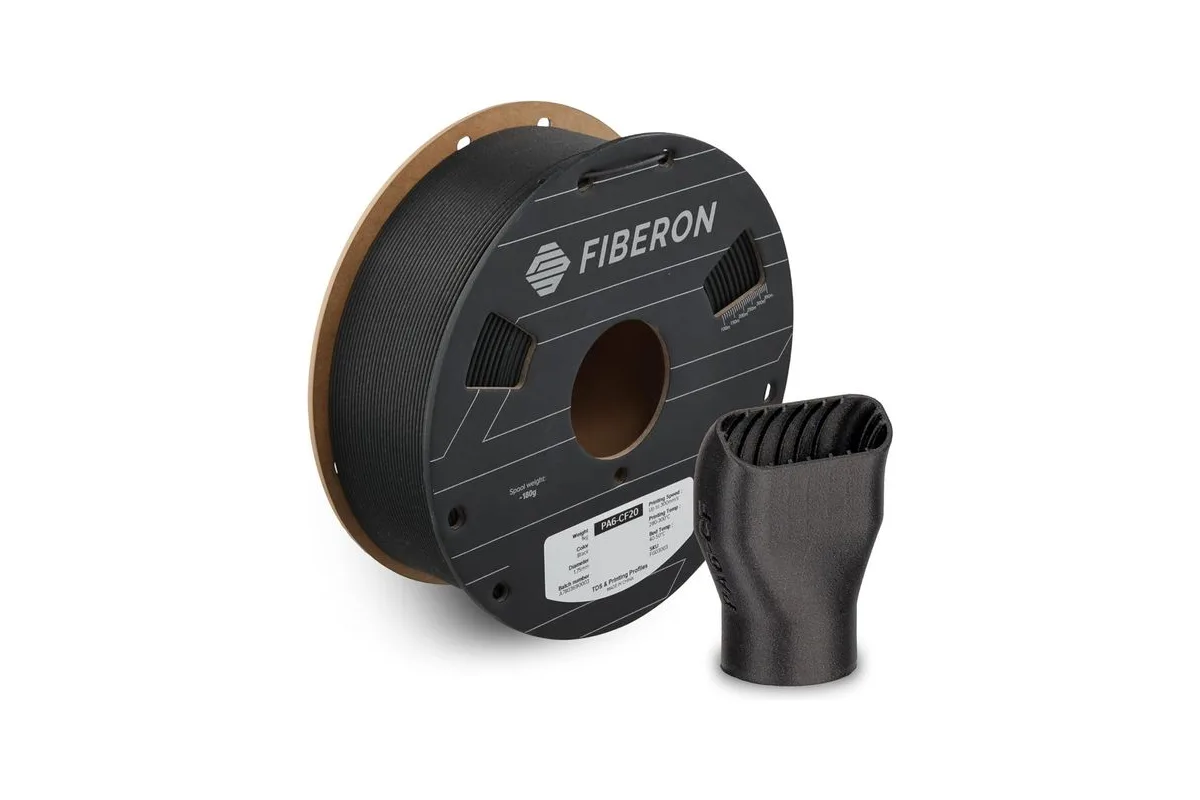
Carbon fiber nylon. On makers’ own data sheets, Polymaker’s Fiberon PA6-CF20 pulls to 109.3 MPa before breaking and Bambu Lab’s PA6-CF to 102 MPa, about three times Bambu’s PLA Basic (35 MPa). Both figures are for dry, flat-printed test bars, and both need an enclosed printer with a hardened steel nozzle.
That answer only holds for one kind of strength. “Strongest” can mean three different things, and a different filament wins each:
- Tensile strength along the layers (X-Y): how hard you can pull a part before it snaps. Carbon fiber nylon wins.
- Layer strength (Z): how hard you can pull the layers apart. This is where most printed parts break. Polycarbonate wins on Bambu’s sheets, at 56 MPa.
- Impact strength: how much of a blow a part absorbs. Flexible TPU and toughened PLA win by a wide margin.
Strength by filament, from Bambu’s data sheets
All figures come from Bambu Lab’s technical data sheets, so the test methods match: tensile strength by ISO 527 and impact by ISO 179 (Charpy), on bars printed at 100% infill. Bambu lists two impact values for most materials; we read them as unnotched and notched.
| Bambu filament | Tensile X-Y (MPa) | Tensile Z, between layers (MPa) | Impact, unnotched (kJ/m²) | Impact, notched (kJ/m²) | Stiffness, bending modulus (MPa) |
|---|---|---|---|---|---|
| PA6-CF | 102 | 48 | 40.3 | 13.4 | 5,460 |
| PAHT-CF | 92 | 47 | 57.5 | 22.8 | 4,230 |
| PPS-CF | 87 | 24 | 27.8 | 6.2 | — |
| PET-CF | 74 | 35 | 36.0 | 8.6 | 5,320 |
| PC | 62 | 56 | 34.8 | 7.5 | 2,310 |
| PETG Basic | 51 | 35 | 34.2 (one value) | — | 1,950 |
| PLA-CF | 38 | 26 | 23.2 | 7.6 | 3,950 |
| ASA | 37 | 31 | 41.0 | 19.6 | 1,920 |
| PLA Basic | 35 | 31 | 26.6 | 7.9 | 2,750 |
| PLA Tough+ | 34.9 | 20.9 | 80.6 | — | — |
| ABS | 33 | 28 | 39.3 | 21.5 | 1,880 |
| TPU 95A HF | 27.3 | 22.3 | 123.2 (one value) | — | — |
Three things stand out:
- Carbon fiber nylon wins on paper, but only along the layers. PA6-CF drops from 102 MPa along the layers to 48 MPa between them. PPS-CF falls from 87 to 24 MPa, below plain PLA’s 31.
- Polycarbonate has the strongest layers. PC keeps 56 of its 62 MPa between layers, a drop of about 10% (our estimate), the smallest share of any material in the table. For a part loaded in every direction, it’s the strongest unfilled filament on Bambu’s sheets.
- Impact is a different contest. TPU absorbs about 123 kJ/m² and PLA Tough+ 80.6, against 26.6 for PLA Basic. Neither is stiff, but both survive drops and blows that crack rigid plastics.
Print orientation matters as much as material. Every material in the table is weaker between layers than along them, so lay a part out so the load runs along the layers, not across them.
Other makers’ numbers
Polymaker and Prusa publish their own sheets. Their tests use similar standards but their own printers and specimens, so compare within a maker, not across makers.
| Maker and filament | Tensile X-Y (MPa) | Tensile Z or layer adhesion (MPa) | Notes |
|---|---|---|---|
| Polymaker Fiberon PA6-CF20, dry and annealed | 109.3 | 54.0 | Highest tensile figure we found on any maker’s sheet |
| Polymaker Fiberon PA6-CF20, after 48 h in 60 °C water | 54.7 | 25.5 | Half the dry strength |
| Polymaker PolyLite PC | 69.1 | 52.8 | |
| Polymaker PolyLite PLA | 52.3 | 40.5 | |
| Prusament PC Blend | 63 | 21 (layer adhesion) | |
| Prusament PLA High Speed (new in 2026) | 68 | 41 (layer adhesion) | More than twice Prusament PLA’s 17 MPa layer adhesion |
| Prusament PA11 Carbon Fiber | 42 | 20 (layer adhesion) | Prusa: “A hardened nozzle is necessary” |
Two lessons from these sheets. First, nylon’s strength is a dry number. Polymaker soaked its PA6-CF20 bars in 60 °C water for 48 hours and tensile strength fell from 109.3 to 54.7 MPa, while notched impact rose from 11.0 to 35.6 kJ/m². Damp nylon gets tougher and much weaker. Second, PC sits at or near the top of the unfilled plastics at every maker: 62 MPa at Bambu, 69.1 at Polymaker and 63 at Prusa, where only Prusament’s new PLA High Speed edges it, at 68.
What is the most heat-resistant 3D printer filament?
Bambu Lab PPS-CF, with a heat deflection temperature (HDT) of 264 °C at 0.45 MPa and 235 °C at 1.8 MPa on Bambu’s sheet. It’s also the hardest to print: Bambu lists a 310–340 °C nozzle, a 100–120 °C bed and a 60–90 °C chamber, and its filament guide limits PPS-CF to the H2 series and X1E printers.
HDT is the temperature at which a printed test bar bends under a set load (ISO 75). Makers quote it at two loads: 0.45 MPa, a light load, and 1.8 MPa, a heavier one. The heavier load gives a lower number, so check which one a figure uses before comparing.
| Filament | Maker | HDT at 0.45 MPa (°C) | HDT at 1.8 MPa (°C) |
|---|---|---|---|
| PPS-CF | Bambu | 264 | 235 |
| Fiberon PA6-CF20 | Polymaker | 215 | 173 |
| PET-CF | Bambu | 205 | 182 |
| PAHT-CF | Bambu | 194 | 170 |
| PA11 Carbon Fiber | Prusament | 192 | 152 |
| PA6-CF | Bambu | 186 | 164 |
| PC Blend | Prusament | 113 | 93 |
| PC | Bambu | 112 | see note |
| PolyLite PC | Polymaker | 111 | 107 |
| HT-PLA, annealed | Polymaker | 107.2 | 71.7 |
| ASA | Polymaker | 103 | 100 |
| ASA | Bambu | 100 | 92 |
| ASA | Prusament | 93 | 86 |
| ABS | Bambu | 87 | 84 |
| PETG-CF | Bambu | 74 | 68 |
| PETG Basic | Bambu | 71 | 68 |
| PLA Tough+ | Bambu | 61 | 58 |
| PLA Basic | Bambu | 57 | 54 |
| PLA | Prusament | 55 | 55 |
Note: Bambu’s PC sheet prints a higher HDT at 1.8 MPa (117 °C) than at 0.45 MPa (112 °C), which looks like a sheet error, so we leave it out.
The ranking falls into clear steps, using Bambu’s 0.45 MPa figures: PLA at 55–61 °C, PETG at 69–74, ABS at 87, ASA at 100, PC at 112, then the carbon fiber engineering grades at 186–264 °C.
Which heat-resistant filament should you actually print?
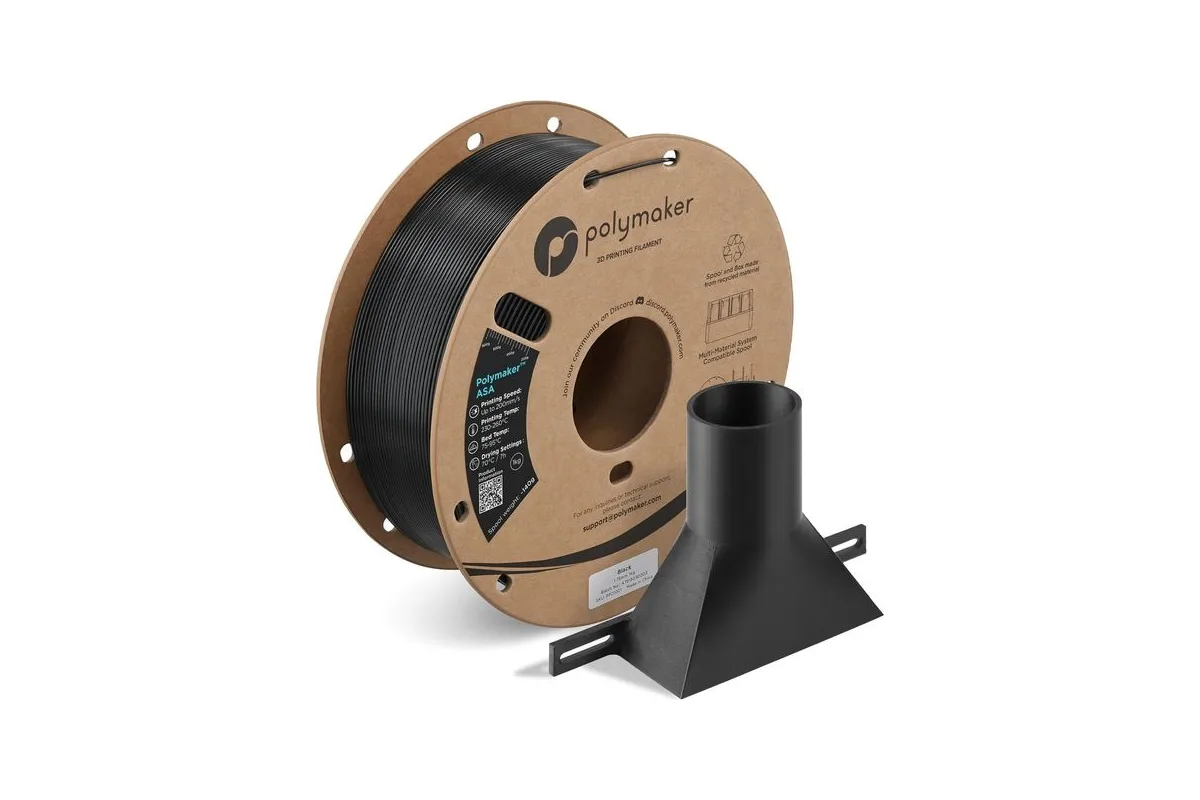
- For a part that sits in a hot car or near a heater: ASA or PC. ASA holds 100 °C at 0.45 MPa on Bambu’s sheet and resists UV, and Bambu’s ASA was $17.99 a spool at its store in November 2026 (typical $29.99). Polymaker ASA was $23.27 on Amazon. Both need an enclosed printer; see PLA vs ABS vs ASA.
- For engine-bay brackets, jigs and parts under load at high heat: a carbon fiber nylon or PET-CF, at 186–215 °C. These need a hardened steel nozzle, an enclosure and dry filament.
- For the most heat you can get: PPS-CF, if you own a printer Bambu lists for it.
Annealing can lift a PLA made for it. Polymaker’s HT-PLA deflects at 61.4 °C as printed and 107.2 °C after annealing (0.45 MPa), against 60 °C for its ordinary PolyLite PLA.
Higher-temperature plastics such as PEEK exist, but this page sticks to filaments with published data sheets from the consumer makers above.
What each strong filament costs
Prices at Bambu’s store and on Amazon in November 2026, during Black Friday sales.
| Filament | Price | Per kg |
|---|---|---|
| Bambu PLA Basic, refill | $14.99 | $14.99 |
| Bambu PETG Basic, refill | $13.99 | $13.99 |
| Bambu ASA, with spool | $17.99 (typical $29.99) | — |
| Bambu PC, with spool | $23.99 (typical $39.99) | — |
| Bambu PA6-CF, 1 kg | $47.99 | $47.99 |
| Bambu PET-CF, 1 kg | $50.99 | $50.99 |
| Polymaker Fiberon PA6-CF20, 1 kg (Amazon) | $52.99 | $52.99 |
| Bambu PAHT-CF, 1 kg | $56.99 | $56.99 |
| Bambu PPS-CF, 0.75 kg | $77.99 (typical $129.99) | about $104 (our estimate: $77.99 ÷ 0.75 kg) |
Carbon fiber nylon costs about three times as much as PLA per kilogram (our estimate: $47.99 against $14.99 for Bambu’s own grades).
What printer do you need for the strongest filaments?
Bambu’s filament guide marks ABS, ASA, PC, PA-CF and PET-CF “Not Recommended” on open-frame printers, and requires a hardened steel nozzle for every carbon fiber grade. Bambu’s PA6-CF sheet lists a 260–290 °C nozzle, an 80–100 °C bed and a 45–60 °C chamber. Polymaker’s PA6-CF20 sheet asks for a 280–300 °C nozzle and warns that a brass nozzle lasts about 9 hours on it.
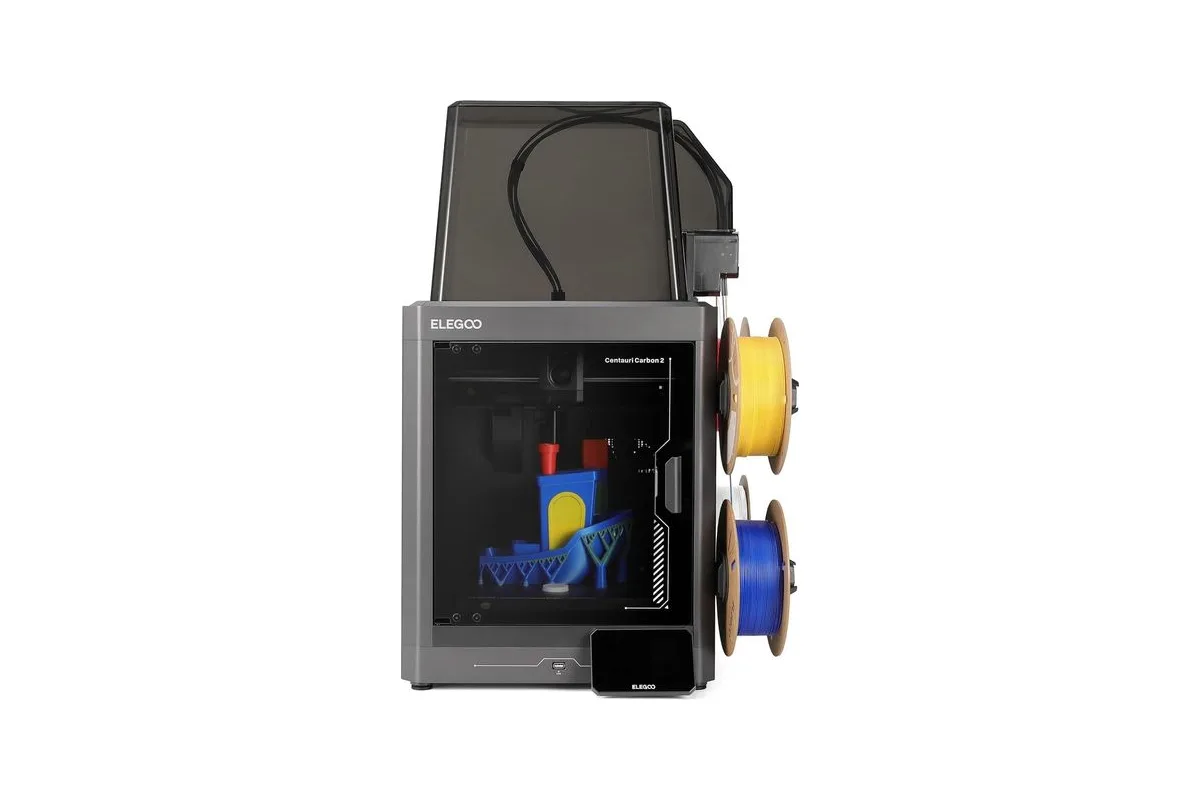
Bambu’s A1, A1 mini and P1S ship with stainless steel nozzles. The Bambu Lab P2S ships with a hardened nozzle and extruder gears in an enclosure, and the Elegoo Centauri Carbon 2 with a 350 °C hardened nozzle. More options are in the best enclosed 3D printers, and nozzle choices are in the 3D printer nozzle guide.
Nylon also has to be dry. Polymaker says to dry PA6-CF20 at 100 °C for 10 hours; Bambu says 80 °C for 8–12 hours for its PA6-CF. See carbon fiber and nylon filament and how to dry filament.
Questions people ask
What is the strongest filament for an open-frame printer like the Bambu A1?
PETG Basic is the best all-round pick on Bambu’s sheets: 51 MPa along the layers and 35 between them, with more heat resistance than PLA (71 °C against 57 °C at 0.45 MPa). Bambu’s new PLA Pure matches it along the layers (51.5 MPa) but is weaker between them (30 MPa). Bambu does recommend an enclosure for PETG in a cold room, because low ambient temperatures reduce its layer strength. For parts that take knocks, PLA Tough+ absorbs about three times PLA Basic’s unnotched impact (our estimate: 80.6 against 26.6 kJ/m²). Carbon fiber PLA and PETG print on open frames too, but need a hardened nozzle; the A1 ships with stainless steel.
Is PLA+ stronger than PLA?
Tougher, not stronger. Polymaker’s own sheets show its PLA Pro absorbing 17.1 kJ/m² in a notched impact test against 3.3 for its plain PolyLite PLA, with nearly the same tensile strength (49.8 against 52.3 MPa) and the same 58 °C HDT at 1.8 MPa. See PLA vs PLA+.
Is PETG stronger than PLA?
On Bambu’s sheets, yes: PETG Basic pulls to 51 MPa along the layers against 35 for PLA Basic, and 35 against 31 between layers. See PLA vs PETG.
Does carbon fiber make filament stronger?
Mostly it makes it stiffer. Bambu’s PLA-CF is 44% stiffer than PLA Basic (our estimate: 3,950 against 2,750 MPa bending modulus) but only slightly stronger (38 against 35 MPa) and no more heat-resistant (55 against 57 °C). See is carbon fiber filament worth it?
Can you compare strength figures across brands?
Only loosely. Each maker tests its own printed bars, and methods differ: eSun, for example, measures impact with a Chinese Izod standard (GB/T 1843) while Bambu and Polymaker use Charpy (ISO 179). Compare materials within one maker’s sheets, as in the Bambu table above.
Does infill change how strong a part is?
Yes. Every figure on this page is for test bars printed at 100% infill, so a part printed at 15% infill will be far weaker than the sheet suggests. See infill and layer height.
Sources
- Bambu Lab PA6-CF technical data sheet, store.bblcdn.com
- Bambu Lab PAHT-CF technical data sheet, store.bblcdn.com
- Bambu Lab PET-CF technical data sheet, store.bblcdn.com
- Bambu Lab PPS-CF technical data sheet, store.bblcdn.com
- Bambu Lab PC technical data sheet, store.bblcdn.com
- Bambu Lab ASA technical data sheet, store.bblcdn.com
- Bambu Lab ABS technical data sheet, store.bblcdn.com
- Bambu Lab PLA Basic technical data sheet, store.bblcdn.com
- Bambu Lab PLA Tough+ technical data sheet, store.bblcdn.com
- Bambu Lab PETG Basic technical data sheet, store.bblcdn.com
- Bambu Lab TPU 95A HF technical data sheet, store.bblcdn.com
- Bambu Lab PLA-CF technical data sheet, store.bblcdn.com
- Bambu Lab filament guide: material table, wiki.bambulab.com
- Polymaker Fiberon PA6-CF20 technical data sheet, cdn.shopify.com
- Polymaker PolyLite PC technical data sheet, cdn.shopify.com
- Polymaker ASA technical data sheet, cdn.shopify.com
- Polymaker HT-PLA technical data sheet, cdn.shopify.com
- Prusament PC Blend technical data sheet, prusament.com
- Prusament PA11 Carbon Fiber technical data sheet, prusament.com
- Prusament PLA High Speed technical data sheet, storage.googleapis.com
- Bambu Lab store: PA6-CF, us.store.bambulab.com
- Bambu Lab store: PPS-CF, us.store.bambulab.com
- Polymaker Fiberon PA6-CF20 on Amazon, amazon.com
Keep exploring

How to
Hardened steel vs brass nozzles, and what nozzle size to use
Brass, or the stainless steel Bambu ships on the A1, is fine for PLA, PETG, ABS, ASA and TPU. Carbon fiber, glass fiber, glow-in-the-dark and sparkle filaments need hardened steel. Use a 0.4 mm nozzle for most prints, 0.6 mm for carbon fiber and big parts, and 0.2 mm for miniatures.
Read story
How to
Can you 3D scan with an iPhone? Yes, but not to tight tolerances
Yes. Any current iPhone can 3D scan objects from photos (photogrammetry), and KIRI Engine's free tier exports STL for printing. Only the iPhone 18 Pro and 18 Pro Max have LiDAR in Apple's current lineup. For parts that must fit, a $359 scanner is about ten times tighter.
Read story